for quality writing

Ken Borland


Leopard Creek 0

Posted on July 05, 2017 by Ken


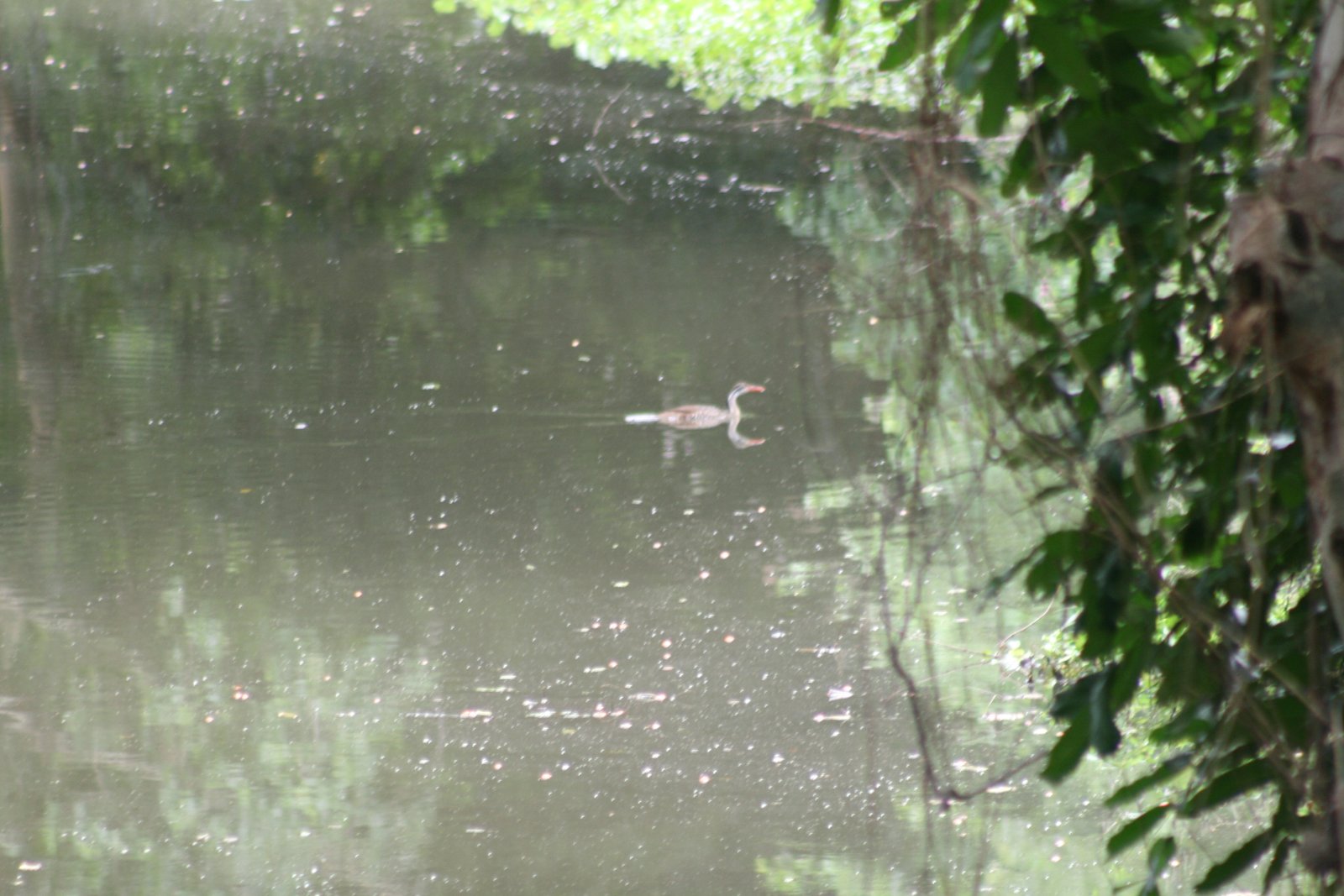
The elusive, mysterious and secretive African Finfoot

The elusive, mysterious and secretive African Finfoot

Leopard Creek has recently been rated amongst the top 100 golf courses in the world by the prestigious Golf Digest magazine and it is surely the wildest top-class golf course in the world, situated as it is alongside the Kruger National Park.

The Crocodile River forms the northern boundary between Leopard Creek and the Kruger National Park and the back nine runs along the river, offering tremendous sightings of all the animals and birds made famous by one of the largest game reserves in the world.

A channel runs off the Crocodile River and flows right in front of the clubhouse, making the verandah of this opulent building an ideal spot for bird and animal spotting. Unfortunately the clubhouse is also extremely hard to access for the rank and file visitor to Leopard Creek, but the good news is that there is a little service road that runs along this channel for a hundred metres or so, before turning up the hill to the 10th tee.

Shaded by luxuriant riverine trees, the road passes right by the water and I always make a point of taking a quiet stroll along this area. It has always seemed to me to be a perfect spot for African Finfoot – which Roberts describes as favouring “quiet, wooded streams and rivers flanked by thick riparian vegetation and overhanging trees” – the very description of my favourite part of Leopard Creek.

And so, on my eighth visit to this special place outside Malelane for the Alfred Dunhill Championship, I finally got my Finfoot.

There in this shady channel I saw the bright orange legs first as the bird stood on the bank and then went into the water, gliding stealthily to the other side of the river.

A hippopotamus was contentedly passing the day between this channel and the main Crocodile River, while a Brownhooded Kingfisher called from high up in the trees and a Malachite Kingfisher hunted from low down on fallen branches close to the water.

Heuglin’s Robin, one of my favourites, also hangs around this area.

Coming back up out on to the golf course, a series of dams is in front of you between the ninth, 18th and 10th holes, with Lesser Striped Swallow flying over and African Pied Wagtail patrolling the banks.

Heading backwards through the front nine, Blackbacked Puffback is calling away and Blue Waxbill are in a sapling on the side of the ninth fairway.

The seventh hole, a par-three, shares a dam with the fifth hole, fringed by Fever Trees, and Spottedbacked, Southern Masked and Thickbilled Weavers were all nesting in the same specimen of this archetypal tree of tropical wetlands, from which gin and tonics (no doubt consumed in large quantities on the verandah of the clubhouse) originated.

Along the stream feeding this dam, a Giant Kingfisher was eating a good-sized fish, while a Greenbacked Heron was flying upstream.

Anywhere on the course, you are likely to see Whitebacked Vultures soaring overhead and Purplecrested Louries flying between patches of thicker bush. Whitefaced Duck are also often flying over.

But the 13th is the signature hole of Leopard Creek, not just because of its great design but mostly because of the dazzling vista it provides over the Crocodile River just beneath the elevated green and Kruger Park just across the way.

Charl Schwartzel when the going was still good

Charl Schwartzel when the going was still good

While sitting there on the final day and watching Charl Schwartzel’s challenge implode in the face of young Brandon Stone’s brilliance, I was able to admire Great White Egret, Purple Heron, Grey Heron, Black Crake, Egyptian Goose, Whitefronted Bee-Eater, African Elephant and Nile Crocodile along the river.

Away from the golf course, Leopard Creek is in an area of typical dense bushveld savanna with Forktailed Drongos, sometimes even perching on low aloes, ruling the day and Spotted Dikkops, marching around the parking lot, at night.


Where is Leopard Creek?


Sightings list

Forktailed Drongo

Spotted Dikkop

Impala

Bushbuck

Whitefaced Duck

Blackeyed Bulbul

Little Swift

Hippopotamus

Brownhooded Kingfisher

Malachite Kingfisher

African Finfoot

Heuglin’s Robin

Whitebacked Vulture

Lesser Striped Swallow

African Pied Wagtail

Blackbacked Puffback

Blue Waxbill

Spottedbacked Weaver

Southern Masked Weaver

Thickbilled Weaver

Giant Kingfisher

Grey Lourie

Greenbacked Heron

Yellowthroated Sparrow

Nile Monitor

Purplecrested Lourie

Great White Egret

Purple Heron

Grey Heron

Black Crake

Egyptian Goose

Whitefronted Bee-Eater

African Elephant

Nile Crocodile

Sombre Bulbul

Pintailed Whydah


Cosmopolitan mix of owners for new T20 Global League 0

Posted on July 05, 2017 by Ken


The new T20 Global League to be held in South Africa at the end of the year will have the most cosmopolitan feel of any of the T20 tournaments around the world as team owners from five different countries were unveiled at a function in an upmarket Knightsbridge hotel in London on Monday.

Cricket South Africa’s desire for the bulk of the franchises to be locally-owned has played second fiddle to the rewards of big overseas investment, with the eight team owners coming from Pakistan (2), India (2), Hong Kong and Dubai. The two teams based in Pretoria and Stellenbosch will have South African owners.

“It’s really important that there is local investment from a South African point of view, but the foreign interest means we’ll be playing in front of much bigger audiences. It places a much bigger emphasis on South African cricket, especially for our domestic players. It should keep most of our players in the country now because the T20 Global League provides a huge step forward in terms of opportunity and financially,” Proteas captain Faf du Plessis, who will be playing for the Stellenbosch franchise, said at the launch.

There are drawbacks, however, that come with the overseas investment, with the foreign team-owners having no real answer to questions about transformation imperatives.

Both the Pakistani team owners – their teams will be based in Durban and Benoni – spoke about T20 cricket being the answer to the problems besetting their game. Even though Pakistan’s memorable Champions Trophy triumph at the weekend had London’s large cricket fanbase abuzz, their game is still faced with the problems of not being able to host any games due to security concerns.

The Pakistan Super League has attracted some overseas players back and both Fawad Rana (Durban) and Javed Afridi (Benoni) spoke about their involvement in the T20 Global League improving the image of cricket in their troubled country.

https://www.pressreader.com/south-africa/the-citizen-gauteng/20170620/282759176664564

Rule-bound IRB criticised for Cyprus exclusion 0

Posted on July 03, 2017 by Ken


The International Rugby Board (IRB) has been accused of being more concerned with rules and regulations than actually growing the game in the wake of Cyprus’s exclusion from the European qualifiers for the 2015 World Cup.

In the last four-and-a-half years, Cyprus have stormed through the lower echelons of European rugby, winning 19 consecutive Tests – more than any other team in the history of the game – on their way to the top of Nations Cup Division 2C (effectively the sixth division).

But their ultimate dream – that of playing in the World Cup qualifiers – has been denied them due to the fact that the tiny, football-mad island does not have enough rugby teams.

Quite how the country – in the midst of a financial crisis much like Greece’s – is meant to develop more rugby teams when the IRB are closing down their opportunities is difficult to fathom.

Cyprus’s problem is that they have less than the four teams (the IRB don’t count the British Army sides based on the island, which is ridiculous) required for associate membership of the IRB. And a country has to be an associate member for at least two years before they can become full members. Only full members are allowed to participate in World Cup qualifiers.

“The IRB certainly don’t want to stand in the way of Cyprus, we will assist them and try to encourage rugby there. We have 117 members so we don’t want to exclude anyone. But the rules are to ensure quality control and they are the criteria agreed by the members,” IRB spokesman James Fitzgerald told the Daily Maverick.

“Cyprus can’t be included in World Cup qualifiers until they’ve been associates for two years and then they have to apply for full member status.

“They don’t fulfil the criteria in terms of the number of teams – for national 15s rugby you need at least four teams. They are moving towards that, but that competition won’t start until September. To be a full member, you need 10 teams.”

Critics of the IRB decision have pointed out that both Greece and the United Arab Emirates were given full membership due to “extenuating circumstances”.

“Greece fulfil the core criteria but have had financial problems, therefore they were given consideration as a special case,” Fitzgerald explained, while the UAE were fast-tracked due to the collapse of the previous Arabian Gulf Rugby Football Union and the strategic importance of the region.

These rules don’t take into account the fact that Cyprus rugby is in a stronger state than in countries like Slovenia and Luxembourg, both of whom will take part in World Cup qualifying. Because Cyprus are four levels below serious potential European qualifiers like Georgia, Russia, Romania and Portugal, there is little chance of them keeping anyone out of the showpiece event, but they should at least be allowed to chance their arm at the highest level of the game.

The qualifiers start in four days’ time on May 4 so even if the IRB relent in the face of public pressure and give Cyprus membership, it is probably too late for them to take part in the 2015 tournament.

The IRB will be meeting this week and South African Rugby Union president Oregan Hoskins, who is the vice-chairman of the IRB, believes the game’s governing body can make exceptions to their rules.

“There’s a crucial meeting and I’m certain it will be up for discussion. Cyprus form a part of Fira, the European governing body, and they do have a representative in the council, Octavian Morariu, a Romanian.

“Countries can be exempt from the regulations if there are extenuating circumstances. Every law can be bent, I like to think, if there’s a very good case for it,” Hoskins told the Daily Maverick.

“We’ve made exceptions before in South Africa, for instance with clubs that didn’t have five teams but their rugby was so good that we let them play in the premier leagues. Some clubs have so few players, but because of the quality of those players they should not be penalised.

“If countries make a good case, a compelling argument, then rugby’s attitude is pragmatic,” Hoskins said.

“The Cyprus Rugby Federation regrets that the IRB has taken this decision which we believe will have severe and detrimental effects on Cyprus rugby, especially due to the economic and continuous crisis that has affected the nation recently,” Lawrence Vasiliades, the president of the CRF, said.

Hopefully a plan can be made because rugby will certainly be the loser if one of the great fairy tales of the game’s history is allowed to wither away, denied the chance to compete on the highest stage. Cyprus in the World Cup qualifiers would be a wonderful advertisement for the IRB’s efforts to develop the sport all over the world.

https://www.dailymaverick.co.za/article/2013-04-30-rule-bound-irb-tackled-over-cyprus-exclusion/#.WVo8hoSGPIU

Speeding towards the World Cup with an elephant in the dressingroom 0

Posted on June 29, 2017 by Ken


Judging by AB de Villiers’ comments after the Champions Trophy fiasco, South Africa could go speeding towards the 2019 World Cup having still not addressed the elephant in the dressingroom which is their continued, inexplicable failure to perform at their best in ICC knockout matches.

The Proteas are scheduled to play just 36 more ODIs before the June 2019 World Cup in England; they have played 36 ODIs since midway through their series in India in October 2015, just to give some perspective as to how quickly time will fly before the next showpiece ICC tournament starts.

And yet De Villiers maintained after the horrible showing against India last weekend that there was no lack of composure and the run outs and batting failures were not due to a mental problem. Given the skill levels of the players involved, it’s difficult to know what else could be the explanation.

It is probably a good thing, though, that the Champions Trophy disaster is still fresh in the minds as CSA begin the process to decide on who will be the Proteas coach that will guide yet another attempt at the elusive holy grail for South African cricket.

Two former Proteas coaches – who were both involved in coaching capacities during India’s memorable 2011 World Cup triumph – in Gary Kirsten and Eric Simons will sit on the five-man committee that will evaluate the applications and both have been outspoken about the problems South African players have in handling the pressures of ICC knockout matches.

It is one of the unwritten laws of sport that the most successful teams are able to shift pressure on to their opposition; sadly for the Proteas, they seem to crush themselves by piling pressure on to their own shoulders. In between ICC events, they are able to play freely and express themselves, at world cups they play totally differently – tentative and fearful cricket. Reading De Villiers’ autobiography, it is clear he has a Moby Dick sized obsession with winning the World Cup, an unhealthy obsession that probably does more harm than good.

The big difference between De Villiers and Virat Kohli is how the Indian captain invariably makes big runs when they are most needed; his 96 not out in the Champions Trophy semi-final was yet another example of that.

Whoever the Proteas coach will be, he needs to be able to free up the players when it comes to the high-pressure situations. The players need to pledge to each other that they will not change their games in knockout matches and it is the captain and coach who have to drive that.

No team plays with a greater burden of expectation than India, and yet Kirsten and Simons were able to get them winning and expressing themselves when they won the World Cup on home soil under immense pressure.

Simons raised some interesting points in the aftermath of the Champions Trophy loss, both in the SuperSport studio and in a subsequent conversation I had with him.

He pointed out that the Proteas never tried to shift the pressure India exerted on them with an excellent display in the field, India were never asked to try anything different.

When I asked him why India are consistently able to handle the pressure and expectation at ICC knockout events, he said he felt it was because their international players had come through a system featuring millions of cricketers so they have spent their entire lives ensuring they are on top of their game, they are always playing under intense scrutiny and, in a developing nation still wracked by poverty, it’s do or die for many of them. Natural selection and survival of the fittest in many ways.

“It’s not just these 11 Proteas players who have had the problem. CSA need to sit down and decide what to do, what do our teams lack? Somehow the players have got to be freed up … we saw them play differently against India. There needs to be a broader conversation about why? The world is asking the question, it’s time we did too,” Simons said.

I have no doubt Simons will bring the same questions to the panel that will decide the coaching situation moving forward.

But the first step in sorting out a problem is admitting you have a problem. As Paddy Upton, who was the mental coach when India, Kirsten and Simons won the 2011 World Cup, has pointed out, it’s part of the South African macho man psyche to never admit our vulnerabilities.

That has to change.

https://www.pressreader.com/south-africa/the-citizen-kzn/20170617/282269550387810

  • Recent Posts

  • Archives

  • Thought of the Day

    Have a fulfilled life by caring about the feelings of others. Show interest in the welfare of others, listen to their problems.

    Be tolerant of people and allow for their mistakes, because no-one is perfect.

    Follow the example of Christ, who showed sympathy and understanding towards all people.


↑ Top