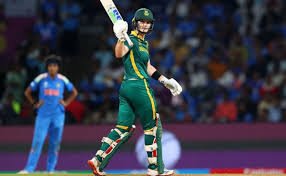
Proteas captain Laura Wolvaardt raised her bat for fifty in four of her five record-breaking innings in the series.
The Proteas Women’s performances made the grade in most departments during their 4-1 T20 series win over India, according to captain Laura Wolvaardt, but there are a couple of areas of their game which still need brushing up as they head into the 20-over World Cup in England in June.
South Africa signed off the series with a dominant performance at Willowmoore Park in Benoni, beating India by 23 runs. Wolvaardt was once again the Player of the Match as her sparkling 92 not out off just 56 balls carried the home team to 155 for six. An impressive bowling performance then restricted India to 132 for eight.
Wolvaardt took her tally of runs for the series to 330, the most in a women’s T20 rubber, making her the obvious choice for Player of the Series. The 27-year-old averaged 82.50 at a strike-rate of 168.36.
Her opening partner, Sune Luus, also enjoyed a successful series, scoring 197 runs at an average of 49.25 and a strike-rate of 138.73. But one concern for the Proteas will be that no other batter scored more than Annerie Dercksen’s 65 runs in four innings, two of which were not out.
Wolvaardt said after the fifth T20 that the lack of partnerships after the powerplay, in which they scored 49 without loss, was a concern. She faced 30 of the first 50 deliveries of the innings, reaching 50 in that time, but only 26 deliveries in the remaining 70. The Cape Town born player hit the last two balls of the innings for six to provide a crucial late boost in the company of Sinalo Jafta (16* off 8).
“Our total of 155 was somewhere around our goal in the end. The one area we lacked a bit in was partnerships. If we had one big partnership then we would have got over 165, which would have been decent. But we were about par, maybe a bit under.
“I did feel that I lost momentum a bit after the powerplay. We needed just one more big partnership, because when you lose wickets you’re also building dot balls. But I’m very happy with our batting in the powerplay and how much intent we showed.
“In all five matches that was good, and it was something that was not the best in the past. Previously we’ve been having slow starts and then some massive finishes. Now our starts are putting us in really good positions,” Wolvaardt said.
“Our death bowling has also come a long way, after we had found it tough in New Zealand. I thought it was a proper bowling effort today, the spinners were very good, Chloe Tryon and Nonkululeko Mlaba were excellent. We found a way to keep the batters quiet in the first 10 overs, they tried to force things but they just couldn’t do it. I was very impressed with the bowling.
“Taking our catches is one area we need to improve though. It’s been frustrating that in every game, one or two catches have gone down. But our play has been pretty good overall in this series, and I will now take a look at the different phases of the game more deeply.
“But we are very happy to beat India 4-1 and they are in our World Cup group as well. We now have a bit of momentum going into the tournament and it tells us that we are doing a lot of things right,” the skipper added.
While Wolvaardt was loathe to describe her performances as being the best she has ever batted, she did say she enjoyed being so fluent at the crease.
“I’m very happy with my form, although I did always have the best of the conditions because I won all the tosses. My batting had been a bit sluggish – in New Zealand I was getting like seven off the first 16 balls – and I can’t really say what changed. That’s how cricket is sometimes and it was nice to keep it going and enjoy the freedom to play positively,” Wolvaardt said.
“The current structure of global cricket is unsustainable and countries outside of the ‘Big Three’ (India, England and Australia) will play less and less bilateral series cricket, with some in danger of disappearing altogether from the Test cricket scene,” Tony Irish, who is an independent director of cricket’s global players’ body, the World Cricketers’ Association, has warned.
The only international cricket that really makes money now is India at home and abroad, and England and Australia tours. Any other bilateral cricket loses money. Bilateral cricket is those tours between countries playing Tests, ODIs and T20 matches.
The Future Tours Program previously ensured every team would play each other twice in a four-year cycle, home and away. But Narayanaswami Srinivasan [India], Giles Clarke [England] and Wally Edwards [Australia] deregulated everything in 2016, making bilateral tours a free-for-all. There are no rules, and therefore there is no context to so much international cricket.
It has become like Liverpool playing Arsenal and Chelsea five times a year and Bournemouth just once. But the BCCI [Board of Control for Cricket in India] don’t want more regulation and a well-structured calendar. That would mean they cannot wheel-and-deal, give and take games away from countries depending on whether they vote with them or not.
They want the status quo to continue so they can maximise their own revenues. England and Australia just go along with them and no-one stands against them.
There also needs to be a more equitable distribution of ICC revenues. India take nearly 40% of the revenues and they already get huge pots of money through the IPL and bilateral cricket.
There is huge financial inequality across the game with India at the top of the pile. India has resources of approximately $1.5 billion dollars per year; the country in 13th place gets $6 million per year yet these two teams must compete against each other. How do they expect this to be a contest? There are 108 International Cricket Council (ICC) member countries and 50% of ICC revenues go to the ‘Big Three’, 87% of bilateral revenues are retained by England, Australia and India; while countries ranked 13 to 108 get 2% of total cricket revenues. ICC revenues are those generated from ICC events i.e. world cups, and is different to bilateral revenues which are the aggregate of what all of the countries generate from their series against each other.
Why must the ‘Big Three’ take such a huge slice? The system is just so inequitable and so incoherent. The whole structure, even ICC events, is set up for them and they have won 19 of the last 22 major ICC events.
While life is obviously good for Indian cricket, and they do deserve consideration for being the biggest market in the game, the second-biggest sport in the world is in danger of becoming like gridiron or baseball, which are minor sports in all but a couple of countries.
The ‘Big Three’ are just maximising revenue for themselves now, but it’s very short-sighted because in five or six years they might have no-one else to play against. People will get bored of just watching England-versus-Australia-versus-India. It’s a bad strategy and it’s one of the reasons the players are gravitating towards franchise leagues.
The ICC held their AGM in late July and set up a working group to make recommendations to the ICC board on an improved system of playing international cricket. But Irish, who is also a former chief executive of the South African Cricketers’ Association, told kenborland.com that despite this initiative and the phenomenal interest created by the magnificent five-Test series between England and India, “bilateral international cricket for other countries is highly endangered unless structural changes are recommended by this group and those structural changes are implemented”.
“The current system is broken,” said Irish, “primarily because there is no coherent playing schedule centrally controlled by the ICC, and bilateral cricket consists of a matrix of individual deals between countries, with no rules.
“This allows the ‘Big Three’ to play more and more against each other and less and less against the smaller countries. In a landscape where the global media rights revenue pie is also getting smaller, the commercial value of series between the smaller countries is dropping and these countries will soon no longer be able to afford to play bilateral series, which includes Test matches.
“This is also happening in a system where there is an inequitable sharing of revenues from ICC events. The combined effect is that in the current system the rich get richer and the poor get poorer. The smaller countries will, in addition, struggle to retain their best players for bilateral cricket as these players can earn more playing in T20 leagues around the world than they can playing bilateral cricket for their countries.
“The ICC sees all these franchise T20 leagues purely as domestic cricket, but in reality they are not – they all use international players and because of that they compete with bilateral cricket for players. In an unregulated schedule they also compete for calendar space. For a number of the small countries, the leagues are winning this battle against bilateral cricket; and Test cricket being the longest format, and the most expensive to stage, will suffer the most.
“In South Africa, despite the Proteas being the world Test champions, the team is scheduled to play only four Test matches over the next 12 months and there is no home Test cricket in the coming season,” Irish pointed out.
Amidst this pessimistic outlook, however, the World Cricketers Association released its Game Structure Report (https://theworldca.com/wp-content/uploads/2025/03/Global-Game-Structure-Report-Final-1.pdf) in March. The report is the only holistic review of the structure of cricket and is based on over 60 detailed interviews with game stakeholders (including administrators, media and commercial partners, players, team owners and broadcasters and journalists), extensive player surveys, statistical and scheduling data, and financial and economic data. Among the recommended structural solutions are:
A centrally controlled (by ICC) global calendar which includes all bilateral cricket, ICC events (eg World Cups) and T20 leagues using international players
Simpler and easier to follow competition structures across all formats with credible points systems to provide context
Workable windows for core international bilateral (including Test) cricket
A more equitable distribution of ICC event revenues
A regulatory framework across the cricket system.
“This shouldn’t be all doom and gloom because there are solutions to this. They however require structural change to the whole system and not a tinkering with the current system. The introduction of windows for bilateral cricket is part of a workable solution to ensure bilateral cricket, including Test cricket, can co-exist with T20 leagues rather than compete with them,” Irish said.
“In the current system, no top countries play during the IPL, so that effectively has its own window. The IPL is fantastic for the game, but that window will continue to grow because of the billion-dollar investments in it and its insatiable market. It’s already gone from six weeks to nine weeks and this growth cuts into the playing calendar of other countries.”
“In addition, we’re now seeing cross-ownership of teams with the IPL franchises having sides in the SA20, The Hundred, Caribbean Premier League and Major League Cricket (USA). Eventually we’ll get to the stage where T20 franchises will offer the best players contracts to play for all of their teams across multiple leagues.
“If this happens, the national Boards will lose contractual control over their most important assets, being their players. If anything should act as a warning sign to the national Boards that the system must change, it is this.
“In a restructured system, the World Test Championship could also be improved. Currently it is confusing because the points system is contrived to fit the existing matrix of bilateral deals which has some teams playing more matches than others and some countries not playing others at all.
“Very good Test teams like the Proteas and New Zealand are playing fewer and fewer Tests, which will translate into less and less domestic four-day cricket – the breeding ground of Test cricketers. A four-day domestic first-class competition is one of the biggest cost items for every national Board, but if Test cricket loses money and less and less of it is played, then it is obvious that Boards will cut back more and more on four-day domestic competitions,” Irish said.
“We believe, said Irish, “that by making these changes it would significantly improve the global cricket product and that this would result in additional annual global revenues of approximately $250 million. The Boston Consulting Group, which has done a significant amount of work on the economics of the game, believes that the global cricket industry revenues should be about double what they currently are.
“We presented the World Cricketers Association Game Structure Report at the World Cricket Connects conference at Lords in June (just before the World Test Championship final) and it was well-received by the majority of those present at the conference.
“We know however that our proposals are being met with resistance at the ICC level. I think that most countries know that the current system is either broken or that it should be significantly improved. If the ICC group looking into the global structure don’t like our proposals, then it will be interesting to see what recommendations they make to deal with the current problems.
“I don’t believe the current system can carry on much longer without some countries being forced to abandon aspects of bilateral cricket or them losing their most important assets as the game continues in the current direction of travel,” Irish said.
If we want international cricket to be a healthy product then we can’t just go on doing the same thing. Even the richer countries will eventually fall off the edge, it’s a downward spiral. It’s all going in the wrong direction, especially if you’re a smaller country, and no-one is stopping the train.
The Global Game Structure Report calls for four 21-day protected windows reserved for bilateral cricket in which no T20 leagues can be held. It would mean every country would play at least one match per format against all other teams. Promotion and relegation between two divisions would provide greater context and jeopardy.
To save bilateral cricket, we need structural change, not a little plaster. Day/night Tests, pink balls, four-day Tests – none of it has worked to meaningfully change things.
Previously, the Woolf Report was specifically about ICC governance, but India didn’t like it and so the ICC dismissed it. It was the same three countries getting their way because India don’t want to lose their bargaining chips. Remember when Haroon Lorgat stood up to them and India cut their tour to South Africa in half and CSA lost a billion Rand?
The ICC and the ‘Big Three’ seem intent on allowing such great cricketing nations as South Africa, New Zealand and the West Indies to fade into obscurity, their heroes and entertainers seen only in dusty old archival film footage.
Having dealt with their T20 World Cup disappointment in level-headed fashion, South Africa’s cricketers have shown a mature outlook on their narrow defeat to India in the final at Bridgetown, Barbados, and are excited for the future, according to head coach Rob Walter.
The Proteas looked poised to end their miserable record in world cups in their first appearance in a men’s final as they reached the last five overs needing 30 runs from 30 balls with six wickets in hand. But India were exceptional at the death, Jasprit Bumrah bowling two of those closing overs and conceding just six runs while also taking a wicket, being well-backed by fellow seamers Hardik Pandya and Arshdeep Singh, while Suryakumar Yadav took an incredible boundary catch in the final over as South Africa fell an agonising seven runs short.
“When you lose that way, it always hurts and you think about all those small margins during the game. But you only end up torturing yourself thinking about one run here or there,” Walter told SportsBoom.com upon his return to Johannesburg on Thursday.
“You have to give India credit, Bumrah was incredible in the two overs he had left, he’s a world-class bowler who made a big difference at the end. But I’m also very proud of how we acquitted ourselves, the guys showed a lot of resilience and courage.
“Reaching the final shows that we’ve made great strides as a team and I’m excited for the future. Just look at our attack and the pacemen who didn’t play (Gerald Coetzee, Lungi Ngidi & Nandre Burger) – we’ve probably got seven quick bowlers who can make an impact at that level.
“And everyone said India’s spinners would choke us in the middle overs, but look at how our batsmen attacked them, they made a play and we got to parity at the back end. We won a lot of big moments through the tournament and we didn’t do much wrong in the final,” Walter said.
Captain Aiden Markram handled the immediate devastation of defeat with aplomb in the couple of hours after the final. While admitting he was gutted, he spoke mostly about the pride he felt in his team and his confidence that they will fight another day.
Previous Proteas captains have left the world cup looking drained of all inspiration, their faces as glum as someone who has just had a beloved family member pass away.
“Everyone was shattered after the final, but Aiden found a way to put a smile on his face,” Keshav Maharaj said. “That optimism is something we could feed off as a team, it restored our belief and it shows how far we have come as a team. We will bounce back and I’m pretty sure Aiden will be one of the first South Africans holding the world cup. As our leader, he is very much in command and we respect him greatly.”
While South Africa’s part in the great spectacle of a gripping final will go down in cricketing lore, Walter believes the team is steadily building towards winning an ICC trophy. The 48-year-old coach said the low of being 24 for four at the start of the 50-over World Cup semi-final against Australia at Eden Gardens in November last year was the genesis of their new-found belief in the big moments.
“We may have lost the game in the end, but that match was a massive win for us psychologically. From 24 for four, we played outstandingly well and gave ourselves a chance, we did the same with the ball.
“I still believe that semi-final will be the catalyst to us finally winning a world cup, and in the T20 World Cup now we just kept chipping away and clawing our way back, there’s a lot of resilience in this team,” Walter said.
SUN CITY, North-West – India’s Tvesa Malik claimed her first professional title on foreign soil as she kept the ball on the fairways and putted well to win the SuperSport Ladies Challenge presented by Sun International by three strokes at the Lost City Golf Club on Friday.
Malik began the final round as co-leader with 2022 SuperSport Ladies Challenge champion Paula Reto, and the 28-year-old produced the sort of controlled golf required on the last day to clinch titles. Malik made just two bogeys, one on each nine, but collected three birdies to post a one-under-par 71 and finish on nine-under overall.
It was a round that none of the other contenders could better.
“I was very consistent off the tee which was vital because the fairways are tight and really firm. The greens are big so hitting from good positions on the fairways is fine and my putting is what I was most pleased with. I gave myself several opportunities and I hit so many good putts that just did not go in. But then 10-foot birdies on the 11th and 16th holes were really important,” Malik said.
“I just wanted to focus today and not get too wrapped up in every shot being do-or-die. I just tried to stay stable mentally and not stress too much about making birdies. I am thrilled and relieved to have my first pro win outside India.”
First-round leader Lauren Taylor drew level with Malik as she collected two birdies on a faultless front nine, but the Englishwoman saw her chances go up in smoke when she came home in 41 shots with three bogeys and a double drop on the par-four 16th.
Reto found herself on a sinking ship on the front nine, as she double-bogeyed both the second and sixth holes to go out in 40. The South African fought back on the back nine to come home in 35 shots and finished third on five-under-par.
Young Gabrielle Venter once again showed that her game has the equipment to be a title contender on the Sunshine Ladies Tour as she claimed second place on six-under-par with a 71, moving up to third on the official order of merit.
Lee-Anne Pace is second in the overall standings after charging up the leaderboard in the last two rounds of the SuperSport Ladies Challenge, finishing in a tie for fourth at Lost City on four-under after a 71 on Friday. England’s Amy Taylor vaulted up to four-under as well after posting a 68, the joint best round of the day. Germany’s Helen Kreuzer (71) was the other golfer tied for fourth.
Dimension Data Ladies Pro-Am winner Kylie Henry is still top of the order of merit, despite finishing tied for 32nd, on six-over-par, at Lost City.
Colossians 3:13-14 – “Bear with each other and forgive whatever grievances you may have; forgive as the Lord forgave you. And over all these virtues put on love, which binds them all together.”
“When the Holy Spirit lives in you, you reflect the qualities of Christ in your life. Love and courtesy are basic characteristics of the Christian life. … If Chris lives in you, you will be kind and patient toward others.
“A person who is truly courteous is humble, … His attitude is the same regardless of whether he is talking to kings or beggars. He treats everyone alike, no matter what race, colour or creed they are. He rejoices in making the path through life easier for others to travel.
“It is impossible to say that you love and serve God while at the same time treating your neighbour with contempt and disrespect.” – Solly Ozrovech, A Shelter From The Storm