for quality writing

Ken Borland


Hudson has clearer grasp of transformation – CSA 2

Posted on January 22, 2013 by Ken


Convenor of selectors Andrew Hudson had to explain himself to the board of Cricket South Africa (CSA) in Johannesburg on Wednesday and left with a clearer understanding of his transformation duties, according to acting president Willie Basson.

Hudson and his fellow selectors have been criticised for their handling of wicketkeeper Thami Tsolekile, who was given a national contract last year and was assured he would be given an opportunity in the Test side during the current series against New Zealand.

Instead, Tsolekile has been dropped from the squad, having not been given an opportunity to play a single Test on tours of England and Australia, with key batsman AB de Villiers being entrusted with the gloves as the current successor to Mark Boucher.

“Andrew Hudson was invited to address us and he explained the selectors’ thinking in detail. After a long and intensive debate, he left more enlightened and informed about what is required from the selectors in terms of transformation. He has been sensitised to make sure the selectors deal with transformation in the most appropriate way in future,” Basson said at O.R. Tambo International Airport on Wednesday.

Basson confirmed that a mandatory number of Black African players for franchise and national teams is being considered by CSA.

“The target at the moment is four blacks for franchise and national teams, but a stipulation for Black Africans will be coming as part of the strategy of the Transformation Committee,” Basson said.

Basson acknowledged that more needed to be done at the higher levels of cricket in terms of transformation, but he said this had to be part of “a natural, bottom-upwards process”.

“Transformation at school and club level is far advanced – more than 60% of players are black at those levels. Transformation is still in progress at national level, and our efforts have been recognised by the minister of sport.

“But we’re now looking at three levels of transformation because they all have different requirements – national teams, franchises and schools and clubs. The pipeline needs to flow in a natural, bottom-upwards process,” Basson explained.

According to the acting president, Hudson defended the exclusion of Tsolekile because AB de Villiers was a much better batsman than the 32-year-old Highveld Lions wicketkeeper.

“Andrew explained to us the problems faced by the selectors in ensuring the team remains at the highest level and balancing that with the sensitivities of selection in ensuring there are necessary opportunities for everyone. He said it had been a case of AB de Villiers’ tremendous batting ability being more valuable than Tsolekile’s outstanding wicketkeeping and that, according to Andrew, Thami understands the position 100%.

“But the foundation has been laid for much better communication between the selectors, players and the board than in the past,” Basson said.

Basson also confirmed that the appointment of a Black African national selector was “in the pipeline” with nominations now being called for.
Non-independents to still hold sway in CSA 0

Posted on January 22, 2013 by Ken


The board of Cricket South Africa on Wednesday announced that non-independent, “amateur” directors would continue to form the majority in their new structure, complying with the wishes of the South African Sports Confederation and Olympic Committee.

A special general meeting agreed at O.R. Tambo International Airport on Wednesday that the restructured board would comprise five independent directors and seven non-independent directors for a period of 18 months following the AGM on February 2, after which the board would be expanded to include seven independent directors and nine non-independent representatives from each of the national provinces.

“Initially, the seven non-independent directors will come from the ranks of the presidents of the affiliates, before following the due geo-political regions. Of course we are not entirely happy with this, our goal was to have a 5-5 split of directors, but as a member of Sascoc we have to fulfil their criteria and they are very clear about that,” acting president Willie Basson said after the meeting.

“Rugby and cricket will face huge practical problems implementing this, but the new board will continue to engage with Sascoc because we don’t want to set up conflict with them. But we will also try to ensure the board is not too unwieldy.”

Basson said even though non-independent administrators would be in the majority, contrary to the recommendations of the Nicholson Inquiry, the views and skills of independent voices would still be heard on the board.

“We are the only sports body in the country that has as significant a number of independent directors and that will definitely impact the way the board operates in the future. The independent directors will bring greater objectivity and their skills base to the board,” Basson said.

As proposed in the King III report on corporate governance, a lead independent director will be elected to act as a guide for the chairperson of the board. The president of CSA will act as the chairperson of the board.

“The president will have ultimate authority, without question, as recommended by King III and Sascoc is adamant about that as well. The independent, lead director is appointed in case there is conflict between the president and the board and it is a good governance principle,” Basson said.

Basson confirmed that he will continue to act as acting president until the AGM, despite suggestions the board may ask him to step down in the wake of allegations he was involved in Apartheid-era chemical warfare programs.

“I will carry on until the AGM having explained myself for the umpteenth time to the board and they accepted my explanation. It’s very simple: I had been involved for two years in the 1980s with the defensive side of chemical research and since just before 1994 in exactly the same area for the present government structures,” Basson said.

Mt Moreland, La Lucia 0

Posted on January 22, 2013 by Ken

There are many, many Phragmites reedbeds scattered through South Africa and they do sustain an array of life and are an important habitat for birdlife.

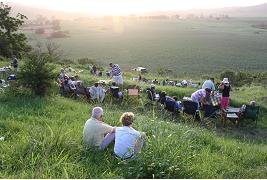
But one reedbed in particular has become pretty famous – the Lake Victoria wetland in Mount Moreland, La Lucia, about 25km north of Durban. That’s because since the 1970s it has been a roost for what is reputed to be millions of European Swallows and has become quite the tourist attraction and sundowner event for people on the North Coast.

I was drawn as much by the potentially amazing sight of all those swallows as by an old record of Black Coucal in the area but, as typically happens when one goes birding for something in particular, it fails to turn up!

There were about 50 swallows around as the shortest night of the year fell (December 21), but barely enough to be considered a flock!

It was still a wonderful way to enjoy sunset, sitting on the terraced banks above the reedbed, enjoying some snacks & beverages.

The Mt Moreland swallow viewsite. Courtesy http://www.barnswallow.co.za/

A Purple Heron flew over as a reminder that the reedbeds are valuable for other birds too, while I went walking in search of a Burchell’s Coucal that was calling away, only to return and find it posing on a dead treestump!

There was no sign of its Black cousin, but a half-dozen Hamerkop did fly over as well, shortly before the swallows made their underwhelming arrival.


Sightings list

Spottedbacked Weaver

Speckled Mousebird

Blackeyed Bulbul

Yellowbilled Kite

Hadeda Ibis

Burchell’s Coucal

Purple Heron

Hamerkop

European Swallow


R20m loss for Cricket SA as SABC cut back 0

Posted on January 21, 2013 by Ken

The SABC announced on Wednesday that they would only be providing live coverage of the limited-overs and T20 internationals between South Africa and New Zealand, and Cricket South Africa (CSA) are set to lose R20 million as a result.

The only coverage SABC are willing to provide of the two Tests against the Black Caps will be two highlights packages per day and, as a result,  CSA will only receive R11 million – R3 million from the SABC and R8 million from advertising time that has already been bought by the sponsors – for the television rights, when their actual value is R30 million.

“We are disappointed that the Tests will receive limited coverage and, although we are committed to the free-to-air broadcaster as part of our development mandate, we took a substantial cut in our broadcast rights fee to ensure we can take cricket to the South African public,” acting CSA chief executive Jacques Faul said in a statement released on Wednesday.

But behind the scenes, the cricket governing body is seething over the SABC’s unwillingness to fulfil their Icasa-stipulated mandate of providing live coverage of sporting events that are in the national interest. South Africa have been the number one ranked team in Test cricket since August, but the matches against New Zealand are their first on home soil since winning the pre-eminent ranking.

CSA sources told Business Day that Faul is so upset over the deal that he had to be talked out of considering whether to step down as CEO.

“The decision to broadcast these matches is a clear indication that we take our mandate seriously and we are cognisant that the public of South Africa deserve to see their cricket team – which is rated number one in the world in Test cricket and also highly in the other formats of the game.

“The SABC will continue to serve the public of South Africa and be true to their mandate of educating, informing and entertaining them,” SABC spokesman Sizwe Nzimande said.

CSA are now determined to handle their television rights differently next summer, with SuperSport likely to be offered exclusive rights and paying considerably more for them.

As one high-ranking CSA official said: “We’ve been falling over backwards to try and get cricket on free-to-air television because we know how vital that is to developing the game, especially amongst the disadvantaged communities. But now we’ve sold the rights to SABC at nearly one-third of their value. Where do they think most of our money to run our development programmes  comes from? It’s from selling the television rights and now we’ve taken a big knock in that department.”

Negotiations with the SABC had been ongoing for the last two months through world leading television rights company IMG, while CSA had also tried to get Sascoc and the sports ministry to intervene on their behalf as Faul acknowledges the importance of cricket being on the majority of TVs in the country.

“To grow our game, we need cricket on free-to-air. We see it as an obligation to all South Africans that they can see their number one team in action,” he said earlier this week.

http://www.bdlive.co.za/sport/cricket/2012/12/20/cricket-south-africa-seethes-over-sabc-test-rights-snub

  • Recent Posts

  • Archives

  • Thought of the Day

    Galatians 5:22-23 – “But the fruit of the Spirit is love, joy, peace, patience, kindness, goodness, faithfulness, gentleness and self-control.”

    The fruit of the Spirit are elements of the character of Christ and we should have the constant desire to become more and more like Christ in thought and deed. But what seems impossible for you becomes possible through Jesus. In him, we are filled with love, joy, peace, patience, kindness, goodness, faithfulness, gentleness and self-control.


↑ Top