for quality writing

Ken Borland


Flyhalves Pollard & Lambie have Boks resting easy after victory over All Blacks 0

Posted on November 03, 2014 by Ken

The Springboks can rest easy in the knowledge that they can, after all, play some of the best rugby on the planet and that the All Blacks are beatable after snatching a dramatic 27-25 victory at Ellis Park on Saturday night to end a five-game losing streak against New Zealand.
 South Africans can also rest assured that they have two world-class, match-winning flyhalves in Handre Pollard and Pat Lambie.

Pollard set up victory in the epic test as he scored two brilliant tries to give the Springboks a 21-13 lead after a scintillating first half, and then Lambie, who can consider himself a finisher par excellence, slotted a 55m penalty in the 79th minute to save the game as a strong All Blacks comeback threatened to deny the home side once again.

Who knew that Lambie can even kick the ball that far? But the 23-year-old’s composure in big games should be undoubted.

The Test started at a typically furious pace, but this time it was the Springboks who set the blazing tempo.

A phenomenal first half will be remembered for a long, long time.

Pollard missed a penalty and the Springboks twice turned over possession on attack in the 22, and it was the New Zealanders who struck first, flyhalf Beauden Barrett kicking an eighth-minute penalty.

South Africa will surely never again be called one-dimensional after their opening try was an extraordinary effort that started in their own 22. Willie le Roux made the decision to spread the ball, and Pollard produced a hard, direct run that created some space on the outside. A grubber from Jean de Villiers was then picked up by right wing Cornal Hendricks, who burst clear. Jan Serfontein was up in support and when he was tackled, scrumhalf Francois Hougaard came roaring up and evaded the clutches of Richie McCaw to score under the poles.

Pollard converted but another Barrett penalty in the 17th minute closed the gap to 7-6.

The Springboks’ second try, in the 28th minute will easily go down as one of their greatest ever.

De Villiers, who made ball-handling in a congested, hugely physical midfield look like a Sunday picnic, made a superb pass a split-second before contact to Le Roux, who sent Bryan Habana hurtling away down the left. From the subsequent ruck when the flyer was caught, Teboho ‘Oupa’ Mohoje took the ball at pace and charged over the advantage line. With such good, quick ball, Pollard easily scythed through the remaining defence, finishing a superb team try with an intoxicating mixture of gliding, power and pace.

The All Blacks were 14-6 down and under the pump heading into the last five minutes of the first half, but despite a retreating scrum, Aaron Smith spotted space on the blindside and sent wing Julian Savea off on a powerful run.

He was caught by Pollard but the ball was recycled infield and, when centre Malikai Fekitoa noticed Eben Etzebeth making a lazy retreat, he made a beeline for him. The lock totally disrupted the defensive line and Fekitoa was able to break through and score, Barrett’s conversion making it a one-point game again.

It was all New Zealand for the last five minutes, but Bismarck du Plessis effected a crucial turnover deep in defence and Hougaard hacked the ball ahead. An enthralling foot-race ensued between Hendricks and Fekitoa, with the Sevens star forcing a five-metre scrum.

Solid frontfoot ball was all Pollard needed to once again show his sheer class with ball in hand, gliding through for his second try, dotting down through McCaw’s desperate tackle. The exclamation by the All Black captain said it all.
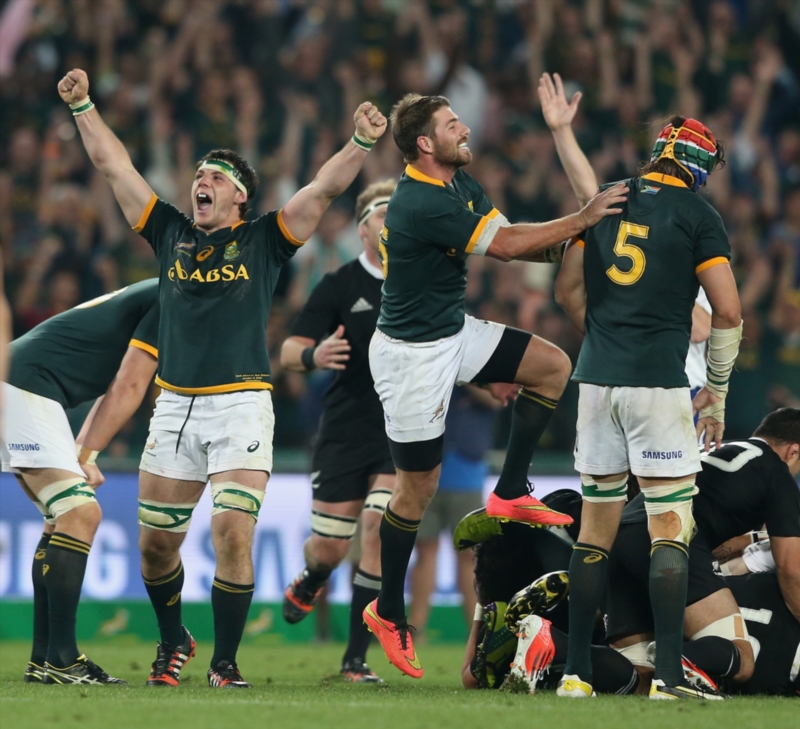
Marcel Coetzee (L) of South Africa leads the celebrations with team mate Willie le Roux after their victory during the Rugby Championship match between the South African Springboks and the New Zealand All Blacks at Ellis Park Stadium on October 4, 2014 in Johannesburg, South Africa. (Photo by David Rogers/Getty Images)

The Springboks took the attack again to the All Blacks in earnest from the start of the second half and an excellent rolling maul led to a penalty for a deliberate knock-on, Pollard extending the lead to 24-13.

It had been a memorable day for the Springboks thus far, but the All Blacks then mounted one of the famous, stirring comebacks. Today was not going to be the day they gave up their winning streak without a tremendous fight.

The home side were not only up against the world’s number one side playing with tremendous urgency, but also referee Wayne Barnes, who seemed determined to ensure there would be no All Blacks loss on his watch.
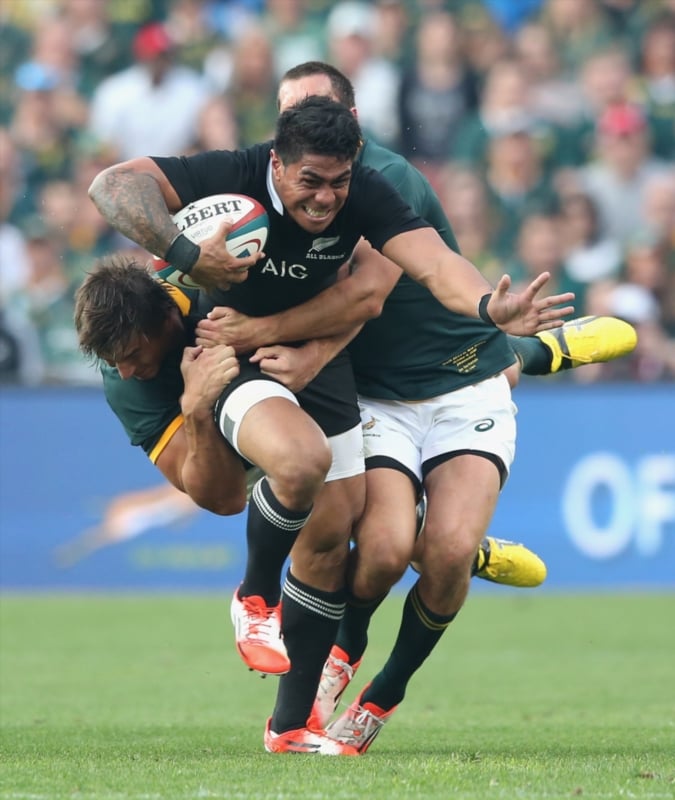
Malakai Fekitoa of the All Blacks is tackled by Eben Etzebeth (L) and Jan Serfontein during the Rugby Championship match between the South African Springboks and the New Zealand All Blacks at Ellis Park Stadium on October 4, 2014 in Johannesburg, South Africa. (Photo by David Rogers/Getty Images)

The All Blacks were given free rein at the breakdown and the Springboks were nailed. In the 67th minute, one such injustice led to outside centre Conrad Smith showing wonderful skill as he took a flat pass, half-shimmied and then burst through Jan Serfontein, before passing the ball out wide for Ben Smith to score and cut the deficit to 20-25.

Three minutes later and the Springboks were back under their poles. They had begun to fade, turning over possession, kicking more than they had and then losing a five-metre lineout. The All Blacks went right and then came back left, just passing the ball down the line and replacement hooker Dane Coles was the extra man to dive over in the corner.

Barrett’s conversion crucially did not go over though, and the Springboks had eight minutes to show their belief.

Lambie managed to get his monster over, sealing one of the more impressive Springbok triumphs.

The gap is not as wide as many believe and the Springboks are most certainly on the right track.

http://citizen.co.za/252444/pollard-lambie-boks/

Too much reliance on dazzling skills of Steyn & Le Roux 0

Posted on October 23, 2014 by Ken


Close to 60 000 people will be mesmerised at Ellis Park this afternoon when the Springboks take on the All Blacks, with a five-game losing streak against the New Zealanders suggesting that the home side have some catching up to do.

One of the problems the Springboks face is that there seems to be an over-reliance on the skills of Willie le Roux on attack. At times it seems that everybody else is expecting him to spark something and the pressure is causing the poor fullback to continually come into the flyhalf channel and try more and more outlandish things, leading to more and more mistakes. He is also being tightly marked by opposition defences which are well aware of the danger he poses.

It is never a wise strategy to put so much of a burden on one player, rather spread the load around by up-skilling others, and our national cricket team is facing the same issue when it comes to the limited-overs game.

The lack of bowling skill in South African cricket has been exposed by the dismal performances of the Cape Cobras and the Dolphins in the Champions League T20, where both teams’ attacks were put to the sword by opposition batsmen on flat pitches.

While Dale Steyn is still able to lay down the law in the powerplay up front and in the death overs due to his mastery of reverse-swing and the intelligent variations of slower-balls, yorkers and different-speed bouncers he uses, you have to wonder who else the South Africans will be able to rely on come the World Cup and a situation where they might be defending 50 off the last five overs in the final.

Just like the Springboks are relying too heavily on Le Roux, the Proteas are too dependent on Steyn and you can only be dismayed by the poor bowling performances of the two best T20 sides in the country in India.

You need only to look at the averages of the tournament to notice the problem: Sybrand Engelbrecht (what an impressive time he had) was the only Cobras bowler to concede less than eight runs an over, while not one Dolphins bowler managed that economy rate.

Batsmen were able to have a go with impunity, especially in the death overs. The Cobras conceded 60 in the last five overs against Northern Districts, 61 in four versus Hobart Hurricanes, and 63 in six against Barbados.

The Dolphins were belted for 63 in the last six by the Perth Scorchers, 68 in five by Chennai Super Kings, 109 in nine by Lahore and 80 off the last seven by the Kolkata Knight Riders.

A major part of the problem is that bowlers have little incentive to learn skills playing in domestic cricket because the pitches generally allow them to just bang the ball in and allow the surface to give them bounce and movement.

According to Cricket South Africa high performance manager Vincent Barnes, it is an area of great concern they have identified, especially since most ICC tournaments are held in sub-continental conditions these days. Who would bet against the BCCI instructing their new ruling triumvirate partners Australia to make sure World Cup pitches next year are flat and don’t assist pace bowlers?

In order for our bowlers to develop the skills of consistently bowling yorkers or being able to produce an array of deliveries like Ben Loughlin of the Hobart Hurricanes possesses, they need to be practising those skills regularly at home. Our pitches for domestic cricket need to force bowlers to improve their standards.

As Graeme Smith pointed out last week, it’s not just all about bowling yorkers; death bowling is a mindset issue and bowlers need to develop strategies, they need to have a definite plan.

Leaving it all up to Dale Steyn is not a good plan.

Fleming now mentoring Morris 0

Posted on May 23, 2013 by Ken

New Zealand captain Stephen Fleming pulled some wicked stunts on a 25-year-old Graeme Smith when they clashed in a Test series, but then became something of a mentor for the Proteas skipper and the cerebral Kiwi is once again helping the growth of another potential South African star of the same age in Chris Morris.

Spinner Aaron Phangiso may have won the man of the match award for his brilliant two for 17 in four overs when the Highveld Lions beat Fleming’s Chennai Super Kings in the Champions League at Newlands last October, but it was Morris who turned the coach’s head.

Morris took one for 24 in four overs, halting a blazing start to the game by CSK, and also helped seal victory for the Lions with an important 12 not off seven balls at the death, including a massive six.

“I bowled well against Stephen’s team in Cape Town and I also hit a six when I was batting. I then happened to bump into him in a restaurant and spoke to him. He pulled me aside and said he was very impressed with my bowling and said I should keep in touch. It’s funny how things go in cricket … ” Morris told Sapa at the Wanderers on Tuesday.

Three-and-a-half months later, the Super Kings paid a head-spinning $625 000 [R5.5 million] to sign the all-rounder for this year’s Indian Premier League and a dazed Morris can still hardly believe how things have turned out.

“I’m still a bit speechless after going for a price like that and it’s mind-blowing because I modelled my captaincy at school on Stephen Fleming, he was my hero, the ultimate captain with a great cricket brain. And I’ll also be playing alongside people like Mike Hussey, a schoolboy hero of mine too, and Ben Hilfenhaus, who I really enjoy watching bowl,” Morris said.

India is probably not top of the list of places pacemen want to bowl in and the Super Kings are based in Chennai, a particularly spin-friendly venue, so Morris knows the IPL will be hard work.

“I hope I catch a game but it’s going to be a very different environment and pitches, plus there’s the heat. Conditions will be tough but it’s going to be a massive learning experience and a big test of my skills.”

But for now, Morris has to focus on the final cycle of four-day domestic series fixtures, with the Lions needing to beat the Warriors in Port Elizabeth to overcome a 9.66-point deficit behind the Cape Cobras in order to win the title.

Morris has been in top-class form with the ball, taking a superb 26 wickets in five matches at an average of just 16.73 and Lions captain Stephen Cook praised his bowlers for doing “a terrific job”.

“Someone has always stepped up, most of them have 20-odd wickets at a low average. When we played the Warriors in PE in a one-day game, the pitch seamed around a bit, but we have Imran Tahir too if the wicket is low and slow,” Cook said.

The weather has bought some breathing space for the Cobras at the top of the log as the Lions have had two matches washed out in the last three weeks, but coach Geoff Toyana, who has enjoyed considerable success since taking over from Dave Nosworthy at the start of the summer, remains positive his team can still win the trophy.

“The boys are in good spirits, although they are disappointed about the last three weeks, and if we play well enough we might be champions. I trust in the guys that they can do their skills and if we play to our full potential then we can come through,” Toyana said.

The Lions will be at full strength with current internationals Alviro Petersen and Quinton de Kock returning to the line-up and considerably boosting the batting.

No celebration, but see the bigger picture – Kirsten 0

Posted on May 08, 2013 by Ken

NARROWLY avoiding a whitewash against the eighth-ranked New Zealanders will not provide cause for celebration, but Proteas coach Gary Kirsten says the one-day international series should be seen as part of a bigger picture.

That bigger picture is the 2015 World Cup, with Kirsten hired as coach in large part because he won that title with India in 2011 and South Africa crave success in that event after a litany of heartbreak stretching back to 1992.

But while South Africa have a settled Test unit that is rightly ranked No1, there is a perception that there is no clarity when it comes to what the best one-day international team is.

Finding a top-class all-rounder to cover for the day when Jacques Kallis calls it quits looms large as a major assignment, and Kirsten will be delighted that Ryan McLaren repaid the faith invested in him with a match-winning performance under pressure in Potchefstroom.

“Jacques is a two-in-one cricketer and we’ve had the luxury of having him for 18 years,” Kirsten said.

“What can we do when he’s no longer around? Do we choose a fourth specialist pace bowler or play an all-rounder at seven?

“We’ve been mixing and matching to see what’s best and Ryan’s inclusion comes after the selectors decided that he’s the best all-rounder. He’s played 16 one-day internationals spread over four years and probably feels like he’s always playing for his place, plus it’s a grey-area position.

“So I would like to give him a run, to see what he can do and he’s learnt a lot about bowling in the middle overs,” Kirsten said.

Other new, or less regular, faces in the squad — Quinton de Kock, Farhaan Behardien, David Miller, Rory Kleinveldt and Aaron Phangiso — did not manage to have the same effect as McLaren, but Kirsten says the use of a larger pool of players is all part of the plan.

“I’m pretty clear on what the 15-man squad for the Champions Trophy will be and our focus is on the World Cup, which is two years out.

“This time of exploration allows for a great number of opinions and people get irritated. But this is a very important phase, and we need to go through this process.

“There’s obviously a risk attached in doing it at international level and we knew New Zealand would be dangerous and didn’t take them for granted. But we needed to find a series where we could explore our talent because in the long term, it has given us depth and exposure for those players,” Kirsten said.

There is a more worrying question over who is actually the best leader for the team.

It is becoming apparent that too much is being placed on AB de Villiers’s shoulders, hence the decision to call up De Kock as wicketkeeper. But then South Africa had to call on Faf du Plessis to captain the team after De Villiers was suspended for a dreadfully slow over rate.

Thrusting such a high-pressured job on somebody like De Villiers, who has no previous captaincy experience, was always going to be risky and the 28-year-old may be better advised to focus on his batting and keeping wicket in the one-day internationals.

“Faf has great leadership potential but it’s only fair that we give AB a run as captain, he’s only done it for 14 games.

“He wasn’t going to keep wicket because we wanted him to grow his captaincy, but it’s early days, we’ll have to see how things unfold,” Kirsten said.

“There’s a lot of conversation around AB as wicketkeeper and captain and yes, there is a risk attached that it might diminish his batting, but there’s also a risk that we’ll waste one of the greatest careers. He adds massive value as a wicketkeeper.

“We haven’t closed the door on him being the one-day international wicketkeeper. That was very specific to this series and we won’t make a rushed decision,” he said.

http://www.bdlive.co.za/sport/cricket/2013/01/28/new-zealand-series-part-of-preparation-for-2015-says-kirsten

  • Recent Posts

  • Archives

  • Thought of the Day

    Revelation 3:15 – “I know your deeds, that you are neither cold nor hot. I wish you were either one or the other.”

    How can you expect blessings without obeying?

    How can you expect the presence of God without spending time quietly before him?

    Be sincere in your commitment to Him; be willing to sacrifice time so that you can grow spiritually; be disciplined in prayer and Bible study; worship God in spirit and truth.

    Have you totally surrendered to God? Have you cheerfully given him everything you are and everything you have?

    If you love Christ, accept the challenges of that love: Placing Christ in the centre of your life means complete surrender to Him.


↑ Top