for quality writing

Ken Borland


From having to convince her Mom to cricket superstar: the journey of Marizanne Kapp 0

Posted on February 13, 2019 by Ken

When Marizanne Kapp mooted the idea of becoming a professional cricketer to her mother, her greatest supporter, it did not go down well. But remembering it was the previous decade and Cricket South Africa contracts and having their matches televised was still a long way off for our top women’s players, this should not be a surprise.

Mother Nereda Lamprecht had earlier been the one to approach the principal of Hoerskool DF Malherbe to convince him to allow her 13-year-old daughter to play boys cricket at the Port Elizabeth school. The immense talent was obvious, but ensuring Kapp had the platform to reach her potential was another matter.

“To be able to play cricket for a living, that’s my biggest dream come true. My mother was so upset when I told her I wanted to be a professional cricketer, she said no, I must get a proper job. Well now I can take her anywhere in the world she wants to go and pay for her, so I guess it worked out in the end.

“I was a bit of a tomboy growing up and I wanted to do anything the boys were doing. My cousins used to play cricket in the streets, so I started playing with them and then I graduated to indoor cricket. Then my mother went to the principal and asked if I could join the boys team. I did everything at school and I got provincial colours for swimming, biathlon, cross-country and netball, but it was cricket that really stuck,” Kapp, who has a degree in sports management and is studying for another one in human resources, told Saturday Citizen.

Chosen by South Africa for the first time in March 2009, Kapp was still a teenager when she was given a baptism of fire by hosts Australia in the World Cup. But she has grown into one of the best all-rounders in world cricket, chosen by the International Cricket Council for their 2017 ODI team of the year and headhunted by the Sydney Sixers for the inaugural Big Bash in 2015. That’s the most lucrative event for women’s cricketers, their version of the IPL, and the Sixers have been the most successful team, winning the title twice and being runners-up in the other two seasons.

There is no question that the Proteas Women have been helped into the upper echelons of the world game by the arrival of the tremendously athletic Kapp. She forms a formidable new-ball partnership with Shabnim Ismail, rated by many as the best in the world, while she is good enough with the bat to play in the top-order and she has scored South Africa’s only World Cup century.

A feisty character on the field, Kapp may seem a bit shy and withdrawn in the public eye when not playing cricket. But she is clearly the type of person you can go to war with and is hard on herself. She is especially eager to contribute more with the bat.

“I really want to do a bit more with the bat, I’ve been playing for the Proteas for quite a while now and the seniors need to put up their hands and take the load. The bowling is still our team’s big strength, but the batting has to improve. Batting at number three, I’d like to end more games.

“The bowling just comes more naturally for me and in ODIs you’re normally bowling first and batting second. Which is why my batting took a bit of a knock, but I want to get into it more and it’s something I can work on. I’m just waiting for the chance now because we’re playing matches every second day at the moment, whereas in the past we had a few more rest days,” Kapp says.

The Proteas, having whitewashed Sri Lanka 3-0 in their T20 series, now take on the tourists in three ODIs in Potchefstroom next week and if Kapp plays in them all, she will be tantalisingly poised on 99 ODI caps.

Her wife, Dane van Niekerk, is the national captain and will probably get to the 100th game milestone first as she already has 98 caps. They will join Mignon du Preez and Trisha Chetty as the only centurions.

The corridors of Cricket South Africa  can be a rabbit warren of political intrigue, but one thing they are clearly getting right is stabilising and growing the women’s game. Kapp is very appreciative of their efforts and, once her playing days are over (which will hopefully only be in a long while because she is only 29), she is determined to continue working towards the progress of South African women’s cricket.

“It’s tough but there are very good signs which show how serious CSA are in taking the women’s game forward. I wold like to give back when I’m done playing, to contribute to women’s cricket here becoming like it is in Australia,” Kapp said.
https://citizen.co.za/sport/south-african-sport/sa-cricket-sport/2080036/women-in-sport-how-feisty-marizanne-won-her-mom-over/

Swys has brushed aside all teething problems & maintained Lions’ high standards 0

Posted on August 28, 2018 by Ken


Swys de Bruin endured some teething problems early on in his career as Lions head honcho, but hats off to the well-travelled coach for keeping the faith and his nerve and maintaining the high standards of excellence that have characterised Ellis Park as the team head into their third successive SuperRugby final on Saturday.

Change – especially when it involves losing someone as integral as Johan Ackermann – is often difficult but it is a credit to the smooth systems in place at Ellis Park and De Bruin’s own wisdom and level-headedness that the performance of the Lions in the long run has barely suffered.

It was not as smooth a road to the final this year, which has forced them to make the daunting trip to Christchurch, but reports of the Lions’ demise were greatly exaggerated. Sure, they have had their problems this season, but in a way that makes their achievement all the more impressive because they had to overcome greater challenges to reach the final.

Without their inspirational captain, Warren Whiteley, for most of the season, the Lions also lost their most influential player in Malcolm Marx at a crucial stage of the tournament while Jaco Kriel, a matchwinner, has been ruled out of the entire campaign due to injury. They also had to cope with the departure of integral players like Ruan Ackermann, Faf de Klerk and Akker van der Merwe, while also dealing with the rumours swirling around contracted players wanting to leave and those that did depart mid-season like Rohan Janse van Rensburg.

Apart from still churning out the results against the odds, with so many things mounted against them, the Lions have also still played with flair, which is unsurprising considering how obsessed coach De Bruin is with scoring tries; in a sport which is marred by plenty of cynicism, it is refreshing to have a head coach state so openly, with almost childish naivety, that all he cares about are tries. But that is why most people started playing rugby.

Whatever the result of Saturday’s final, and it would be an upset for the ages if the Lions were to beat the Crusaders in Christchurch, they have done the nation proud. And I don’t agree with the prophets of doom who say it’s now or never for the Lions to win SuperRugby; these are probably the same naysayers who predicted the team would fall off the rails this year already.

The wonderful thing that the culture of success at Ellis Park – and here we must also give the credit to the superb leadership trio of Rudolf Straeuli, Kevin de Klerk and Altmann Allers – has done is to ensure that the Lions are now the team everyone wants to play for. It is the first port of call for the SA Schools star looking to start his professional career.

And the pipeline is working well. Players such as Madosh Tambwe, Marco Jansen van Vuuren, Len Massyn, Hacjivah Dayimani, Gianni Lombard, Jeanluc Cilliers, Wandisile Simelane, Reinhard Nothnagel, Keagan Glade, Asenathi Ntlabakanye, Cristen van Niekerk, Mark Snyman and Yanga Hlalu will be at the vanguard of the Lions’ efforts to remain the undisputed champion franchise in South Africa.

It was not always thus and, as Allers said in his address at the post-match function after the semi-final win over the Waratahs, the last home game of the season, so many of the current Lions stars came to Ellis Park with the reject tags around the neck.

The irony is that so many of those players were shown the door just up the road at Loftus Versfeld, the former SuperRugby champions who used to be the place of choice for young players. The new Bulls coach, John Mitchell, is currently negotiating with the board to fix the mess that has been created there by years of terrible talent identification.

The beneficiaries have been the Lions and so many of the franchise’s stars now carry a new label, the precious tag of being a Springbok.


https://www.pressreader.com/south-africa/the-citizen-gauteng/20180804/282651803301630


Close encounters on the Kransberg 1

Posted on April 27, 2018 by Ken


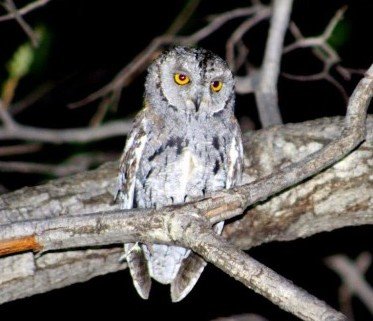
An African Scops Owl comes to visit our campsite

An African Scops Owl comes to visit our campsite


by Anthony Stidolph


I am, by nature, a wanderer. For me there is nothing quite like the thrill of departure, the joy of being on the road again, of heading off to remote and cut-off places.

As an antidote to this restlessness I have travelled the length and breadth of South Africa searching out new places I can claim as my own. In recent years this has involved launching several expeditions up to the Limpopo, along the way taking in Punda Maria and Pafuri in North Kruger, Mapungubwe, Ratho on the Botswana border,  Hans Merensky on the Groot Letaba, the forests of Magoebaskloof, parts of the Soutspanberg and that little-known gem, Blouberg Nature Reserve near Vivo.

Having explored and fallen in love with this sun-drenched landscape, my birding partner Ken and I recently took a notion to recreate these epic treks by heading back up there once again, only, this time, adding Marakele National Park, which would be new country for me.

A Tshwana word, aptly meaning “Place of Sanctuary”, Marakele falls within a transitional zone between the dry western habitat, made up mostly of Kalahari thornveld, and the typical bushveld country of the moister eastern sections of South Africa. It also lies within the Waterberg range of mountains, with an altitude ranging from 1050 metres on the plains to 2088 metres at its highest point.

Because of this broad range of vegetation types and its diverse topography the area boasts a wide variety of game (including the Big Five and Wild Dog) and an abundant bird life. Its biggest attraction, for birders anyway, is the around 800 breeding pairs of Cape Vulture which nest high up in the cliffs of the Kransberg

Arriving at the park, which is situated about twenty kilometres north of the old iron-ore mining town of Thabazimbi, we set up camp and then headed off on our first drive. I was immediately rewarded with my first lifer of the trip – a Greyheaded Kingfisher.

As we sat having a celebratory beer that night, listening to the clear, articulated noises of the bushveld at night, a tiny African Scops Owl landed on a branch above us and began its odd but strangely comforting, frog-like, “Prrrt…prrrt…prrrt…” call. This was more like it. My latest Excursion Into The Great Unknown had officially begun.

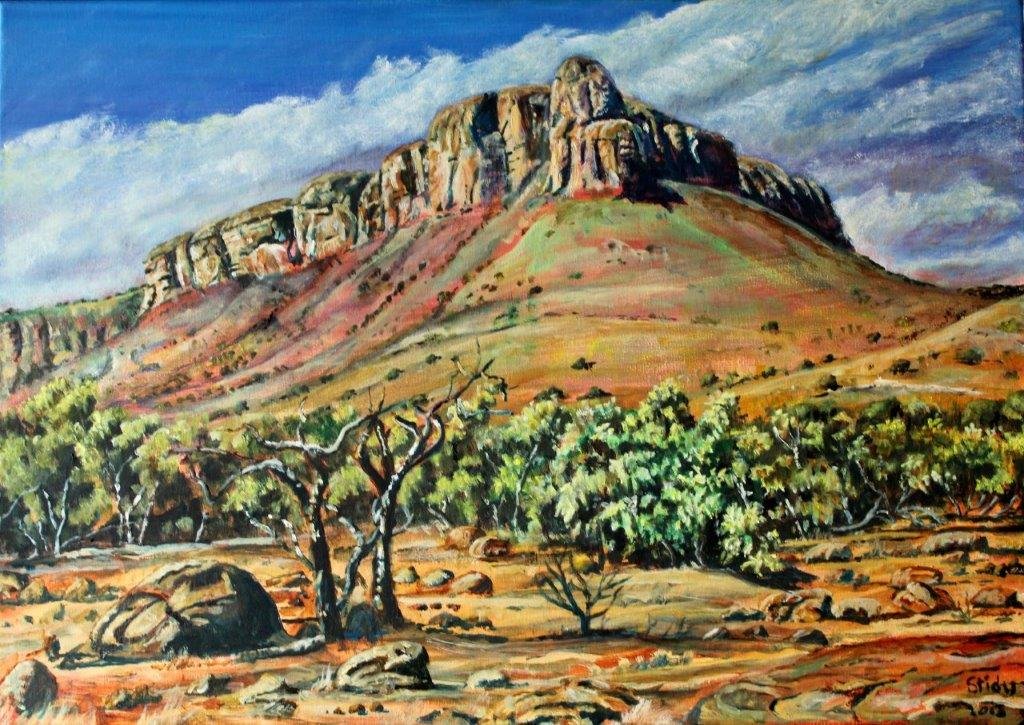
The Kransberg, Marakele NP

Anthony Stidolph’s painting of The Kransberg in Marakele National Park. For Sale – contact Stidy at stidy@sai.co.za (42×60)

The next day we were up at dawn and driving through heavy bush country towards the impressive pass that leads up to the top of the Kransberg mountain. A friend of ours had told us that her biggest concern going up this narrow, winding, precipitous road, was what she would do if she encountered another vehicle coming down the other way as there is little room to pass. That proved to be the least of our worries.

Rounding one steep-sided corner we suddenly found ourselves coming face-to-face with a young elephant bull that had stepped out on to the road. Having been in this situation many times before, Ken immediately pulled up short, stopping a sufficient distance from the animal so as not to make it feel threatened or think that we were encroaching on its space. It didn’t help.

Coming face-to-face with a wild animal so much bigger than yourself can be a slightly intimidating experience and this one decided to remind us of its size advantage. Without even affording us the courtesy of a warning mock charge, it let out an almighty bellow and came thundering down the road.

There was nothing to do but slam the car into reverse and head back down the road with me craning my head out of my window, shouting directions, while Ken did the same on his side.

The kilometre or so we drove in this manner was like a rapid ride through eternity. We kept hoping that each time we rounded a corner and the elephant lost sight of us it would lose interest. No such luck. The beast definitely did not like the cut of Ken’s jib and was determined to drive us clear off his mountain stronghold.

We went back down into the valley and somehow – and I shall never know how we did it – managed to do so without plunging down the mountain side or getting stomped on by the elephant. Once safely back on the flat we found a turning point, backed into it and sped off in the direction we had earlier come from.

A half-an-hour or so later we gingerly ventured back but, very bravely, decided to allow another vehicle – that had come driving up while we were parked on the side of the road observing, of all things, a Neddicky (the ultimate Little Brown Job), while considering the sagacity of continuing on our journey – go up ahead of us. Once we had seen they had safely cleared the ridge we sailed forth ourselves, this time, thankfully, unmolested.

At the top of this particular stretch the road evens out on to a trough through which you drive before getting to tackle the final, most spectacular, stage of the mountain. Here the road begins an even more torturous ascent. On the one side rise the naked sandstone towers of the Kransberg massif itself, weathered into the shapes of fantastical beasts and strange deformed reptiles. On the other side the slopes plunge steeply down into a treeless, meadowy grassland in which several more elephant and a herd of wildebeest were feeding.

As we advanced the road got narrower and narrower. What got us perspiring heavily all over again was that there were yet more fresh elephant droppings at regular intervals all along its surface, virtually to the top.

On the summit it was like another world. The view was colossal. Below us the mountain stretched away in every direction before dropping down, in a series of steps, to the plains, fading away into the blue distance.

Immediately in front was another castle-like knob, a labyrinth chaos of rock, fitted with clefts and chimneys. It was here the vultures nested. There were many of these large, endangered raptors wheeling gracefully above us, trailing their shadows on the ground beneath them.

The protea-covered hillsides on top of the mountain also provide a home for some other unusual species like the Gurney’s Sugarbird and the Buff-streaked Chat, birds which I more commonly associate with the Natal Midlands, where I live, and the foothills of the Drakensberg. Another occupant is the Kransberg Widow, a very rare and beautiful butterfly which puts in an appearance in November and early December and then, like Cinderella, sheds its finery and disappears. This is the only place in the world where it occurs.

We were reading all about the insect on a large information board they have erected up there, alerting us to its presence, when one came fluttering past. A few minutes later it came fluttering back again … and again. It may be scarce but it certainly wasn’t shy about showing off its beautiful cream markings.


A cold wind was blowing across the mountain top and a storm was brewing in the distance and so, after a warming cup of coffee, which we shared with a pair of very tame Cape Buntings and a cheery Mocking Cliff-Chat, we made our way back down the same twisting road, this time without having to face down any elephants with murder on their minds. Heading into camp I did, however, have another good sighting of two more Greyheaded Kingfishers, dive-bombing a family of Banded Mongoose.

Two days later, in Blouberg, I had an even better view of the kingfisher sitting at the end of a dead branch. This meant that after fruitlessly searching for the elusive bird for years I had now seen four in four days …

The grumpy pachyderm who had chased us down the Kransberg may have scared me witless, but I couldn’t help wondering afterwards if he hadn’t deliberately engineered the whole encounter just to make sure I kept running into the bird!


ANTHONY STIDOLPH


Where is Marakele National Park?


The John McFarland Column: The unsung hero of the Lions’ success 0

Posted on April 25, 2018 by Ken


The Lions’ victory over the Waratahs was a fantastic achievement and one of the best results in the history of our SuperRugby, you have to give credit to the players and the whole coaching staff for pulling off that sort of scoreline in Sydney – and for keeping the New South Welshmen pointless for the first time ever in the competition.

The Lions were really dominant in the scrums and lineouts and they scored some very clever tries. But I would like to single out defence coach Joey Mongalo as their unsung hero.

He took over from JP Ferreira and was under lots of pressure when they started to concede tries in the losses against the Blues, in Argentina and versus the Crusaders, so it is a real credit to him that they have tightened up so much since then. Swys de Bruin took a big punt in appointing his son, Neil, as the skills coach and then he took Joey out of the junior team, where he had been tremendously successful.

It’s a big step up for Mongalo but he can now enjoy the history made in Sydney. He has persevered through the ups and downs and been at the Lions for seven years and was promoted to the Currie Cup last year. He was also the SA U20 defence coach under Dawie Theron and in their last year they finished fourth at the junior world cup. Saru, in their infinite wisdom, decided not to make use of him last year, but he is a quality young coach.

The difference he has made to the Lions’ defence is that they now have great spacing, alignment and width, they really cover the width of the field. They are also very strong in the collisions, guys like Franco Mostert, Harold Vorster and Malcolm Marx really monster guys. They have a great double-hit system which means the ball-carrier can’t get the offload away.

They’ve also shown greater line-speed these last two weeks, they’re coming forward and really laying down the gauntlet to the opposition. With that they can force turnovers through Kwagga Smith and Marx, who is probably the best in the world right now at forcing turnovers. He gets over the ball so often and he is really hard to shift.

The fact that he comes off the lineout and is inside the ball a lot of the time allows him to be very effective at turnovers. The hooker role has changed over the last few years because of the nature of how teams contest for possession and one of the best at stealing ball I ever worked with was Bismarck du Plessis. The hooker nowadays basically defends the inside channel, which enables him to be close to his target.

The other impressive feature of the Lions’ play against the Waratahs was the quality of their kicking game and their lack of fear in doing it anywhere on the field. Elton Jantjies was even prepared to put in a crossfield kick off turnover ball five metres from the goal-line. There was also a great little chip from scrumhalf Dillon Smit in the middle of the field that bounced into Ruan Combrinck’s hands and Kwagga scored.

They have the courage to do it when it’s not expected and they execute those kicks so well. The Lions also have very good chasing wings.

Swys de Bruin obviously gives them the confidence to try anything anywhere on the field and you can never accuse him of taking the safe option. He’s also had his ups and downs as a coach – he spent a long time at the Sharks Academy before Johan Ackermann brought him back into the coaching fold. He brings confidence and a sense of adventure to Lions rugby.

One must also give credit to forwards coach Philip Lemmer. Those two tries from drives off the lineout were really well executed and the way they shifted and created a channel for Marnus Schoeman, ripping a wide open gap for him to go through, was very clever.

So it was almost the perfect performance away from home by the Lions, I expect them to back it up by beating the Reds this weekend, and it is a smart move by Springbok coach Rassie Erasmus to add Swys to the consulting team for the England series. Does it mean the Springboks will play with that same freedom as the Lions do?

Well Rassie is naturally quite a conservative coach so it will be interesting to see if Swys will free up the backs.

Elton Jantjies is now the most capped Lions player ever, having gone past Cobus Grobbelaar’s 94 appearances earlier this season, and he is hardly ever injured, so he is tremendously resilient and looks after his body well. The Lions’ style of play is tailor-made to his strengths and it was encouraging to see him dictate matters in an away game, having shown previously he’s obviously very good at altitude. A lot of it comes down to the backing Swys de Bruin gives him and the question is whether he will now get the same with the Springboks.

I thought the Bulls were good value for their win over the Rebels. Sometimes you have to win ugly but to bank the five points despite that was excellent and coach John Mitchell won’t mind doing that every week.

Adriaan Strauss is certainly in brilliant form, last year’s break did him good and he has dropped some weight. In fact, I have worked with Atta since the U21s and this is the fittest I have ever seen him. He has always been a world-class player, but in the environment Mitchell has created at Loftus Versfeld, he is really performing. Having him there really adds accuracy to the set-pieces and he almost always hits his jumpers with his dead-eye-dick throws.

That brings RG Snyman and Lood de Jager into play and that forms the axis of the Bulls side with flyhalf Handre Pollard.

Under the new regime, Lood is also fitter and more mobile and the offloads and supporting lines of the Bulls forwards are very good, they look to keep the ball alive in space. Their scrum also functioned quite well against the Rebels and they created a great angle on the crucial try scored by Divan Rossouw just before halftime. They took a whole lot of Rebels defenders out of the game, they could not get across in time and the visitors basically ran out of tacklers.

Pollard is also providing direction with the boot and is enjoying a good string of matches, plus you have the magic and game-breaking ability of Jesse Kriel and Warrick Gelant, who has such incredible feet, he could get his way out of a phone box full of tacklers!

In fact there are now a lot of players with good feet on display in South African rugby, there’s that stepping ability. New Zealand’s guys tend to rely on their size, but we’re starting to produce it on the wings, guys who are really quick with good feet and are good in the air, which is going to be crucial in the Rugby Championship and against England.

The Rebels’ tactics are well-known on the Highveld, trying to slow down or stop the game, which gives their forwards longer time to recover. Visiting teams to Pretoria either stack their bench with forwards in a 6/2 split, so for the last 20 minutes they almost have a fresh pack on, or they slow the game down, sit down often and make the whole pace slower.

But hopefully the Bulls will also be able to turn over the Highlanders on the Highveld this weekend.

The Sharks versus Stormers game was obviously between two teams desperate for a win and the loss puts real heaps of pressure now on the Stormers. They’ll have to win with bonus points in their next five games in the Cape, which is possible. But for the Stormers to win with bonus points they need to be far more defensively secure than they have been.

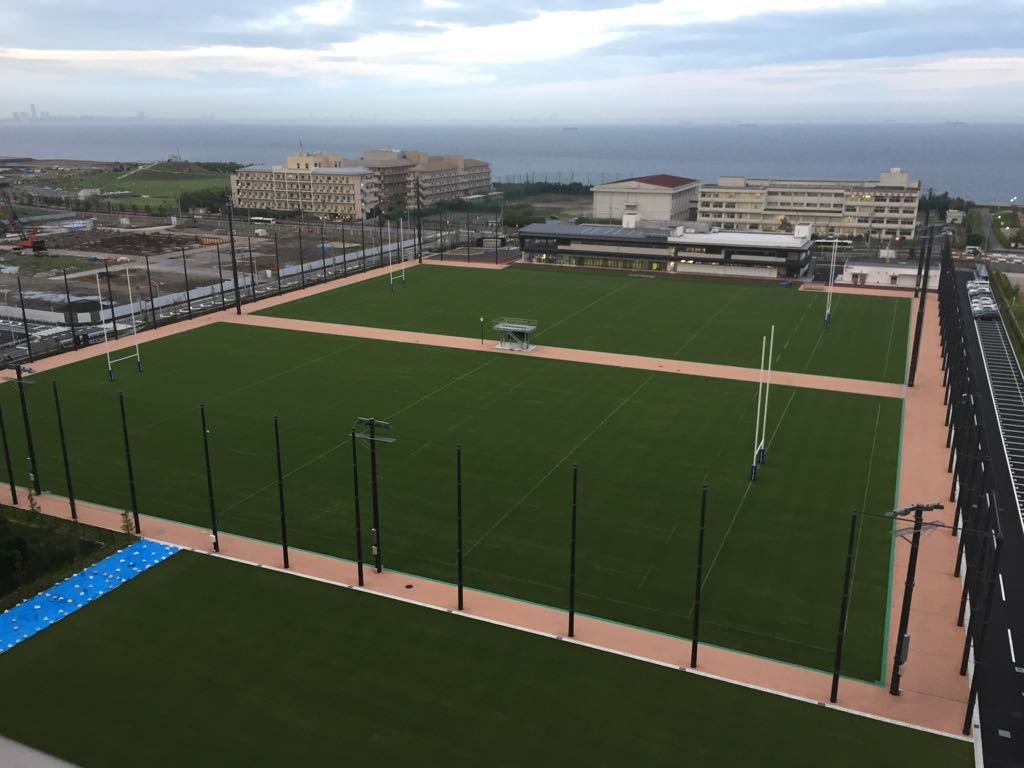
But I look forward to watching the games in my 11th floor Tokyo flat, which overlooks the Springbok training facility for next year’s World Cup. I hope I am still here next year to look out my window and watch them train!


Urayasu City World Cup training facility - where the Springboks will be based while in Tokyo

Urayasu City World Cup training facility – where the Springboks will be based while in Tokyo


John McFarland won three SuperRugby titles (2007, 09, 10) with the Bulls and five Currie Cup crowns with the Blue Bulls as their defence coach. In all, he won 28 trophies during his 12 years at Loftus Versfeld.

He is currently the assistant coach of the Kubota Spears in Japan and was the Springbok defence coach from 2012 through to the 2015 World Cup, where they conceded the least line-breaks in the tournament and an average of just one try per game.


  • Recent Posts

  • Archives

  • Thought of the Day

    Galatians 5:22-23 – “But the fruit of the Spirit is love, joy, peace, patience, kindness, goodness, faithfulness, gentleness and self-control.”

    The fruit of the Spirit are elements of the character of Christ and we should have the constant desire to become more and more like Christ in thought and deed. But what seems impossible for you becomes possible through Jesus. In him, we are filled with love, joy, peace, patience, kindness, goodness, faithfulness, gentleness and self-control.


↑ Top