for quality writing

Ken Borland


Lions expose the Jaguares’ pseudonyms with terrific defence 0
Posted on July 21, 2018 by Ken


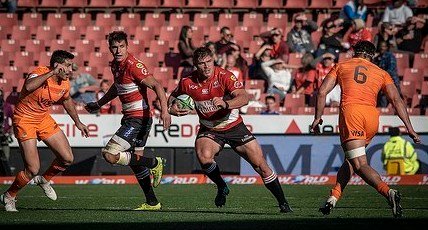
Lions hooker Malcolm Marx on the rampage once again. Photo by Marcel Sigg, runridedive.com

Lions hooker Malcolm Marx on the rampage once again. Photo by Marcel Sigg, runridedive.com

When the ACT Brumbies’ style of play dominated rugby in the early 2000s there were many pseudonyms for what they were doing – structured rugby, expansive rugby, multiphase play, all set up by skilful ball-carriers.

The Jaguares reminded me a bit of that multiphase play at Ellis Park on Saturday afternoon as they valiantly held on to the ball for phase-after-phase. But the game has moved on since the glory days of Gregan, Larkham and Finegan and these days teams trust their defences to hold out for long periods, eventually forcing the error or a one-off runner that is vulnerable to the breakdown steal.

We saw it in the Crusaders’ victory over the Sharks in the other SuperRugby quarterfinal featuring a South African side earlier in the day, and the Lions’ defence was the biggest factor in their 40-23 win over the Jaguares.

As the Jaguares pushed and prodded with more determination, so the Lions just worked harder and with more physicality in defence, simply not allowing the Argentinians to get their game going. Hooker Malcolm Marx led the way with vital turnovers, but Marnus Schoeman also contributed valuably and Kwagga Smith was also a presence at the breakdown.

“Collectively it was a massive effort and you have to give credit for all the turnovers to the guy who makes the tackle as well because he provides the opportunity. A guy like Malcolm is then just impossible to shift, Kwagga made one or two steals as well and Marnus was excellent when he came on. At stages the Jaguares kept the ball for a long time, but we showed good patience on defence,” Lions captain Warren Whiteley said after his team had clinched their third successive SuperRugby semifinal at home.

Run Ride Dive

Captain Warren Whiteley epitomises the Lions defence with this hit on Agustin Creevy. Photo by Marcel Sigg, runridedive.com

The Jaguares are certainly a force to be reckoned with going forward in SuperRugby, as they showed in the third quarter when they came from 9-24 down at the break to close to 23-27.

They were piling on the pressure, but Marx won three turnover penalties and those are the crucial interventions which win knockout games, with coach Swys de Bruin talking afterwards about “great defence at the right times”.

Jaguares coach Mario Ledesma spoke afterwards about how disappointing it was to concede three “soft” tries in the first half, but the Lions are a clever, innovative side on attack, able to try different things and generally pretty clinical.

All three of the tries came from different kicks: An Elton Jantjies crosskick found wing Ruan Combrinck with pinpoint precision for the first try; centre Harold Vorster followed lovely sleight of hand with a clever kick through that became even more effective thanks to the pace of Aphiwe Dyantyi getting there first to hack through and allow Vorster to score after the Jaguares made a mess of the clean-up operation; and a little dink over the top by flyhalf Jantjies was gathered by scrumhalf Gonzalo Bertranou, but his loose pass was immediately intercepted by Marx, who roared away from the 10m line for the try.

The Lions were cruising with a 24-9 halftime lead, but the admirable Jaguares were not done yet though as Bautista Delguy used his quick feet to score a fine try down the right wing two minutes after the break, and seven minutes later the visitors scored again as flank Pablo Matera crashed over. It was not the best grubber kick by the Lions that had given them broken-play possession.

Flank Cyle Brink, after a barnstorming first half, did not come out for the second half due to a shoulder ‘stinger’, but it was not a problem for the Lions as his replacement, Schoeman, played with tremendous industry. He showed terrific tenacity in the build-up to Andries Coetzee’s try as the fullback wriggled through a couple of tackles.
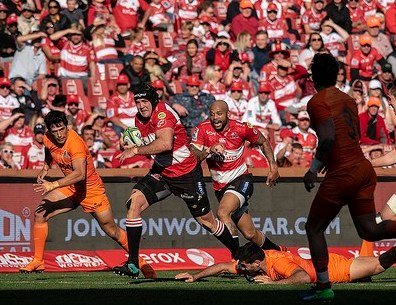
Lions flank Cyle Brink on another storming run. Photo by Marcel Sigg, runridedive.com

Lions flank Cyle Brink on another storming run. Photo by Marcel Sigg, runridedive.com

A typically combative Marnus Schoeman. Photo by Marcel Sigg, runridedive.com

A typically combative Marnus Schoeman. Photo by Marcel Sigg, runridedive.com


Being a knockout game, coach De Bruin had deemed shots at goal acceptable and Jantjies, who produced a polished performance that included a seven-from-seven success rate from the tee, then slotted a sweetly-struck drop goal to take the Lions’ buffer to two converted tries (37-23).

The seventh successful kick at goal by Jantjies was the penalty that completed the scoring with five minutes remaining, confirming that they will host the Waratahs at 3pm next Saturday in the semifinals.

The other huge positive for the Lions was the tremendous dominance of their scrum. The number of set-pieces was relatively low, but whenever the home side needed it, their scrum won them penalties or gave them strong front-foot ball.


Proteas had the gas to win the battle of the bowling attacks – Gibson 0

Posted on May 08, 2018 by Ken


When Australia arrived in South Africa for their four-Test series, it was billed as the battle of the bowling attacks, and it was the Proteas who had the gas required to take 80 wickets, while the tourists could claim just 70 wickets as they went down 3-1.

So just how did South Africa manage to bowl Australia out in all eight innings of the series?

“Firstly, you’ve got to have good fast bowlers and we’re lucky that we do, and they’re good in any conditions. And then you add Keshav Maharaj to the mix and Lungi Ngidi came in and made his mark as well. There were guys putting their hand up all the time.

“Kagiso Rabada was Man of the Series, but I was especially pleased with Vernon Philander. I set him a challenge at the start of the series and he exceeded it, he bowled the overs and got the wickets, so I’m delighted for him. It’s a shame to see Morne Morkel go with the way he’s bowling at the moment, he’s a handful for batsmen,” Proteas coach Ottis Gibson said.

The solid batting performance was also down to the unit as a whole performing, with four different batsmen getting centuries.

Gibson said he was also especially pleased by the way his team handled the controversies and enmity that would burn through the series, until Australia arrived at the Wanderers a beaten side.

“One thing I focus on all the time is keeping the focus on the cricket. It was disappointing that after every game the story was never about the cricket. We lost the first Test badly and we needed a strong statement and we did that. But still our performance didn’t take centre stage, even though we had played really well.

“They were playing under the whole pressure of not winning a series against Australia here since readmission, fixing that was our goal and focus, and after not being at our best in Durban, the guys said it’s okay, there are three Tests left. It was a fantastic performance, with youngsters Aiden Markram and Kagiso Rabada leading the batting and bowling, but when we needed to see the experienced players come through, they did that. We performed across the board,” Gibson said.

https://www.pressreader.com/south-africa/the-citizen-gauteng/20180405/282325385537518

The John McFarland Column: Coaching changes aplenty as SuperRugby returns 0

Posted on February 15, 2018 by Ken


It is really exciting to have rugby starting again in the Southern Hemisphere this weekend and what I’m really looking forward to is having a traditional South African Saturday afternoon braai here while watching the rugby, something I won’t be getting in freezing Japan when I return there.

SuperRugby is a ‘new’ competition this year with 18 teams having been cut to 15, supposedly to ensure more closer contests and greater competitiveness. But I do have my reservations because SuperRugby must be the only competition in the world where over 50% of the competing teams make the playoffs, apart from the Currie Cup of course!

Despite eight teams making it through to the quarterfinals, there are clearly only a few places up for grabs, and you can pretty much see already the teams that aren’t going to make it – the Melbourne Rebels, Queensland Reds, Sunwolves, Jaguares and one New Zealand side.

I would say the Kiwi team to miss out will probably be the Chiefs because they are under new management and have lost some massive names – Tawera Kerr-Barlow, Liam Messam, Michael Leitch and most importantly coach Dave Rennie.

And then there will be two South African sides that miss out. I’m pessimistic about our chances because of our SuperRugby record in New Zealand over the last six years, which is nothing to brag about. We can beat New Zealand teams in South Africa, but it is a whole different kettle of fish doing it away from home – and those are the points you have to get in order to succeed in SuperRugby.

The other thing about the rule that eight out of 15 teams qualify for the knockout rounds is that it makes bonus points very necessary for teams to pick up, so it has been pleasing to see the stated attacking intent of our franchises. But because you only get a bonus point by finishing three clear tries ahead of your opponents, that means teams have to defend as well.

In terms of the South African teams, there have been many changes in coaching set-up.

The Bulls have a fresh coaching team and I know they have been working hard and it will be interesting to see how they go. Having been to training at Loftus Versfeld, they certainly look in good shape, for which you have to credit the conditioning staff and John Mitchell.

The Bulls do have certain strengths, especially at hooker and their lock pairings, and the spine of their team is quite strong – hooker, the locks, eighthman, scrumhalf, flyhalf and fullback all look good. I suppose we can be not entirely sure about scrumhalf because Ivan van Zyl and Embrose Papier have got just two SuperRugby appearances between them. How those two cope with the step up to SuperRugby will be crucial; they are both certainly talented and this is now their chance and their time. These days scrumhalf is a young man’s position because it’s all about energy and work-rate.

The Bulls have a very tough start to the competition and how they get through that will be key. They play three New Zealand teams and the Lions in their first five games and if they can come through that with a positive ledger then they will really be contenders.

The Stormers have obviously lost a lot of quality centres and the injuries around their locks is also a concern. It’s interesting to see the changing roles of their coaching staff  and how that works out.

The Stormers were certainly a real handful in Cape Town last year with their offloading game and the way they scored tries. They will now have even more danger on the wings with the players they’ve added, but the big question mark will be how they defend away from home.

They obviously have problems at flyhalf after losing their lynchpin from last year in Robert du Preez, who really made a difference in the Currie Cup final with his control and ability to dictate field position, as well as his immaculate goal-kicking.

Unfortunately the Stormers have a real draw from hell after being in relatively easy Super 18 pools, but if they get a good start then they obviously can be playoff contenders.

The Sharks have also made changes to their coaching set-up. Dick Muir has come back to Durban and they are obviously not going to die wondering in terms of attack.

They have also made some astute signings like Du Preez and Makazole Mapimpi, and with Japanese players like Philip van der Walt and Andre Esterhuizen coming back, they should certainly be a handful. It’s also going to be interesting to watch Thomas du Toit’s move to tighthead after the Sharks scrum was demolished by Western Province in the Currie Cup final.

The Sharks do have a quality, big forward pack and if they keep them all fit and start well (they have a couple of nice games at home early on), that should bear them in good stead.

The Lions have also undergone a change in coaching staff, making appointments from within the franchise and giving guys their first chance at SuperRugby level, although Swys de Bruin has been there through all their recent success. It will be interesting to see how he steps up to being head coach and how well the Lions ride the loss of the Ackermanns, father and son.

The Lions’ strength is in their centres, with Lionel Mapoe, Harold Vorster and Rohan Janse van Rensburg certainly a quality trio. How the Lions accommodate all three of them through the season will be interesting.

The key for the Lions is that the spine of their team are now all seasoned Test players – Andries Coetzee, Elton Jantjies, Ross Cronje, Warren Whiteley and Malcolm Marx – so their core is still very strong.

It’s vital that they make a good start and they have always had strong set-pieces, so it will also be interesting to see how that evolves under new forwards coach Phillip Lemmer because the Lions have always scored a lot of tries through driving mauls and lineout special plays. Will that strength still be there?

The Sunwolves will be in action next week and they will certainly be stronger this year, they have a whole host of foreign players and the rest are basically the Japan national squad working towards the next World Cup. They are also under the former Highlanders pairing of Jamie Joseph and Tony Brown, who are very experienced SuperRugby coaches.

Once again the Kiwi franchises are the ones to beat, but obviously the British Lions’ success in New Zealand in June gave a little blueprint to teams in terms of how to succeed over there. You need a strong pack of forwards, good set-pieces to put them under pressure, a rush-defence to deny their playmakers time on the ball and extremely accurate box-kicking from scrumhalf because that is the hardest kick to counter-attack from because of the chase.


John McFarland is the assistant coach of the Kubota Spears in Japan and was the Springbok defence coach from 2012 through to the 2015 World Cup, where they conceded the least line-breaks in the tournament and an average of just one try per game. Before that, McFarland won three SuperRugby titles (2007, 09, 10) with the Bulls and five Currie Cup crowns with the Blue Bulls. In all, he won 28 trophies during his 12 years at Loftus Versfeld.

T


Free-thinking Frittelli zooming up the rankings 0

Posted on December 11, 2017 by Ken


Dylan Frittelli is South Africa’s fastest rising golf star and a stellar 2017 has seen him zoom up the world golf rankings from number 152 at the start of the year to 55th when he teed it up at the Joburg Open at Randpark Golf Club this week.

The 27-year-old can certainly hit a little white dimpled ball as cleanly and powerfully as anyone else in the country, courtesy of the natural ball skills that saw him earn junior provincial colours in baseball, soccer, hockey and golf, but Frittelli clearly has another great strength, one that is as priceless as a ming vase when it comes to a sport as mentally taxing as golf.

Frittelli is clearly a deep thinker on the game and much of that thinking can be classified as lateral judging by the unusual decisions he has made.

Golf started as a Sunday driving range occupation with his provincial hockey-playing father, with a few rounds with friends over the holidays, but at the age of 11, Frittelli went to a World of Golf camp where his considerable talent was first spotted by a coach.

“From then I took things seriously, but I still played a bunch of sports until I was 15,” Frittelli said.

It was when the Johannesburg-born youngster went to St Albans boarding school in Pretoria that he made his first eccentric decision that worked out wonderfully.

“At St Albans, I asked the headmaster if I could just play golf and he said no, because they needed me in the cricket and hockey teams. So I did home-schooling instead, it was a bit of a mad scientist idea and I just said ‘let’s see what happens’. I started matric in Grade 10 and was done a year earlier than if I’d stayed in school,” Frittelli explained.

The tall, dark-haired Frittelli continues to do things differently to this day, foregoing time-consuming and often energy-draining practice rounds on courses he has played before, and even taking a compass on to the tee with him to ensure he gets his angles dead right.

The extra year he gained through home-schooling allowed Frittelli to not only play more golf but also seriously consider trying to get into the American college golf programme.

“I had it in mind that I really wanted to go to the United States and when I won the Junior World Championships in San Diego when I was 17, that opened doors for me. It was between the University of Texas and Arkansas, and Texas offered me a full scholarship,” he said.

And, by a quirk of fate, a young Jordan Spieth soon also arrived at the University of Texas and he and Frittelli would earn the Longhorns their first national championship title in 40 years in 2012, the South African sinking a 30-foot putt on the 18th to claim the win.

“Jordan was still a junior then, but I stayed in the same dorm as him at the Spirit International and helped persuade him to come to Texas. We were pretty much playing at the same level back then and to make the putt to win Nationals was huge, especially since we hadn’t won for so long,” Frittelli said.

Frittelli has won twice on the European Tour this year and, although his chances of adding to that tally at the Joburg Open are slim as he ended his second round 10 shots off the pace, he looks set to break into the top-50 in the world rankings in the near future.

And then he will be going to the majors, from which he hopes to get into the U.S. PGA Tour, especially since he still has a house in Austin, Texas.

He also badly wants to win in South Africa, to show local fans, who have not had much chance to get to know him, what he’s made of.

“I’ve only gained spots through qualifying school on the European and Sunshine tours but I would love to play in the U.S. as well. I also haven’t had any big victories in South Africa, which I would love to do because that would definitely cement my standing here.

“But I pride myself on being able to play well away from home and I won in Canada, the U.S. and Puerto Rico as an amateur, and now in Europe and Mauritius as a pro. Every good result you get breeds confidence and I felt really calm winning in Mauritius last week, which is how you want to be. No stress,” the laid-back surfing fan said.

https://citizen.co.za/sport/1753864/sas-fastest-rising-golf-star/

  • Recent Posts

  • Archives

  • Thought of the Day

    Revelation 3:15 – “I know your deeds, that you are neither cold nor hot. I wish you were either one or the other.”

    How can you expect blessings without obeying?

    How can you expect the presence of God without spending time quietly before him?

    Be sincere in your commitment to Him; be willing to sacrifice time so that you can grow spiritually; be disciplined in prayer and Bible study; worship God in spirit and truth.

    Have you totally surrendered to God? Have you cheerfully given him everything you are and everything you have?

    If you love Christ, accept the challenges of that love: Placing Christ in the centre of your life means complete surrender to Him.


↑ Top