Mapungubwe National Park 0
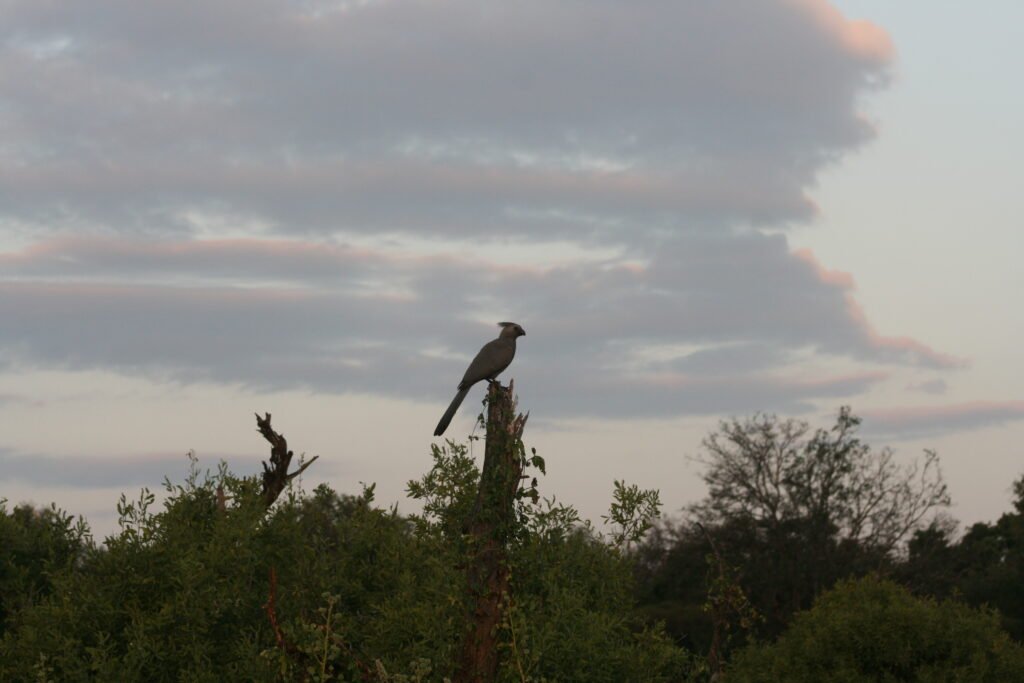
Bird hides have been a staple of twitching ever since the 1880s when watching our avian neighbours rather than hunting them began to become popular.
One of the finest hides I have experienced is the one at the Maloutswa Pan in the Mapungubwe National Park.
This pan is largely ephemeral in nature, although water is pumped into the main pond year round. But in high summer the whole area is a tropical wetland promising magnificent birding.
In late March, the water may be a bit shallower, but the grass is still thick and this provides prime housing for a variety of waterfowl, especially various rallids.
They like the thick vegetation because they can very effectively hide away in it. Which of course makes spotting – and then identifying – these often crepuscular, shy birds which are muted in terms of colour, much harder for hopeful birders.
Fortunately, the digital age has brought with it some most useful tools for the modern birder; electronic gadgets abound and fancy cameras seem more common than binoculars these days.
Social media has also infiltrated birding and it certainly played a major part in me being able to tick off a mega Lifer.
It was my penultimate morning at Mapungubwe and going to Maloutswa had already paid off with a Dwarf Bittern flying first towards and then past the hide, showing the characteristic big, dark stripes down the neck.
I was enjoying watching a Little Egret sitting in a tree on the left of the hide with some Cattle Egrets, its plume waving in the breeze, when some movement below in the thick vegetation on the edge of a bank caught my eye.
It turned out to be a very confusing glimpse of some sort of Rallid, which I could never fully see in the luxuriant grass and there were chicks. Adding to the mystery were the Common Moorhens who were also around with chicks and much more obliging when it came to showing themselves.
The adult of this Mystery of the Marsh (the translation of the Latin generic name Aenigmatolimnas) remained very well hidden, but I did see a couple of the chicks quite well and they had a distinctive black line down their throat.
I was only satisfied a few days later, however, that I had actually seen Striped Crake when social media came to the rescue! I was alerted to the fact that the SA Rare Bird Network site had photos of Striped Crake and chicks from Maloutswa from the same day as my sighting. Looking at the photos (bless you, Kim Porteous!) confirmed my Lifer.
The Striped Crake (Aenigmatolimnas marginalis) is a rare denizen of seasonally-flooded wetlands in east and central Africa and not often seen in South Africa.

When one finally tears oneself away from Maloutswa, there is a very productive road back to the Mazhou camp.
This road goes through various environments: there are thick bushes of thorn scrub bordering the Limpopo riverine forest, sparse grassland plains with bare patches, and dry Acacia tortilis (Umbrella Thorn) woodland with bushy clumps of Salvadora australis (Narrow-Leaved Mustard Tree) & Acacia stuhlmannii (Vlei Thorns).
These semi-arid savanna flats are actually the ancient floodplain of the Limpopo River, with alluvial soils, and there is a wealth of birdlife here too on the outskirts of the lush riverine forest belt.
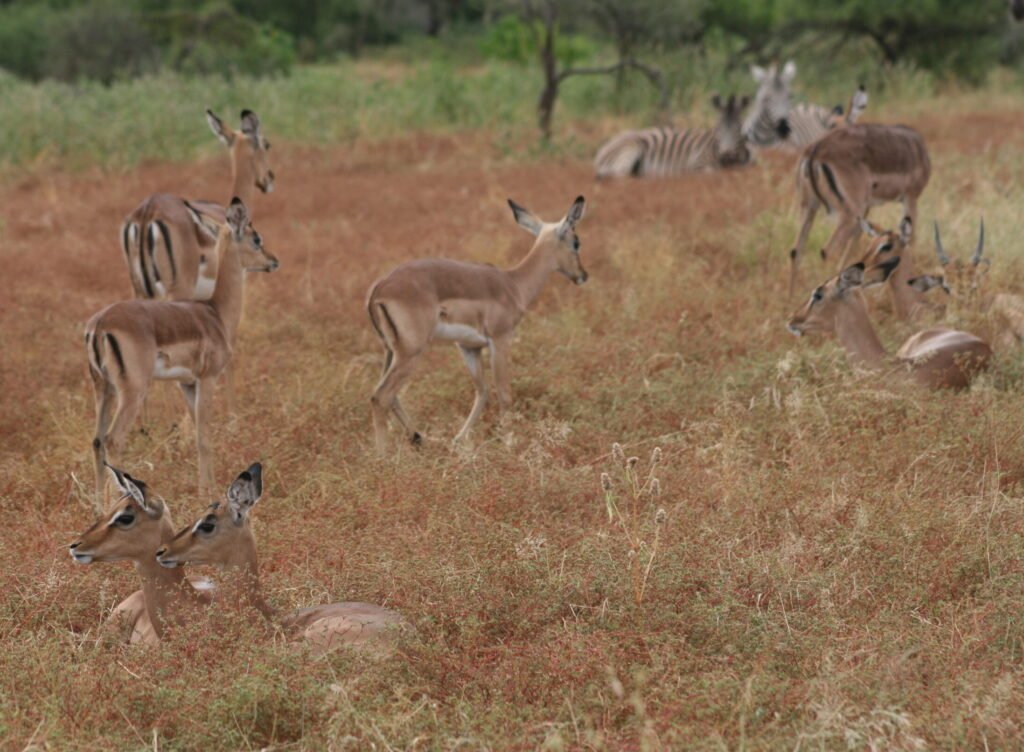
On this road back to camp from Maloutswa the previous evening, I was fortunate to spot something exciting and special – the Threebanded Courser, using the road as open ground for the nocturnal hunting of invertebrates they specialise in.
This bird is rare and erratic in Southern Africa, found most frequently in lowveld river valleys, loving alluvial soils with plenty of open areas, which the elephants have opened up in the scrub mopane.
Speaking of nocturnal delights, inside the Mazhou Camp, there is a regular European Nightjar, that lies (lengthwise, typical of this species) on the branch of an Ana Tree (Faidherbia albida) during the day.
The most helpful camp caretaker can point it out for you, and he found the Barred Owl, high in an Nyala Tree (Xanthocercis zambesiaca), which had been calling incessantly through all the early hours of the morning on my day of departure.
African Scops Owl is also a regular, with three different individuals around camp on this trip.
Sitting in camp in the heat of the day, through the gaps in the canopy of trees, I saw the massive silhouettes of Marabou Storks against the bright blue sky.
I was surprised that the usually friendly Bushbuck only made an appearance in camp on the third day.
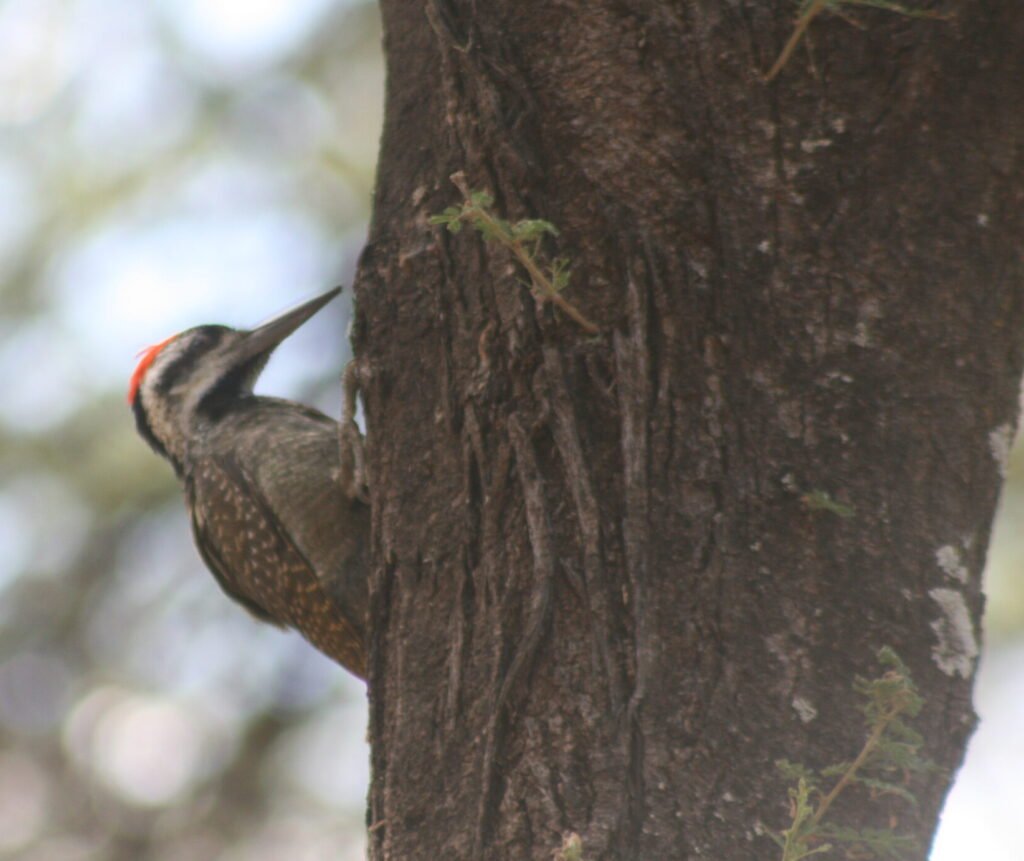
On my final morning, I just caught a glimpse of White Stork flying over the forest. Hearing loud drumming coming from the edge of camp, I managed to find Bearded Woodpecker, a bushveld classic that I am always on the lookout for and a fitting last sighting.
The eastern side of Mapungubwe, where the main Leokwe camp is situated, set amongst rocky outcrops, is also most interesting. The small valleys between the outcrops have mopane scrub and mixed woodland and it was on the side of the entrance road to Leokwe that I spotted a Dusky Lark, just chilling, not walking around looking for insects or seeds, or flicking its wings, as if often does.
A family of three Cut-Throat Finch were in a low, scrubby bush nearby, and, handling the rocky slopes with ease were some lovely Klipspringer, again a family of three.
Even when travelling between the Western and Eastern sections of the park, birding is good.
The Den Staat Road is the shorter route, but has been ravaged by floods in recent years and is not always passable. The Maloutswa watercourse actually stretches up alongside the road, in an area known as Leeupan, and driving up as far as I could, I was pleased to see Yellowbilled Stork and Knob-Billed Duck, while Longtailed Paradise Whydah were on the telephones lines as usual.
The other route is longer and more circular, through the Rhodesdrift farmlands and then on to the tar of the R521 and around to the R572.
There are often interesting birds around Rhodesdrift though, and this time Redheaded Finch were spotted, while there was also a big family group of Banded Mongoose.

The R572 runs along the southern border of the park and it is worth keeping an eye open as you drive along because good sightings can still be made.
Sure enough, just before the main entrance, I spotted, from the road, a Martial Eagle inside the park, dismembering some prey item while perched in a dead tree.
Once through the main gate and inside the park, the first stop is the Nungu Waterhole. Basically just a depression between the rocks, this time there was a decent pool of water that had built up from the rains.
This meant there were lots of doves and Cinnamonbreasted Rock Buntings around, as well as a couple of Longbilled Pipit, and the activity encouraged me to stay a while longer than I usually do when there are just some ridges of dry rock to look at.
And I was rewarded when a few small flocks of Burchell’s Sandgrouse arrived, but would only drink for a couple of seconds before flying off again in seeming panic. There were a couple of individuals that visited too, all in all a wonderful sighting of a shy and secretive bird that I had not seen for 17-and-a-half years!
Arriving at Mapungubwe on a warm 30° afternoon, a Gabar Goshawk was the first bird of real interest as it flew with its lunch across the grassland into a dead tree.
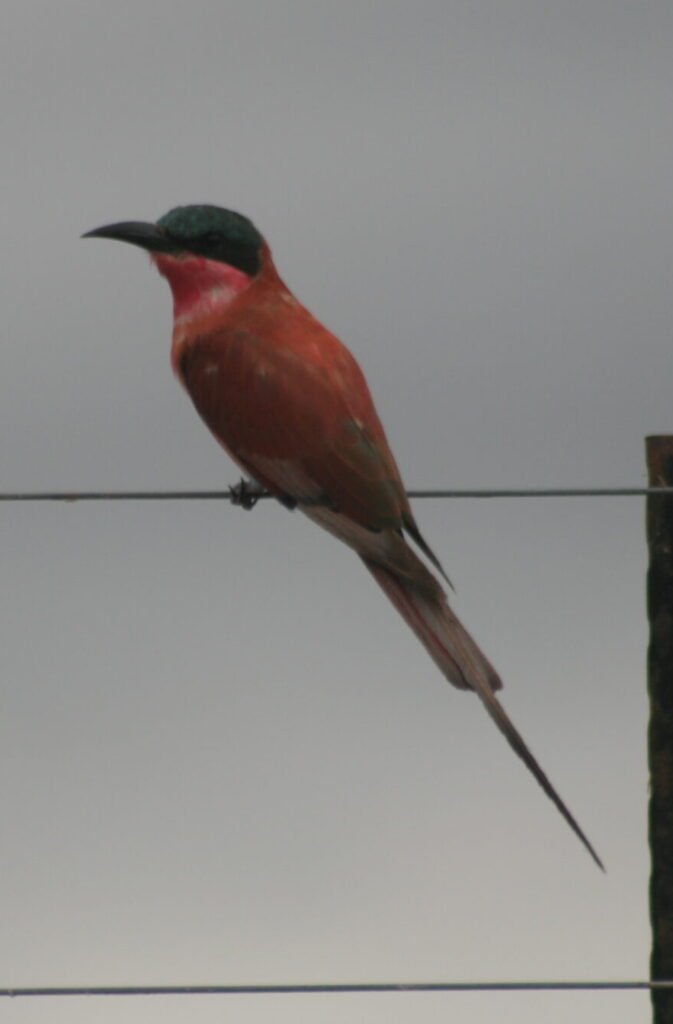
A Lesser Grey Shrike was being hassled by a Southern Greyheaded Sparrow, while Carmine and European Bee-Eaters were doing circuits over the grassland and around my car.
I arrived at Mazhou with more than a dozen birds on my list already, and Tree Squirrels, Natal Francolin and Longtailed Starlings politely inspected my campsite as I applied the finishing touches to my abode for the next three nights.

My next visitors showed far less decorum. They were fascinated by their reflections on the outside of my kettle, and then one of them stole the lid!
You guessed it – the dreaded Vervet Monkeys.
Having set up camp, there was time for sundowners at Maloutswa, with sporadic Whitefaced Duck flying over and making their beautiful whistled calls. A Woodland Kingfisher was having its evening ablutions by plunging into the water and getting thoroughly soaked.
On the way back to camp, more Starlings were on the road and patches of bare ground, looking for supper, and were joined by Crested Barbet.

A couple of Rattling Cisticola were making a real racket before bedtime and a male Chestnutbacked Sparrowlark and the others in his family went running along the road in hunched fashion.
The next morning it was off to the Eastern side of Mapungubwe, where there are fewer trees and less shelter from the searing sun, but thankfully it was a cooler day reaching just 27°.
After the excitement of the Sandgrouse at Nungu Waterhole, it was down into the Limpopo Valley, with a pair of Southern Whitecrowned Shrike standing guard in intimidating fashion in their tree just before the road began its descent.

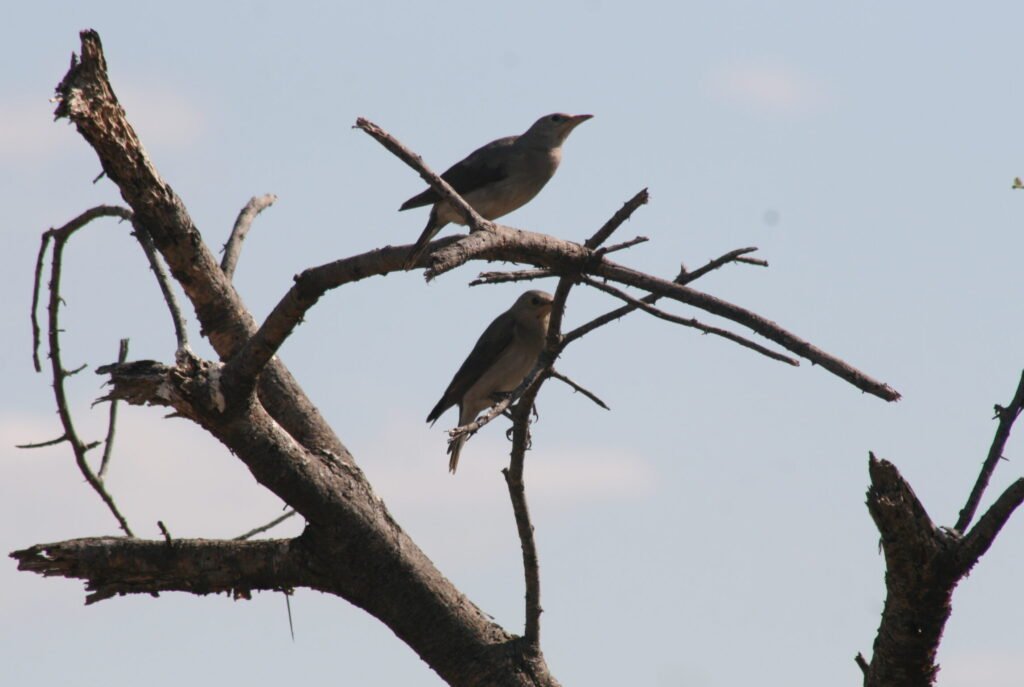
Heading towards the Treetop Boardwalk, a big flock of Wattled Starling flew into the rehabilitating arid thornveld which is next to the riverine woodland, while a Kori Bustard was also strutting around.
While on the boardwalk itself, a Willow Warbler was singing away but stayed deep in the foliage of a Knobthorn (Acacia nigrescens), requiring some effort to see.
A Meyer’s Parrot was more obliging as it was chirping while it munched away on the bladed seeds of the Russet Bushwillow (Combretum heroense).
Once done on the boardwalk, one heads along the road that runs parallel to the Limpopo River for a bit before it climbs through the wonderful rocky landscape up a hill where one overlooks its confluence with the Shashe River. From this viewpoint one can gaze into Botswana and Zimbabwe at the same time, while also looking down on the ubiquitous and fascinating Baobab trees from your elevated perch.
One of these Baobabs was hosting a rather considerable, and messy, nest of thorny twigs – the communal nest of the Redbilled Buffalo Weaver. Amidst the seeming chaos of sticks jutting this way and that, a male was very carefully and delicately placing a single stick very specifically next to the hundreds of others that make up these multi-chambered constructions.
From Confluence one heads back down again towards the Limpopo, through some spectacular buttresses of rock. High up on a shelf in one of the cracks that split these dramatic ramparts, a Mocking Chat sat.
Leaving the fascinating rock formations behind, one heads down to the fertile, beautiful riverine forests along the Limpopo. A little circular route takes one to Poachers’ Corner, where one can park at the bank of the river and gaze across into Zimbabwe just a hundred metres away, with a family of Redbilled Woodhoopoe flying past on this occasion.
Heading away again from the Limpopo, there is a little road that goes off from the Poachers’ Corner loop to Zebra Pan, a beautiful little spot, an oasis from the dry surrounding veld and dust which usually has something interesting around.
On this occasion, a pair of Saddlebilled Stork were digging in a muddy field with the Waterbuck, Plains Zebra, Cattle Egrets and nearby Blue Wildebeest.
Heading up out of the Limpopo River Valley on the Vhembe Road, one starts climbing over the rocky sandstone ridges; a Jacobin Cuckoo flew into a mopane bush on the side of the road, dug around in there for a bit and then emerged with a big cicada.
Closer to Schroda Dam, a group of Common Eland were also frequenting the mopane.
There is another small dam just before one exits via the main gate, another good spot. Some Cape Teal, with unusually black bills, were upending in the water weed, while a Dabchick had young, as did the Whitefaced Ducks. A Greater Kudu was enjoying the sweet grasses around the dam.
Black Crake, Wood Sandpiper, Threebanded Plover and Common Greenshank were the other waders present.
Another lovely drive from Mazhou Camp is the River Road along the Limpopo river bank, through the huge trees of the gallery forest.
There are a couple of spots where the road allows you to scan the actual river. While I had stopped early one morning, several Reed Cormorant, along with a couple of Grey Heron and a few Cattle Egrets, came flying eastwards along the river.
One can actually follow a road along the Limpopo River bank for quite some distance and the striking trees of the riverine forest continue, with a dense grassy understory, all the way to Sanana farm.
Something like a small francolin was on the road ahead of me and then it dashed into the long grass. Drawing alongside, I found it peering at me, before it scooted off deeper into the undergrowth. The plaintive, repetitive whistling of its colleagues could still be heard and helped in the identification of what I had seen as being a Common Quail.
Sightings List
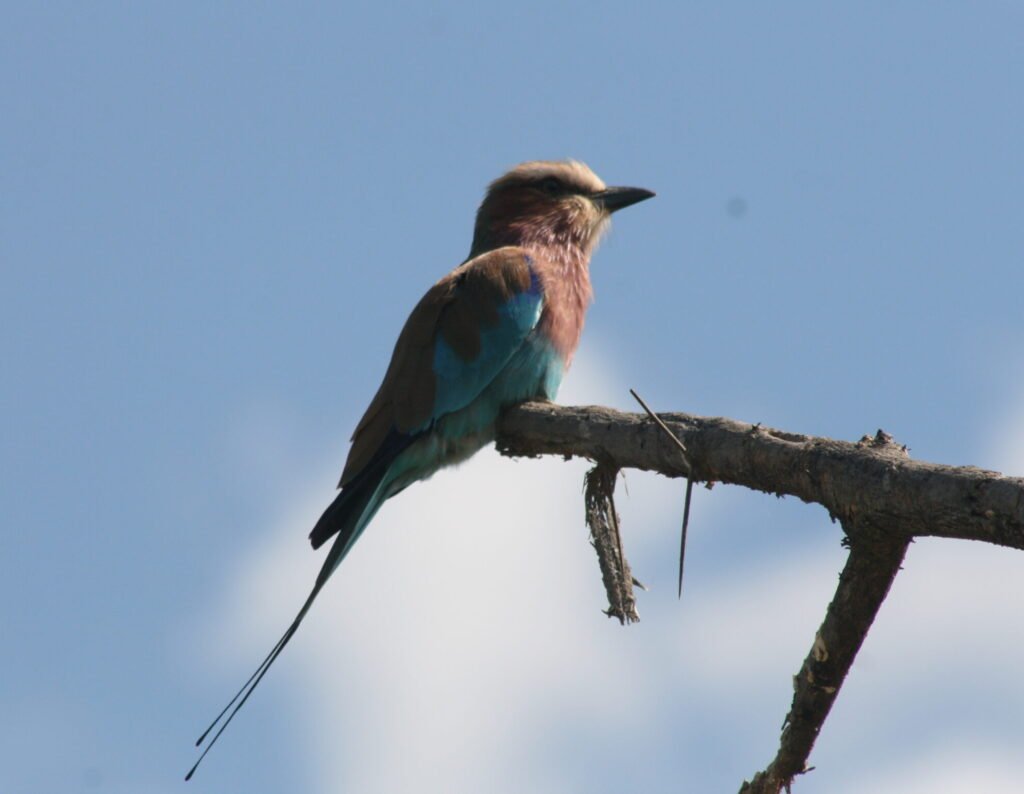
Lilacbreasted Roller
Redbilled Quelea
Gabar Goshawk
Lesser Grey Shrike
Southern Greyheaded Sparrow
Longtailed Starling
Impala
Grey Hornbill
Whitewinged Widow
Carmine Bee-Eater
.
.
.
.
.
.
.
.
.
.
.
European Bee-Eater

Redbacked Shrike
Laughing Dove
Cape Turtle Dove
Tree Squirrel
Natal Francolin
Vervet Monkey
Redbilled Hornbill
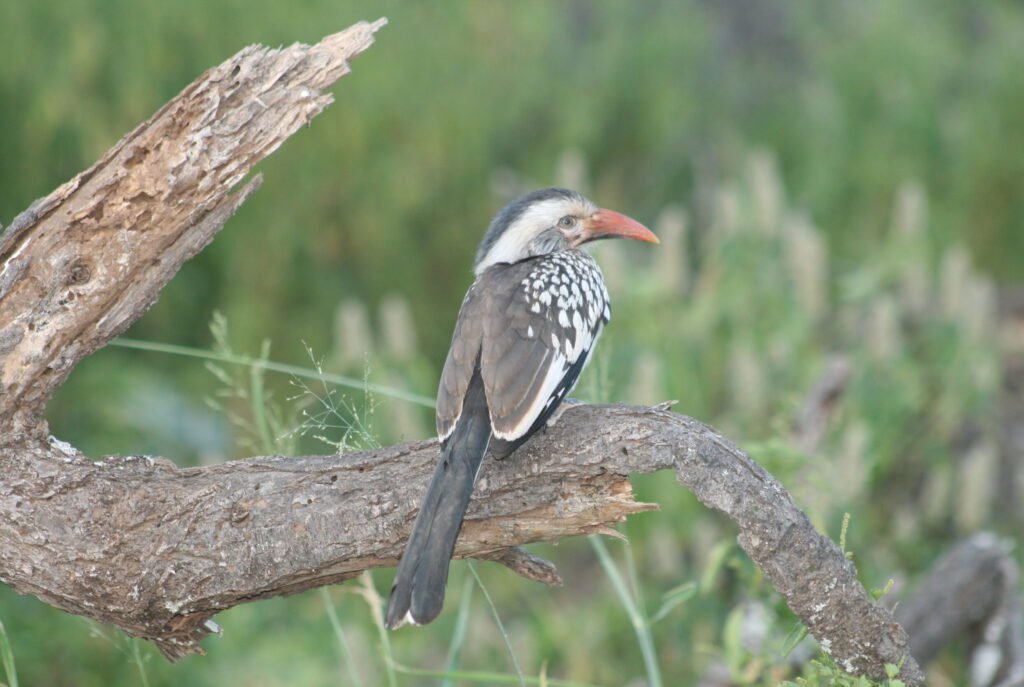
Whitebrowed Sparrow Weaver
Crested Barbet
Grey Lourie

Blue Wildebeest
European Swallow
Rattling Cisticola
Crowned Plover
Chestnutbacked Sparrowlark
Spurwinged Goose
Egyptian Goose
Whitefaced Duck
Woodland Kingfisher
Common Sandpiper
Marsh Terrapin
Chacma Baboon
Plains Zebra
Threebanded Courser
African Scops Owl
Goldentailed Woodpecker
Redbilled Oxpecker
Namaqua Dove

Namaqua Dove female 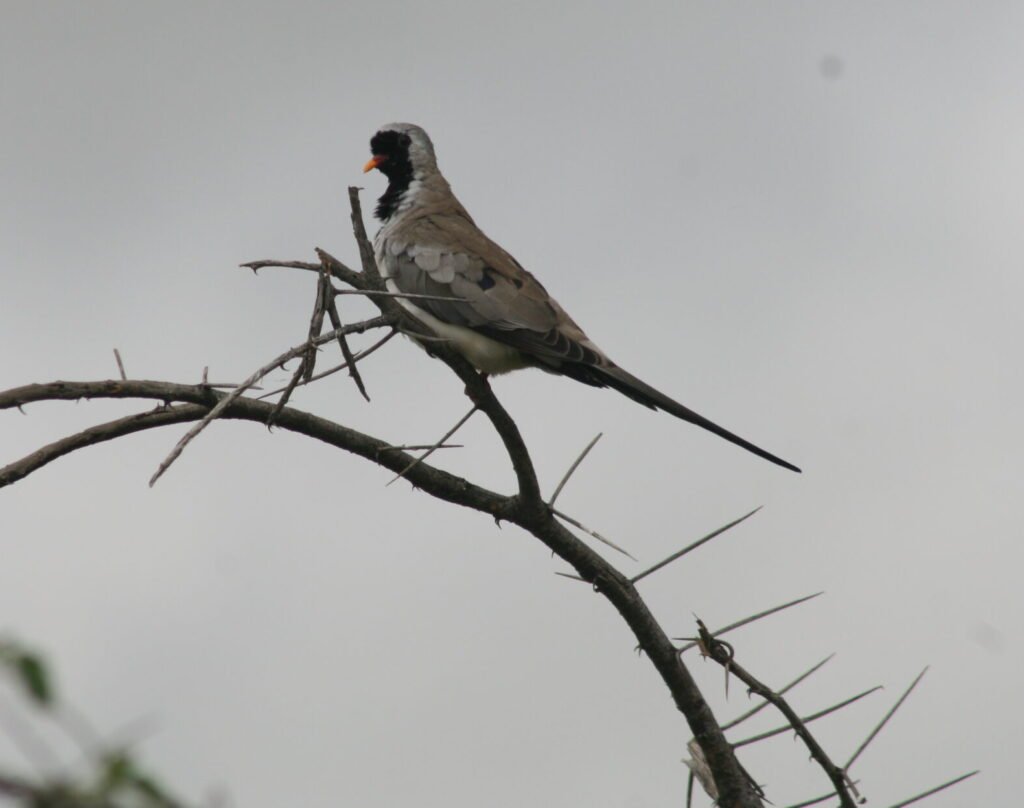
Namaqua Dove male
Redheaded Finch
Fantailed Cisticola
Banded Mongoose
Blackeyed Bulbul
Hadeda Ibis
Blue Waxbill
Lesser Striped Swallow
Brown Snake Eagle
Martial Eagle
Cinnamonbreasted Rock Bunting
Sabota Lark

Longbilled Pipit
Burchell’s Sandgrouse
Southern Masked Weaver
Southern Whitecrowned Shrike
Browncrowned Tchagra
Redwinged Starling
Klipspringer
Giraffe
Marico Flycatcher
Cut-Throat Finch
Dusky Lark
Kori Bustard
Wattled Starling
Common Warthog
Blackbacked Puffback
Willow Warbler
Forktailed Drongo
Blackheaded Oriole
Whitefronted Bee-Eater
Palm Swift
Meyer’s Parrot
Little Bee-Eater
Redbilled Buffalo Weaver
Familiar Chat
Longbilled Crombec
Mocking Chat
Redbilled Woodhoopoe
Waterbuck
Cattle Egret
Saddlebilled Stork
Blackcollared Barbet
Steelblue Widowfinch
Jacobin Cuckoo
Common Eland
Cape Teal
Dabchick
Black Crake
Wood Sandpiper
Threebanded Plover
Common Greenshank
Greater Kudu
Great Sparrow
Thicktailed Greater Bushbaby
Reed Cormorant
Grey Heron
Tawnyflanked Prinia
Common Quail
Emeraldspotted Wood Dove
Sacred Ibis
Dwarf Bittern
Pied Kingfisher
Little Egret
Striped Crake
Common Moorhen
Amur Falcon
Lesser Kestrel
Blacksmith Plover
Southern Black Tit
White Helmetshrike
European Nightjar
Marabou Stork
Bushbuck
Bluegrey Flycatcher
Yellowbilled Stork
Longtailed Paradise Whydah
Knob-billed Duck
Southern Yellowbilled Hornbill
Barred Owl
Whitebacked Vulture
White Stork
Spotted Flycatcher
Paradise Flycatcher
Bearded Woodpecker