HARARE, Zimbabwe – The third round of the FBC Zimbabwe Open at Royal Harare Golf Club will not be fondly recalled by Luca Filippi, but the good news for the 23-year-old is that he still leads going into Sunday’s final round despite his 74 on Saturday.
That lead is a tenuous one, however, with Wynand Dingle firing an excellent four-under-par 68 to climb within one shot of Filippi, who is on nine-under-par overall.
Things looked to be progressing smoothly for Filippi, who took a five-shot lead into the weekend, as he birdied three successive holes in the middle of the front nine. But a bogey at the par-four eighth started the trouble and a double-bogey six at the 10th hole was a bitter blow.
The Milnerton Golf Club representative did manage to collect a couple of birdies on the back nine, but a bogey, double-bogey finish put the seal on a tough afternoon at the office.
“It felt like a very long day and it was tough going out at 12.30pm in the swirling wind,” Filippi admitted. “So three-under through six holes was a great start.
“But then the double on 10 set me back, and I unfortunately had two bad holes to end too. But I thought I hung in nicely on the back nine.
“It was a nice start in conditions that were not easy and I thought I was building a nice lead, but golf thought otherwise and instead I just have a one-shot lead,” Filippi said philosophically.
It is only a one-shot lead thanks to Dingle, who is also seeking his first Sunshine Tour win, finishing birdie-birdie. And it is not only the 37-year-old that Filippi has to worry about, with the vastly-experienced Jaco Ahlers (71) and Louis de Jager (72) both on six-under, while the in-form Louis Albertse (72) and Zambia’s Madalitso Muthiya (72) are both one further stroke back.
But Filippi has a good head on his young shoulders and it’s not only about winning his maiden Sunshine Tour title in the final round for him; whatever happens, he sees it as another learning experience in an exciting professional career that was only launched a couple of years ago.
“The FBC Zimbabwe Open is a massive event, one of the bigger tournaments on the Sunshine Tour, and I’ve never had a one-shot lead going into the final day of a four-round event before.
“But regardless of the outcome, I would have learnt a lot after tomorrow’s round and I look forward to see what the day has in store for me,” Filippi said.
A hat-trick of second-half tries by Cornal Hendricks carried the Bulls to a brilliant 38-31 win over the Ospreys in their United Rugby Championship match in Swansea on Friday night, with the determined Welsh side overwhelmed by the physicality and clinical finishing of the visitors.
The Bulls led 12-10 at halftime and were not flattered as they looked in firm control of proceedings, being well-served by their powerful ball-carriers and the presence of Hendricks and Harold Vorster in midfield, until a dreadful blunder by fullback Canan Moodie inside his 22 gifted Ospreys an important try.
But Hendricks then stamped his mark on proceedings in the second half, obliterating the Ospreys backline, which included the highly-rated George North as his opposite number, with several knifing runs. His tries in the 47th and 66th minutes were provided by young Moodie, who more than made up for his early mistake by counter-attacking well and showing beautiful judgement when it came to the timing of his passes.
Just three minutes before completing his hat-trick, Hendricks rounded off a prolonged, patient build-up by the Bulls, featuring big carries by outstanding forwards Marcell Coetzee and Gerhard Steenekamp, when he sliced through the line again to score.
Hendricks’ hat-trick meant the job had been done for the Bulls, with a 38-17 lead and the bonus point in the bag, in terms of doing all they could to secure a home quarterfinal.
But Ospreys kept fighting in admirable fashion and were rewarded by two late tries which earned them two bonus points. By doing that, they ensured Scarlets have to beat the Stormers on Saturday to win the Welsh Shield and earn a place in the European Champions Cup.
A team’s fortunes in knockout rugby depend on your ability to convert your opportunities and Bulls coach Jake White will be delighted with how clinical his team were in the first half.
In the first quarter, they were in the Ospreys’ 22 twice and scored on both occasions, through wing Madosh Tambwe and then by flyhalf Chris Smith, who showed sharp footwork and thinking on the tryline.
With the Sharks losing to Ulster, the Bulls rose to third on the log and are in line for a home quarterfinal, providing one of Munster (v Leinster) or the Stormers lose on Saturday.
Scorers
Bulls: Tries – Madosh Tambwe, Chris Smith, Canan Moodie, Cornal Hendricks (3). Conversions – Smith (4).
Ospreys: Tries – Jac Morgan, Luke Morgan, Sam Parry, Luke Morgan. Conversions – Gareth Anscombe (4). Penalty – Anscombe.
HARARE, Zimbabwe – Just about every golfer chats about bringing an aggressive approach to the course, but it doesn’t always translate into reality or a low score. But it did for 23-year-old Luca Filippi on Friday in the second round of the FBC Zimbabwe Open as he fired a superb seven-under-par 65 at Chapman Golf Club to claim a five-shot lead heading into the weekend.
Filippi, who began the day in a tie for fifth after shooting 68 at Royal Harare Golf Club on the first day, was just one-under-par through nine holes on Friday, but he knew he was playing well and stuck at it. Even missing a short birdie putt on the 10th did not derail him and he then exploded into action with successive birdies on the 11th and 12th holes, an eagle on the par-five 14th, and further birdies on 16 and 18.
“I played nicely from the start, even though I was only one-under on the front nine,” Filippi said. “I had some nice opportunities for birdie and then missed a short one on 10, but it was great to then start making putts. I was especially happy about my eagle on 14 because I had only played the par-fives in level-par on the front.
“I wanted to be aggressive and on both courses they’re using for the tournament you’ve got to hit your Driver very well. If you position yourself well off the tee then there are lots of birdies out there.
“I was doing that well today, although the putting was a little tricky at Chapman, the greens aren’t rolling quite as pure as at Royal Harare. But I knew there was definitely a low score out here.
“I will keep my game-plan pretty much the same over the weekend, shooting four-under at Royal Harare on the first day was a good start. I need to keep being aggressive, I can’t afford to sit back and relax. I need to keep my foot on the pedal, be aggressive off the tee and give my putts a chance,” Filippi said.
The Milnerton Golf Club representative, who is on 11-under-par at the halfway stage, will need to keep an eye on second-placed Louis de Jager (-6), who it must always be remembered did the South African Amateur Championship double in 2007, has won five times on the Sunshine Tour and competed in over 100 DP World Tour events.
All that experience has come to the fore in solid back-to-back rounds of 69 by De Jager, while in-form first-round leader Louis Albertse is with a group of five golfers at five-under-par after shooting 74 at Chapman GC.
Zambia’s Madalitso Muthiya kept himself in the top-three with a level-par 72 on the same course, while veteran Jaco Ahlers shot a 69 at Royal Harare to also go five-under for the tournament. Albert Venter and American Dan Erickson are the other golfers on that mark.
An idyllic spot in Limpokwena Nature Reserve, next to the Mogalakwena River.
Birding in the arid north-western reaches of the Limpopo Province is much more profitable when there are rivers around and the Limpokwena Nature Reserve is a case in point.
Situated where the Limpopo and Mogalakwena rivers meet, Limpokwena is like a bushveld oasis in the vast stony plains of Mopane scrub that dominate the region.
The well-equipped lodge area is a place of tremendous tranquility under the fever and sausage trees and, from the reserve entrance to the main camp, there is a road along the Mogalakwena River that provides a foretaste of the marvellous birdlife that is to come.
There are lovely massive trees along this major tributary of the Limpopo, which marks the border between South Africa and – from west to east – Botswana, Zimbabwe and Mozambique. The Mogalakwena starts life as the Nyl River in the eastern Waterberg.
A morning drive along the Mogalakwena River brought something special early on as the bright yellow flash of a Goldenbreasted Bunting flying into a tree next to the river caught my eye, closely followed by a Greyheaded Kingfisher alighting in the same dead branches.
Not far from where I spotted the Greyheaded Kingfisher, an intra-African migrant that is always a good sighting, the road passes a beautiful spot with the Mogalakwena on the one side and a big pond on the other, surrounded by very pleasant riverine forest.
A Malachite Kingfisher, a year-round resident, was catching breakfast in the pond and creating ripples that disturbed the serene reflection of trees and clear blue sky in the water.
A little further on, a handful of Blackfaced Waxbill were feeding on the seeds of the tall grass, that is so prevalent in March in the Limpopo River Valley, and then flying up into the remains of a thorn tree. These typical seed-eaters of the arid west nest in thorn trees.
Blackfaced Waxbill are pretty unobtrusive little birds, the antithesis of the raucous Hadeda Ibis.
But my first sighting of these very familiar birds that are normally quick to announce their presence was of a couple quietly straggling along the river road. Of course I did soon hear noisier Hadedas.
Seeing as though ‘Mogalakwena’ means ‘fierce crocodile’ in the local Tswana language, it was little surprise to spot a rather large one, on a sandbank, well-hidden by some short trees.
Lodge sundowners
Heading back to the lodge, just up the road from that idyllic space, some Vervet Monkeys peered at me naughtily, their heads poking above the long grass. Fortunately they were no trouble at all on this trip.
A sundowner outside my cottage, close to the Mogalakwena and a smaller stream, was called for and, overlooking the stream bed from a slighly elevated vantage point, one gets excellent views of whatever is flying around the riverine forest.
A Tropical Boubou was rather noisy as it settled down for the night in the trees above the firepit and, well after sunset, a Woodland Kingfisher landed in the tree in front of me, calling away; their loud, piercing call is one of the sounds of summer in northern South Africa.
An African Scops Owl also popped in for a visit, giving its characteristic frog or insect-like call (depending on what amphibians or insects sound like in your neck of the woods) – Prrrrruup! – from close quarters.
The smaller stream was a side channel, a dry bed with pools of water after the rains and well-wooded fringes, which is why there was still a fairly new-looking Hamerkop nest in a tree in front of my cottage.
These massive nests are amongst the most remarkable in the Avian kingdom and I did see a few Hamerkop flying in fluttery fashion along both rivers.
The next day a Crested Barbet was investigating holes in the trees in front of the cottage and an Emeraldspotted Wood Dove was pottering around in one of the dry stream beds.
The deck
The lodge have built a deck on the banks of the Mogalakwena River and this is a great spot to look over and along the water.
A Brown Snake Eagle was cruising overhead and a Meyer’s Parrot was clearly visible at the top of a Red Bushwillow, eating the seeds, which are poisonous to livestock but loved by parrots.
A Greenbacked Heron came flying along the full river, which also had a Pied Kingfisher patrolling, and then the dry 35° heat meant it was time to cool off at the swimming pool, which was sparkling most alluringly in the shade of the welcoming trees back at the warm hospitality of the lodge.
An African Fish Eagle was calling and soaring high above the swimming pool and then a single Arrowmarked Babbler flew with great purpose over the pool to join its noisy colleagues who were headed towards the riverine bush.
As one enters Limpokwena, one is struck by the rugged, arid landscape. Thorny trees and Mopane thickets seem to be the only vegetation seen in the heat haze, apart from the Baobabs, scattered amongst the old farms and scratched by the former inhabitants and gouged by the Elephants which currently roam the area, many coming across the Limpopo from the Tuli Block in adjoining Botswana.
As I drove through the gate, a group of Chacma Baboons seemed to be chilled and happy to see me, but my closer approach saw them stampede away, fleeing across the old farmlands.
A Common Myna then came flying across the road towards the Mogalakwena River with nesting material in its beak.
It was not a very promising start.
The Mopaneveld
But it’s not just the riverine areas of Limpokwena that make this such a highly-recommended spot for nature lovers. There is also much to discover in the rocky koppies of this hot and dry region.
When one comes out of the river drive, the road heads westwards straight into the heart of the Mopaneveld. A Jacobin Cuckoo flew across the road and then played a bit of hide-and-seek as I tried to get a decent sighting.
There were numerous Whitebrowed Sparrow Weavers and lots of nests, although many of these are roosting nests. Practically all of them, however, are on the leeward side of the trees, away from the prevaling wind. The most widespread of the Sparrow Weavers is also quite chirpy and bossy.
A family group of White Helmetshrike also flew across the road, chuckling away at their noisy, colonial neighbours.
A big group of Banded Mongoose, 15-20 of them, were also on the road and, with no termitaria in sight, they had probably come down from their shelter in the rocky outcrops, which were dotted with the striking Purple-Pod Cluster-Leaf (Terminalia prunioides). The plum-coloured fruits of this deciduous tree, which is often associated with Mopane, are also loved by parrots.
Giraffe peering over Purple-Pod Cluster-Leaf (Terminalia prunioides)
As the road then turns north and heads gently down towards the Limpopo River, one comes across a clearing in the Mopaneveld, a peaceful bit of open Acacia savanna.
A Giraffe was enjoying browsing in a less-enclosed space, attended to by a Redbilled Oxpecker. Whitefronted Bee-Eaters were sharing a tree with Redbilled Buffalo Weavers and there was also a European Roller in the vicinity. An African Hoopoe and a Glossy Starling were confidently picknicking on the ground next to the road.
The peace was rather shattered, however, when a Namaqua Dove male that was chilling in a tree was dive-bombed by another arriving male!
When I headed out again in the afternoon on my complimentary game drive with host Riley as a wonderful companion – so passionate and interesting about the bush – we started by admiring a Lesser Grey Shrike, which was incredibly dapper in its bright white, grey and black colours.
Soon we were enjoying a herd of African Elephant as a couple of Helmeted Guineafowl went careening down the road at breakneck speed.
We went through that same patch of open Acacia savanna and the Bee-Eater, Hoopoe and Glossy Starling were all still there.
Our destination was Island Camp, and seeing it was one of the highlights of my stay. It would be a dream camping spot for me and anyone else feeling adventurous.
Island Camp is a stunning spot on the Limpopo and you have to cross a high log-bridge over one of the channels of the river to get there. You are basically camping right in the river as there are four rustic tents set up on an actual small, unfenced island in the river famous for both its beauty and danger.
There is a little bench of waterfalls just up the way from the camp which looks a great spot for fishing birds, and the pristine riverine trees, where a Collared Flycatcher had been seen a month earlier, allowed me to add Goldentailed Woodpecker and Spottedbacked Weaver to my list.
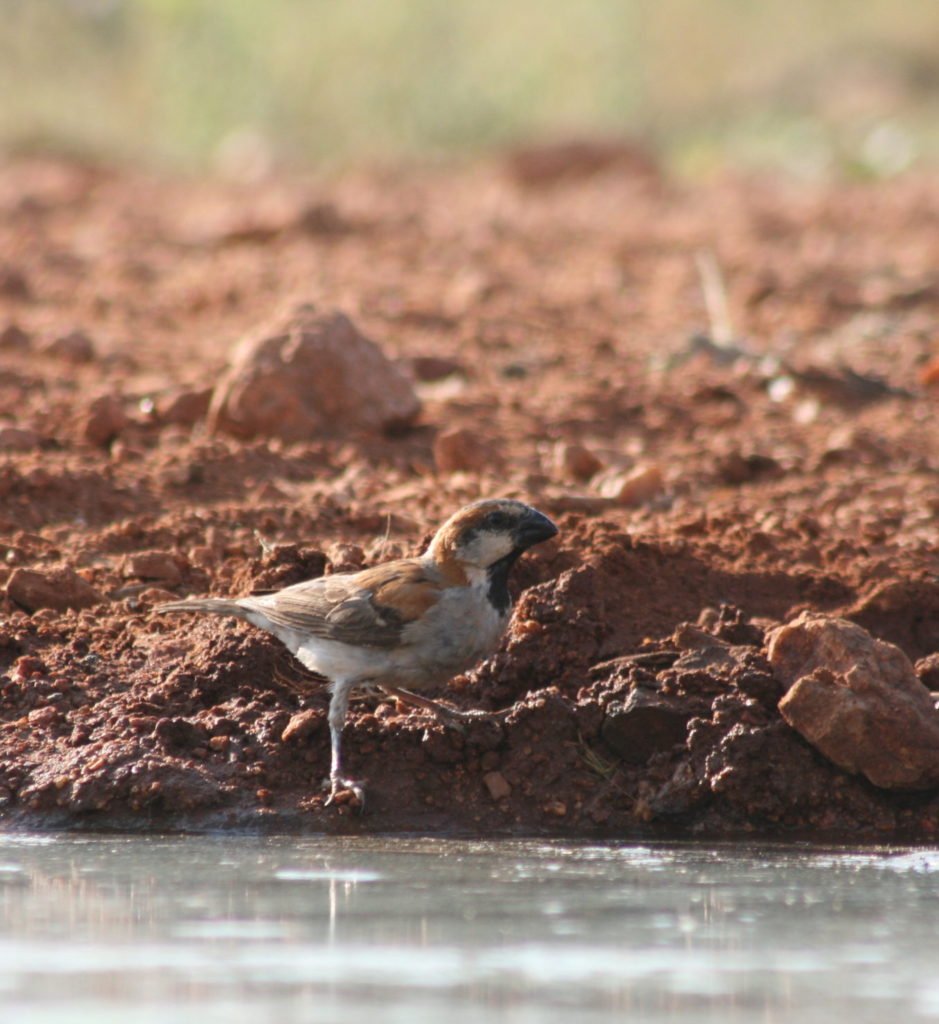
Before returning to the Lodge, we popped in at the superb sunken photographic hide. There were a pair of Great Sparrow, which can be locally common but are mostly uncommon in South Africa, on the telephone line approaching the hide and I was delighted when they then came to the water to drink.
Great Sparrow
On my final morning at Limpokwena, a quick scan of the waterhole, that has water pumped into it regularly, at the lodge showed little else than Marsh Terrapins and a Brownhooded Kingfisher in the trees along the dry watercourse running just outside the fence-line.
On the way out of this quite wonderful bit of natural wilderness, a Steppe Buzzard was quietly perched, perhaps also departing, beginning its northward migration as summer came to a perfect end.
Colossians 3:13-14 – “Bear with each other and forgive whatever grievances you may have; forgive as the Lord forgave you. And over all these virtues put on love, which binds them all together.”
“When the Holy Spirit lives in you, you reflect the qualities of Christ in your life. Love and courtesy are basic characteristics of the Christian life. … If Chris lives in you, you will be kind and patient toward others.
“A person who is truly courteous is humble, … His attitude is the same regardless of whether he is talking to kings or beggars. He treats everyone alike, no matter what race, colour or creed they are. He rejoices in making the path through life easier for others to travel.
“It is impossible to say that you love and serve God while at the same time treating your neighbour with contempt and disrespect.” – Solly Ozrovech, A Shelter From The Storm