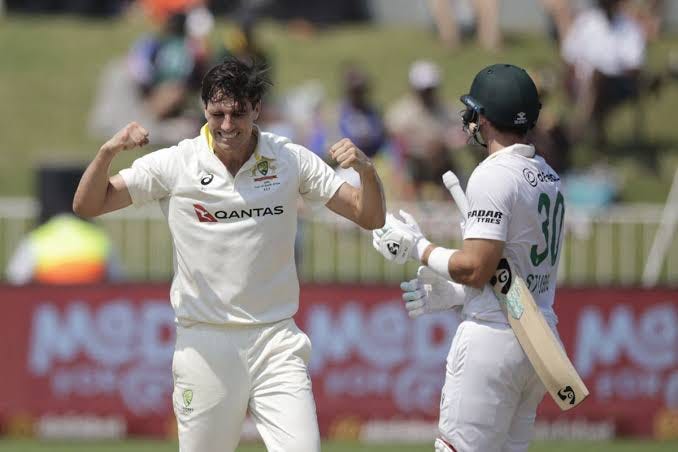
Australia captain Pat Cummins (left) celebrates the wicket of Tristan Stubbs, whose dismissal for a second loose stroke in the match will invite questions over his selection for the second Test.
The current Proteas team’s capacity to bounce back from poor performances has been impressive, but after two bad days in a row at Kingsmead, it is going to take something miraculous for them to escape from the first Test against Australia with a draw.
This Substack is reader-supported. To receive new posts and support my work, consider becoming a free or paid subscriber.
South Africa go into Tuesday’s final day on 102 for four, chasing 421 for the most unlikely of wins, but more realistically they are going to have to not lose six wickets in at least 75 overs of stern examination from the brilliant Australian attack.
Aiden Markram is holding firm on 45 not out after nearly three hours and 115 balls at the crease. He has Wiaan Mulder for company, with Ryan Rickelton (2), David Bedingham (46), Temba Bavuma (1) and Tristan Stubbs (1) all dismissed and out of the equation.
Keshav Maharaj, who put some of those batsmen to shame in the first innings with his gutsy 34, was the unfortunate player who had to front the media. His bowling has not been much to talk about in this Test – overall figures of 29-0-131-2 – so it was batting that he spoke about, with some honesty.
“We’ve lost a couple of soft wickets again if we’re honest. The application that Aiden has shown is what we’re looking for, but a lot of our dismissals have been self-inflicted rather than due to good bowling. Maybe it’s because of the transition from white-ball cricket and you want to feel bat on ball, which has led to our demise.
“We need to zone in and be strong-minded in terms of shot-selection and match awareness plays a big hand too. Whatever happens, we need to dust ourselves off because there’s still a series at stake. What stands out about this team in the last while has been our ability to find a way in difficult situations. We’re focused on our first task, which is to take care of the first hour tomorrow,” Maharaj said.
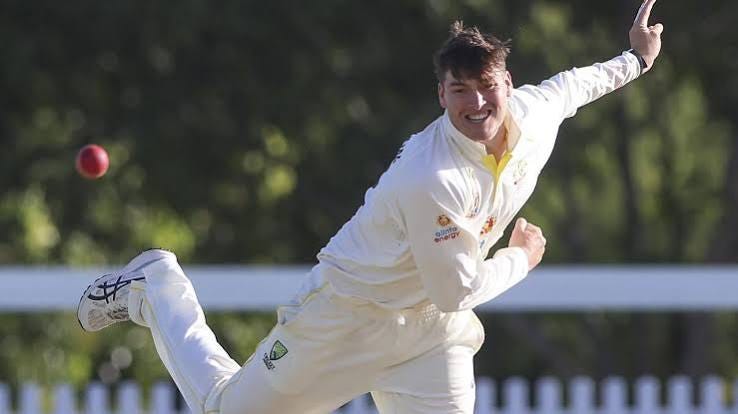
What is highly likely is that South Africa will once again be tested by an outstanding attack. The famed Australian quartet is relentless, consistent and highly-skilled. And on Monday Matt Renshaw, fresh from scoring 82 to take his match tally to 272, joined Hazlewood, Cummins, Starc and Lyon in being an absolute handful with his part-time off-spinners.
Matt Renshaw followed up his incredible exploits with the bat with some surprisingly testing part-time off-spin, using his height to obtain awkward bounce.
It was if Renshaw was bowling grenades as he took one for 16 in seven overs, Bavuma being his victim. That was the one South African wicket to fall on Monday for which one could safely give all credit to the bowler.
Renshaw landed his off-break on exactly the right length to have the diminutive Bavuma stretching as far forward as he could, but the delivery turned more than expected, and there was good bounce, an inside-edge going on to the pad and then being snaffled by Nic Maddinson, lunging to his left at short-leg.
As Maharaj correctly pointed out, the other dismissals were down to batsman error.
Rickelton edged behind an attempted hook at a brilliantly-directed Hazlewood bouncer in the fourth over of an innings that was meant to be a rearguard battle for survival and not about flashy strokeplay.
Josh Hazlewood gave Bedingham as strenuous an examination as a proctologist, testing him over and over outside off-stump. Bedingham, despite getting on to off-stump, so he must have known where it was, often sparred well away from his body. Hazlewood kept dragging him across his stumps before the inevitable full in-ducker came and he was trapped plumb lbw for a promising, but ultimately unfulfilling 46.
Stubbs was the last wicket to fall, shortly after Bavuma, and he left the field shouting at himself and little wonder. He reached for a full and wide delivery from Pat Cummins, but was he trying to drive or was he defending? It was the sort of indeterminate shot that is often fatal and he too edged behind.
How Australia, starting the day on 33 without loss and already leading by 139, went about their batting on Monday was similarly clinical.
Nic Maddinson has recently survived cancer, so his controversial selection and then making a 33-ball duck in the first innings were brushed off as he played with tremendous freedom in scoring 48 off 38 balls. He hooked his first ball, a Marco Jansen bouncer the previous afternoon, for four and collected five more fours and two sixes on Monday.
Marnus Labuschagne (37) and Steve Smith (27) added 53 for the third wicket. The former Australian captain was on two when he was belted on the helmet by a fired up Anrich Nortje and, while he lashed the fast bowler through the off-side for three fours soon after, he was being tested for concussion while South Africa batted. He had passed all the tests at the ground, but the Australian medical team will apparently continue the testing until satisfied that he has no symptoms.
Renshaw fell when Smith holed out to off-spinner Simon Harmer, and once again went about his business with clarity and composure. He was understandably more aggressive, however, and once again playing spin superbly, with numerous reverse-sweeps, was how he needed just 99 deliveries for his breezy 82.
Alex Carey (24) and Beau Webster (39 not out) both chipped in, and Cummins’ 32 not out off just 12 balls, hitting Harmer for four sixes in five balls was exactly how to emphasise your sheer dominance over a team that has not been nearly sharp enough.
In the wake of a triumphant 2024 following on from their 2023 World Cup victory, Ken Borland spoke to some of the finest men to have ever pulled on the Springbok jersey and asked them one question: Is the current class of Springboks (2019-2024) the greatest Springbok team ever?
They were all at Sun City playing golf and giving back in support of the Gary and Vivienne Player Foundation and the fundraising effort for the Blair Atholl Pre-Primary School, which was the late Vivienne’s passion since its establishment in 1990 for the children of farmworkers on their Lanseria estate.
All these former Springbok stars pointed to the achievement of winning back-to-back World Cups and the incredible strength in depth that coach Rassie Erasmus has cultivated for himself as being key factors in determining that this team is the greatest to represent South Africa.
Naas Botha
“By repeating in 2023 what they did in 2019 and winning the World Cup again, they did something that nobody can ever take away from them. No matter how you analyse it, they are the first South African team to do that. So who do you compare them to?
“You can’t really compare different eras and the 1980s were totally different to 2024. I played in some really good Springbok teams like the 1981 one that went to New Zealand was fantastic and the 1986 side that played the New Zealand Cavaliers. Then we have the Jake White and Francois Pienaar teams that won World Cups.
“But it’s absolutely amazing what Rassie Erasmus and his squad have achieved and you have to give them that credit. We now know who has progressed after the 2023 World Cup, it’s clear where New Zealand, England, Ireland and France are. You can’t compare this Springbok team to any of their rivals because we know the pool of players they have is frightening.
“One win does not make a great team, a magic moment does not make a great team. But magic season after season after season makes a great team.”
Pat Lambie
“I would argue that Springbok rugby is in the best shape it has ever been. It’s not just their achievements – winning back-to-back World Cups and the Rugby Championship and beating the British and Irish Lions – but the depth they have created in so many positions. That’s going to stand us in good stead going into the next World Cup.
“There is healthy competition for all 23 places and it’s a mix of experience, youth and x-factor that can have a massive impact off the bench. Rassie has done an excellent job leading the young players into international rugby and everywhere you turn, there’s a player who looks like a matchwinner.”
Robbie Kempson
“It’s the most successful Springbok team ever, but for me it’s the depth that is the greatest factor in rating them as the best. The quality of individuals in key positions at Rassie’s disposal is amazing and he’s brought a lot of them through. He’s a wily old man who has managed big players for 8-12 years, it’s the same group and yet he’s getting a much higher level out of them.
“They are way better than the All Blacks teams we played against 25 years ago. They were a phenomenal side, but these Springboks now have consistency, they’re definitely a better outfit, winning two back-to-back World Cups and everything else they’ve played for. And now they’ve evolved to really stretching teams with a running game. For me, they are definitely the number one side to have played this game.”
Butch James
“I believe it’s the greatest Springbok team we’ve ever had, definitely in terms of squad depth, which is unbelievable. We didn’t even pick our best team for the matches in the United Kingdom, but they were still great teams, which shows our depth.
“I think they’ve proved it already that they are the best Springbok team ever, they don’t have to do more. It was a tough tour of the UK because of that expectation that they would win all the games, which they did, even though England had us worried.
“I’ve liked the All Blacks over the last couple of decades, but the consistency of this Springbok team stands out, especially since Rassie keeps chopping and changing the selections.”
Steven Kitshoff
“I’ve read a lot about whether this is our best team ever and there’s no doubt that Jacques Nienaber and Rassie Erasmus have really been getting things right. To win back-to-back World Cups is special, we’re performing year in, year out and the depth is feeding into the machine nicely.
“I think there’s still a long road ahead before we can call ourselves the best team ever, but we’ve definitely put our hands up as one of the best. Although there have been some amazing teams in the last couple of decades, so I think we still have a long way to go.”
“The current structure of global cricket is unsustainable and countries outside of the ‘Big Three’ (India, England and Australia) will play less and less bilateral series cricket, with some in danger of disappearing altogether from the Test cricket scene,” Tony Irish, who is an independent director of cricket’s global players’ body, the World Cricketers’ Association, has warned.
The only international cricket that really makes money now is India at home and abroad, and England and Australia tours. Any other bilateral cricket loses money. Bilateral cricket is those tours between countries playing Tests, ODIs and T20 matches.
The Future Tours Program previously ensured every team would play each other twice in a four-year cycle, home and away. But Narayanaswami Srinivasan [India], Giles Clarke [England] and Wally Edwards [Australia] deregulated everything in 2016, making bilateral tours a free-for-all. There are no rules, and therefore there is no context to so much international cricket.
It has become like Liverpool playing Arsenal and Chelsea five times a year and Bournemouth just once. But the BCCI [Board of Control for Cricket in India] don’t want more regulation and a well-structured calendar. That would mean they cannot wheel-and-deal, give and take games away from countries depending on whether they vote with them or not.
They want the status quo to continue so they can maximise their own revenues. England and Australia just go along with them and no-one stands against them.
There also needs to be a more equitable distribution of ICC revenues. India take nearly 40% of the revenues and they already get huge pots of money through the IPL and bilateral cricket.
There is huge financial inequality across the game with India at the top of the pile. India has resources of approximately $1.5 billion dollars per year; the country in 13th place gets $6 million per year yet these two teams must compete against each other. How do they expect this to be a contest? There are 108 International Cricket Council (ICC) member countries and 50% of ICC revenues go to the ‘Big Three’, 87% of bilateral revenues are retained by England, Australia and India; while countries ranked 13 to 108 get 2% of total cricket revenues. ICC revenues are those generated from ICC events i.e. world cups, and is different to bilateral revenues which are the aggregate of what all of the countries generate from their series against each other.
Why must the ‘Big Three’ take such a huge slice? The system is just so inequitable and so incoherent. The whole structure, even ICC events, is set up for them and they have won 19 of the last 22 major ICC events.
While life is obviously good for Indian cricket, and they do deserve consideration for being the biggest market in the game, the second-biggest sport in the world is in danger of becoming like gridiron or baseball, which are minor sports in all but a couple of countries.
The ‘Big Three’ are just maximising revenue for themselves now, but it’s very short-sighted because in five or six years they might have no-one else to play against. People will get bored of just watching England-versus-Australia-versus-India. It’s a bad strategy and it’s one of the reasons the players are gravitating towards franchise leagues.
The ICC held their AGM in late July and set up a working group to make recommendations to the ICC board on an improved system of playing international cricket. But Irish, who is also a former chief executive of the South African Cricketers’ Association, told kenborland.com that despite this initiative and the phenomenal interest created by the magnificent five-Test series between England and India, “bilateral international cricket for other countries is highly endangered unless structural changes are recommended by this group and those structural changes are implemented”.
“The current system is broken,” said Irish, “primarily because there is no coherent playing schedule centrally controlled by the ICC, and bilateral cricket consists of a matrix of individual deals between countries, with no rules.
“This allows the ‘Big Three’ to play more and more against each other and less and less against the smaller countries. In a landscape where the global media rights revenue pie is also getting smaller, the commercial value of series between the smaller countries is dropping and these countries will soon no longer be able to afford to play bilateral series, which includes Test matches.
“This is also happening in a system where there is an inequitable sharing of revenues from ICC events. The combined effect is that in the current system the rich get richer and the poor get poorer. The smaller countries will, in addition, struggle to retain their best players for bilateral cricket as these players can earn more playing in T20 leagues around the world than they can playing bilateral cricket for their countries.
“The ICC sees all these franchise T20 leagues purely as domestic cricket, but in reality they are not – they all use international players and because of that they compete with bilateral cricket for players. In an unregulated schedule they also compete for calendar space. For a number of the small countries, the leagues are winning this battle against bilateral cricket; and Test cricket being the longest format, and the most expensive to stage, will suffer the most.
“In South Africa, despite the Proteas being the world Test champions, the team is scheduled to play only four Test matches over the next 12 months and there is no home Test cricket in the coming season,” Irish pointed out.
Amidst this pessimistic outlook, however, the World Cricketers Association released its Game Structure Report (https://theworldca.com/wp-content/uploads/2025/03/Global-Game-Structure-Report-Final-1.pdf) in March. The report is the only holistic review of the structure of cricket and is based on over 60 detailed interviews with game stakeholders (including administrators, media and commercial partners, players, team owners and broadcasters and journalists), extensive player surveys, statistical and scheduling data, and financial and economic data. Among the recommended structural solutions are:
A centrally controlled (by ICC) global calendar which includes all bilateral cricket, ICC events (eg World Cups) and T20 leagues using international players
Simpler and easier to follow competition structures across all formats with credible points systems to provide context
Workable windows for core international bilateral (including Test) cricket
A more equitable distribution of ICC event revenues
A regulatory framework across the cricket system.
“This shouldn’t be all doom and gloom because there are solutions to this. They however require structural change to the whole system and not a tinkering with the current system. The introduction of windows for bilateral cricket is part of a workable solution to ensure bilateral cricket, including Test cricket, can co-exist with T20 leagues rather than compete with them,” Irish said.
“In the current system, no top countries play during the IPL, so that effectively has its own window. The IPL is fantastic for the game, but that window will continue to grow because of the billion-dollar investments in it and its insatiable market. It’s already gone from six weeks to nine weeks and this growth cuts into the playing calendar of other countries.”
“In addition, we’re now seeing cross-ownership of teams with the IPL franchises having sides in the SA20, The Hundred, Caribbean Premier League and Major League Cricket (USA). Eventually we’ll get to the stage where T20 franchises will offer the best players contracts to play for all of their teams across multiple leagues.
“If this happens, the national Boards will lose contractual control over their most important assets, being their players. If anything should act as a warning sign to the national Boards that the system must change, it is this.
“In a restructured system, the World Test Championship could also be improved. Currently it is confusing because the points system is contrived to fit the existing matrix of bilateral deals which has some teams playing more matches than others and some countries not playing others at all.
“Very good Test teams like the Proteas and New Zealand are playing fewer and fewer Tests, which will translate into less and less domestic four-day cricket – the breeding ground of Test cricketers. A four-day domestic first-class competition is one of the biggest cost items for every national Board, but if Test cricket loses money and less and less of it is played, then it is obvious that Boards will cut back more and more on four-day domestic competitions,” Irish said.
“We believe, said Irish, “that by making these changes it would significantly improve the global cricket product and that this would result in additional annual global revenues of approximately $250 million. The Boston Consulting Group, which has done a significant amount of work on the economics of the game, believes that the global cricket industry revenues should be about double what they currently are.
“We presented the World Cricketers Association Game Structure Report at the World Cricket Connects conference at Lords in June (just before the World Test Championship final) and it was well-received by the majority of those present at the conference.
“We know however that our proposals are being met with resistance at the ICC level. I think that most countries know that the current system is either broken or that it should be significantly improved. If the ICC group looking into the global structure don’t like our proposals, then it will be interesting to see what recommendations they make to deal with the current problems.
“I don’t believe the current system can carry on much longer without some countries being forced to abandon aspects of bilateral cricket or them losing their most important assets as the game continues in the current direction of travel,” Irish said.
If we want international cricket to be a healthy product then we can’t just go on doing the same thing. Even the richer countries will eventually fall off the edge, it’s a downward spiral. It’s all going in the wrong direction, especially if you’re a smaller country, and no-one is stopping the train.
The Global Game Structure Report calls for four 21-day protected windows reserved for bilateral cricket in which no T20 leagues can be held. It would mean every country would play at least one match per format against all other teams. Promotion and relegation between two divisions would provide greater context and jeopardy.
To save bilateral cricket, we need structural change, not a little plaster. Day/night Tests, pink balls, four-day Tests – none of it has worked to meaningfully change things.
Previously, the Woolf Report was specifically about ICC governance, but India didn’t like it and so the ICC dismissed it. It was the same three countries getting their way because India don’t want to lose their bargaining chips. Remember when Haroon Lorgat stood up to them and India cut their tour to South Africa in half and CSA lost a billion Rand?
The ICC and the ‘Big Three’ seem intent on allowing such great cricketing nations as South Africa, New Zealand and the West Indies to fade into obscurity, their heroes and entertainers seen only in dusty old archival film footage.
South Africa’s Allan Donald and Herschelle Gibbs are both well-acquainted with the sorrow of World Cup failure, but the pair of cricketing legends believe that the current crop of Proteas who are in the West Indies will end the country’s startling lack of success in showpiece events when they compete in the T20 World Cup final at Bridgetown, Barbados, on Saturday.
The Proteas bowled Afghanistan out for a record low of just 56 on their way to a commanding nine-wicket victory in their semi-final on Wednesday night in Tarouba, Trinidad, and will meet the winners of Thursday’s semi-final between India and England in the final.
Despite being consistently one of the strongest teams in international cricket since returning from isolation in 1991, South Africa’s men’s team have never before reached a major International Cricket Council final. They had lost out in seven previous semi-finals before their triumph against Afghanistan.
Renowned fast bowler Donald and dashing opening batsman Gibbs both played in the 1999 World Cup semi-final against Australia at Edgbaston, which is probably South Africa’s most famous ‘defeat’ of all. The match ended in a tie after Donald was run out, having set off late and dropping his bat, meaning Australia went through based on their higher log-position.
The eventual champions had finished above South Africa thanks to beating them four days earlier by five wickets with two balls to spare in a Super Sixes match at Leeds. Chasing 272, Australia were in trouble on 48 for three when captain Steve Waugh came to the crease. He had just reached his half-century when Gibbs dropped an easy catch from him at midwicket, spilling the ball as he tried to throw it up in a premature celebration. Waugh would go on to score a magnificent 120 not out. Gibbs had earlier been the mainstay of the South African innings with his 101.
“I honestly believe this is South Africa’s time,” Donald told SportsBoom.com, “they are battle-hardened and mentally-conditioned now to winning the very big moments. They have found a way to win every time, someone has made a breakthrough or someone has come up with crucial runs eight matches in a row.
“Coach Rob Walter has brought top character through and made everyone responsible. I really think it is their time. They are playing with fantastic calmness and are really tight-knit as a squad,” Donald, who also fell short in the 1992, 96 and 2003 World Cups, said.
Gibbs told SportsBoom.com that he also believed the time was now to end South Africa’s World Cup jinx.
“T20 cricket is all about momentum and momentum is with the Proteas. They have done it the hard way and now that they’ve got to the final, I believe the cricketing gods will smile on us.
“Our bowling line-up is as good as any and with the pitches doing so much, the bowlers are always in play. Captain Aiden Markram’s decision-making has been really good, he’s made the changes, the big calls, at the right times. He shows a lot of composure in reading the situation. The final will be the ultimate game and playing the situation is the vital thing,” Gibbs, who was also part of the failed 2003 and 2007 campaigns, as well as the 2007, 2009 and 2010 T20 World Cup tournaments, said.
Gibbs, who was one of the most dashing batsmen of his era and would have earned himself millions of rand in franchise cricket had he been born 10 years later, also said that the tricky pitches in the current T20 World Cup had shown modern batters were not willing to grind through tough conditions.
“The pitches have done a lot, it’s been a bit excessive at times, but then average batsmen can look world-class on flat decks – they just hit through the line. The IPL scores were a bit ridiculous this year and the game needed to be brought down to earth a little.
“The tough conditions bring out the temperament of the batsmen and technique is needed. When bowlers have been able to land the ball in the right areas at the right pace, the batters have not been able to handle it because of their flawed techniques. They’re just used to taking the easy route, they don’t grind, they don’t fancy it. You need gritty innings in those conditions.
“At the IPL final for Deccan Chargers at the Wanderers in 2009, I scored 53 not out in the 20 overs because I knew I just had to be there. Anil Kumble bowled the first over for Bangalore and Adam Gilchrist charged down the pitch third ball and was bowled.
“But I said to myself that I must just have a look, the onus was on me, you have to take that responsibility on your shoulders. You have to allow yourself to get to grips with the surface and the tough runs are the most satisfying,” Gibbs said of the Deccan Chargers’ six-run win in South Africa.
The 50-year-old Gibbs said he expected the batsmen to have another mountain to climb at the Kensington Oval in Bridgetown, but the IPL experience of the likes of Heinrich Klaasen, Quinton de Kock, Tristan Stubbs, Markram and David Miller should stand them in good stead.
“In the CPL, that pitch has turned and there have been a lot of close games. Our spinners can come to the party with the ball, but for the batsmen, building partnerships against spin is going to be the key. It’s something they still haven’t mastered and they will need to do it.
“Heinrich Klaasen says the pressure of the IPL will stand them in good stead and they need to show that the pressure does not get to them because BMT has been our achilles heel in the past. But this team has found ways to win,” Gibbs said.
Donald, as coach, and Gibbs will return next week to Edgbaston, the scene of their agonising near-miss in 1999, representing South Africa in the World Championship of Legends, a new six-team T20 tournament that has signed a five-year contract with the England and Wales Cricket Board.
Colossians 3:13-14 – “Bear with each other and forgive whatever grievances you may have; forgive as the Lord forgave you. And over all these virtues put on love, which binds them all together.”
“When the Holy Spirit lives in you, you reflect the qualities of Christ in your life. Love and courtesy are basic characteristics of the Christian life. … If Chris lives in you, you will be kind and patient toward others.
“A person who is truly courteous is humble, … His attitude is the same regardless of whether he is talking to kings or beggars. He treats everyone alike, no matter what race, colour or creed they are. He rejoices in making the path through life easier for others to travel.
“It is impossible to say that you love and serve God while at the same time treating your neighbour with contempt and disrespect.” – Solly Ozrovech, A Shelter From The Storm