for quality writing

Ken Borland


The John McFarland Column: Bitter disappointment for Bulls & Lions; looking at Bok captaincy prospects 0

Posted on May 03, 2018 by Ken


The Bulls will be pleased with their performance but will obviously be bitterly disappointed not to get the result they wanted against the Highlanders last weekend.

To outscore a New Zealand team four tries to two is quite a performance and there were so many good things about their display at Loftus Versfeld. They scored a good try through the driving of their forwards and Handre Pollard’s brilliance at the end to put Jesse Kriel away for a try was an example of exquisite timing. It takes quality players to execute that sort of move and cut through the defensive line.

The key talking point of the game, however, was the offsides penalty against the Bulls right at the end. In that situation, you should never be putting doubt in the referee’s mind. Normally there is a designated player on the outside who makes sure everyone is one metre back from the offsides line and you don’t go as hard at the ball on the floor. The fact that the guilty player was four or five players away from the ruck makes it even more disappointing.

With the Springboks, we experienced many games that were that close; the 2012 Test against England in Port Elizabeth springs to mind. They had possession at the hooter and we were locked at 14-14, but we went 24 phases without conceding a penalty to secure the draw. To do that you want numbers on their feet and staying out of the rucks. You look for the opposition to make a mistake, and obviously you need quality tackling in that period.

And you don’t want to put any doubt in the referee’s mind, especially when you have already conceded too many penalties – the Bulls gifted Lima Sopoaga with five shots at goal.

Also, at the back end of the game, the only really experienced forward the Bulls had on the field – someone with 50+ caps – was Lood de Jager. They needed calmness and assurance, some wise old heads. Those small differences can make or break you on the final log.

There was also bitter disappointment for the Lions in Brisbane, where they just weren’t sharp in the first half against the Reds. You very rarely see the Lions forwards being so dominated, but the three tries they conceded in the first half came from bring drilled at a scrum, a lineout drive and a sloppy intercept given away at scrumhalf.

Maybe there was a bit of complacency, the Lions just didn’t have that sharp edge and they woke up too late. You have to give them credit for getting the bonus point though, which could prove very crucial on the final log. It all depends on how they go in New Zealand, but the South African Conference could still be wide open.

The worry for the South African teams – and our national side – is how well the Jaguares are doing. Three away wins on the trot is unheard of and they have all been quality performances by the Argentinians, who are clearly starting to peak at the right time for the Rugby Championship.

Coach Mario Ledesma is starting to bring through some younger players with real talent and belief, which is what we want to see in the Sanzaar competitions, and they will certainly be a handful at home. It would really throw a spanner in the works if one of the SuperRugby conference winners is based in Argentina!

This is also the time of the year when speculation over the Springbok captain heightens. It is a really prestigious job that all the players aspire to and it’s not just about the on-the-field duties but also the ceremonial role off the field. The captain also has to manage the relationship between the coaches and players, which is a real skill in itself.

It’s also the start of a new era in Springbok rugby, so the appointment requires a lot of consideration. There are a few players available who have done the job before, but Rassie Erasmus may have different ideas about what he wants. The two incumbents – Warren Whiteley and Eben Etzebeth – are both injured at the moment and they both bring different strengths to the role.

Eben is more of a follow-me type leader who brings great physicality. Maybe some of that was lacking last year at the end of a long season and maybe he was carrying an injury or two. But there are four really good options at lock for Rassie to choose from, it’s one of the most competitive positions in South African rugby, and Lood de Jager, RG Snyman, Pieter-Steph du Toit and Franco Mostert are all world-class.

Warren Whiteley ticks all the boxes: He has good empathy with his team, he always turns up and has a very high work-rate, while also being a good speaker and person. Taking the Lions to two SuperRugby finals must count for something.

Of the SuperRugby franchise captains, Ruan Botha and Burger Odendaal are probably not going to be picked in the national squad, which leaves Siya Kolisi as the other option. He has done a good job for the Stormers and was in the form of his life last year for the Springboks. He would obviously tick a lot of boxes too in terms of the demographics of our country and what most people want to see.

He hasn’t been as influential this year though and I feel he is a bit out of form. He’s been playing a bit like a hybrid six or seven and is not really fulfilling the role of an openside or being an influential carrier.

All indications are though that Duane Vermuelen will make his return to the Springboks this year and he is also an option going forward, depending on where he decides to play his rugby. His body will be a bit tired after the end of the French season and he will need to be managed. The Springboks always do well against the European sides in June and that is why they have been so successful – they hardly ever lose in June in South Africa because the northern hemisphere guys are tired while the Springboks are excited and fresh to play.

So a lot of thought will be needed going into the series against England: Does Rassie choose a captain just for the series or for the whole season, or even nail his colours to the mast and pick someone for the next World Cup? But as the career of Jean de Villiers showed, many things can change in World Cup year …

Interestingly, New Zealand are also under the cosh a bit in terms of the All Blacks captain with Kieran Read being injured and England will be without their captain, Dylan Hartley, when they arrive in South Africa. But our position needs clarity too, which I’m sure will come as the injury situation eases.


John McFarland, the assistant coach of the Kubota Spears in Japan, was the Springbok defence coach from 2012 through to the 2015 World Cup, where they conceded the least line-breaks in the tournament and an average of just one try per game. Before that, McFarland won three SuperRugby titles (2007, 09, 10) with the Bulls and five Currie Cup crowns with the Blue Bulls. In all, he won 28 trophies during his 12 years at Loftus Versfeld.
 

Shamsi puts the disappointments of last season behind him 0

Posted on May 01, 2018 by Ken


Tabraiz Shamsi put the disappointments of the 2016/17 season behind him and was one of the star players for the Multiply Titans as they won two of the three domestic trophies on offer this season, so much so that he was named the Players’ Player of the Year at the franchise’s awards evening.

The left-arm wrist-spinner’s phenomenal form in limited-overs cricket – he was the leading wicket-taker in both the Momentum One-Day Cup (26 @ 14.84, economy 4.50) and Ram Slam T20 Challenge (16 wickets, economy 7.00) – was obviously the major reason he won the prestigious award, but he also made a valuable contribution in the triumphant Sunfoil Series campaign, taking 13 wickets in three matches.

His Momentum One-Day Cup display included one of the greatest wicket-taking runs in South African day/night cricket history as he took 20 wickets in six games.

“It was a very, very successful season and to be the top wicket-taker in two competitions was really amazing for me. Last season there were quite a few disappointments, so it was important I had a good mindset this season because I was a bit disheartened. The best way to do that is to keep performing. To play just the one Test in 2016 was one of the disappointments, although Keshav Maharaj has done an exceptional job since then,” Shamsi said.

At the age of 28, Shamsi is still developing his game and is still a few years away from the age a spinner is usually considered to be hitting his peak.

“I feel in a good space and I’m still very young for a spinner and I still have a lot to learn. But I feel comfortable now at international level. Even against India, who are great players of spin bowling, I felt relatively comfortable. So it was a massive boost doing well against them in unfavourable conditions for a spinner,” Shamsi said.

Shamsi played two of the ODIs and all three of the T20 internationals against India and, added to his experience of playing in both the Caribbean Premier League and the Indian Premier League, it means he is settling in nicely at international level.

“I went to the Caribbean Premier League as an uncapped player and it changed my life to get noticed there and then be signed up for the IPL. There’s a very negative perception of these T20 tournaments in general, which is a bit unfair. They brought me recognition and playing against world-class opposition in those leagues means I felt a lot calmer when I played for South Africa.

“I’ve been selected more for white-ball cricket for South Africa and I’ve bowled to all those international batsmen before. If I’ve made mistakes then I’ve learnt from them and if I can dominate them in the T20 league then I will be able to take that edge into international cricket. I’m a big believer in having the mental edge,” Shamsi said.

Part of the Titans’ success this season has been deploying both Shamsi and leg-spinner Shaun von Berg in matches, and Shamsi believes they dovetail well.

“We’re very spoilt to have Shaun, who is a great spinner, too and it’s quite exciting for a team to have two quality wrist-spinners. Generally I’m more attacking and he does the holding role more, but I also only went for 3.3 runs-per-over in the Sunfoil Series, so we complement each other, I feel comfortable doing both jobs.

“I still dream of playing more Test cricket and there is a sub-continent tour coming up, so I haven’t given up on that. I didn’t play a lot of four-day cricket last season, so this year was about finding my groove again. I’m confident I have a lot to offer with the red ball as well,” Shamsi said.

Having risen from a low ebb, Shamsi will continue to bring the sort of positive attitude to his game that usually brings results.

http://www.titans.co.za/index.php/k2-8/2014-12-23-04-21-46/listing-2-columns/item/834-shamsi-disappointments-of-the-2016-17-season-put-to-bed


Close encounters on the Kransberg 1

Posted on April 27, 2018 by Ken


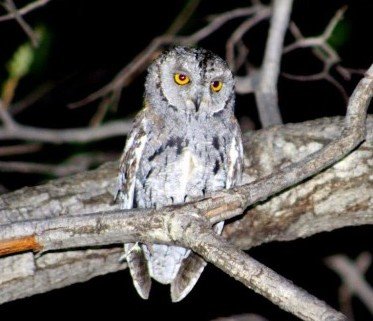
An African Scops Owl comes to visit our campsite

An African Scops Owl comes to visit our campsite


by Anthony Stidolph


I am, by nature, a wanderer. For me there is nothing quite like the thrill of departure, the joy of being on the road again, of heading off to remote and cut-off places.

As an antidote to this restlessness I have travelled the length and breadth of South Africa searching out new places I can claim as my own. In recent years this has involved launching several expeditions up to the Limpopo, along the way taking in Punda Maria and Pafuri in North Kruger, Mapungubwe, Ratho on the Botswana border,  Hans Merensky on the Groot Letaba, the forests of Magoebaskloof, parts of the Soutspanberg and that little-known gem, Blouberg Nature Reserve near Vivo.

Having explored and fallen in love with this sun-drenched landscape, my birding partner Ken and I recently took a notion to recreate these epic treks by heading back up there once again, only, this time, adding Marakele National Park, which would be new country for me.

A Tshwana word, aptly meaning “Place of Sanctuary”, Marakele falls within a transitional zone between the dry western habitat, made up mostly of Kalahari thornveld, and the typical bushveld country of the moister eastern sections of South Africa. It also lies within the Waterberg range of mountains, with an altitude ranging from 1050 metres on the plains to 2088 metres at its highest point.

Because of this broad range of vegetation types and its diverse topography the area boasts a wide variety of game (including the Big Five and Wild Dog) and an abundant bird life. Its biggest attraction, for birders anyway, is the around 800 breeding pairs of Cape Vulture which nest high up in the cliffs of the Kransberg

Arriving at the park, which is situated about twenty kilometres north of the old iron-ore mining town of Thabazimbi, we set up camp and then headed off on our first drive. I was immediately rewarded with my first lifer of the trip – a Greyheaded Kingfisher.

As we sat having a celebratory beer that night, listening to the clear, articulated noises of the bushveld at night, a tiny African Scops Owl landed on a branch above us and began its odd but strangely comforting, frog-like, “Prrrt…prrrt…prrrt…” call. This was more like it. My latest Excursion Into The Great Unknown had officially begun.

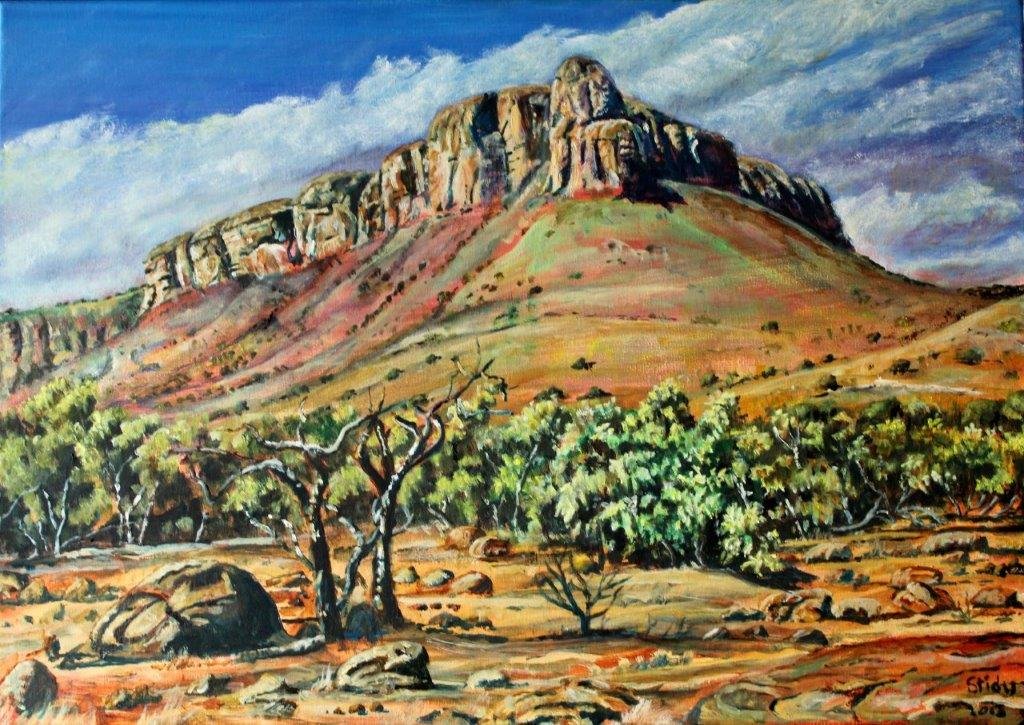
The Kransberg, Marakele NP

Anthony Stidolph’s painting of The Kransberg in Marakele National Park. For Sale – contact Stidy at stidy@sai.co.za (42×60)

The next day we were up at dawn and driving through heavy bush country towards the impressive pass that leads up to the top of the Kransberg mountain. A friend of ours had told us that her biggest concern going up this narrow, winding, precipitous road, was what she would do if she encountered another vehicle coming down the other way as there is little room to pass. That proved to be the least of our worries.

Rounding one steep-sided corner we suddenly found ourselves coming face-to-face with a young elephant bull that had stepped out on to the road. Having been in this situation many times before, Ken immediately pulled up short, stopping a sufficient distance from the animal so as not to make it feel threatened or think that we were encroaching on its space. It didn’t help.

Coming face-to-face with a wild animal so much bigger than yourself can be a slightly intimidating experience and this one decided to remind us of its size advantage. Without even affording us the courtesy of a warning mock charge, it let out an almighty bellow and came thundering down the road.

There was nothing to do but slam the car into reverse and head back down the road with me craning my head out of my window, shouting directions, while Ken did the same on his side.

The kilometre or so we drove in this manner was like a rapid ride through eternity. We kept hoping that each time we rounded a corner and the elephant lost sight of us it would lose interest. No such luck. The beast definitely did not like the cut of Ken’s jib and was determined to drive us clear off his mountain stronghold.

We went back down into the valley and somehow – and I shall never know how we did it – managed to do so without plunging down the mountain side or getting stomped on by the elephant. Once safely back on the flat we found a turning point, backed into it and sped off in the direction we had earlier come from.

A half-an-hour or so later we gingerly ventured back but, very bravely, decided to allow another vehicle – that had come driving up while we were parked on the side of the road observing, of all things, a Neddicky (the ultimate Little Brown Job), while considering the sagacity of continuing on our journey – go up ahead of us. Once we had seen they had safely cleared the ridge we sailed forth ourselves, this time, thankfully, unmolested.

At the top of this particular stretch the road evens out on to a trough through which you drive before getting to tackle the final, most spectacular, stage of the mountain. Here the road begins an even more torturous ascent. On the one side rise the naked sandstone towers of the Kransberg massif itself, weathered into the shapes of fantastical beasts and strange deformed reptiles. On the other side the slopes plunge steeply down into a treeless, meadowy grassland in which several more elephant and a herd of wildebeest were feeding.

As we advanced the road got narrower and narrower. What got us perspiring heavily all over again was that there were yet more fresh elephant droppings at regular intervals all along its surface, virtually to the top.

On the summit it was like another world. The view was colossal. Below us the mountain stretched away in every direction before dropping down, in a series of steps, to the plains, fading away into the blue distance.

Immediately in front was another castle-like knob, a labyrinth chaos of rock, fitted with clefts and chimneys. It was here the vultures nested. There were many of these large, endangered raptors wheeling gracefully above us, trailing their shadows on the ground beneath them.

The protea-covered hillsides on top of the mountain also provide a home for some other unusual species like the Gurney’s Sugarbird and the Buff-streaked Chat, birds which I more commonly associate with the Natal Midlands, where I live, and the foothills of the Drakensberg. Another occupant is the Kransberg Widow, a very rare and beautiful butterfly which puts in an appearance in November and early December and then, like Cinderella, sheds its finery and disappears. This is the only place in the world where it occurs.

We were reading all about the insect on a large information board they have erected up there, alerting us to its presence, when one came fluttering past. A few minutes later it came fluttering back again … and again. It may be scarce but it certainly wasn’t shy about showing off its beautiful cream markings.


A cold wind was blowing across the mountain top and a storm was brewing in the distance and so, after a warming cup of coffee, which we shared with a pair of very tame Cape Buntings and a cheery Mocking Cliff-Chat, we made our way back down the same twisting road, this time without having to face down any elephants with murder on their minds. Heading into camp I did, however, have another good sighting of two more Greyheaded Kingfishers, dive-bombing a family of Banded Mongoose.

Two days later, in Blouberg, I had an even better view of the kingfisher sitting at the end of a dead branch. This meant that after fruitlessly searching for the elusive bird for years I had now seen four in four days …

The grumpy pachyderm who had chased us down the Kransberg may have scared me witless, but I couldn’t help wondering afterwards if he hadn’t deliberately engineered the whole encounter just to make sure I kept running into the bird!


ANTHONY STIDOLPH


Where is Marakele National Park?


The John McFarland Column: The unsung hero of the Lions’ success 0

Posted on April 25, 2018 by Ken


The Lions’ victory over the Waratahs was a fantastic achievement and one of the best results in the history of our SuperRugby, you have to give credit to the players and the whole coaching staff for pulling off that sort of scoreline in Sydney – and for keeping the New South Welshmen pointless for the first time ever in the competition.

The Lions were really dominant in the scrums and lineouts and they scored some very clever tries. But I would like to single out defence coach Joey Mongalo as their unsung hero.

He took over from JP Ferreira and was under lots of pressure when they started to concede tries in the losses against the Blues, in Argentina and versus the Crusaders, so it is a real credit to him that they have tightened up so much since then. Swys de Bruin took a big punt in appointing his son, Neil, as the skills coach and then he took Joey out of the junior team, where he had been tremendously successful.

It’s a big step up for Mongalo but he can now enjoy the history made in Sydney. He has persevered through the ups and downs and been at the Lions for seven years and was promoted to the Currie Cup last year. He was also the SA U20 defence coach under Dawie Theron and in their last year they finished fourth at the junior world cup. Saru, in their infinite wisdom, decided not to make use of him last year, but he is a quality young coach.

The difference he has made to the Lions’ defence is that they now have great spacing, alignment and width, they really cover the width of the field. They are also very strong in the collisions, guys like Franco Mostert, Harold Vorster and Malcolm Marx really monster guys. They have a great double-hit system which means the ball-carrier can’t get the offload away.

They’ve also shown greater line-speed these last two weeks, they’re coming forward and really laying down the gauntlet to the opposition. With that they can force turnovers through Kwagga Smith and Marx, who is probably the best in the world right now at forcing turnovers. He gets over the ball so often and he is really hard to shift.

The fact that he comes off the lineout and is inside the ball a lot of the time allows him to be very effective at turnovers. The hooker role has changed over the last few years because of the nature of how teams contest for possession and one of the best at stealing ball I ever worked with was Bismarck du Plessis. The hooker nowadays basically defends the inside channel, which enables him to be close to his target.

The other impressive feature of the Lions’ play against the Waratahs was the quality of their kicking game and their lack of fear in doing it anywhere on the field. Elton Jantjies was even prepared to put in a crossfield kick off turnover ball five metres from the goal-line. There was also a great little chip from scrumhalf Dillon Smit in the middle of the field that bounced into Ruan Combrinck’s hands and Kwagga scored.

They have the courage to do it when it’s not expected and they execute those kicks so well. The Lions also have very good chasing wings.

Swys de Bruin obviously gives them the confidence to try anything anywhere on the field and you can never accuse him of taking the safe option. He’s also had his ups and downs as a coach – he spent a long time at the Sharks Academy before Johan Ackermann brought him back into the coaching fold. He brings confidence and a sense of adventure to Lions rugby.

One must also give credit to forwards coach Philip Lemmer. Those two tries from drives off the lineout were really well executed and the way they shifted and created a channel for Marnus Schoeman, ripping a wide open gap for him to go through, was very clever.

So it was almost the perfect performance away from home by the Lions, I expect them to back it up by beating the Reds this weekend, and it is a smart move by Springbok coach Rassie Erasmus to add Swys to the consulting team for the England series. Does it mean the Springboks will play with that same freedom as the Lions do?

Well Rassie is naturally quite a conservative coach so it will be interesting to see if Swys will free up the backs.

Elton Jantjies is now the most capped Lions player ever, having gone past Cobus Grobbelaar’s 94 appearances earlier this season, and he is hardly ever injured, so he is tremendously resilient and looks after his body well. The Lions’ style of play is tailor-made to his strengths and it was encouraging to see him dictate matters in an away game, having shown previously he’s obviously very good at altitude. A lot of it comes down to the backing Swys de Bruin gives him and the question is whether he will now get the same with the Springboks.

I thought the Bulls were good value for their win over the Rebels. Sometimes you have to win ugly but to bank the five points despite that was excellent and coach John Mitchell won’t mind doing that every week.

Adriaan Strauss is certainly in brilliant form, last year’s break did him good and he has dropped some weight. In fact, I have worked with Atta since the U21s and this is the fittest I have ever seen him. He has always been a world-class player, but in the environment Mitchell has created at Loftus Versfeld, he is really performing. Having him there really adds accuracy to the set-pieces and he almost always hits his jumpers with his dead-eye-dick throws.

That brings RG Snyman and Lood de Jager into play and that forms the axis of the Bulls side with flyhalf Handre Pollard.

Under the new regime, Lood is also fitter and more mobile and the offloads and supporting lines of the Bulls forwards are very good, they look to keep the ball alive in space. Their scrum also functioned quite well against the Rebels and they created a great angle on the crucial try scored by Divan Rossouw just before halftime. They took a whole lot of Rebels defenders out of the game, they could not get across in time and the visitors basically ran out of tacklers.

Pollard is also providing direction with the boot and is enjoying a good string of matches, plus you have the magic and game-breaking ability of Jesse Kriel and Warrick Gelant, who has such incredible feet, he could get his way out of a phone box full of tacklers!

In fact there are now a lot of players with good feet on display in South African rugby, there’s that stepping ability. New Zealand’s guys tend to rely on their size, but we’re starting to produce it on the wings, guys who are really quick with good feet and are good in the air, which is going to be crucial in the Rugby Championship and against England.

The Rebels’ tactics are well-known on the Highveld, trying to slow down or stop the game, which gives their forwards longer time to recover. Visiting teams to Pretoria either stack their bench with forwards in a 6/2 split, so for the last 20 minutes they almost have a fresh pack on, or they slow the game down, sit down often and make the whole pace slower.

But hopefully the Bulls will also be able to turn over the Highlanders on the Highveld this weekend.

The Sharks versus Stormers game was obviously between two teams desperate for a win and the loss puts real heaps of pressure now on the Stormers. They’ll have to win with bonus points in their next five games in the Cape, which is possible. But for the Stormers to win with bonus points they need to be far more defensively secure than they have been.

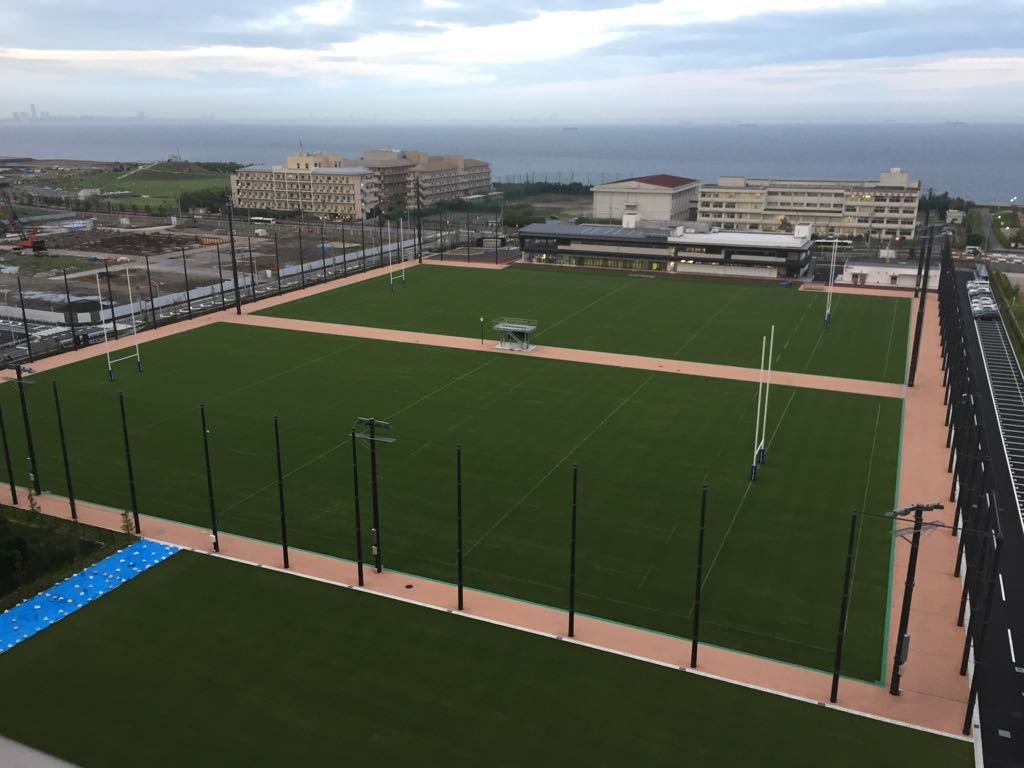
But I look forward to watching the games in my 11th floor Tokyo flat, which overlooks the Springbok training facility for next year’s World Cup. I hope I am still here next year to look out my window and watch them train!


Urayasu City World Cup training facility - where the Springboks will be based while in Tokyo

Urayasu City World Cup training facility – where the Springboks will be based while in Tokyo


John McFarland won three SuperRugby titles (2007, 09, 10) with the Bulls and five Currie Cup crowns with the Blue Bulls as their defence coach. In all, he won 28 trophies during his 12 years at Loftus Versfeld.
He is currently the assistant coach of the Kubota Spears in Japan and was the Springbok defence coach from 2012 through to the 2015 World Cup, where they conceded the least line-breaks in the tournament and an average of just one try per game.


  • Recent Posts

  • Archives

  • Thought of the Day

    Have a fulfilled life by caring about the feelings of others. Show interest in the welfare of others, listen to their problems.

    Be tolerant of people and allow for their mistakes, because no-one is perfect.

    Follow the example of Christ, who showed sympathy and understanding towards all people.


↑ Top