In the first two editions of the Mzansi Super League (MSL), feted cricketers like AB de Villiers and Chris Gayle have been marquee players allocated to one of the teams but that is all set to change, along with many other aspects, in this year’s T20 carnival.
The third instalment of the MSL will see only eight CSA-contracted players allocated to teams. The plan is for each of the eight franchises to then be able to choose one Kolpak or non-contracted South African and one overseas player from the draft.
In that way the MSL draft will become a much more exciting extravaganza with the eight teams competing for some truly top-class attractions. It means someone like De Villiers, who is a non-contracted player, will no longer be allocated to the Tshwane team but will no doubt cause something akin to a bidding war amongst the eight teams as he will be available on the draft. And there will also be much jostling for international players, who have been of mixed quality over the first two seasons.
Quinton de Kock, formerly of the Cape Town Blitz, has been mooted as the new marquee player for the Centurion-based side.
The other change will be in the names of the teams. The six domestic franchises will now be able to choose whether to continue with their MSL brands or revert back to their own names – i.e. Cobras, Dolphins, Knights, Lions, Titans and Warriors.
It means cheesy names like the Tshwane Spartans, which have developed little traction with fans (what are Spartans anyway?), will be ditched.
Franchises will also be able to source their own sponsors and will share in whatever profits the tournament makes.
A new broadcast deal has yet to be signed for MSL III, but CSA are known to have offered the rights to SuperSport. The first two editions of the MSL were broadcast for free by the SABC, contributing to the massive losses the tournament made.
The fact that almost all of them have international playing experience was first and foremost in fast bowler Lutho Sipamla’s mind this week when he spoke about the effect the Proteas coaching staff have had on his own fledgling career for South Africa.
Since making his Proteas debut in a T20 against Pakistan at the Wanderers in February last year, the 22-year-old Sipamla has played four ODIs and five T20 Internationals. For all his inexperience, he has been quick to recognise the value of all the experience around him.
“Guys like Charl Langeveldt, Mark Boucher, Jacques Kallis and Justin Ontong have walked the talk, they know what it takes to be a good international cricketer. It’s awesome to have them as coaches because they have been in our shoes and they have done it all before. So they can relate to what we are going through because they’ve experienced it themselves.
“Someone like Charl, when it comes to bowling at the death, he’s had to defend six or seven runs to win the game and done that. So he knows the processes involved, he’s been successful and he passes that on to the bowlers,” Sipamla said.
Bowling coach Langeveldt played 72 ODIs, but the respect he is held in by local cricketers suggests he should have played many more; head coach Boucher played 147 Tests and 295 ODIs, batting consultant Kallis is South Africa’s most-capped player ever with 166 Test and 328 ODI appearances, and fielding coach Ontong was unfortunate to play just two Tests, 14 ODIs and 28 T20 Internationals.
Last year was a pretty terrible one for the Proteas, but there were signs of the tide starting to turn when they whitewashed a powerful Australian side 3-0 in the ODI series in February/March.
“It was a great experience making my debut in the limited-overs format and it was a really good win over Australia, a wonderful experience and a great time for me. We had a very young squad but we all worked together towards our goal and gelled nicely. We all knew what we had to do, everyone knew their roles and we were able to execute.
“In that campaign we all grew as individuals and players, and it was something special to be part of it. And now we’ve had a long wait to play again and I’m really excited just to get back to practice and crafting my skills again. As my Dad always tells me when I’m having a tough time, I must just make sure I keep working hard and make sure I’m still doing all the right things,” Sipamla said.
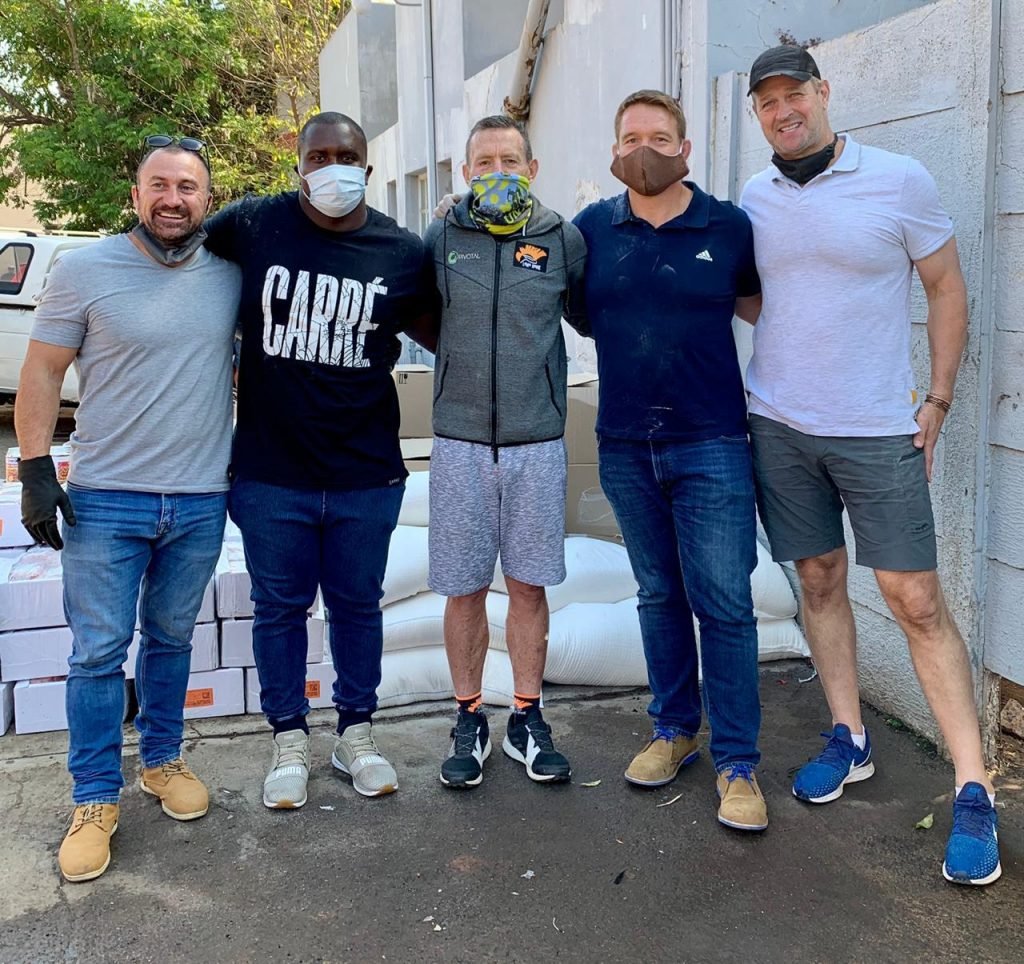
CHAMPIONS – Rugby stars (from left) Dave von Hoesslin, Trevor Nyakane, Joel Stransky, John Smit and Wayne Boardman at a food drop-off for the One Cup of Pap initiative. Photo by Lauren Terras
Africa is certainly a continent of extremes and millions of her inhabitants have scant resources when it comes to basic necessities we take for granted. The situation is only going to become worse due to the Covid-19 pandemic. And although we all miss the game, not being able to play or watch rugby in this time of crisis is a minor hardship compared to those who are living in poverty, in horribly overcrowded conditions, suffering from malnutrition and a lack of running water.
And we can be proud of our South African rugby community because they certainly get this, and the paycuts they have willingly taken and the number of charitable initiatives they have supported or started themselves shows they are not just champion sportsmen but champion human beings.
It’s amazing how far a simple act of kindness can go and this was rammed home for me recently by the work of the One Cup of Pap initiative.
It all started at the beginning of Lockdown in late March when former Sharks and Stormers lock Wayne Boardman, together with his father and domestic worker, decided to put some money together to feed at least one family in need. It started out as one cup of pap and a sachet of soup being dished out at an informal settlement in the northern suburbs of Johannesburg, with a budget of R250 a week.
But seeing desperate people fighting over what little he could give – “We were overwhelmed and the last few people were like hyaenas fighting over the food before it ran out,” Boardman says – he decided to reach out to his friends, local community and his rugby network.
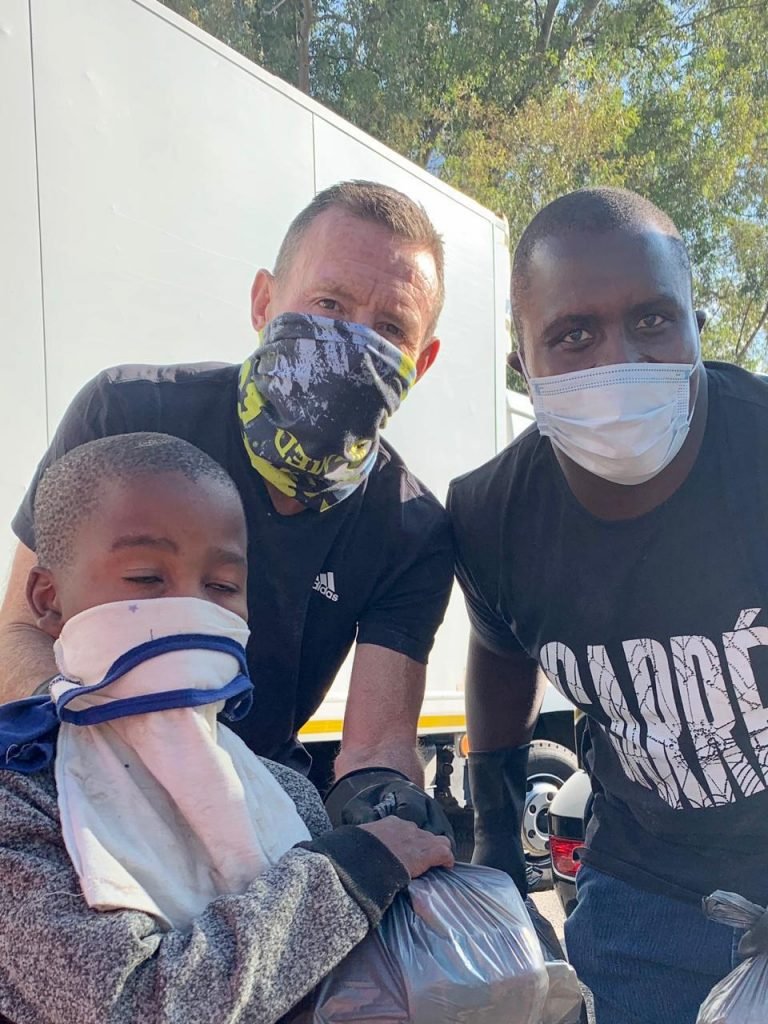
In the last eight weeks, the One Cup of Pap feeding scheme has mushroomed to an R80000-a-week operation, feeding approximately 2000 hungry people with two tons of pap, between 500 and 1000 loaves of bread, and one ton of polony, soup and tinned food.
“We started slowly with not a lot of food, but with the help of a couple of influencers and getting social media full of it, it has grown to a size we never expected. To get one or two big names involved like John Smit and Joel Stransky, who are close to everyone’s hearts, automatically gave us big pull and credibility. Their involvement and that of other Springboks like Trevor Nyakane and Dave von Hoesslin has really seen it grow,” Boardman says.
LINED UP – The different food stations and the queues of people at the One Cup of Pap feeding scheme. Photo by Ken Borland
The project has also spread its reach to areas such as Munsiville in Krugersdorp, Midrand and the Tshuma Stingers development rugby club, Roodepoort and the Feed Thy Kids Creche, the Chilli Lane Community in Sunninghill, the Waste Pickers at Megawatt Park, those living under the bridge at Braamfontein Spruit, Ivory Park and Parkmore. Community involvement is essential because it’s not as if the One Cup of Pap initiative have a census of informal settlement residents to work with when calculating the numbers they need to cater for. The South African Police Services, especially Sandton Police Station, have offered considerable support along with TRSG Security and Security Web.
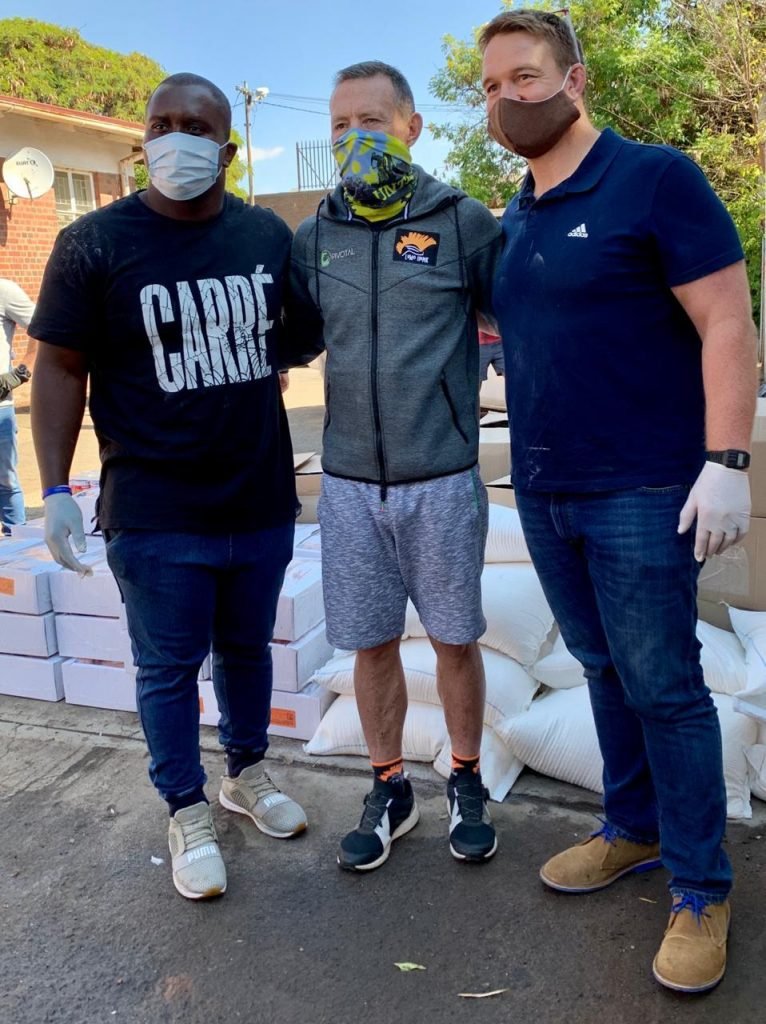
Joel Stransky & Trevor Nyakane Photo by Lauren Terras
Stransky is famous for his charitable initiative, the LumoHawk Foundation which specialises in testing the eyesight of underprivileged children and giving them glasses. But with Covid-19 having stopped all testing, Stransky has now taken over sponsoring all the children’s food packs for the One Cup of Pap scheme. “I just want to see these kiddies get a proper education that will prepare them for life and give them hope,” he told Saturday Citizen.
Smit has had his own charitable foundation, Barney’s Army, since 2012 and they have also thrown their weight behind Boardman. “If we all do a little bit then we can make it through this crisis. I’m able to leverage off my profile and I’m sure there are plenty of others doing great work, but we need to highlight everyone doing their bit,” Smit said.
Nyakane, who completed the hat-trick of World Cup winners involved, was moved by the experience.
“Lending a hand has made me realise how poor so many people are, it was a no-brainer to help out and hopefully make a difference in their lives. Every little bit helps and it hit me seeing hundreds of people lining up, all needing a lot of help, even if it’s just shelter and being able to get food. I would urge every South African to just lend a hand, it goes a lot further than you realise,” Nyakane said.
World Cup winners (from left) Trevor Nyakane, Joel Stransky & John Smit. Photo by Lauren Terras
To get in touch with the charity: Wayne Boardman 084 545 1717
There was nothing logical about the Springboks’ epic victory over the All Blacks in Wellington last weekend: their recent form and that of their opponents certainly didn’t suggest it and neither did South Africa’s miserable record at The Cake Tin, where they had lost all six previous matches against New Zealand. The match statistics were thoroughly dominated by the home side, who outscored the Boks by six tries to five.
And, unusually when I get to watch the Springboks in a non-working capacity, there wasn’t a beer or a braai in sight when I settled down to watch the TV broadcast. That’s because I was watching in a shopping mall (not maul) of all places.
The occasion was one of those “events” that marketing people are so fond of, but this one was memorable, not just because the long nine-year wait for a Springbok win in New Zealand came to an end. I remember thinking, shortly before those excruciating final minutes when the world’s best referee, Nigel Owens, lost his composure as much as anyone, that this had been one of my most enjoyable Springboks-on-TV viewing experiences ever.
I know this next bit will be met with as much disbelief in some quarters as the revelation that I did not have a beer the entire match, but I was also the only White person at the gathering.
In terms of the demographics of the country, it is logical that last weekend’s Fine Leg Productions event with the Gwijo Squad and Touch Rugby Sundays shows what the future of rugby in this country will be like. And what a bright future it is judging by the sheer passion on display, the knowledgeable comments and the tremendous spirit that led to a wonderful atmosphere, even when many of us were cursing Owens under our breath.
I have watched rugby in many establishments in the supposed rugby heartland and felt way less comfortable in a testosterone-fuelled atmosphere and way less impressed by the knowledge of the game that was on display. Several women attended the Fine Leg Productions event and seemed totally at home.
And imagine how much harder it is for these rugby-loving Black fans to feel comfortable in some of our stadiums? This was one of the issues raised after the match in the discussion that was held and it is also central to the creation of the Gwijo Squad.
They are a group of rugby-mad Springbok followers who are transforming the stadium vibe by singing and chanting vernacular war cries and their efforts to inculcate a more inclusive culture have been mirrored at Springbok level. It has been hard for Black Springboks to feel totally comfortable in that environment, to feel that they can bring their own culture into the team, but that has all changed with the appointment of Siya Kolisi as captain. Now we see the team singing traditional songs before and after the game and it is wonderful to behold this new, all-South African culture taking hold.
With so much focus now on the economics of our rugby – the viability of our professional structures and how we are struggling to compete with overseas teams because of the weakness of the rand – it is definitely necessary for the sport to be open to as many communities as possible. In order for that to really take off, those communities have to feel wanted and truly part of South African rugby.
A term like “rugby development” is perhaps not the best word to use because it implies creating an interest that is not already there. Contrary to what All Blacks coach Steve Hansen may believe, judging by the extracts of his book published this week, rugby has also been a Black sport for more than a century.
Perhaps the Gwijo Squad can arrange to take Hansen, when he is here in the first week of October, on a little tour of the Eastern Cape, where Black clubs are more than a hundred years old and rugby poles are seen in the rural areas far more often than soccer goals.
Proverbs 20:24 – “A person’s steps are directed by the Lord. How then can anyone understand their own way?”
If God controls your life, then you should abide by God-given and God-inspired virtues like love, forgiveness, goodness, faithfulness, compassion and self-control.
An immature spirit harbours pettiness or narrow-mindedness, grievances against people, a refusal to forgive or delight when someone else falls or fails. A mean or shallow attitude is not part of God’s plan for your life.
Your spirit as well as your attitude and actions should reveal something of the greatness of God if you live according to his will.
Appreciate the small things in life, but don’t allow them to divert your attention from the truly important things.
Be guided by his Holy Spirit and live to the glory of God under his protective hand!