for quality writing

Ken Borland


Kruger National Park: Malelane 2

Posted on February 13, 2020 by Ken

Three African Hawk Eagles in a tree on the Steilberg Loop

The south-western foothills around Malelane and Berg-en-Dal provide some of the more interesting bird-spotting drives of the Kruger National Park and a sweltering December day was no exception.

The Steilberg Loop (S120) heads north off the Matjulu Loop between the two camps and this mountainous, rugged country boasts tall woodland.

And it was between those hills, in a tall tree, that three African Hawk Eagle, one of the fiercest hunters of the park, were majestically posing.

Given that African Hawk Eagle are often seen in pairs and are believed to pair for life, the third, brownish member of the group was probably a juvenile.

The African Hawk Eagle is closely associated with the Berg-en-Dal region, but an even more interesting bird soon came along and it was a less predictable sighting than the raptor that is comfortable with both high-flying hunting from the thermals or at close quarters under cover.

Bursting from the cover of some thick woodland, a Eurasian Golden Oriole provided a flash of golden yellow and black.

This beautiful Palaearctic migrant is uncommon and always a good sighting, even if it’s normally just seen zipping between trees. On this fortunate occasion though there was time to watch the Oriole a bit as it moved through the canopy of a tree.

It can be famously hot in this area of the Lowveld so it is always a good idea to spend some time on the bridge over the Crocodile River at Malelane Gate, birds tending to congregate around the water or in the riverside vegetation.

Great White Egret, Blacksmith Plover, Egyptian Goose, Blackwinged Stilt, Sacred Ibis and Little Swift are almost always there, but today there was also a Wood Sandpiper rustling around in the shallows and a Purple Heron, often secretive, was spotted in a little backwater. Other waterbirds seen were a Water Dikkop, African Jacana, a single African Openbilled Stork, Greenbacked Heron and Hamerkop.

A Bateleur came flying over the river, followed later by a Tawny Eagle, while a Striped Cuckoo was doing its best to hide away in the canopy of a Natal Mahogany tree.

Between the tar road from Malelane Gate and the Steilberg Loop lies the S110 and the Acacia woodlands it traverses are also excellent for birding, throwing up good views of Lilacbreasted Roller, Redbilled Buffalo Weaver, Crested Barbet and Marico Sunbird.

Clear blue skies & Lilacbreasted Rollers

Game seen along the S110 included African Elephant and Plains Zebra.

The eastern side of the tar road (H3) has roads like the Timfenheni Loop and the S114 taking one into mixed bushwillow and Marula woodlands and it was wonderful to see a pair of endangered animals along this stretch.

A Squarelipped Rhinoceros was passing the day serenely in the grasslands and, just a short way down the hill, a small group of Southern Ground Hornbill were walking around.

These are good game-viewing areas as well and Giraffe, Warthog and Chacma Baboon were also spotted.

Map of the Malelane/Berg-en-Dal area

Sightings list

Great White Egret

Blacksmith Plover

Egyptian Goose

Blackwinged Stilt

Sacred Ibis

Little Swift

Wood Sandpiper

Grey Heron

Reed Cormorant

Blackeyed Bulbul

Southern Black Tit

Bateleur

Impala

Waterbuck

Longtailed Shrike

Lilacbreasted Roller

African Elephant

Redbilled Buffalo Weaver

Plains Zebra

Crested Barbet

Marico Sunbird

African Hawk Eagle

African Hawk Eagle

Glossy Starling

European Swallow

Forktailed Drongo

Eurasian Golden Oriole

Helmeted Guineafowl

Giraffe

Squarelipped Rhinoceros

Southern Ground Hornbill

Warthog

Striped Cuckoo

Rattling Cisticola

Chacma Baboon

Striped Cuckoo

Tawny Eagle

Hippopotamus

Purple Heron

Water Dikkop

African Jacana

African Openbilled Stork

Greenbacked Heron

Hamerkop

Pilanesberg National Park 0

Posted on January 30, 2019 by Ken


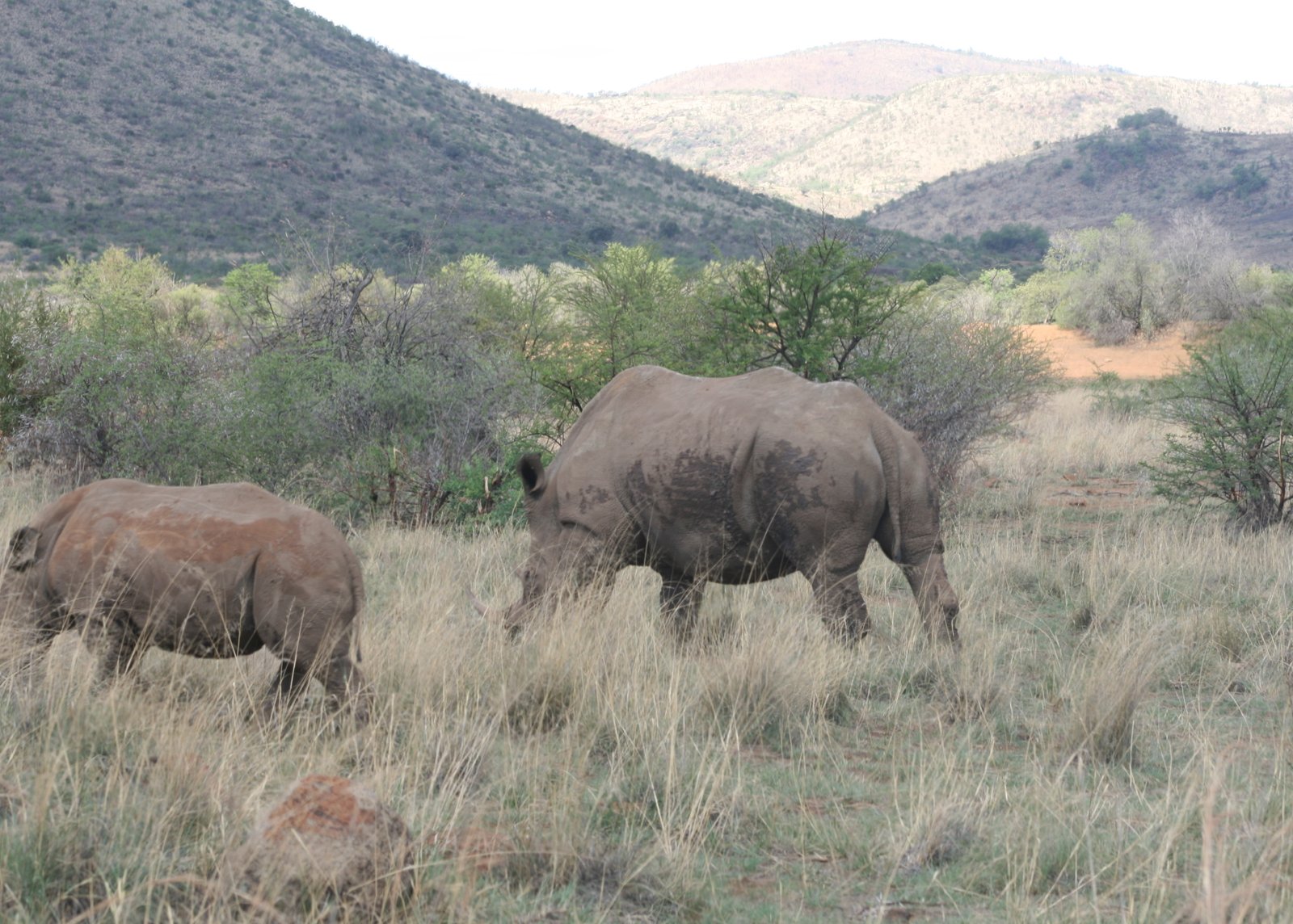
SERENE ... A White Rhinoceros and its calf with the valleys of the Pilanesberg stretching into the distance

SERENE … A White Rhinoceros and its calf with the valleys of the Pilanesberg stretching into the distance

The open country around the Mankwe Dam is bordered by the Tshwene and Kubu drives, two of the four tar roads in the Pilanesberg National Park. I normally try to avoid the tar roads when I’m in the bush, but this area is so peaceful and tranquil, and being the main water source in the reserve, there is also usually lots of game in the vicinity.

But as a very warm afternoon clouded over and a typical Highveld thunderstorm approached, there came a stark reminder that this is wild Africa, red in tooth and claw.

Between the Mankwe and Motlobo drive turnoffs from Tshwene Drive, less than 20 metres from the tar and at the edge of a little bank, an unfortunate Impala took its last breaths. Two Cheetah, still panting hard from the exertions of the chase, soon had blood-stained faces as they tucked into their hard-won meal.

This is Lion and Leopard country as well so the Cheetah, the most lightweight of the big cats, needs to eat quick because there’s nothing like a kill to attract other meat-eaters. While the Cheetahs ripped at the carcass, a sly Blackbacked Jackal was already hanging around waiting for scraps.

Seeing one of the cats on a kill is always a special sighting, but to see Cheetah in the Pilanesberg is an exceptional occurrence because there are only five in the entire 572 square-kilometre park. The open country around Mankwe Dam is probably the best area for them because it allows them the space for their sprint, which is what sets them apart from other predators.

The adrenaline was still flowing from my first Cheetah sighting in the Pilanesberg when my buzz was shattered by an extremely loud, piercing call right next to the car. I was startled and momentarily baffled by what it could be – it was such a high-pitched, pure sound that I thought some sort of emergency alarm had gone off and was wondering if my windshield would crack!

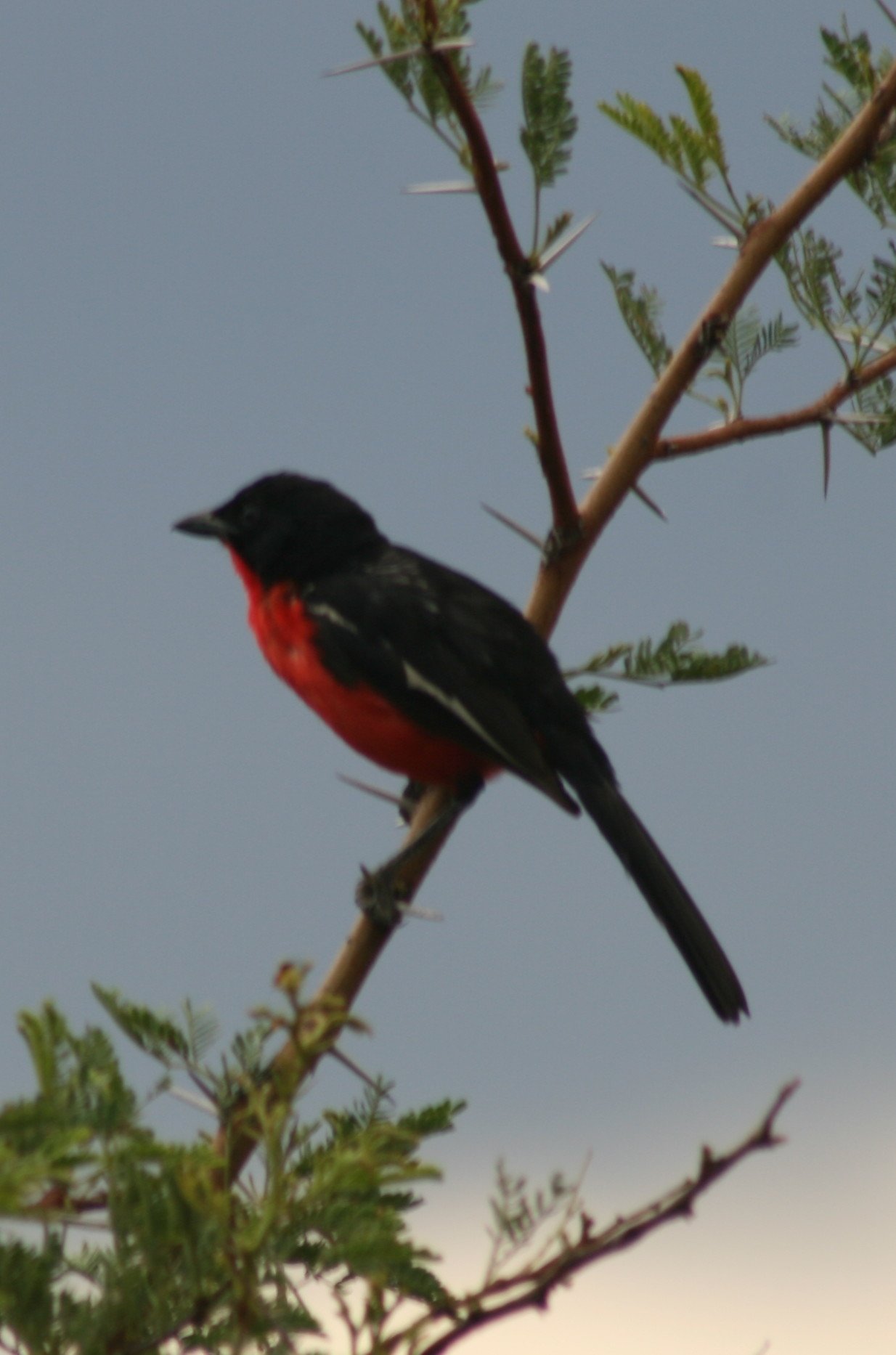
Having regained my senses enough to realise that it was coming from the bushes next to the road, I scanned the vegetation and there the source was, with colours as bright as its song was loud – a beautiful Crimsonbreasted Shrike sitting in an open gap in the bushes.

The Crimsonbreasted is certainly the most brightly coloured of the Laniarius (Boubou) Shrikes and its underparts are a brilliant scarlet colour, heading towards crimson.

Crimsonbreasted Shrike

Crimsonbreasted Shrike


It provides a real flash of colour particularly when contrasted with the muted tones of the thorny scrub it likes to inhabit.


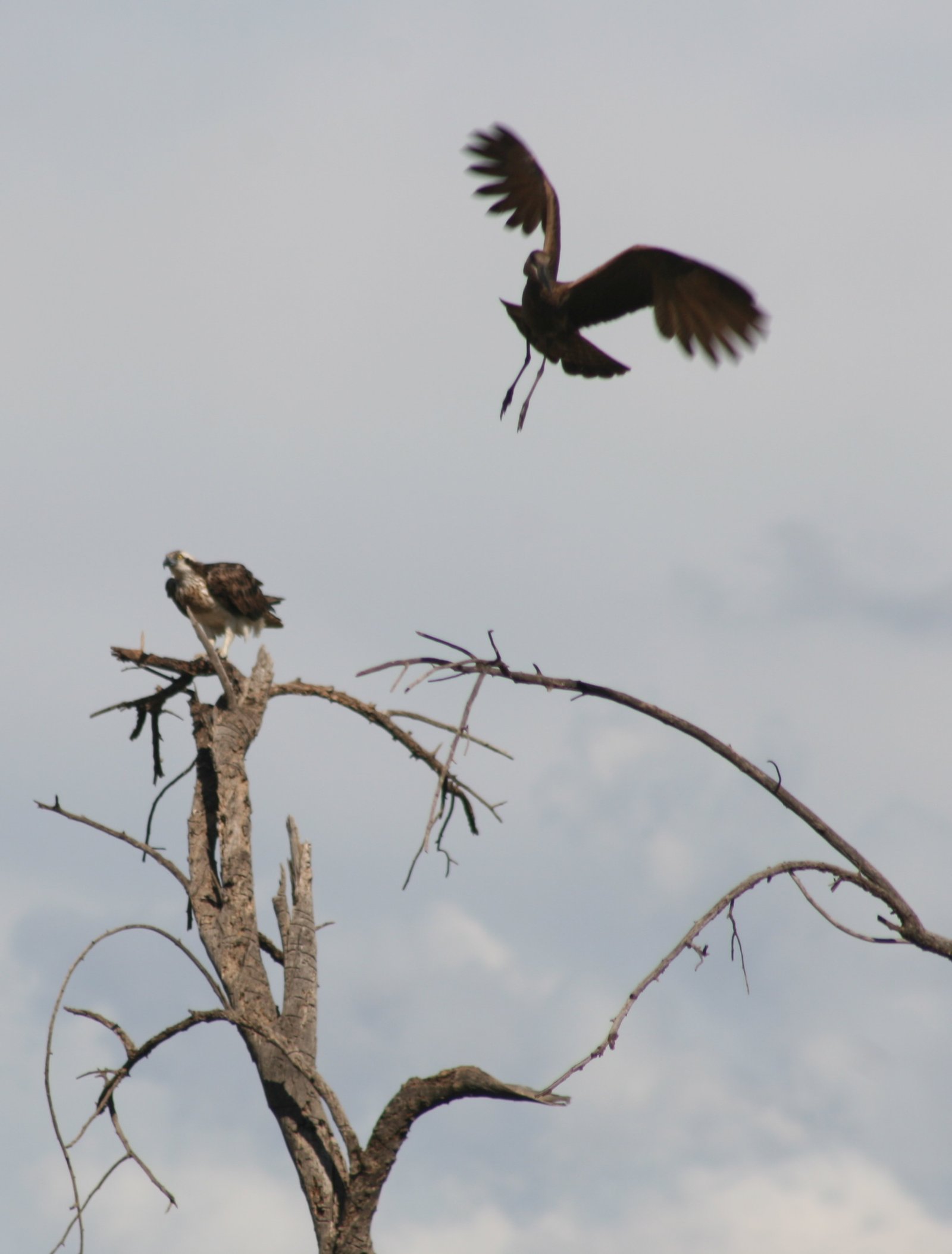
This is where the Mankwe River flows out of the dam and Mankwe Way crosses the river just north of the Fish Eagle turnoff. It’s a good spot to stop and scan for birds and, having seen one in the exact same dead tree on a previous trip, it was great to see an Osprey once again sitting up in the highest branches. It was joined by a Hamerkop that came to share its lofty perch and there were Pearlbreasted Swallows flying around and landing nearby as well.

MAY I JOIN YOU? ... A Hamerkop (right) landing in the same tree as an Osprey

MAY I JOIN YOU? … A Hamerkop (right) landing in the same tree as an Osprey

Mankwe Way takes one into an area of open grassland, dotted with termite mounds and boulders as it heads west, past the old farm of General Jan Smuts, Buffelsdrift. Transitional zones where dry plains with short grass meet the longer grasses of the rugged upland areas are excellent for birding as well.

Apart from the White Rhinoceros in the vicinity, there were also Scalyfeathered Finches hopping on the ground and then flying quickly into the small trees when disturbed; Sabota Lark, Crowned Plover, Cinnamonbreasted Rock Bunting and Blackthroated Canary.

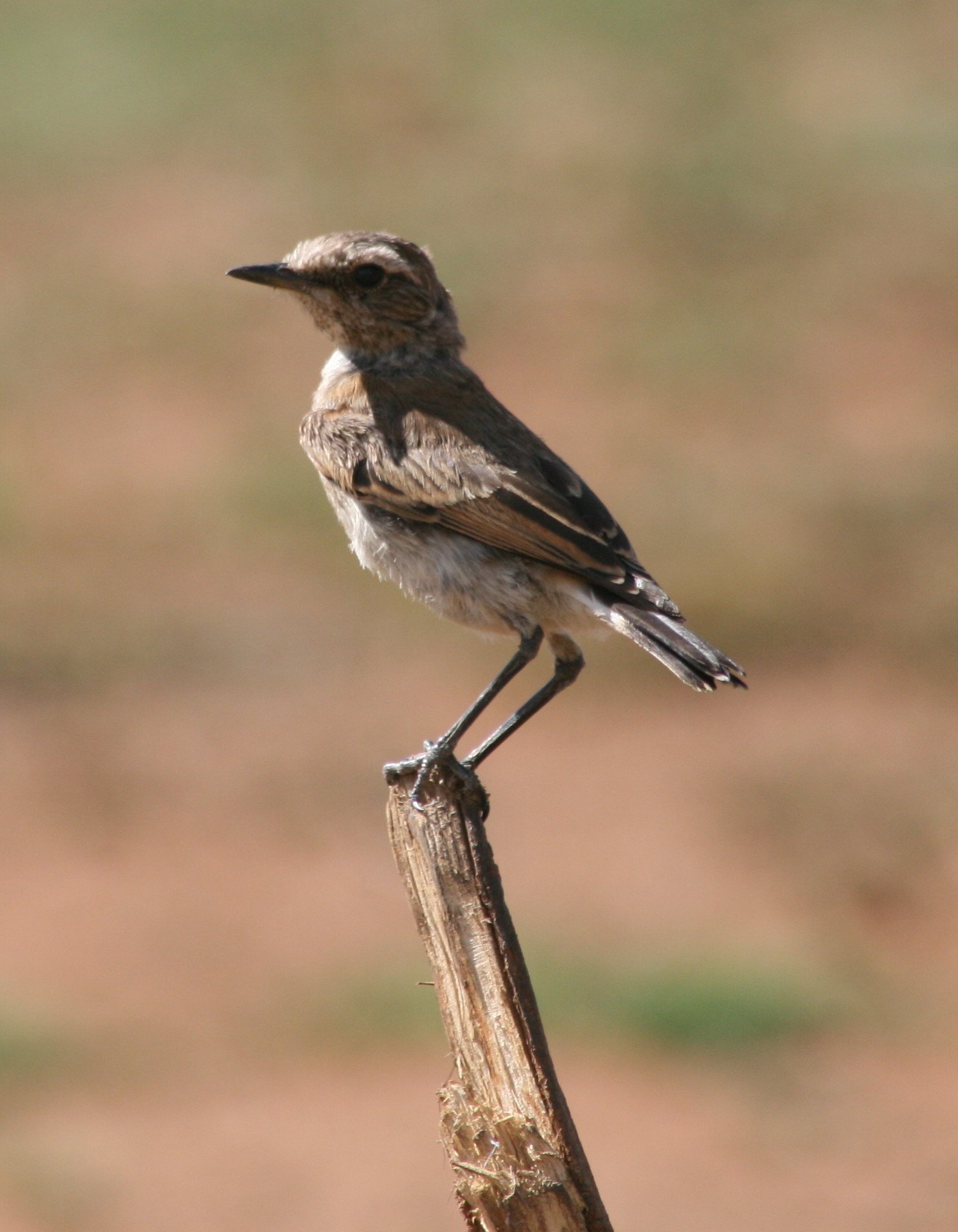
But a pair of birds had me a bit confused as they hopped around on the low bushes, behaving much like Capped Wheatears. But the adults of that plains specialist are distinctively marked and these birds were also making some strange, Lark-like calls. With their mottled bands of brown, buff and yellowish colours, they had me thinking of similar-looking rarities.

But discretion won the day and, considering that Capped Wheatears are well-known mimics, I went the most likely route and decided they were, in fact, a pair of immature Capped Wheatears.

One of the juvenile Capped Wheatears

One of the immature Capped Wheatears

Pilanesberg holds good numbers of both the Kalahari and Whitebrowed Scrub Robins and the central part of the

Kalahari Scrub Robin

Kalahari Scrub Robin

park has both these twitching, insectivorous lovers of thicket and low bushes in close proximity to each other.

Mankwe Dam is by no means the only productive body of water in the park, and if one enters through the south-western gate of Bakubung, after two-and-a-half kilometres on the tarred Kubu Drive, or a bit further if one turns left and takes the more meandering dirt road known as Kgama Drive, one comes to the Lengau Dam.

There are usually large numbers of birds here and on this occasion it was good to see African Darter, Whitefaced Duck, Pied Kingfisher, Greenshank, Marsh Sandpiper and Threebanded Plover. There are usually animals about as well, but this time there was just a solitary Warthog snuffling around.

Even the smallest bodies of water can provide something of interest though and as I was exiting through the easternmost gate – Manyane – four Redbilled Oxpeckers were drinking water from a puddle in the road.

Life can be very tough in the beautiful African bush and to survive the residents need to take advantage of every little windfall they can get.


Sightings List

Blue Wildebeest

Plains Zebra

Sacred Ibis

Warthog

Egyptian Goose

African Darter

Whitefaced Duck

Laughing Dove

Little Swift

Pied Kingfisher

Greenshank

Blacksmith Plover

Marsh Sandpiper

Threebanded Plover

Waterbuck

Jackal Buzzard

Impala

Greater Kudu

Rufousnaped Lark

Palm Swift

Marico Flycatcher

Greater Striped Swallow

Giraffe

Crested Francolin

Streakyheaded Canary

Great White Egret

Southern Masked Weaver

Pintailed Whydah

Blackeyed Bulbul

Whitebrowed Scrub Robin

Blackchested Prinia

Kalahari Scrub Robin

White Rhinoceros

Scalyfeathered Finch

Sabota Lark

Capped Wheatear

Crowned Plover

Cinnamonbreasted Rock Bunting

Blackthroated Canary

Hamerkop

Osprey

Pearlbreasted Swallow

Natal Francolin

Cape Turtle Dove

Grey Lourie

Glossy Starling

Cheetah

Blackbacked Jackal

Helmeted Guineafowl

Rattling Cisticola

Crimsonbreasted Shrike

African Elephant

Forktailed Drongo

Common Myna

Redbilled Oxpecker


THE TROUBLE WITH ELEPHANTS 0

Posted on August 14, 2018 by Ken


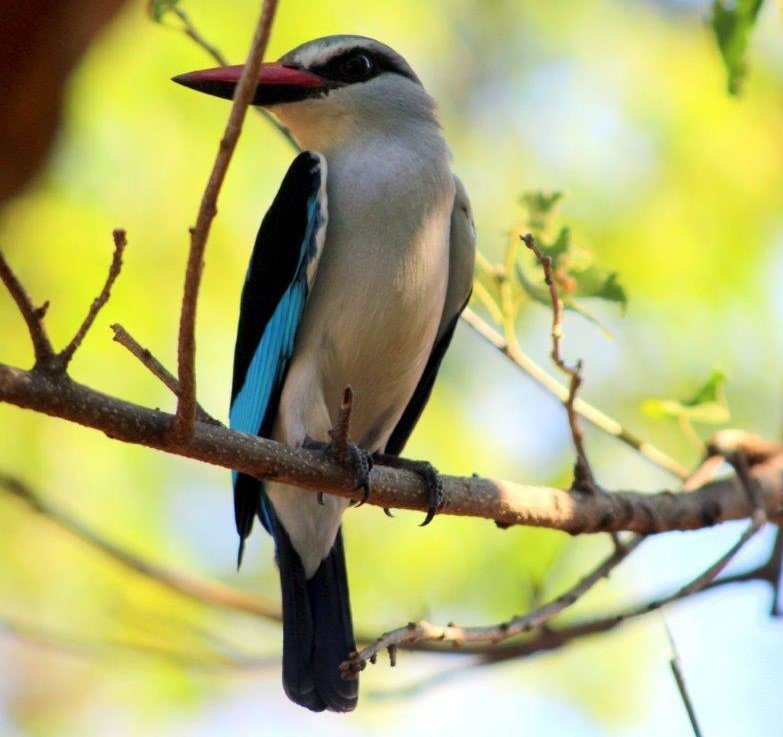
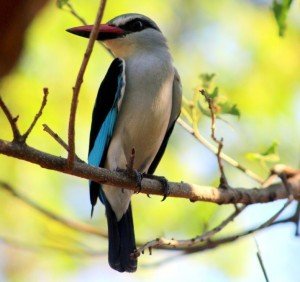
Woodland Kingfisher

Woodland Kingfisher

by Anthony Stidolph

I am not a man who deliberately courts disaster or intentionally goes looking for bad experiences. By the same token, I am not such a fool as to think the odd mishap won’t occasionally befall me. And when you go travelling with my birding partner Ken, rotten luck does have a habit of following you around.

For example: on a recent trip to Marakele National Park we found ourselves being chased down a narrow, twisting mountain pass in reverse by a very angry elephant who clearly resented our presence in his private domain.  Luckily – I have a feeling some benevolent deity saw fit to intervene – we survived that harrowing encounter. What I did not realise was that more trouble with elephants lay ahead…


From Marakele we had followed a circuitous route that took us to Blouberg Nature Reserve and then cut east along the base of the Soutpansberg range to Punda Maria in North Kruger. We planned to camp the night here and then press on to Pafuri the next day, where we hoped to get in some good birding.

Up until now the weather had been kindly – more spring than summer and I had even found myself wearing a jacket in the evenings and early mornings. In Kruger, however, the hot weather we had been expecting all along finally caught up with us, with the temperature soaring up to 39 degrees. The air around us was heavy and listless and steamy, almost tropical, perhaps hardly surprising since we had crossed over the Tropic of Capricorn some days before.

Eager to be off, I was up early the next day although I had to first wait for Ken to complete his complicated early-morning-ablution rituals. Once he was done with that, we set off northwards through the familiar vastness of flat grassland and mopane trees. On the way we stopped to allow the biggest herd of elephants I have ever seen cross the road. Shortly afterwards we were forced to repeat this exercise for an even bigger herd of buffalo.

The common bird in this neck of the woods – or at least the most vocal – is the Rattling Cisticola. There seemed to be one trilling its silly head off on top of virtually every second tree we passed.
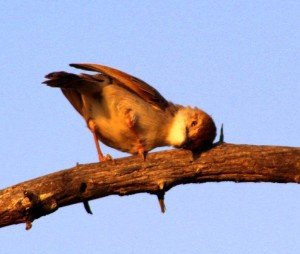
Cisticola, Wailing, Kruger

The highly-vocal Rattling Cisticola – Can rub some people up the wrong way

As you draw close to Pafuri, the terrain starts to break up and rearrange itself and you are suddenly confronted by the arresting sight of Baobab Hill, with its commanding views over the Limpopo Valley. In the early days this iconic hill served as both a landmark and sleepover point for the ox-wagons travelling up from Mozambique.

By the time we got to Pafuri the sun was high and blazing. There had obviously been no rain here this season and the grass was pale and dry, although the trees had mostly come out in leaf.

At the crossroads we turned left down the Nyala Drive, which takes you into some wonderfully hilly country before taking a lazy loop back to the main road. Ken likes this less-used drive because, he says, it often throws up unexpected surprises.

There wasn’t much on offing this time around besides the usual suspects – Meves’s Starlings, Arrowmarked Babblers, Whitefronted Bee-eaters and Emeraldspotted Wood Dove. We passed a solitary elephant but he paid us no mind.

On the top of the small, baobab-clad hillock, directly above where the road swings back, is the Thulamela archaeological site, a restored Zimbabwe-type ruin. Unfortunately you can only go up with a guide and because of our tight schedule we did not have time for that.
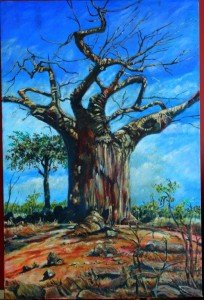
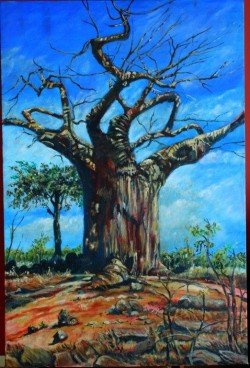
One of the commanding Baobab trees of northern Kruger. This painting by Stidy is available for sale. 42x60 stidy@sai.co.za

One of the commanding Baobab trees of northern Kruger.
This painting by Stidy is available for sale. 42×60 stidy@sai.co.za

From the Nyala Drive we crossed back over the main tar road and followed the dirt track that takes you to Crooks Corner, where the brown waters of the Luvuvhu collide with the blue of the Limpopo. The combination of water, sun and rich alluvial soils has led to a proliferation of vegetation along the rivers’ banks so that you drive through a glittering tunnel of Sycamore Figs, Nyala trees, Jackal Berry, Ana and Fever trees.

Crooks’ Corner, where you can get out of your cars, marks the border between South Africa, Mozambique and Zimbabwe. In the early 1900s this remotest of places gained its moniker and dodgy reputation with gun-runners, fugitives and others on the run from the law, using it as a safe haven because it was easy to hop across the border whenever the police from one country approached.

Distinctly, there was a sense of a frontier on that lazy meandering river, although I don’t think the solitary Saddlebilled Stork fishing in its waters gave a fig where the international boundary lay or as to who held sovereignty over the country he was standing in.

Normally, it feels like you can’t get much further away from civilization than here, but we had chosen a busy weekend to visit so it was like a major thoroughfare with a steady stream of traffic passing through. Many of the visitors didn’t even bother to wind down their windows or get out of their luxury 4x4s because it would mean switching off their air-conditioners. They just drove in, stopped, glanced around and drove out again, leaving me to wonder why they had bothered to come all this way …

Needless to say Ken – who, contrarily, makes it a rule to ALWAYS switch off his air-conditioner when he enters a park because he likes to experience Africa in all its extremes –  and I did get out.

Rich plant life invariably means rich animal and bird life and Pafuri is no exception. In the past the storied riverine forest has provided both of us with some good sightings. It was here I saw my first Gorgeous Bush Shrike, Bohm’s Spinetail and Ayre’s Hawk Eagle. I have also recorded Lesser Jacana, Greencapped Eremomela, Hooded Vulture, Tropical Boubou and the palm-dwelling Lemonbreasted Canary.

This time, we could hear both the Gorgeous Bush Shrike and a melodious Whitebrowed Robin-Chat calling from the depth of a nearby thicket but could not entice either of them out.  Instead we had to make do with a bunch of waders and a noisy party of Trumpeter Hornbills who, I think, were off to join the celebrations in neighbouring Zimbabwe.

It was now well past lunchtime so we doubled back to the Pafuri picnic site on the edge of the Luvuvhu. Feeling somewhat dehydrated, I was desperate for an ice-cold coke but had to wait patiently in queue behind an American who was explaining to the bemused coke seller-cum bird guide – who, I suspect, knew the answer but was too polite to say so – what a turkey is (“It’s a big black bird with a red head”).

At this juncture of its journey the Luvuvhu is always a ruddy brown colour such as might be achieved by mixing cans of tomato soup with cans of chicken soup. There was an enormous crocodile lying directly opposite us, not, as one would expect, by the water’s edge but high up on the bank under some trees. I had a feeling some unsuspecting animal was in for a nasty surprise.

On the way back to Punda Maria, we took the shortcut via Klopperfontein Dam, another place which can throw up some unexpected treats even though the area around the dam has been grazed as smooth as a billiard board. Sure enough, we were rewarded with a wonderful sighting of a Painted Snipe snooping around in the shallows of the nearby stream.

It was getting on for late afternoon by now. Ken consulted Emily, his prissy, admonishing Satnav, and worked out how far we had to go and what time we had to do it in. What neither factored into their calculations was our old nemesis, the elephant.

The first one, which we encountered just after Klopperfontein, kept us waiting for ages, while it feasted on the side of the road, before moving off into the surrounding bush. A little later we passed him siphoning water by the trunk load out of the top of a reservoir.

We ran in to the second one on the home stretch with the hills around Punda Maria in plain sight. Although this bull appeared much more amiable then the one who had chased us down the mountain in Marakele, he had obviously decided he held all the rights to this road.

The whole thing quickly degenerated into a stage farce. We kept reversing and reversing and he kept trundling on towards us. I suspect he was headed for his evening sundowner at the same reservoir where the other elephant was sloshing water around.

One of us had to blink and we did so first. Muttering angrily to ourselves about the beast’s poor road etiquette, we turned around and headed back to the tar and took the much longer route home to Punda Maria.

In Kruger, as in other parks, you are not supposed to arrive in camp after dark, which we now did, finding the gate locked on us. Fortunately, the guard was still at his post but Ken had to use all his silky skills as a sports writer and commentator to try to convince him it wasn’t really our fault. I am not sure he bought our explanation, but he let us through without imposing a fine.

So we drove into camp feeling like a pair of naughty schoolboys who had just been caught bunking …

But we were not done yet. We arrived to a scene of utter devastation – in our absence a troop of baboons had ransacked the place, flattening my tent, breaking its poles and ripping gaping holes in the fly-sheet (even though there was nothing inside but my bedding and clothes), as well as scattering our possessions far and wide.

To tell you the truth I was getting seriously tired of this. I had just bought the tent to replace the one that got ripped by monkeys in Mapungubwe on my last trip which, in turn, I had bought to replace the one that had suffered a similar fate at the hands of baboons when I attended a wedding in De Hoop Nature Reserve in the Western Cape. At the rate I was getting through tents, it would have been cheaper to have just booked into a luxury lodge!

I am not sure what one does about this menace. The problem is both monkeys and baboons have become habituated to both human beings and human beings’ food.

We did discover afterwards that there was supposed to be a guard on duty to stop these opportunistic raids but, even though the campsite was virtually booked out, he had decided to take the Sunday off …

I was still sulking about my poor tent the next morning when we drove out of the gate, destination Mapungubwe. There to wish us on our way was the scruffiest Ground Hornbill I have ever seen. It flew up into a tree from where it regarded us quizzically through its girlishly-long eyelashes.

For some reason the sight of that lugubrious bird, peering around its branch, cheered me up no end. It made me realise that on the Richter Scale of Travel Disasters we had got off relatively lightly compared to what other great explorers, like David Livingstone or Scott’s Antarctic expedition, had been forced to endure…


ANTHONY STIDOLPH

Gauteng cricket revolutionising the game by axing Black African icon 0

Posted on May 15, 2018 by Ken


There has been a lot of talk recently around Gauteng cricket of revolutionising the game, but so far their only notable action has been to strip the most successful Black African coach in franchise cricket of his duties, making him the fall guy for a poor season by the Highveld Lions.

Geoff Toyana was the first Black African head coach of a franchise when he was appointed in 2012 and he steered the Lions to four trophies in the next four seasons. There have been lean pickings since then, but there have certainly been extenuating circumstances – Toyana has had to practically rebuild a whole team due to the matchfixing scandal and the retirement of several senior players.

Sure, Toyana will still be employed by the Gauteng Cricket Board as High Performance Coach, but there is little doubt that this is a demotion and a slap in the face for someone who has been at the forefront of transformation at franchise level.

The last season was particularly disappointing for the Lions – they finished last in the Sunfoil Series and fifth in both the Momentum One-Day Cup and RamSlam T20 Challenge – but when board members come into the changeroom mid-season and lambast the players with threats that eight of them will lose their contracts, it’s hardly conducive to inspirational performances.

Toyana will be the first to admit that he was probably not at his best as coach either, but again, a more sensitive administration would have understood the reasons why. It could not have been easy for the Soweto Cricket Club product to start the summer as the favourite to be the new Proteas coach and then watch it all unravel.

Add to that massive disappointment the family bereavements he also had to deal with, and it was clear Toyana was a man under severe pressure this last summer.

But the 44-year-old still had an additional year to run on his contract and surely the right thing to do, especially if one is serious about transformation and not just political powerplays, would have been to wipe the slate clean on the last season and allow Toyana to finish his term. Based on results, a less knee-jerk decision could then be taken.

Especially since this is a man who has added so much to the reputation of Gauteng cricket. Let’s not forget that before he became Highveld Lions coach, the franchise had won just one paltry trophy in eight seasons. Under Toyana’s watch, six new Test cricketers, ranging from Quinton de Kock to Stephen Cook, as well as six other limited-overs internationals were produced for the Proteas.

The talk in the Wanderers corridors is that Enoch Nkwe is in line to replace Toyana, which would make sense (at the right time) because the 35-year-old is intimately linked with Gauteng cricket. Currently the assistant coach of the national women’s side, and having fulfilled a similar role for the men’s team in the Netherlands, Nkwe played for the franchise for seven seasons before coaching the semi-pro provincial side.

But there is also talk that the Gauteng Cricket Board have got themselves into a tangle that has led to them axing Toyana. So confident were they that Toyana would be in the Proteas coaching set-up that they allegedly bought Nkwe out of his contract with Haarlemsche Cricket Club and the union now cannot afford to be paying the salaries of two head coaches at the same time.

Perhaps if the board were not so busy with putting out the regular fires that spring up from all the infighting and politicking – if it were all about the transformation needs of the game that would be fine, but the impression is that most of it is all about the personal benefit of the egos involved – then they would be more able to keep their eye on the ball and ensure the franchise is excelling where it really matters – out on the field.

https://www.pressreader.com/south-africa/the-citizen-gauteng/20180414/282595968496043

  • Recent Posts

  • Archives

  • Thought of the Day

    Proverbs 3:27 – “Do not withhold good from those who deserve it, when it is in your power to act.”

    Christian compassion is a reflection of the love of Jesus Christ. He responded wherever he saw a need. He did not put people off or tell them to come back later. He did not take long to consider their requests or first discuss them with his disciples.

    Why hesitate when there is a need? Your fear of becoming too involved in other people’s affairs could just be selfishness. You shouldn’t be afraid of involvement; have faith that God will provide!

    Matthew 20:28 – “The Son of Man did not come to be served, but to serve, and to give his life as a ransom for many.”


↑ Top