for quality writing

Ken Borland


Rugby will need to be streamlined post-Covid, says Smit; ‘Speed it up!’ says Stransky 0

Posted on May 21, 2020 by Ken

Former Springbok captain John Smit believes rugby will need to be drastically streamlined once it resumes after the Covid-19 pandemic, while his fellow World Cup winner Joel Stransky is hoping for a quicker, less contact dominated game when action gets underway again.

Typically for the great South Africans they are, the two World Cup winners were busy handing out food parcels in Lonehill for the One Cup of Pap charitable initiative when they spoke to The Citizen about what they were hoping for once rugby is allowed to take place again.

Smit’s focus was on the effects of the suspension of play and how rugby organisations are going to have to adjust not just their schedules but also the very structure of the game in their respective countries in order to ameliorate the tough financial conditions that will be prevalent.

“Covid-19 has been a massive storm that has had a massive impact on our game, showing us how we have taken certain things for granted. I think it’s important to remember that rugby is largely a product of the players and wherever the sport is not streamlined enough, guys are going to have to make cuts.

“Decisions are going to have to be made about not just the survival of those in the game at the moment. Where the game is running fat, where most of the money is going, that’s where there have to be cuts and I think we all know where those places are,” Smit, a former CEO of the Sharks, said cryptically.

Former flyhalf Stransky wanted to see a pacier game in which there will be more exciting backline play.

“I don’t think the game will change so much although there will be more screening and testing, we will be more aware of the risks but there will still be running, scrumming and tackling. I would just like to see the space on the field used more. Rugby has become very predictable with defensive structures so well organised. The players are now very physical and tend to just bash it up.

“There is not too much backline excitement anymore; players like Cheslin Kolbe at the World Cup, stepping and beating players, using the space, are few and far between; normally the backs just kick the ball through now and hope for a mistake,” Stransky said.

The 1995 drop goal hero said he hoped being deprived of live rugby would encourage people to go back to the stadiums when the action resumes, and Stransky said he counted himself now amongst the people who used to just watch on television (when not broadcasting) but he would now be taking the family to games.

“There’s still going to be massive drama but every sport is in the same boat and we’re no different to other industries – we have all taken a knock. It could take years to bounce back but as soon as there is sport to watch live then hopefully people will be more inclined to go to the stadiums. I know I will be taking the family once rugby is back,” Stransky said.
Gibbs agonizing over Proteas’ World Cup all-rounder selections 0

Posted on April 16, 2019 by Ken


Herschelle Gibbs was South Africa’s leading run-scorer as they dominated the group stages of the 1999 World Cup, only to fall agonizingly short in their notorious tied semi-final against Australia, but he believes all-rounders were the key to their success in England that year and that is an area that has the potential to be a problem for the Proteas as the tournament returns there next year.

South Africa had Lance Klusener, named the player of the tournament, backed by Jacques Kallis and Shaun Pollock, in 1999 and the current Proteas obviously don’t have all-rounders of that proven quality and experience at the moment.

“In 1999 we had three all-rounders and that led us to probably our best chance of winning the World Cup. A strong one-day team always has good all-rounders, but I think at the moment, all-rounders are our biggest headache. The depth is not quite there; we have Chris Morris in and out the side and Andile Phehlukwayo and Wiaan Mulder blow a bit hot and cold for me.

“So that’s going to be a big question mark for the selectors. Conditions in England could suit a guy like Vernon Philander perfectly. He can bat, but there are question marks over how effective he is in limited-overs cricket. Otherwise the bowlers are pretty sorted and it’s nice to see Dale Steyn firing again, bowling in the late 140s and looking great,” Gibbs told Saturday Citizen at the Sanlam Cancer Challenge, where he was playing golf as one of the celebrity delegates.

Like politicians trying to impress the voters, those players who are not assured of their places in the World Cup squad will be mounting one last desperate push to impress the selectors in the next couple of months. Gibbs believes there are still enough matches before the World Cup to sort out any deficiencies in the team.

“There are enough ODIs before the World Cup and there’s still a chance for some new faces. We’re probably also still lacking a bit in specialist batting depth. Dean Elgar was given a chance, but the selectors have probably decided that he’s not a one-day player. So there’s more pressure on Hashim Amla and Quinton de Kock, especially with AB de Villiers having retired, and Quinny is going to have to bear the brunt of the run-scoring I think.

“Our variety in the attack is also a bit short – Ngidi, Steyn, Rabada and Phehlukwayo are all right-armers, and then there’s Tabraiz Shamsi or Imran Tahir and JP Duminy to bowl a bit. So we might lack a bit of variety, but we might get away with it if the overhead conditions help us. But the all-rounders and the top-order are the two main question marks for me,” Gibbs said.

https://www.pressreader.com/south-africa/the-citizen-gauteng/20181013/282428465149110

Nothing logical, just sheer passion 0

Posted on February 06, 2019 by Ken


There was nothing logical about the Springboks’ epic victory over the All Blacks in Wellington last weekend: their recent form and that of their opponents certainly didn’t suggest it and neither did South Africa’s miserable record at The Cake Tin, where they had lost all six previous matches against New Zealand. The match statistics were thoroughly dominated by the home side, who outscored the Boks by six tries to five.

And, unusually when I get to watch the Springboks in a non-working capacity, there wasn’t a beer or a braai in sight when I settled down to watch the TV broadcast. That’s because I was watching in a shopping mall (not maul) of all places.

The occasion was one of those “events” that marketing people are so fond of, but this one was memorable, not just because the long nine-year wait for a Springbok win in New Zealand came to an end. I remember thinking, shortly before those excruciating final minutes when the world’s best referee, Nigel Owens, lost his composure as much as anyone, that this had been one of my most enjoyable Springboks-on-TV viewing experiences ever.

I know this next bit will be met with as much disbelief in some quarters as the revelation that I did not have a beer the entire match, but I was also the only White person at the gathering.

In terms of the demographics of the country, it is logical that last weekend’s Fine Leg Productions event with the Gwijo Squad and Touch Rugby Sundays shows what the future of rugby in this country will be like. And what a bright future it is judging by the sheer passion on display, the knowledgeable comments and the tremendous spirit that led to a wonderful atmosphere, even when many of us were cursing Owens under our breath.

I have watched rugby in many establishments in the supposed rugby heartland and felt way less comfortable in a testosterone-fuelled atmosphere and way less impressed by the knowledge of the game that was on display. Several women attended the Fine Leg Productions event and seemed totally at home.

And imagine how much harder it is for these rugby-loving Black fans to feel comfortable in some of our stadiums? This was one of the issues raised after the match in the discussion that was held and it is also central to the creation of the Gwijo Squad.

They are a group of rugby-mad Springbok followers who are transforming the stadium vibe by singing and chanting vernacular war cries and their efforts to inculcate a more inclusive culture have been mirrored at Springbok level. It has been hard for Black Springboks to feel totally comfortable in that environment, to feel that they can bring their own culture into the team, but that has all changed with the appointment of Siya Kolisi as captain. Now we see the team singing traditional songs before and after the game and it is wonderful to behold this new, all-South African culture taking hold.

With so much focus now on the economics of our rugby – the viability of our professional structures and how we are struggling to compete with overseas teams because of the weakness of the rand – it is definitely necessary for the sport to be open to as many communities as possible. In order for that to really take off, those communities have to feel wanted and truly part of South African rugby.

A term like “rugby development” is perhaps not the best word to use because it implies creating an interest that is not already there. Contrary to what All Blacks coach Steve Hansen may believe, judging by the extracts of his book published this week, rugby has also been a Black sport for more than a century.

Perhaps the Gwijo Squad can arrange to take Hansen, when he is here in the first week of October, on a little tour of the Eastern Cape, where Black clubs are more than a hundred years old and rugby poles are seen in the rural areas far more often than soccer goals.

https://www.pressreader.com/south-africa/the-citizen-gauteng/20180922/282720522881060

Lions expose the Jaguares’ pseudonyms with terrific defence 0

Posted on July 21, 2018 by Ken


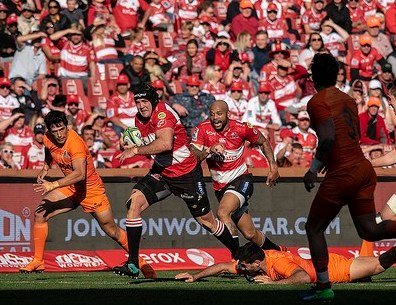
Lions hooker Malcolm Marx on the rampage once again. Photo by Marcel Sigg, runridedive.com

Lions hooker Malcolm Marx on the rampage once again. Photo by Marcel Sigg, runridedive.com

When the ACT Brumbies’ style of play dominated rugby in the early 2000s there were many pseudonyms for what they were doing – structured rugby, expansive rugby, multiphase play, all set up by skilful ball-carriers.

The Jaguares reminded me a bit of that multiphase play at Ellis Park on Saturday afternoon as they valiantly held on to the ball for phase-after-phase. But the game has moved on since the glory days of Gregan, Larkham and Finegan and these days teams trust their defences to hold out for long periods, eventually forcing the error or a one-off runner that is vulnerable to the breakdown steal.

We saw it in the Crusaders’ victory over the Sharks in the other SuperRugby quarterfinal featuring a South African side earlier in the day, and the Lions’ defence was the biggest factor in their 40-23 win over the Jaguares.

As the Jaguares pushed and prodded with more determination, so the Lions just worked harder and with more physicality in defence, simply not allowing the Argentinians to get their game going. Hooker Malcolm Marx led the way with vital turnovers, but Marnus Schoeman also contributed valuably and Kwagga Smith was also a presence at the breakdown.

“Collectively it was a massive effort and you have to give credit for all the turnovers to the guy who makes the tackle as well because he provides the opportunity. A guy like Malcolm is then just impossible to shift, Kwagga made one or two steals as well and Marnus was excellent when he came on. At stages the Jaguares kept the ball for a long time, but we showed good patience on defence,” Lions captain Warren Whiteley said after his team had clinched their third successive SuperRugby semifinal at home.

Run Ride Dive

Captain Warren Whiteley epitomises the Lions defence with this hit on Agustin Creevy. Photo by Marcel Sigg, runridedive.com

The Jaguares are certainly a force to be reckoned with going forward in SuperRugby, as they showed in the third quarter when they came from 9-24 down at the break to close to 23-27.

They were piling on the pressure, but Marx won three turnover penalties and those are the crucial interventions which win knockout games, with coach Swys de Bruin talking afterwards about “great defence at the right times”.

Jaguares coach Mario Ledesma spoke afterwards about how disappointing it was to concede three “soft” tries in the first half, but the Lions are a clever, innovative side on attack, able to try different things and generally pretty clinical.

All three of the tries came from different kicks: An Elton Jantjies crosskick found wing Ruan Combrinck with pinpoint precision for the first try; centre Harold Vorster followed lovely sleight of hand with a clever kick through that became even more effective thanks to the pace of Aphiwe Dyantyi getting there first to hack through and allow Vorster to score after the Jaguares made a mess of the clean-up operation; and a little dink over the top by flyhalf Jantjies was gathered by scrumhalf Gonzalo Bertranou, but his loose pass was immediately intercepted by Marx, who roared away from the 10m line for the try.

The Lions were cruising with a 24-9 halftime lead, but the admirable Jaguares were not done yet though as Bautista Delguy used his quick feet to score a fine try down the right wing two minutes after the break, and seven minutes later the visitors scored again as flank Pablo Matera crashed over. It was not the best grubber kick by the Lions that had given them broken-play possession.

Flank Cyle Brink, after a barnstorming first half, did not come out for the second half due to a shoulder ‘stinger’, but it was not a problem for the Lions as his replacement, Schoeman, played with tremendous industry. He showed terrific tenacity in the build-up to Andries Coetzee’s try as the fullback wriggled through a couple of tackles.

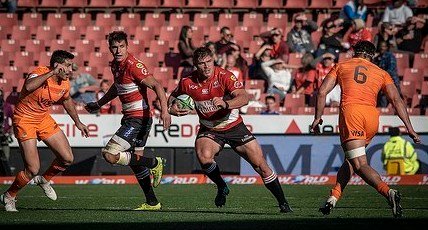
Lions flank Cyle Brink on another storming run. Photo by Marcel Sigg, runridedive.com

Lions flank Cyle Brink on another storming run. Photo by Marcel Sigg, runridedive.com

A typically combative Marnus Schoeman. Photo by Marcel Sigg, runridedive.com

A typically combative Marnus Schoeman. Photo by Marcel Sigg, runridedive.com


Being a knockout game, coach De Bruin had deemed shots at goal acceptable and Jantjies, who produced a polished performance that included a seven-from-seven success rate from the tee, then slotted a sweetly-struck drop goal to take the Lions’ buffer to two converted tries (37-23).

The seventh successful kick at goal by Jantjies was the penalty that completed the scoring with five minutes remaining, confirming that they will host the Waratahs at 3pm next Saturday in the semifinals.

The other huge positive for the Lions was the tremendous dominance of their scrum. The number of set-pieces was relatively low, but whenever the home side needed it, their scrum won them penalties or gave them strong front-foot ball.


  • Recent Posts

  • Archives

  • Thought of the Day

    Revelation 3:15 – “I know your deeds, that you are neither cold nor hot. I wish you were either one or the other.”

    How can you expect blessings without obeying?

    How can you expect the presence of God without spending time quietly before him?

    Be sincere in your commitment to Him; be willing to sacrifice time so that you can grow spiritually; be disciplined in prayer and Bible study; worship God in spirit and truth.

    Have you totally surrendered to God? Have you cheerfully given him everything you are and everything you have?

    If you love Christ, accept the challenges of that love: Placing Christ in the centre of your life means complete surrender to Him.


↑ Top