for quality writing

Ken Borland


Ndumo Game Reserve 0

Posted on June 03, 2020 by Ken

I’m sure I speak for most birdwatchers when I say it’s funny how the memory of spotting a Lifer is often permanently seared on the brain with the details of the moment immediately springing to mind.

So much so that when I came across this sightings list from a February 2006 trip to Ndumo Game Reserve in northern Zululand, I could immediately picture in my mind’s eye the little loop off the Paphukulu road that goes around a corner and then crosses a dry river bed before going slightly uphill again and returning to the main road.

As one approaches the dried up river, there is a thorn tree on the other side that hangs over the bank and there, in the gathering gloom of dusk, was a massive owl perched on the edge of the branches, surprisingly exposed.

By its large size I was immediately thinking Giant Eagle Owl and a quick squizz through the binoculars confirmed the diagnostic pink eyelids of the bird now known as Verreaux’s Eagle Owl, annoyingly because those French naturalists had nothing to do with the discovery nor naming of the bird.

The Giant Eagle Owl normally spends its days perched inside a leafy tree along a watercourse and they often begin their nightly hunting forays along an open, dry riverbed.

So perhaps my Lifer Giant Eagle Owl was eager to get going with what would have been its ‘breakfast’. For which I was very grateful and shall always remember my first sighting of what is truly a magnificently impressive bird. Not for nothing are they known as the Martial Eagles of the night sky.

The Paphukulu road runs along the south-western border of Ndumo and is always a very interesting drive as the sand forest and dense thorn thicket of the central regions of the reserve grades into dry savanna woodland, a more bushveld type area dominated by Knobthorn Acacias.

On that steamy February day, there were typical savanna woodland birds present like the Eurasian Bee-Eater, Masked Weaver, Redbacked Shrike, Cardinal Woodpecker, African Hoopoe, Little Bee-Eater, Sabota Lark and Crested Francolin.

The boundary fenceposts along the Paphukulu road are always worth keeping an eye on and Pallid Flycatcher, which is found in the Acacia woodlands of Zululand but is replaced by the Marico Flycatcher in that habitat further west, was spotted as well and then further down the road an interesting-looking raptor was seen perched.

It was a medium-sized brown bird, initial thoughts revolving around a Steppe Buzzard, which often perch on these fence poles. But this bird seemed a bit bigger and then, when it turned around to show its underparts they were all-rufous brown with no hint of white on the breast.

It was an immature Jackal Buzzard, which is not often seen in the tropical north-eastern lowveld, but juveniles do sometimes wander over from the escarpment, in this case probably the nearby (less than 100km) Lebombo Mountains.

An immature Steppe Buzzard was seen later on and Sombre Bulbuls also make their way into this area, on the fringes of the thorn thicket.

Icterine Warbler was also seen in the thorn trees close to the Giant Eagle Owl spot, a good sighting because it is scarce in these parts and sparsely distributed in KwaZulu-Natal as a whole.

The next day, on a small track leading to the NRC Picnic Spot, an even more seclusive but much bigger warbler was spotted. The Olivetree Warbler is a very uncommon and often overlooked Mediterranean summer visitor and I managed to get a glimpse of one foraging in a dense grove of acacias.

Heading back from west-to-east on the Paphukulu-Balemhlanga roads, the more open knobthorn woodlands allowed one to tick other typical bushveld gems like African Cuckoo and both the Eurasian and Lilacbreasted Roller.

It’s an under-rated but always good drive. Ndumo is more famous for the Nyamithi Pan and its guided walks.

But on this occasion in mid-summer, the pan was full to the brim, meaning a much lower waterbird count. There were egrets patrolling the shoreline and Wiretailed Swallows flew overhead along with passing groups of Trumpeter Hornbills.

Closer observation of the fringes of the pan, with bushy cover now right up to the edge of the water, provided sightings of Purple and Greenbacked Heron and Water Dikkop. Where there were some muddy edges, Wood Sandpiper was seen.

African Fish Eagles were seen in the Fever Trees on the other side of the pan, while both Pied and Giant Kingfisher were present, and a Hamerkop came yelping past as Hippopotamus frolicked in the water.

The road back from Nyamithi Pan to camp takes one past the reserve’s vulture restaurant, an open patch in which carcasses of deceased large mammals like Giraffe are dumped. There’s almost always something interesting hanging around and occasionally some real specials wander into this area.

On this occasion a Lesser Spotted Eagle, a Palearctic migrant which, given its preference for savanna and open woodland you wouldn’t fancy seeing at Ndumo, was strolling around on the ground. A real raptor special.

A Reedbuck was also pottering around.

The most famous of the Ndumo guided walks is probably North Pongolo, which takes one through the climax riverine forest of the beautiful dark brown river that has flown from Utrecht in Northern Natal, crossed the Lebombo Mountains and is now close to its confluence with the Usutu and its journey to Maputo Bay.

But the fullness of the Nyamithi Pan was a hint to the conditions of the Pongolo floodplain in general and the North Pongolo forest had been flooded and was temporarily off the roster for guided walks.

So instead a guide and I went to Shokwe Pan, an ear-shaped, generally shallower pan nearly seven kilometres long and in the western portion of Ndumo.

This turned out to be an excellent move because we came across, there in the thickets below the majestic Sycamore Fig trees, an African Broadbill, one of the Ndumo specials that is especially challenging to find.

But on this occasion this largely black, grey, brown and white oddity was just sitting on its display perch and allowed us to approach close enough for me to get a photo.

Other typical forest birds seen at Shokwe were Squaretailed Drongo, Collared Sunbird and Blackheaded Oriole, while Samango Monkey were enjoying themselves high in the trees, keeping their distance as they usually do.

A couple of Darter flew over and there were also a few flocks of Whitefaced Duck which passed by.

The route to and from camp, which is in the south-east of the park, to Shokwe takes you right through the centre of Ndumo and the densest, most impenetrable thickets probably anywhere in the country.
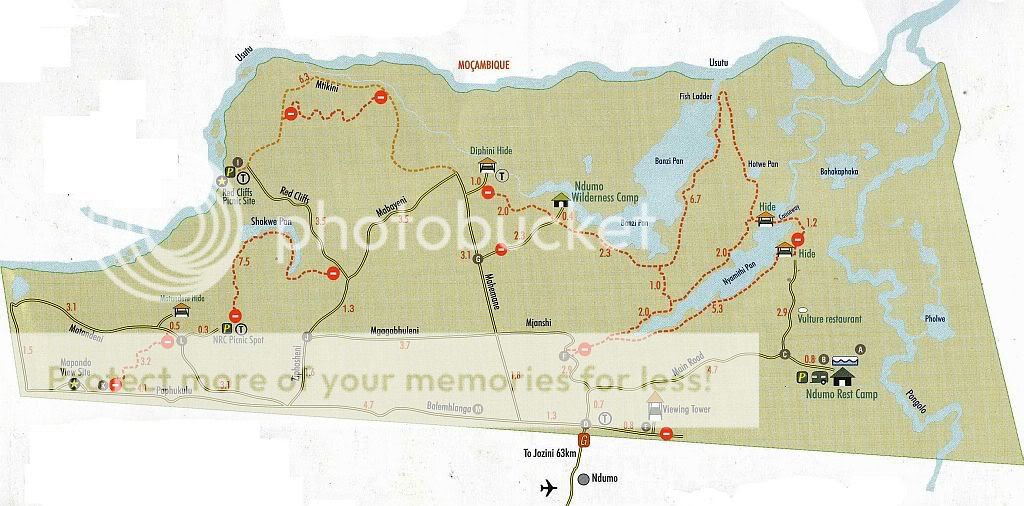
Detailed map of Ndumo

Birding is difficult but there are always surprises for the keen-eyed.

On this occasion the biggest surprise was coming around a corner and finding a thorn tree had toppled over and was blocking the road. Refusing to be denied my route through the wonderful sand forest in the middle of the park, prime birdwatching territory and known for the rare birds that are in residence, I was forced to tow the offending tree out of the road with my car!

My determination was partly rewarded with good sightings of Crested Guineafowl, Orangebreasted Bush Shrike, Dwarf Mongoose and Scimitarbilled Woodhoopoe, while little pans secluded in the forest provided Woollynecked Stork, Common Sandpiper and Greenspotted Dove.

The woodlands on the southern, hilly side of the park are also rich in birdlife. In the thickets and rank grass under the trees one gets the beautiful Melba Finch busily going about its business, normally with a Rattling Cisticola shouting the odds nearby. Neddicky (especially where there are fallen trees), Bronze Mannikin and Common and Blue Waxbill share this habitat too and Tawnyflanked Prinia is often around as well.

Bleating Warbler prefers thicker cover and will often call from a perch two-to-three metres up a tree. While looking for this secretive little bird, the likes of Paradise, Spotted and Black Flycatchers, Redfaced and Speckled Mousebird, Longbilled Crombec, Brownhooded Kingfisher, Puffback, Blackbellied Starling, Crowned Hornbill, Southern Black Tit and Purplecrested Lourie can also be spotted in the trees.

Searching carefully in the canopies threw up African Green Pigeon and Eurasian Golden Oriole.

Birding around the main camp, set in typical Maputaland woodland, is also good and the highlights from there on this trip were a Lanner Falcon, a regionally threatened bird that happened to fly by, probably heading to nearby grasslands to forage, while I was patiently watching the sky from my camp chair, and a Grey Sunbird, an Important Bird Area trigger species, that popped in for some nectar from the flowering hedge and a drink from a birdbath.

Where is Ndumo Game Reserve?

Sightings List

Blackeyed Bulbul

Blue Wildebeest

Nyala

Impala

Lesser Striped Swallow

Whitebrowed Robin

Kurrichane Thrush

Yelloweyed Canary

Chinspot Batis

Moreau’s Tropical House Gecko

Giraffe

Crowned Hornbill

Southern Black Tit

Eastern Coastal Skink

Redeyed Dove

Neddicky

Melba Finch

Spotted Flycatcher

African Green Pigeon

Rattling Cisticola

Redfaced Mousebird

Black Flycatcher

Common Waxbill

Blue Waxbill

Warthog

Common Sandpiper

Crested Guineafowl

Orangebreasted Bush Shrike

Hadeda Ibis

Forktailed Drongo

Vervet Monkey

Dwarf Mongoose

Scimitarbilled Woodhoopoe

Woollynecked Stork

Longbilled Crombec

Greenspotted Dove

Tawnyflanked Prinia

Great White Egret

Cattle Egret

Brownhooded Kingfisher

Lesser Spotted Eagle

Paradise Flycatcher

Speckled Mousebird

Bleating Warbler

Puffback

Blackbellied Starling

Wiretailed Swallow

Eurasian Golden Oriole

African Fish Eagle

Reedbuck

Purplecrested Lourie

Bronze Mannikin

Pallid Flycatcher

Jackal Buzzard

Sombre Bulbul

Eurasian Bee-Eater

Masked Weaver

Redbacked Shrike

Cardinal Woodpecker

Icterine Warbler

Giant Eagle Owl

African Hoopoe

Little Bee-Eater

Sabota Lark

Crested Francolin

Fierynecked Nightjar

Spotted Dikkop

Scrub Hare

Lanner Falcon

Squaretailed Drongo

Samango Monkey

Darter

Whitefaced Duck

Collared Sunbird

African Broadbill

Blackheaded Oriole

Goldenbreasted Bunting

Olivetree Warbler

Southern Boubou

Cape Turtle Dove

Burchell’s Coucal

Plains Zebra

Eurasian Swallow

Steppe Buzzard

African Cuckoo

Eurasian Roller

Red Bishop

Lilacbreasted Roller

Trumpeter Hornbill

Egyptian Goose

Sacred Ibis

Purple Heron

Greenbacked Heron

Water Dikkop

Wood Sandpiper

Pied Kingfisher

Giant Kingfisher

Hippopotamus

Hamerkop

Grey Sunbird

Beast has 157 reasons to savour that summons to Dick Muir’s office in 2006 0

Posted on April 06, 2019 by Ken

Tendai Mtawarira is no doubt today savouring the fact that he became South Africa’s most-capped SuperRugby player last night at Ellis Park, and his mind will probably wander back to the past, starting with when he was summoned to then Sharks head coach Dick Muir’s office back in 2006.

The Beast had arrived at Kings Park the year before, a talented Zimbabwe U19 star given an opportunity at the Sharks Academy. While playing for the provincial U21 side, Mtawarira had already impressed with his work ethic and drive. Having arrived in Durban with basically a suitcase, he initially used to walk to training until he had saved up enough money to buy a bicycle.

But he was a loose forward, occasionally even playing at lock. But Muir, in consultation with Swys de Bruin, now head coach of the Lions team against whom Mtawarira played his record 157th SuperRugby game last night, and Grant Bashford, his U21 coaches, made a tough call made even harder by how popular Beast was.

Muir felt that Mtawarira was not quick enough to really make it as a loose forward and not tall enough at 1.83 metres to excel at lock. But he recognised the immense power and raw strength of the young man.

“It’s quite funny to think about it now, but it wasn’t very pleasant at the time. I was called into his office in the U21 season in 2006 and I’d been enjoying my rugby in the loose trio. But then Dick presented his case and said he saw me as only becoming a provincial player as a loose forward, if I wanted to become a Springbok then I had to change to prop.

“It was really hard to accept and I was quite upset. I couldn’t believe that so early in my career, my dream to be a professional rugby player was going to end. I was really shook. But some of my mentors said I must go for it, they said I must not be negative about it because it means the head coach is looking at you and has a plan for you,” Mtawarira recalled when talking to Saturday Citizen this week about how his long journey to the top all began.

But as we now know, Mtawarira always meets his challenges head-on and in 2007 he was already proficient enough at loosehead prop to play SuperRugby for the Sharks.

“I was under Balie Swart’s wing and he taught me everything about scrummaging, I decided to take it all on board and make it work. Balie is right at the top in terms of mentors for me, as well as John Plumtree. And then there were fellow Sharks players like Deon Carstens, BJ Botha, Bismarck du Plessis and John Smit who had big input in my career, they guided me into this world of scrummaging.

“There were some tough lessons at the beginning and sometimes I couldn’t feel my neck for a few days! But it changed my life and the Sharks have been a great organisation since I came here as a young boy with a dream and got my first contract. I was underprivileged and came to Durban with nothing, but now I am something, Durban has become who I am, it is home,” Mtawarira said.

Loyalty is another characteristic of Mtawarira that stands out, both to the Sharks and his family. Not many players stay at one union these days, especially when they are amongst the world’s best in their position, but all 157 of those SuperRugby games have been for the Sharks.

“For me it’s about playing the game and focusing on the next job, it’s never been about counting games, just about using every opportunity. I try to stay humble and hungry, take on good criticism and I’ve had good mentors and team-mates at the Sharks. I’m very privileged to be part of this set-up, which I think of as home.

“Durban is a beautiful city, with the beach, and the people are very warm and welcoming. Although my roots are in Zimbabwe, this is home for us – my family, my wife [Kuziva] and kids [daughter Talumba and son Wangu], they go to school here,” Mtawarira said.

Even once he became a Springbok in 2008, putting one of the biggest dents in a legendary prop’s career when he dismantled veteran Phil Vickery at Kings Park in the first Test against the British and Irish Lions in 2009, there were still hard times ahead.

In 2010, he missed the June Tests due to a controversy over his citizenship, and in 2012 he was admitted to hospital with heart palpitations on the eve of a Test in Ireland, which required surgery.

“I’ve had a lot of challenges, the heart scare back in the day and the citizenship issue, but the prayers of my family and my faith have got me through. I’m very outspoken about my faith, it’s my foundation and I give praise to God and try and use rugby as a platform to honour him. Angels are looking after me, but I’m not perfect,” Mtawarira said.

We might not see Beast on a rugby field again after this year and, apart from winning the World Cup with the Springboks, he also has some unfinished business with the Sharks.

“I’d like to pursue the SuperRugby title, I’m disappointed to have not won one yet, I’ve been in three finals but zero titles. That’s been my motivation to stay here and I will give everything to win SuperRugby because this season might be my last one,” Mtawarira said.

Focus on the overseas-based players as Springbok selection draws near 0

Posted on May 10, 2017 by Ken


It is a rugby truism that any coach stands or falls by his selections and Allister Coetzee’s mind will be rapidly focusing on who will represent the Springboks in the three Tests next month against France, the bulk of whom will surely be invited to the final training camp from May 20-22.

And when the first Springbok squad of 2017 is selected towards the end of the month the focus will once again be on the overseas-based players. But SA Rugby, who have done their coach precious few favours since negotiations with him began in 2015, have put him on the back foot in this regard with their new ruling that, from July 1, only players with 30 Test caps can be chosen from overseas.

If Coetzee had to just choose the most in-form team from SuperRugby then a backline could run on to Loftus Versfeld on June 10 with less than 50 caps, which a coach, on as shaky ground as he is, is highly unlikely to gamble on. The form Super Rugby backline would probably be Bosch-Mvovo-Mapoe-Odendaal-Skosan-Jantjies-Cronje.

So it seems inevitable that Coetzee will call on overseas-based players, especially amongst the backs.

Jan Serfontein is on his way to France and only has 26 Springbok caps at the moment, so he will not be eligible for the Rugby Championship. Should Coetzee pick him anyway against France knowing that he won’t be part of the plans for the rest of the year?

Willie le Roux has been playing with typical enthusiasm for Wasps and is likely to be in the picture at fullback, but Coetzee will be curbing the development of Curwin Bosch by not selecting him against France and instead letting him play in another World Junior Championship for the SA U20s.

Bosch has been one of the standout players in SuperRugby and has come through the ranks having been tipped as a future Springbok star after his exploits with the SA U20s last year. He will surely be involved in the 2019 World Cup, and could quite possibly be needed during this year’s Rugby Championship, so why not get him involved now? Let him play at fullback where he will have more time to settle at senior international level.

Bryan Habana, JP Pietersen, Morne Steyn and Ruan Pienaar are all still playing well overseas, but the general feeling amongst rugby observers is that it is time we moved on from these superstars, particularly since none of them are likely to be around for the 2019 World Cup. Nevertheless, Coetzee is a desperate coach trying to avoid the axe, so don’t be surprised if he calls on some of these elder statesmen.

While there is probably more depth at forward, veteran hooker Bismarck du Plessis is almost certain to be summoned to play the role of a general in the tight five, and playing the French at the end of their gruelling season with two of the Tests being played on the Highveld should produce open rugby and encourage Coetzee to pick players suited to a free-flowing game plan like Warren Whiteley, Siya Kolisi, Jaco Kriel, Franco Mostert, Ruan Dreyer, Malcolm Marx, Thomas du Toit, Coenie Oosthuizen, Pieter-Steph du Toit and Sikhumbuzo Notshe.

But the new 30-cap ruling on overseas players will also hurt Coetzee at forward. There is a hint of lawlessness in the way certain agents are shipping their players off overseas these days, so some tightening probably is necessary, but a hard-and-fast arbitrary number like 30 is not in the Springboks’ best interests.

Someone like Saracens tighthead prop Vincent Koch is playing unstoppable rugby at the moment, but he has only nine caps and is ineligible after July 1. If a couple of tightheads get injured during the Rugby Championship, how desperate will Coetzee be to select him? He may be forced to go back to Jannie du Plessis.

Ferocious flank Marcell Coetzee is in a similar position, stranded on 28 caps and currently out of action after another knee injury.

Instead of an inflexible rule, it should be left up to the national coach and Coetzee has already expressed his preference for locally-based players unless there is no viable option in a position, which is how it should be.

Hopefully the boring predictability of SuperRugby these days – those playing SuperBru will know this well – will give way to a thrilling Springbok resurgence next month, but there are numerous selection concerns for Allister Coetzee.

The rapid returns of Pat Lambie, Damian de Allende and Juan de Jongh to their best would help, but the lack of in-form options at scrumhalf is also an obvious worry. But let’s hope that the natural flair, tremendous tenacity and game-breaking ability of Faf de Klerk is not ignored. Not blooding Curwin Bosch will be a bad enough waste of talent.


The best way to avoid an awful thrashing 0

Posted on September 18, 2016 by Ken


“What is the best way to avoid an awful thrashing,” was the question uppermost in my mind on Thursday afternoon.

It’s fair to say that my mind this week has been a bit like the ocean outside Pegasus Bay, which shelters Christchurch from the wave-tossed Pacific Ocean as it crashes into the rest of New Zealand’s South Island’s rugged coastline –restless, uneasy and with thoughts of Springbok rugby’s demise pounding away.

The lack of focus became apparent in the Sunshine Tour Media Challenge on Thursday afternoon, as Musiwalo Nethunzwi, the gifted 28-year-old from Modderfontein Golf Club, quickly dominated the front nine at Glendower Golf Club to go eight-up over hapless me at the turn.

The prospect of losing 10&8 had thankfully been averted, but the ignominy of a massive defeat was very much on the cards. At the halfway house I decided the only way forward was to stick with the things (it’s a short list) that have worked in the past and I was fortunate to also bump into Thabang Simon, the Soweto Country Club professional who has been playing on tour since 1998/99.

I suspect Simon just wanted to tag along out of morbid curiosity to watch the trainsmash that is my golf – I was having a bad day so it’s probably more like the effects of a tsunami obliterating a densely-populated area – but his presence had the effect of galvanising me and I managed to win a few holes before eventually going down 5&4.

On a serious note, the difficulties our development golfers face in trying to make it as professionals is clearly illustrated by Nethunzwi. He was magnificent off the tee, long and straight, and outplayed James Kamte, the pinnacle of Black African golf in South Africa and part of our fourball, to illustrate the talent he has.

But Nethunzwi, a thoroughly affable chap as well, does not have a full-time coach, simply because he cannot afford one, providing an opportunity for corporate South Africa to help transform the game if ever I’ve seen one.

I have a feeling most Springbok fans are expecting a “5&4” defeat at the hands of the All Blacks on Saturday morning.

It’s important to note, however, that South African rugby has been through these times of mourning before.

Heyneke Meyer’s first Rugby Championship campaign in 2012 saw the Springboks draw in Argentina before losing both games in Australia and New Zealand, the All Blacks also hammering them 32-16 at Ellis Park in Johannesburg.

In Peter de Villiers’ first Tri-Nations tournament, in 2008, the Springboks won just one game, astonishingly against the All Blacks in Dunedin, while Jake White started superbly, but a run of five successive defeats in 2006 left him on the brink of being fired before a 77th-minute Andre Pretorius penalty edged them to a one-point win over New Zealand in Rustenburg. Just over a year after that, the Springboks were winning the World Cup in France.

Even their 1995 triumph came after they had won just three of their previous 15 Tests against Australia, New Zealand, France and England.

The Springboks dug their way out of those troughs and came out stronger, and former star Fourie du Preez certainly believes this will be the case again.

“It’s a tough story for South African rugby at the moment and all supporters would like to believe it will get better. As a former player though, I can tell you that this experience now will really count in their favour further down the line. I remember before the 2007 World Cup it was the same for us.

“When the Springboks have their backs against the wall, they always stand up and we still have great players. I just don’t understand why we have to wait until we’re under such pressure though. It’s very unfortunate that the new coach was appointed just four weeks before his first Test and he’s going through a tough time as well,” Du Preez said.

The inspirational scrumhalf was speaking in studio as part of The Dan Nicholl Show, which so often puts matters of South African sport in perspective. The first episode of season four, which has Du Preez in the line-up, will be broadcast on Wednesday at 7pm on SuperSport 1.

  • Recent Posts

  • Archives

  • Thought of the Day

    Revelation 3:15 – “I know your deeds, that you are neither cold nor hot. I wish you were either one or the other.”

    How can you expect blessings without obeying?

    How can you expect the presence of God without spending time quietly before him?

    Be sincere in your commitment to Him; be willing to sacrifice time so that you can grow spiritually; be disciplined in prayer and Bible study; worship God in spirit and truth.

    Have you totally surrendered to God? Have you cheerfully given him everything you are and everything you have?

    If you love Christ, accept the challenges of that love: Placing Christ in the centre of your life means complete surrender to Him.


↑ Top