for quality writing

Ken Borland


THE TROUBLE WITH ELEPHANTS 0
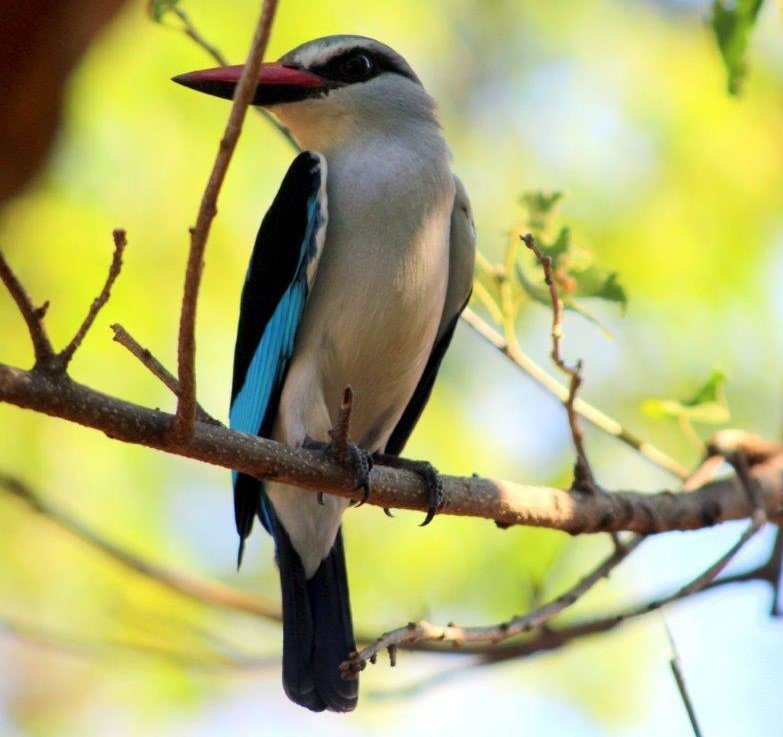
Posted on August 14, 2018 by Ken


Woodland Kingfisher

Woodland Kingfisher

by Anthony Stidolph

I am not a man who deliberately courts disaster or intentionally goes looking for bad experiences. By the same token, I am not such a fool as to think the odd mishap won’t occasionally befall me. And when you go travelling with my birding partner Ken, rotten luck does have a habit of following you around.

For example: on a recent trip to Marakele National Park we found ourselves being chased down a narrow, twisting mountain pass in reverse by a very angry elephant who clearly resented our presence in his private domain.  Luckily – I have a feeling some benevolent deity saw fit to intervene – we survived that harrowing encounter. What I did not realise was that more trouble with elephants lay ahead…


From Marakele we had followed a circuitous route that took us to Blouberg Nature Reserve and then cut east along the base of the Soutpansberg range to Punda Maria in North Kruger. We planned to camp the night here and then press on to Pafuri the next day, where we hoped to get in some good birding.

Up until now the weather had been kindly – more spring than summer and I had even found myself wearing a jacket in the evenings and early mornings. In Kruger, however, the hot weather we had been expecting all along finally caught up with us, with the temperature soaring up to 39 degrees. The air around us was heavy and listless and steamy, almost tropical, perhaps hardly surprising since we had crossed over the Tropic of Capricorn some days before.

Eager to be off, I was up early the next day although I had to first wait for Ken to complete his complicated early-morning-ablution rituals. Once he was done with that, we set off northwards through the familiar vastness of flat grassland and mopane trees. On the way we stopped to allow the biggest herd of elephants I have ever seen cross the road. Shortly afterwards we were forced to repeat this exercise for an even bigger herd of buffalo.

The common bird in this neck of the woods – or at least the most vocal – is the Rattling Cisticola. There seemed to be one trilling its silly head off on top of virtually every second tree we passed.
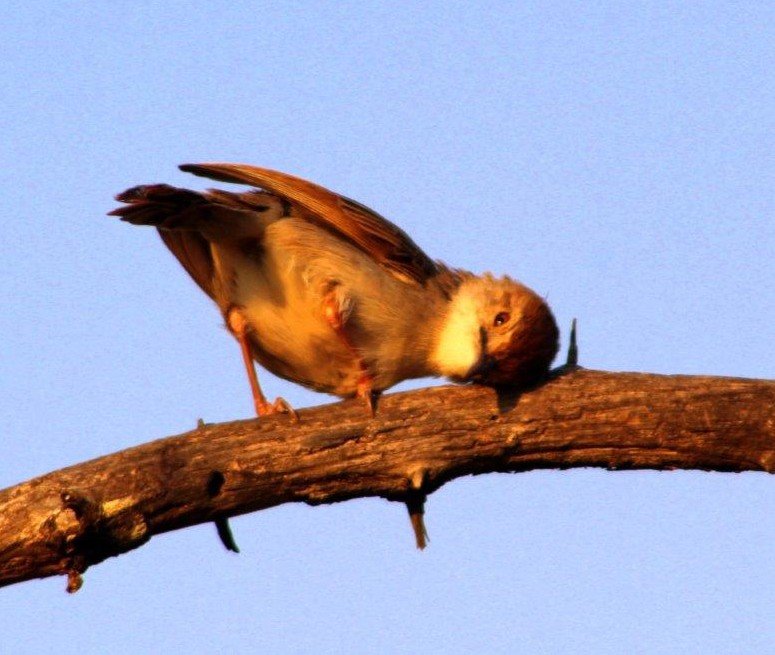
Cisticola, Wailing, Kruger

The highly-vocal Rattling Cisticola – Can rub some people up the wrong way

As you draw close to Pafuri, the terrain starts to break up and rearrange itself and you are suddenly confronted by the arresting sight of Baobab Hill, with its commanding views over the Limpopo Valley. In the early days this iconic hill served as both a landmark and sleepover point for the ox-wagons travelling up from Mozambique.

By the time we got to Pafuri the sun was high and blazing. There had obviously been no rain here this season and the grass was pale and dry, although the trees had mostly come out in leaf.

At the crossroads we turned left down the Nyala Drive, which takes you into some wonderfully hilly country before taking a lazy loop back to the main road. Ken likes this less-used drive because, he says, it often throws up unexpected surprises.

There wasn’t much on offing this time around besides the usual suspects – Meves’s Starlings, Arrowmarked Babblers, Whitefronted Bee-eaters and Emeraldspotted Wood Dove. We passed a solitary elephant but he paid us no mind.

On the top of the small, baobab-clad hillock, directly above where the road swings back, is the Thulamela archaeological site, a restored Zimbabwe-type ruin. Unfortunately you can only go up with a guide and because of our tight schedule we did not have time for that.
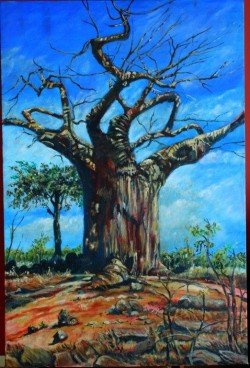
One of the commanding Baobab trees of northern Kruger. This painting by Stidy is available for sale. 42x60 stidy@sai.co.za

One of the commanding Baobab trees of northern Kruger.
This painting by Stidy is available for sale. 42×60 stidy@sai.co.za

From the Nyala Drive we crossed back over the main tar road and followed the dirt track that takes you to Crooks Corner, where the brown waters of the Luvuvhu collide with the blue of the Limpopo. The combination of water, sun and rich alluvial soils has led to a proliferation of vegetation along the rivers’ banks so that you drive through a glittering tunnel of Sycamore Figs, Nyala trees, Jackal Berry, Ana and Fever trees.

Crooks’ Corner, where you can get out of your cars, marks the border between South Africa, Mozambique and Zimbabwe. In the early 1900s this remotest of places gained its moniker and dodgy reputation with gun-runners, fugitives and others on the run from the law, using it as a safe haven because it was easy to hop across the border whenever the police from one country approached.

Distinctly, there was a sense of a frontier on that lazy meandering river, although I don’t think the solitary Saddlebilled Stork fishing in its waters gave a fig where the international boundary lay or as to who held sovereignty over the country he was standing in.

Normally, it feels like you can’t get much further away from civilization than here, but we had chosen a busy weekend to visit so it was like a major thoroughfare with a steady stream of traffic passing through. Many of the visitors didn’t even bother to wind down their windows or get out of their luxury 4x4s because it would mean switching off their air-conditioners. They just drove in, stopped, glanced around and drove out again, leaving me to wonder why they had bothered to come all this way …

Needless to say Ken – who, contrarily, makes it a rule to ALWAYS switch off his air-conditioner when he enters a park because he likes to experience Africa in all its extremes –  and I did get out.

Rich plant life invariably means rich animal and bird life and Pafuri is no exception. In the past the storied riverine forest has provided both of us with some good sightings. It was here I saw my first Gorgeous Bush Shrike, Bohm’s Spinetail and Ayre’s Hawk Eagle. I have also recorded Lesser Jacana, Greencapped Eremomela, Hooded Vulture, Tropical Boubou and the palm-dwelling Lemonbreasted Canary.

This time, we could hear both the Gorgeous Bush Shrike and a melodious Whitebrowed Robin-Chat calling from the depth of a nearby thicket but could not entice either of them out.  Instead we had to make do with a bunch of waders and a noisy party of Trumpeter Hornbills who, I think, were off to join the celebrations in neighbouring Zimbabwe.

It was now well past lunchtime so we doubled back to the Pafuri picnic site on the edge of the Luvuvhu. Feeling somewhat dehydrated, I was desperate for an ice-cold coke but had to wait patiently in queue behind an American who was explaining to the bemused coke seller-cum bird guide – who, I suspect, knew the answer but was too polite to say so – what a turkey is (“It’s a big black bird with a red head”).

At this juncture of its journey the Luvuvhu is always a ruddy brown colour such as might be achieved by mixing cans of tomato soup with cans of chicken soup. There was an enormous crocodile lying directly opposite us, not, as one would expect, by the water’s edge but high up on the bank under some trees. I had a feeling some unsuspecting animal was in for a nasty surprise.

On the way back to Punda Maria, we took the shortcut via Klopperfontein Dam, another place which can throw up some unexpected treats even though the area around the dam has been grazed as smooth as a billiard board. Sure enough, we were rewarded with a wonderful sighting of a Painted Snipe snooping around in the shallows of the nearby stream.

It was getting on for late afternoon by now. Ken consulted Emily, his prissy, admonishing Satnav, and worked out how far we had to go and what time we had to do it in. What neither factored into their calculations was our old nemesis, the elephant.

The first one, which we encountered just after Klopperfontein, kept us waiting for ages, while it feasted on the side of the road, before moving off into the surrounding bush. A little later we passed him siphoning water by the trunk load out of the top of a reservoir.

We ran in to the second one on the home stretch with the hills around Punda Maria in plain sight. Although this bull appeared much more amiable then the one who had chased us down the mountain in Marakele, he had obviously decided he held all the rights to this road.

The whole thing quickly degenerated into a stage farce. We kept reversing and reversing and he kept trundling on towards us. I suspect he was headed for his evening sundowner at the same reservoir where the other elephant was sloshing water around.

One of us had to blink and we did so first. Muttering angrily to ourselves about the beast’s poor road etiquette, we turned around and headed back to the tar and took the much longer route home to Punda Maria.

In Kruger, as in other parks, you are not supposed to arrive in camp after dark, which we now did, finding the gate locked on us. Fortunately, the guard was still at his post but Ken had to use all his silky skills as a sports writer and commentator to try to convince him it wasn’t really our fault. I am not sure he bought our explanation, but he let us through without imposing a fine.

So we drove into camp feeling like a pair of naughty schoolboys who had just been caught bunking …

But we were not done yet. We arrived to a scene of utter devastation – in our absence a troop of baboons had ransacked the place, flattening my tent, breaking its poles and ripping gaping holes in the fly-sheet (even though there was nothing inside but my bedding and clothes), as well as scattering our possessions far and wide.

To tell you the truth I was getting seriously tired of this. I had just bought the tent to replace the one that got ripped by monkeys in Mapungubwe on my last trip which, in turn, I had bought to replace the one that had suffered a similar fate at the hands of baboons when I attended a wedding in De Hoop Nature Reserve in the Western Cape. At the rate I was getting through tents, it would have been cheaper to have just booked into a luxury lodge!

I am not sure what one does about this menace. The problem is both monkeys and baboons have become habituated to both human beings and human beings’ food.

We did discover afterwards that there was supposed to be a guard on duty to stop these opportunistic raids but, even though the campsite was virtually booked out, he had decided to take the Sunday off …

I was still sulking about my poor tent the next morning when we drove out of the gate, destination Mapungubwe. There to wish us on our way was the scruffiest Ground Hornbill I have ever seen. It flew up into a tree from where it regarded us quizzically through its girlishly-long eyelashes.

For some reason the sight of that lugubrious bird, peering around its branch, cheered me up no end. It made me realise that on the Richter Scale of Travel Disasters we had got off relatively lightly compared to what other great explorers, like David Livingstone or Scott’s Antarctic expedition, had been forced to endure…


ANTHONY STIDOLPH

2015 SuperRugby preview – SA franchises 0

Posted on June 11, 2018 by Ken


SHARKS


Coach – Former Bath and Kobe Steelers coach GARY GOLD has brought a fresh approach to player management and an emphasis on more attacking play since taking over from Jake White, who left the Sharks at the end of September at a crucial stage of the Currie Cup. The current Montpellier coach left Durban in something of a pall, the fans not happy with a territory-dominated game plan and the players and other coaches not enjoying White’s abrasive management style.


Top Players – The Sharks probably have the most star-studded team of the South African Conference, starting with the first-choice Springbok front row of Tendai Mtawarira, Bismarck and Jannie du Plessis, the exciting lock pairing of up-and-coming Pieter-Steph du Toit and experienced former Saracens and England player Mouritz Botha, a loose trio headlined by Springboks Willem Alberts and Marcell Coetzee, the incumbent Springbok halfback pair of Cobus Reinach and Pat Lambie, and plenty of quality outside them in former Racing Metro centre Francois Steyn, and JP Pietersen and Lwazi Mvovo on the wings.


Captain – BISMARCK DU PLESSIS is arguably the best hooker in the world and a talismanic figure for both the Springboks and the Sharks with the huge physical presence he brings to the game. The veteran of 70 Tests turns 31 in May, but he will want to show he has many golden years ahead of him.


Last year – The Sharks won the South African Conference but finished third on the final round-robin log following crucial late defeats at the hands of the lowly Stormers and Cheetahs which cost them the home semi-final they always seemed to be heading for. That condemned them to a quarterfinal against the Highlanders before travelling to Christchurch to play the Crusaders, who romped home 38-6 in the semi-final. Many critics blamed the Sharks’ “stone-age game-plan” for their failure to turn their forward dominance through most of the campaign into a home semi-final.


This year – The Sharks, with almost all of their stars returning to action and some valuable additions to their squad, are obviously amongst the favourites to win the title. The more positive approach of Gold, plus the input of tactical guru Brendan Venter, should make them even more of a threat this year. But the effects of change can also be disruptive and how well the Sharks adapt remains to be seen.


STORMERS


Coach – The demands of the fickle supporters in the Western Cape have finally had their toll on ALLISTER COETZEE and the former Springbok assistant coach will head to Japan to replace Gary Gold at the Kobe Steelers at the end of the SuperRugby season. Western Province, basically the Stormers minus their Springboks, are the Currie Cup champions, but the Stormers have always offered much in the southern hemisphere competition without delivering the goods. Since reaching the final in 2010 and the semi-finals in 2011 and 2012, they have slipped down the standings to seventh in 2013 and a parlous 11th last year, their worst finish since 2006. So the pressure is on Coetzee to finish his five-year stint as head coach on a high.


Top players – The Stormers have rectified their former ills by assembling a powerful pack that includes stars such as prop Frans Malherbe, one of the best loose trios in the competition in Schalk Burger, Nizaam Carr and Duane Vermeulen, and two tremendous locks in Eben Etzebeth and former Biarritz star Manuel Carizza, who has 44 Test caps for Argentina. Given enough ball, backs like Juan de Jongh, Damian de Allende and Cheslin Kolbe certainly have the ability to beat opposing defences.


Captain – It is probably only a matter of time till DUANE VERMEULEN becomes the Springbok captain and the SA Player of the Year for 2014 will lead from the front in trying to make Newlands one of the toughest lairs of all. An indefatigable eighthman, Vermeulen is a powerful force with ball in hand, a steely defender and a potent force at the breakdown, as well as being a natural leader.


Last year – The Stormers had little to smile about in their 2014 campaign, the highlights being their wins over the Sharks and Bulls at the back-end of the competition that effectively messed up the chances of their South African rivals. They were hard hit by injuries up front but also struggled to match the tempo of play set by overseas opposition.


This year – The Stormers looked a different side in winning eight of their 10 Currie Cup matches and claiming the title in a dramatic final, upping the pace of their play, looking to keep ball in hand more and generally playing more positive rugby, all with an eye on this year’s SuperRugby campaign. Their coaching staff have put a particular emphasis on conditioning as they believe the game has changed into a much more high-intensity affair and they certainly seem better equipped for a title challenge this year.


BULLS


Coach – Patience could well start running out for coach FRANS LUDEKE, who at times last season sounded like a broken record as he bemoaned his side’s poor execution and utter failure to get results away from home. But the momentum of the three previous years that saw the rebuilding Bulls rise from seventh to fifth to second on the log was broken by poor contracting of players that saw a raft of first-choice stars leave Loftus Versfeld, forcing Ludeke to start the rebuilding process again.


Top players – With Handre Pollard pulling the strings at flyhalf, and Jan Serfontein next to him, the Bulls are hopeful of being a much more effective attacking force this year. The pack has been boosted by former Cheetahs stars Lappies Labuschagne, Trevor Nyakane and Adriaan Strauss electing to play their rugby with the Bulls this year. With Springboks Victor Matfield, Pierre Spies, Arno Botha, Marcel van der Merwe and Deon Stegmann also up front, the backs should have plenty of front-foot ball to play with.


Captain – PIERRE SPIES has plenty of pressure to deal with this year: Not only does he need to meet the expectations created by the proud tradition of Bulls rugby, with their last major trophy coming five years ago, but he is also struggling to regain his place in the Springbok squad ahead of the World Cup. Spies, who has not played much rugby over the last two years due to injury, sometimes seem caught between the more traditional eighthman style of play that suits his former life as a wing, and the more robust, tighter approach the Bulls’ game plan seems to favour.


Last year – Already ravaged by the exodus of unhappy players to foreign clubs, the Bulls were then hard-hit by injuries to key loose forwards Botha, Spies and Stegmann. But they were even harder-hit by their self-inflicted sorrows away from home, crucial errors seeing them fail to win a single game on the road. Their only blemish at home came when they were held to a draw by the Chiefs, but by losing away games to the Lions and Stormers in the closing weeks of the competition, they dropped out of playoff contention and finished ninth.


This year – There is more optimism about the Bulls’ chances this year because they have focused on developing a more expansive style of play, they have been willing to spend some money in obtaining three key players from the Cheetahs, and surely their top players will stay injury-free this year and actually be able to play more rugby.


CHEETAHS


Coach – NAKA DROTSKE has been at the helm of the Cheetahs since the 2007 season and has only managed to steer his side into the top-10 once, in 2013. But the gains of that year were reversed in embarrassing fashion last year as the Cheetahs tumbled to 14th on the log and the former Free State captain was sent to the United Kingdom to study new coaching techniques. The pressure is clearly on Drotske.


Top players – Newly-capped Springboks Lood de Jager and Oupa Mohoje provide the spark amongst the pack, while prop Coenie Oosthuizen weds plenty of physicality with surprising mobility and skill at the breakdown. Willie le Roux and Cornal Hendricks provide plenty of joy with their lovely attacking skills at the back, but there were hints towards the end of last year that the honeymoon might be over for them as defences grow wise to their tricks.


Captain – Loyal lock FRANCOIS UYS has exchanged his status as a stalwart performer in the pack for the captain’s armband this year. A hard-working 28-year-old, Uys does not shy away from the physical battle up front, but also has useful ball-skills suiting the free-flowing style of rugby the Cheetahs prefer.


Last year – The Cheetahs did well on attack, playing some thrilling rugby as they scored 37 tries. But their defence was full of holes and conceding 58 tries and an average of 33 points per match saw them plummet from sixth in 2013 to second-last in 2014. Despite the talent available to them and their enthusiasm for positive rugby, the Cheetahs were not well-coached last year.


This year – With their coach almost at the exit door and key players such as Racing Metro flyhalf Johan Goosen, hooker Adriaan Strauss, prop Trevor Nyakane and flank Lappies Labuschagne already gone, it is hard to see the Cheetahs finishing anywhere but in the bottom handful of teams.


LIONS


Coach – Former Springbok lock JOHAN ACKERMANN comes across as a genial giant, ever polite and humble, and this has led to a far happier camp at Ellis Park. But he is far more than just a pretty face as evidenced by his ability to get the best out of relatively limited resources. The Lions have not only produced the results under his leadership but have played attractive rugby while impressing with their forward play, especially their scrummaging.


Top players – While his squad does not boast any superstars, Ackermann has reason to be chuffed by the development of his players over the last 18 months. Critically, he has a powerful front row anchored by Julian Redelinghuys, tremendous loose forwards in Warren Whiteley, Jaco Kriel and Derick Minnie, and two Springbok flyhalves in Marnitz Boshoff and Elton Jantjies.


Captain – At times WARREN WHITELEY seems too skilful, pacy and innovative to be a Springbok forward and he has been a driving force behind the Lions’ high-tempo style of play. Hugely popular as a leader, he is also highly-respected, especially overseas, as a player.


Last year – The Lions marked their return to SuperRugby with a highly-commendable 12th-place finish, winning a franchise record seven games. Given that they had no high-profile players after being cast into the SuperRugby wilderness in 2013, many are still wondering how they managed to do it. The answer is simple: through determination, tremendous belief, commitment, passion and pride, work ethic, positive intent with ball in hand and technical accuracy up front.


This year – The Lions did all that could have been expected and more in the Currie Cup, suggesting that this team is continuing to grow and improve. They do have a challenging draw this year, however, going on tour in Week Four – they did struggle overseas in 2014 – and only having a bye in Round 10.


The John McFarland Column: SA’s SuperRugby downgrade hard to understand 0

Posted on April 12, 2017 by Ken


Sanzaar obviously had to make changes to SuperRugby because the crowds were not reflecting the status of the competition, but I struggle to understand why South Africa have to give up two teams.

Our previous wins at the Sanzaar negotiating table have been because we could always use the threat of going to Europe and our TV figures to get our own way.

So why do New Zealand keep five franchises and South Africa have just four, but we’re a much bigger nation! I know the argument based on the performance of the teams, but in 2013 we had four teams in the top eight and in 2012 three sides in the top six. So we have had the strength, and the Bulls were a dominant force in SuperRugby from 2005-2010, which is not so long ago!

So I struggle to comprehend how a team like the Cheetahs, who are such a strong rugby region, can be facing the axe. Everyone understands that the Kings will have to go due to their financial woes and because they are propped up by Saru, but it will be very disappointing to lose the Cheetahs after they have been in SuperRugby for so long. And the Free State and Griqualand West region has provided a heck of a lot of players who have gone on to greater things.

What really concerns me is that the Springboks will miss out on an extra 30 players to choose from, while New Zealand will have a pool of 150 SuperRugby players, a 20% bigger selection pool.

And it’s easy to say we will retain more players because we will now have more money, but as Faf de Klerk’s offer from Sale shows, guys can still earn more than triple what they’ll get in South Africa by going overseas. I believe we’ll actually retain fewer players because there will be less opportunity with only four franchises. Our coaching ranks will also be diminished with less opportunity for them too.

The funny thing is, a year ago Sanzaar said everything was fine and a big fuss was made about how the new format would mean much less travel for South African sides – a maximum of two flights overseas.

The tournament did need expansion and Argentina have now been able to keep their best players, they haven’t gone to Europe, because there’s a clear pathway for them to develop and express themselves at the highest level. We’ve seen that with the Sunwolves too.

People say it’s not our job to develop rugby in South America and Asia, but that’s shortsighted. Rugby has to be a global game, if it just stayed within the Commonwealth and Argentina, it would die.

Exposing a team from Japan to higher levels of rugby has certainly brought an improvement to their play. There were 22 000 people at the Bulls game in Tokyo and the excitement was incredible, especially considering that the last game in Tokyo saw the Sunwolves lose 83-17 to the Hurricanes!

But there was a great atmosphere and huge interest in the Bulls game, but more on that shock result later on.

In my view, the SuperRugby format should be a 16-team competition – so five New Zealand and South African franchises, four from Australia and the Sunwolves and Jaguares – with everyone playing everyone else once. You would have two three-week tours as part of that.

Six teams would then progress to the playoffs, with the top two sides initially having a bye straight into their home semis against the winners of the quarterfinals, which would be third versus sixth and fourth against fifth.

This weekend I am really looking forward to the match between the Lions and the Stormers, which should be a high-tempo, all out attacking game, but the side that defends best will win it. For the main Easter weekend game to be between the two conference leaders is going to provide a great spectacle.

The quality and skill level of the Stormers last weekend against the Chiefs shows that they have reached a new dimension and you have to credit Robbie Fleck and his staff, and the players, for their willingness to play like that. It’s really high-risk, high-reward rugby and, believe me, it has to be coached!

What was especially pleasing was the way they really matched a New Zealand team at the back end of the game, when it’s normally been a huge struggle for South African teams.

The Sharks also had a good win, even though they are not scoring a lot of tries. They are playing off the other side’s mistakes, like their spectacular intercept try against the Jaguares.

They hung on in there against the Argentinians and it was an important win for their conference, although they will be a bit disappointed they gave the Jaguares a point. But it’s good that they were able to grind it out, hopefully they can get on a roll and get their confidence going.

The humidity in Durban made the ball very slippery and there were similar conditions for the Bulls in Tokyo, a match I was fortunate enough to attend. It was very wet and the Sunwolves managed the conditions better. The Bulls are not far off but they were simply not good enough last weekend.

They took time to get into their stride, they struggled to get control of the game. But then they had control when they were nine points ahead, they were in the pound seats, but the yellow card obviously had a huge influence.

After that the Sunwolves took a scrum with 10 minutes to go and scored the matchwinning try. The lesson for the Bulls is that when a backline player like Jan Serfontein gets a yellow card, then you must replace him. It’s better to have a full backline because you need that speed on defence. It was standard procedure when I was with the Springboks that if a backline player got a yellow card late in the game then we would take a forward off and replace him. Otherwise you’re defending with six versus seven, which is why the Sunwolves were able to break out so easily.

The Sunwolves were also able to keep the ball in play and did a good job of nullifying the Bulls’ lineout maul threat by standing off. That meant the Bulls had to mostly play from static ball. The home side were also very good with their kicks and chips, while the Bulls could have done much better with their chips, especially the one from their own 22 that led to a try.

The Bulls will be really hurting, but they now have a lot of games at home. No other team in the competition has had such a tough start away from home, and the Bulls will now hope they can get some form and a winning run at Loftus Versfeld.

John McFarland is the assistant coach of the Kubota Spears in Japan and was the Springbok defence coach from 2012 through to the 2015 World Cup, where they conceded the least line-breaks in the tournament and an average of just one try per game. Before that, McFarland won three SuperRugby titles (2007, 09, 10) with the Bulls and five Currie Cup crowns with the Blue Bulls. In all, he won 28 trophies during his 12 years at Loftus Versfeld.

Tenacious Highveld Lions’ colours not lowered yet 0

Posted on February 08, 2017 by Ken


The Highveld Lions may be languishing in fifth place on the Sunfoil Series log, but it’s been a topsy-turvy competition and their colours have not been lowered yet as they go into the final weekend of fixtures in South Africa’s premier domestic tournament.

The Lions are 11.28 points behind the log-leading Titans and 8.90 points behind their opponents at the Wanderers from Thursday – the Knights.

So they simply have to beat the Knights and hope that the Warriors manage to prevent the Titans from winning their match in Benoni. They could also do with the Dolphins and Cape Cobras drawing in Durban.

That the Lions are still in the running is thanks to their remarkable, last-ditch 14-run victory over the Warriors last weekend in East London, set up by a couple of bold declarations.

“We’re happy that we’re still alive and the key now is to win this weekend. We’ve played well at home over the last four years and it’s simple, we just have to control our own game and not concentrate on the others. We can’t have one eye on the other games because we’re up against a quality side in the Knights. But we will keep fighting like we did when we finished in the dark with just two or three overs left against the Warriors,” coach Geoff Toyana told The Citizen on Tuesday.

It was a special effort by the Lions attack to dismiss the Warriors for just 243 in 68 overs on a rainy final day and Toyana praised his bowlers after the weather had forced captain Stephen Cook to declare earlier than he would have liked.

“It was a great result and the character shown, the belief and fight, was very good. Aya Myoli (3-58) really came through for us by striking up front and kept running in, while Beuran Hendricks (3-70) and Bjorn Fortuin (3-39) were also very good on the last day.”

Keith Dudgeon and Nono Pongolo, who did not play against the Warriors, have been retained in the squad to meet the Knights and one of them could play if the Lions decide to go with an all-pace attack.

The Knights will come to Johannesburg with Theunis de Bruyn and Rudi Second amongst the most successful batsmen in the competition, while fast bowlers Duanne Olivier and Marchant de Lange have spearheaded their attack.


  • Recent Posts

  • Archives

  • Thought of the Day

    Revelation 3:15 – “I know your deeds, that you are neither cold nor hot. I wish you were either one or the other.”

    How can you expect blessings without obeying?

    How can you expect the presence of God without spending time quietly before him?

    Be sincere in your commitment to Him; be willing to sacrifice time so that you can grow spiritually; be disciplined in prayer and Bible study; worship God in spirit and truth.

    Have you totally surrendered to God? Have you cheerfully given him everything you are and everything you have?

    If you love Christ, accept the challenges of that love: Placing Christ in the centre of your life means complete surrender to Him.


↑ Top