for quality writing

Ken Borland


Lions expose the Jaguares’ pseudonyms with terrific defence 0
Posted on July 21, 2018 by Ken


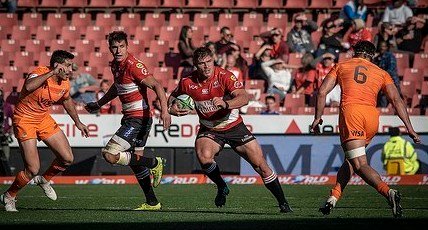
Lions hooker Malcolm Marx on the rampage once again. Photo by Marcel Sigg, runridedive.com

Lions hooker Malcolm Marx on the rampage once again. Photo by Marcel Sigg, runridedive.com

When the ACT Brumbies’ style of play dominated rugby in the early 2000s there were many pseudonyms for what they were doing – structured rugby, expansive rugby, multiphase play, all set up by skilful ball-carriers.

The Jaguares reminded me a bit of that multiphase play at Ellis Park on Saturday afternoon as they valiantly held on to the ball for phase-after-phase. But the game has moved on since the glory days of Gregan, Larkham and Finegan and these days teams trust their defences to hold out for long periods, eventually forcing the error or a one-off runner that is vulnerable to the breakdown steal.

We saw it in the Crusaders’ victory over the Sharks in the other SuperRugby quarterfinal featuring a South African side earlier in the day, and the Lions’ defence was the biggest factor in their 40-23 win over the Jaguares.

As the Jaguares pushed and prodded with more determination, so the Lions just worked harder and with more physicality in defence, simply not allowing the Argentinians to get their game going. Hooker Malcolm Marx led the way with vital turnovers, but Marnus Schoeman also contributed valuably and Kwagga Smith was also a presence at the breakdown.

“Collectively it was a massive effort and you have to give credit for all the turnovers to the guy who makes the tackle as well because he provides the opportunity. A guy like Malcolm is then just impossible to shift, Kwagga made one or two steals as well and Marnus was excellent when he came on. At stages the Jaguares kept the ball for a long time, but we showed good patience on defence,” Lions captain Warren Whiteley said after his team had clinched their third successive SuperRugby semifinal at home.

Run Ride Dive

Captain Warren Whiteley epitomises the Lions defence with this hit on Agustin Creevy. Photo by Marcel Sigg, runridedive.com

The Jaguares are certainly a force to be reckoned with going forward in SuperRugby, as they showed in the third quarter when they came from 9-24 down at the break to close to 23-27.

They were piling on the pressure, but Marx won three turnover penalties and those are the crucial interventions which win knockout games, with coach Swys de Bruin talking afterwards about “great defence at the right times”.

Jaguares coach Mario Ledesma spoke afterwards about how disappointing it was to concede three “soft” tries in the first half, but the Lions are a clever, innovative side on attack, able to try different things and generally pretty clinical.

All three of the tries came from different kicks: An Elton Jantjies crosskick found wing Ruan Combrinck with pinpoint precision for the first try; centre Harold Vorster followed lovely sleight of hand with a clever kick through that became even more effective thanks to the pace of Aphiwe Dyantyi getting there first to hack through and allow Vorster to score after the Jaguares made a mess of the clean-up operation; and a little dink over the top by flyhalf Jantjies was gathered by scrumhalf Gonzalo Bertranou, but his loose pass was immediately intercepted by Marx, who roared away from the 10m line for the try.

The Lions were cruising with a 24-9 halftime lead, but the admirable Jaguares were not done yet though as Bautista Delguy used his quick feet to score a fine try down the right wing two minutes after the break, and seven minutes later the visitors scored again as flank Pablo Matera crashed over. It was not the best grubber kick by the Lions that had given them broken-play possession.

Flank Cyle Brink, after a barnstorming first half, did not come out for the second half due to a shoulder ‘stinger’, but it was not a problem for the Lions as his replacement, Schoeman, played with tremendous industry. He showed terrific tenacity in the build-up to Andries Coetzee’s try as the fullback wriggled through a couple of tackles.
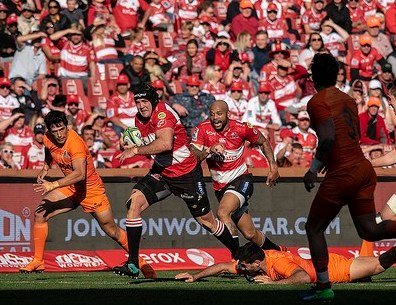
Lions flank Cyle Brink on another storming run. Photo by Marcel Sigg, runridedive.com

Lions flank Cyle Brink on another storming run. Photo by Marcel Sigg, runridedive.com

A typically combative Marnus Schoeman. Photo by Marcel Sigg, runridedive.com

A typically combative Marnus Schoeman. Photo by Marcel Sigg, runridedive.com


Being a knockout game, coach De Bruin had deemed shots at goal acceptable and Jantjies, who produced a polished performance that included a seven-from-seven success rate from the tee, then slotted a sweetly-struck drop goal to take the Lions’ buffer to two converted tries (37-23).

The seventh successful kick at goal by Jantjies was the penalty that completed the scoring with five minutes remaining, confirming that they will host the Waratahs at 3pm next Saturday in the semifinals.

The other huge positive for the Lions was the tremendous dominance of their scrum. The number of set-pieces was relatively low, but whenever the home side needed it, their scrum won them penalties or gave them strong front-foot ball.


The John McFarland Column: Extremely encouraging 1st Test win for Boks 0

Posted on June 14, 2018 by Ken


It was extremely encouraging to see a really transformed Springbok team play some superb rugby in beating England in the first Test at Ellis Park at the weekend, and you have to give the head coach, Rassie Erasmus, a lot of credit for how his team were able to come through in the end.

England were superfired-up and it’s never easy to win a Test against them, and one can see how the amazing comeback win has uplifted everyone in the country.

At the start, there were some setting issues for the Springbok defence, they were too tight. The wings generally set the width of the defensive line and you’re looking for field coverage from them to the ruck. Depending on the speed of the ball out of the breakdown, you can get 70 to 85% coverage or even 90-95% of the field covered if it’s very slow ball.

They also were trying to come in on England’s second-last player, but the tourists were very clever and they used skip passes, which enabled them to easily get through, as they did when they engineered a two-on-one on Willie le Roux for Owen Farrell’s try. The Springboks also had a disconnected defensive line for the late outside runner from 10 which the English were able to exploit.

So the home side found themselves in a heck of a position – 24-3 down after 17 minutes. The biggest change after that was that England did not see the ball in the middle of the game. For the Springboks to turn ahead of England at halftime echoed so many of the Lions’ games at altitude at Ellis Park – the opposition would go ahead early, but the Lions would always come back in that death-zone period at altitude 15 minutes before halftime.

You could see England were struggling to fold and the key issue was the number of turnovers that Duane Vermeulen got at the breakdown. They were all around halfway and the Springboks were able to kick the penalties for great field position and get their lineout drive going.

South Africa’s third try was a perfect example of that: the maul with poor defence from England in the 22 and an easy walk-in for the open wing, and you have to give Sbu Nkosi credit for working his way all the way around off his wing and getting the inside ball from Aphiwe Dyantyi, the other wing.They both showed a willingness to support off their wings.

At altitude, the game is always so fast and it was perfect conditions for rugby, which is why 56 points could be scored in the first half. There was some calmness though at the start of the second half and it was almost like a huge sigh for the crowd of more than 55 000 as both teams hit each other hard on the gain-line.

I do believe England missed a trick though by taking lock Nick Isiekwe off after just 36 minutes. Sure, Brad Shields, normally a loose forward, made an impact and gave them more mobility, but I felt the England scrum had been quite dominant until that point. You could see the energy South Africa got from the set-pieces after that and rugby is obviously still confrontational at set-piece at Test level. It also left England with only one real jumper in Maro Itoje and that key lineout at the end of the game was lost.

In the first quarter, England cut the Boks’ line so much, and exerted set-piece pressure, but once they made the change at lock it changed. They obviously wanted to play a ball-in-hand type of game, to not have lots of set-pieces. They wanted to keep the ball alive and have a broken-play type of game.

These were the tactical errors made by Eddie Jones, only having loose forwards on the bench instead of another lock. You still need a set-piece or else you will concede penalties.

After the first 20 minutes, the Springboks rarely allowed England into their own half by forcing turnovers and dominating territory. They were totally dominant and rampant in the middle period and it’s been a long time since we’ve seen that – the last time was probably against France last June, so the Ellis Park factor carried on.

When England tried to exit with box-kicks, Vermeulen was there to field them and take the pressure off the debutant wings.

But there were only three points between the sides at the end, which makes one think back to the Elliot Daly howler when he just needed to dot the ball down to prevent Nkosi scoring.

South Africa also didn’t finish all their chances and it’s fair to say England controlled the first 15 minutes and the last 15 minutes, and the Springboks were in charge for the middle 50. If England had won that last lineout, who knows what would have happened with the way the game ebbed and flowed.

The match was a fantastic spectacle and hopefully the next two Tests are sold out because we can definitely see the fact that the crowds are enjoying watching the Springboks win again. It will be a great Test on the weekend in Bloemfontein and I remember all the way back to 2000 when Jonny Wilkinson kicked eight penalties and a drop goal there to give England a 27-22 victory.

It was the penalty count that destroyed England too at Ellis Park last weekend and they came mostly from the scrum or breakdown. England need to carry the ball better and get their cleaners there quicker and more effectively and pick another lock!

The Springboks’ set-piece became stronger and can be a real weapon, it was really encouraging to see RG Snyman really come through. He clearly has a lot of athleticism and is so good in space.

The Boks need the same attitude and attacking mindset this weekend.

Maybe the most important positive so far for the Springboks though is that they have taken a lot of players out of overseas eligibility with 16 new caps in the first two weeks of Rassie Erasmus’s reign!


John McFarland won three SuperRugby titles (2007, 09, 10) with the Bulls and five Currie Cup crowns with the Blue Bulls as their defence coach. In all, he won 28 trophies during his 12 years at Loftus Versfeld.

He is currently the assistant coach of the Kubota Spears in Japan and was the Springbok defence coach from 2012 through to the 2015 World Cup, where they conceded the least line-breaks in the tournament and an average of just one try per game.


The John McFarland Column – Great expectations for the Boks 0

Posted on June 06, 2018 by Ken


I had great expectations for the new-look Springboks last weekend against Wales and I thought a young and energetic team under a fresh coaching staff would play with real vigour and physicality. So it was a surprise to see them play so ponderously and under pressure they seemed scared to take the initiative and impose themselves on the Welsh.

It was strange to see a guy like Ivan van Zyl, who at the Bulls is always keen to move the ball, to keep the flow going, suddenly slow the whole game down. He normally plays an up-tempo passing game, so why did he become a box-kicking player in one week?

To offer some perspective though, it was a difficult away Test and it was obviously just a money-making venture to send them all the way to Washington. It was the  Springboks’ choice  to have only one training session in Washington, and a captain’s run and then play. An international coach has a lot of time for planning and preparation, with Rassie Erasmus resigning from Munster in November,  they had those alignment camps, but they chose not to have training camps which possibly came back to bite them in hindsight.

The conditions were the same for both sides, the Springboks really needed to play a lot more adventurously. Obviously Wales also did a lot of kicking, but whenever the Springboks fielded the ball they tended to slow things down, a whole line of forwards involved in the ruck very slowly setting up the box-kick, and it meant there was no width to the chase. That whole set-up tactic also gives time for the opposition to drop men back to deal with the kick they know is coming because there is no attacking shape, and it’s made easier for them because the chase is so narrow, the Springboks exposing themselves out wide. The big problem for the Springboks was that Wales were able to deal with their kicks and showed more adventure; they were able to put in attacking kicks on the open wing, regain possession and put more pressure on the Boks.

On the positive side, the Springbok set-pieces were good, they scrummed well and were able to get their own lineout ball well, forming the driving maul easily and quickly. Marvin Orie also had the measure of the Wales lineout at the end of the game and was able to steal some crucial balls.

The defence was not up to scratch according to Erasmus, but I didn’t think it was too bad, they had good line-speed when they were set and generally kept the attack from getting gainline and momentum. There are things that they need to put in place better, but they’ve got time now ahead of the first Test against England.

The first try conceded was because of the ball just squirting out at a ruck, while the scrumhalf try after that came after a very poor kick-chase and there was a blocker in the line who took out our props. I don’t understand why they are front-line on a chase, you don’t want to expose them to wings or fullbacks. The Springboks then did not get set in the pillar area, they were moving outwards at pillar two when Tomos Williams broke, which is a basic error.

Obviously they regrouped at halftime and the Springboks’ line-speed forced an error and Travis Ismaiel’s intercept try brought them back in the game. Having been 14-3 down, they did well to get back into it.

But then came the last try conceded by the unfortunate Robert du Preez. One had to ask where the blockers/screen were around the ruck? There was massive space left which enabled Wales to come through easily and put pressure on the replacement flyhalf. Two chargedowns in a passage of play will definitely lead to a try at this level.

While Du Preez had his problems at the end, I also didn’t feel Elton Jantjies controlled the game that well. Van Zyl also did most of the kicking and I think it was probably an instruction for them to kick from scrumhalf because that’s what worked for Rassie at Munster, but then he did have Conor Murray, the best scrumhalf in the world!

Apart from the Springbok scrum being good, they were also very flat and direct on attack from the scrum and they went hard over the gain-line. Jantjies did a lot of this too, but then that means the flyhalf is on the floor for the next two rucks and by the time he is back up on his feet he has static ball, which is why Elton used the outlet of a kick-pass so often. No flyhalf enjoys not having quick ball because that’s when the defence dictates and rushes, and a static flyhalf easily has his wide runners picked off.

The Springboks now need to get back to their best quickly for the England series, which everyone is really looking forward to. It certainly is interesting, as it always is with Eddie Jones and his words off the field. He’s under pressure and deflecting from the fact that England have lost their last four games, which is quite a run and includes their worst ever loss at Twickenham, against the Barbarians in their last outing. They are coming in with no confidence and they rarely win in South Africa – three wins in 13 Tests – so Eddie could be staring down the barrel of seven successive defeats if the Boks hit their straps.

The Springboks are also under pressure though because a world ranking of seven is certainly not where a side with the strength and rugby culture of South Africa wants to be. But it will be a completely different game to Erasmus’s first one in charge, playing at altitude at Ellis Park, which is a super-quick, big field with quick ball.

It’s a bit strange that England have gone to Durban to prepare and have not come straight to altitude. Maybe they wanted to escape winter on the Highveld, but they are definitely going to feel it at the back end of the game and they will need a strong bench to cope. At altitude you have to use 23 players.

I am looking forward to seeing Willie le Roux back at fullback, and with Handre Pollard at flyhalf it means the Springboks have left and right-footed kickers. Willie is tremendous at seeing things on the field, he has great vision in terms of spotting space, and chips and other little kicks -plus he’s lightning quick -to exploit it. He’s also very safe under the high ball.


John McFarland was the Springbok defence coach from 2012 through to the 2015 World Cup, where they conceded the least line-breaks in the tournament and an average of just one try per game. He won three SuperRugby titles (2007, 09, 10) with the Bulls and five Currie Cup crowns with the Blue Bulls as their defence coach. In all, he won 28 trophies during his 12 years at Loftus Versfeld.

He is currently the assistant coach of the Kubota Spears in Japan.


Standard Bank jump in at grassroots level to ensure decent opportunities for all 0

Posted on October 31, 2017 by Ken


That there is enormous cricketing potential in this country is generally accepted, but due to a variety of reasons, it is tough for Cricket South Africa (CSA) to ensure all our communities get decent opportunities to play the game.

CSA’s development programmes are one thing, but what happens next? How do those talented young cricketers in the outlying areas then get to play enough decent matches, how are they transported to matches, what facilities do they have with which to hone their game? Are they given the love of cricket and then just left to their own devices?

CSA identified these problems and came up with the idea of hubs and regional performance centres (RPCs).

The RPCs have been a heck of a success in ensuring it is no longer the case that talented young cricketers from disadvantaged areas are lost to the system due to socio-economic circumstances. And, in tremendous news for South African cricket, it has been announced on Thursday that Standard Bank, the headline sponsors of the Proteas, will no longer be focused on just the pinnacle of the pipeline, but are now making a major contribution at grassroots level with their sponsorship of the RPC programme.

The implementation of the RPC programme means CSA are now making great headway in terms of building relationships with communities and local municipalities. And now this progress will be accelerated thanks to the support of Standard Bank, who have added this vital development initiative to their naming rights sponsorship of the national team.

“Standard Bank has been a key supporter and sponsor of the Proteas for many years and by sponsoring the RPCs we hope to develop the immense cricketing talent we have in our country.

Budding young cricketers in many outlying areas are still in desperate need of facilities and coaching, and this RPC in Soweto will assist in helping these players fulfil their true potential and turn their dreams into reality,” Vuyo Masinda from Standard Bank said at the launch of the new deal at the Dobsonville RPC in Soweto on Thursday.

There are RPCs in all nine provinces, with each having several hubs in their stable acting as feeders. Having a centralised venue dedicated to nurturing the disadvantaged talent in the vicinity allows CSA to pour resources into it, ensuring there is adequate infrastructure with which to develop quality cricketers.

Girls and women’s cricket is also included in this programme.

The quality of coaching is also of the greatest importance and each RPC must have a head coach who is Level III certified and an assistant coach who is Level II certified. The Hubs must have a head coach who is Level II certified and an assistant coach who is Level I certified.

The feeder system for the Hubs starts with the KFC Mini-Cricket programme and, thanks to the Momentum Friendship Games, the Hubs and RPCs get to play against the leading schools in their area.

Some of the franchise players who will be acting as mentors for the programme include Omphile Ramela, Malusi Siboto, Khaya Zondo, Mangaliso Mosehle and Temba Bavuma.

  • Recent Posts

  • Archives

  • Thought of the Day

    Revelation 3:15 – “I know your deeds, that you are neither cold nor hot. I wish you were either one or the other.”

    How can you expect blessings without obeying?

    How can you expect the presence of God without spending time quietly before him?

    Be sincere in your commitment to Him; be willing to sacrifice time so that you can grow spiritually; be disciplined in prayer and Bible study; worship God in spirit and truth.

    Have you totally surrendered to God? Have you cheerfully given him everything you are and everything you have?

    If you love Christ, accept the challenges of that love: Placing Christ in the centre of your life means complete surrender to Him.


↑ Top