for quality writing

Ken Borland


Absorb intensity and assess the situation: Princely advice and what was lacking 0

Posted on October 13, 2026 by Ken

In wonderful batting conditions, South Africa dismayed their sparse number of supporters at the ground with a naive, almost clownish batting display.
The Ball in Play

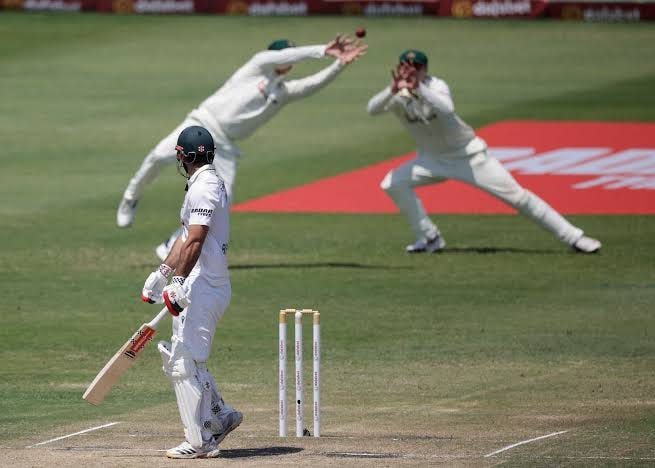
Steve Smith is about to catch David Bedingham, who has played an ill-advised back-foot drive, for one of his four catches, three of them brilliant, which gave him the world record for the most outfield catches – 223.

Absorbing intensity and assessing the situation were the two key phrases used by Proteas batting coach Ashwell Prince at the end of the third day of the first Test against Australia at Kingsmead on Sunday.

It was a day which ended with Australia leading by 139 runs with all 10 second-innings wickets intact. That fact alone suggests things did not go well with the bat for South Africa, who had begun the day on 27 for one in reply to Australia’s 390.

While it may seem appropriate to blame the bowlers for allowing the tourists to score so many first-innings runs, having been 124 for six at one stage, Australia’s revival was down to the conditions easing and the brilliance of Matt Renshaw in scoring a career-best 190 which was the epitome of patience and good judgement.

So the template for success with the bat was there, plain to see, and South Africa’s batsmen had seen it up close for the whole of the second day as they toiled in the field under clear blue skies and a north-easterly wind: Leave well, stick to safe shots that fit your game plan and make the bowlers bowl to you.

But the Proteas top-order ignored what had been in plain sight and tumbled to 284 all out. The fact that their first innings made it that far – a deficit of 106 – was thanks to partnerships of 52 for the ninth wicket between Simon Harmer and Keshav Maharaj (34) and 35 for the last wicket between Harmer (35*) and Anrich Nortje (16).

Those two last partnerships showed up the proper batsmen for their lack of composure and indicated that there were no demons in the Kingsmead pitch. The north-easterly blew again and batting should have been a pleasure. The pace and carry were true, the new ball moved around just a bit and off-spinner Nathan Lyon obtained bounce but not much turn.

Australia bowled full lengths at the start of the day, looking for swing with the ball being nine overs old, and Aiden Markram and David Bedingham capitalised with a series of handsome drives.

They put on 84 for the second wicket in an hour-and-a-half and all seemed right with the world.

But Australia, who have undoubtedly played smarter cricket than the hosts, then switched to back-of-a-length bowling, plugging the line just outside off-stump. Markram fell for 37 trying to punch Mitchell Starc off the back foot through the covers with little footwork; Bedingham did much the same on 49 to give Pat Cummins his first wicket. The back-foot drive is a difficult stroke to play on a pitch renown for the bounce it offers.

Lyon and Starc bowled particularly well to Proteas captain Temba Bavuma, who could only score three runs off 26 balls. And so he tried to relieve the pressure through a reverse-sweep, which was a reasonable option. Except when Steve Smith is at slip and, in a moment of brilliant anticipation, he moved rapidly into the likely path of the ball and made the catch.

Bavuma could maybe be sympathised with, but when Kyle Verreynne (13) did exactly the same thing two-and-a-half hours later, it seemed awfully naive and foolish, notwithstanding the psychic Smith making a sensational one-handed grab.

That was the most frustrating aspect of the Proteas’ batting display, their complete failure to learn from what had happened before. Renshaw had been widely praised for leaving so much during his epic innings; South Africa’s batsmen flashed with abandon outside off-stump.

Cummins then devoured the middle-order as both Wiaan Mulder (30) and Tristan Stubbs (32), who had combined promisingly for a 56-run fifth-wicket stand in just over an hour, tried to hook well-directed bouncers in that off-side channel. Not taking the bait would have been a far better option.

Marco Jansen lifted the mood briefly with six fours in a 26 off just 20 deliveries with powerful pulls and classy drives down the ground. But then he too picked the wrong delivery to attack. Josh Hazlewood hit the deck hard and bowled a straight line, cramping Jansen, who still tried to clear mid-on but with a more vertical bat, only managing to sky the ball to mid-off.
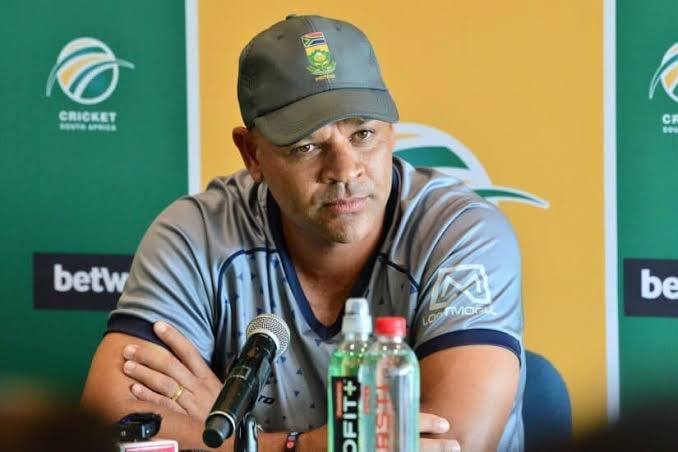
Ashwell Prince in serious mood trying to explain the Proteas’ batting woes.

Ashwell Prince is the batting coach of the Proteas and the man who shored up their middle-order in the 2000s was careful to tread gently as a guardian of his charges.

“I don’t think there was too much aggression, it was more the timing of the dismissals, which kept hurting us. Everyone has their individual approaches and we’ve talked a lot about playing positively and being on the front foot.

“In the subcontinent we played spin well and all the sweeps are options there. As long as the guys have been training them and playing them well, then you can accept it when they get out to one. They were a couple of blinders by Steve Smith.

“It was a really good innings by Renshaw and he deserves a lot of credit. He was very patient and he took the approach of wearing the bowlers down. Everyone has their personal approach and some are more aggressive, they go after their shots more and sometimes it does not pay off.

“There’s lots to take away from today, probably the biggest learning is that the make-up of the Australian attack means they are heavily dependent on three seamers and they have a classy spinner, they come at you with a certain intensity, but that can only last for so long. Sometimes you have to absorb intensity, because it can only last so long.

“The pitch so far has been pretty good and most batsmen feel that they can play more strokes. The ball seemed to come on better today, the bounce was consistent. You could trust the bounce and pace, so the confidence is there.

“Maybe we need to be better at sensing the intensity of the bowlers and assessing the situations. Pat Cummins is astute and when he feels they have a sniff, he pushes his fast bowlers. Just when it looked like a partnership was going to wrestle the advantage our way, a wicket would fall. Every time that would energise them and the bowlers would come again,” was Prince’s carefully considered, diplomatic response.

Australia came out to bat for 25 minutes before bad light stopped play and their dominant position allowed them to be aggressive. Nic Maddinson, who had made a 33-ball duck in the first innings, shook off the pressure of being a controversial selection and hooked his first ball from Marco Jansen for four.

The comeback man added one more four and a flick for six over midwicket to reach 17 not out off 19 balls at stumps, with Travis Head on 10 not out off 15 deliveries, out of a total of 33 without loss.

Prince believes they will bring the same aggressive approach on the fourth day.

“Tomorrow we’re going to see a lot more of the same approach, they’re going to come out with a lot of aggression to try and make up time and stretch their lead as much as possible,” he said.

South Africa will need to try and prolong the amount of time Australia spend at the crease, to make their task of saving the match an easier one. To do that, Prince says they will need to attack rather than defend.

“Taking wickets will be our best approach, while trying to control the run-rate at the same time. In the first innings, Australia made a big total, but they scored it at 2.8 runs-per-over. It’s a different scenario now that they are over a hundred ahead and they can take more risks.

“So we have to be positive, we’ll probably see more spin tomorrow and some innovative field placings to put the ball in their court,” Prince said.

Innovative is one thing, but what the Proteas most require is smarter cricket.

Barker massages his game ahead of Q-School with 63 at Glendower 0

Posted on October 30, 2025 by Ken

EDENVALE (Gauteng) – Kyle Barker has been trying to massage his game in preparation for DP World Tour Qualifying School at the end of this month in Spain, and the 26-year-old fired an exceptional 63 in the opening round of the Fortress Invitational at Glendower Golf Club on Thursday to fill him with confidence.

The Serengeti Estates golfer enjoys a one-stroke lead in the R2 million event, after Werner Deyzel and defending champion Robin Williams pushed him hard with 64s.

Barker’s nine-under-par score, which was also bogey-free, was his best round of the season and it seems he could be peaking at the right time after a solid, but unspectacular start to the campaign sees him sitting in 18th position on the Order of Merit delivered by The Courier Guy.

“I had a great first couple of months but then things just slowed down. I was struggling a bit with my game and the set-up in my bag. But now I’ve found a really nice putter that is rolling the ball fantastically.

“This is my last event before going to DP World Tour Qualifying School and I really enjoyed the day. I was hitting the ball really nicely on the range in my warm-up and I just wanted to keep that feeling going, so birdies on the first two holes was a great way to start. I didn’t know that I was going to make only 26 putts though!

“The greens were very receptive after rain on Tuesday night, long-irons were pretty much stopping where they landed and wayward tee-shots would not bounce into too much trouble under trees. So I could be quite aggressive, but the back nine was a bit tougher because the wind picked up,” Barker said.

The highlight of a round that was just the right therapy for Barker was his eagle on the par-five 11th.

“I smashed a drive down the middle and I had 196m to the front left, but the wind was slightly in my face, about seven or eight metres. So I hit a 205 shot with a six-iron, it was a bit long, in the middle of the green, but I had a downhill, 30ft putt which straight in the middle of the hole, which was really cool,” Barker explained.

Deyzel and Williams also had eagles in the first round, both of them on the 500m par-five sixth. Williams hit a brilliant seven-iron from 165 metres to three feet, which put him level with Barker on nine-under-par, but he bogeyed the par-three eighth, his penultimate hole.

Williams continued the momentum from his brilliant fourth-place finish in the Alfred Dunhill Links Championship earlier this month and he was satisfied that he had positioned himself well in his first defence of a title in his professional career.

“It’s been really cool today, it’s the first time I’ve defended and I’m just remembering all the good memories from last year. It all kicked off for me here last year. Playing in Europe was good, but it is so tough there because everything is so different.

“My game was really good today, everything was solid, just a bit of a mistake on eight. But I kept the ball on the fairways. It’s just a course I really enjoy, the par-fives are not that long, so I picture them as par-fours and try to be more aggressive, as long as you find the fairway. I drove well and was able to take advantage of the par-fives.

“I will definitely take that first round, I just want to put myself in position to defend on the back nine on Sunday,” Williams said.

Deyzel & Muller have a brush with a count-out but do enough to win 0

Posted on July 10, 2025 by Ken

Kathu, Northern Cape (19 September 2024) – Werner Deyzel and amateur partner Hennie Muller had a brush with a count-out on their final hole of the Vodacom Origins of Golf Sishen Pro-Am on Thursday, but in the end a par and a bogey were enough for them to clinch a one-point victory on 93 points.

Deyzel steered Bloemfontein-based 16-handicapper Muller to the trophy after Craig Ross had laid a good platform as his pro on the first day. The Sishen Vodacom Origins of Golf Pro-Am had a slightly different format to other events in the series, with the amateurs pairing with two different professionals over the two days.

Woodhill Country Club golfer Deyzel and Muller beat out four other teams, who all finished on 92 points, for the title on Thursday: Neil Schietekat, Quintin Wilsnach and Tebogo Ruwana were second on a count-out from Rhys West, Regan Steyn and Steve Tshabalala in third; Jovan Rebula, Jbe’ Kruger and Mxolisi Dukwana were fourth; and fifth-placed Matthew Spacey, Toto Thimba Jnr and Luke Saffy completed the prizewinners.

“Hennie had a check on the live scoring on the ninth tee and saw we were tied for first place. So we knew we needed a three-pointer, but unfortunately Hennie hit his tee-shot a bit left. I hit a good drive and managed to make par, and Hennie made a five so we had two two-pointers. We were sure someone would get a three-pointer, but fortunately that turned out to be enough in the end,” Deyzel said. “I played well but it was thanks to my ammie Hennie that we won. He was very solid, played very well and he made a lot of points.”

Deyzel is a rookie player on the Sunshine Tour, having excelled on the Blue Label Development Tour. The 24-year-old is a phlegmatic golfer and, currently 40th on the Order of Merit delivered by The Courier Guy, he knows he is not playing badly, but he also knows a small change of fortunes in terms of posting a few low scores, could be just around the corner with the Vodacom Origins of Golf Sishen tournament starting on Friday.

“My game is not bad at the moment, but I wouldn’t say it is very good either. I just need some putts to drop and then I will be making the good scores. But it’s been fun playing with the amateurs and Vodacom’s clients and it also allows us to get a practice round in before the tournament proper.

“It’s my second time playing at Sishen Golf Club, I’ve played in an amateur event here before. So I feel like I know the course quite well. Considering the time of year and the amount of rain that they have not had, the course is in spectacular condition,” Deyzel said.

Attention pivots to new Super League after Bulls Daisies win title again 0

Posted on May 05, 2025 by Ken

Another season of the Women’s Premier Division came to an end last weekend with the Bulls Daisies securing back-to-back titles, and the attention in local ladies rugby will now pivot to the newly-announced Super League professional franchise competition recently announced by SA Rugby.

While the Super League would be a boost for the growth of high-performance women’s rugby in South Africa, there are still pivotal questions around when it will start and how it will work, especially in terms of player contracting.

SA Rugby said they intend to contract 150 women players for the new competition, with the provincial unions being invited to submit proposals for inclusion of a franchise in the new Super League.

But the Bulls, who made a groundbreaking move to being fully professional last year, already have 35 players contracted and the vast majority of those will be offered new contracts on September 1.

SA Rugby want the Super League to begin in early 2025 and have said the “centrally contacted players will be shared out among the teams”. Unless the 150 given SA Rugby contracts don’t include any Bulls players, there is going to be a tug-of-war over the services of the players who have dominated the Women’s Premier Division over the last two seasons.

“We will entrench our players,” Thando Manana, the executive in charge of women’s rugby for the Blue Bulls Company, told Rapport. “SA Rugby say they are going to contract 150 players and although it is good to have this innovation, we need to tread carefully in our rush to get this Super League underway. There’s definitely going to be a timing issue if they want to start in January.

“I love anything that develops the game, but we can’t wait for all the details to come out, we will be renewing contracts for the new cycle that starts on September 1, and some of those will be extended to two or three years. We’re not looking at what others do, we will be pushing forward in the months ahead to take women’s rugby to another level,” Manana said.

Blue Bulls Rugby Union president Willem Strauss said he would rather reserve comment on the Super League until they have more information.

“I don’t know much about it, but anything that takes women’s rugby to the next level, I will support. But I need to know the details about the Super League, hopefully it aligns commercially with what we have done with such success over the last two years.

“As a board, we are very happy with what we have achieved in women’s rugby. It was a brave step to go professional in the women’s game because the financial impact was negative. But once we started performing then we started to attract commercial partners.

“Our team has improved a helluva lot and this year we had to use a lot of club players because of national team call-ups. But the number of women taking up the game has expanded by 30% per year, which is fantastic because it shows that going professional is sustainable. There are more and more women’s teams joining the league, as well as youth clubs, which shows that the ecosystem is healthy.

“Plus the Bulls Daisies bring a new audience to Loftus Versfeld which is very important, it’s not a traditional Pretoria crowd. The Bulls Daisies have certainly added value to our brand of excellence and they are inspiring the next generation of women’s stars,” Strauss told Rapport.

Lynne Cantwell, SA Rugby’s High Performance Manager for women’s rugby, praised the Bulls for their top-class programme and said the aim of the Super League was to get the rest of the country’s players to that level of excellence.

“The goal of the competition is to make that leap into where the performance standards align. Once we get there, all the teams will be more competitive and the women’s tournament will go down to the wire, we want to get to the situation where you never know who is going to win.

“The Bulls took that leap two years ago and have led the way, and we’ve seen their big performance leap. You have to give credit to Western Province, and the fact that they pushed the Bulls in the final is testament to their pipeline. There are great signs of growth, they are swelling their player numbers and Boland have done this as well.

“The goal is to have all our premier teams to be like the Bulls, and then that will make for a strong national team. The Super League will be performance-driven, and hopefully that means teams can ask more of sponsors, they can pitch higher because of increased visibility. That will drive game standards and allow teams to employ high-quality coaches, physios, medics and strength-and-conditioning coaches,” Cantwell told Rapport.

The former Ireland star envisages a league with four or five teams, with each side playing eight to 10 matches. The Super League will not replace the Premier Division because it will be played at a different time of year.

Cantwell is keen on a draft system to allocate the contracted players, but she acknowledges the Bulls issue will need to be resolved.

“The Bulls have a significant number of our top players and it will need to be a gradual approach in terms of how we spread the top players around. The Super League will be our top-end competition, but it will take a couple of years for everything to be aligned.

“We want the other teams to have programmes that are the equivalent of the Bulls. With SA Rugby funding the player contracts, there won’t be as much pooling of players at a single union because we can say where they must play,” Cantwell said.

  • Recent Posts

  • Archives

  • Thought of the Day

    Colossians 3:13-14 – “Bear with each other and forgive whatever grievances you may have; forgive as the Lord forgave you. And over all these virtues put on love, which binds them all together.”

    “When the Holy Spirit lives in you, you reflect the qualities of Christ in your life. Love and courtesy are basic characteristics of the Christian life. … If Chris lives in you, you will be kind and patient toward others.

    “A person who is truly courteous is humble, … His attitude is the same regardless of whether he is talking to kings or beggars. He treats everyone alike, no matter what race, colour or creed they are. He rejoices in making the path through life easier for others to travel.

    “It is impossible to say that you love and serve God while at the same time treating your neighbour with contempt and disrespect.” – Solly Ozrovech, A Shelter From The Storm


↑ Top