for quality writing

Ken Borland


Back to training but SA Rugby planning not getting any easier – Roux 0

Posted on July 22, 2020 by Ken

The country’s rugby players may have returned to training this week but planning for them to actually play competitive matches is not getting any easier with Jurie Roux, the CEO of SA Rugby, confirming on Tuesday that there is “about zero chance” of South Africa hosting any international rugby this year.

And the effects of the Covid-19 pandemic are likely to deeply affect the 2021 rugby calendar as well, necessitating major changes in local rugby. Roux did reiterate though that SA Rugby are still hopeful that they will be able to return to play at least by mid-September with local competitions.

“It is still a very fluid situation and there are multiple factors feeding into our daily decisions. But if anyone thinks we are going to return to a format that is close to what existed before this pandemic then they are making a big mistake. The market has corrected itself, it was due a change and it has been brought on by Covid. Rugby will be significantly different, we are trying to prepare for 2020/21 but everything else is in flux.

“There are no plans to host any international games this year because there is about zero chance of entrance into South Africa with our borders closed. The only chance of playing international rugby is in the New Zealand bubble in the Rugby Championship. The broadcast revenue from the Rugby Championship is significant and international rugby will hopefully resume towards the end of October, whatever we can fit in before mid-December,” Roux told an online media conference on Tuesday. a

International travel is not expected to return to normal until midway through next year and quarantine requirements are also squeezing the calendar, and while Roux said SuperRugby was not dead after New Zealand expressed their preference for a trans-Tasman competition with Australia, SA Rugby are hard-pressed to find space for a cross-conference competition before the British and Irish Lions tour to South Africa kicks off in early July.

“They stated their preferred structure due to restrictions and the costs of travel with fewer flights to New Zealand, and there is every indication that ourselves and Argentina will not be able to go there without spending two weeks in quarantine until the end of May, so the previous format of SuperRugby is just not viable. So New Zealand will play domestically first and then hopefully we can have some sort of crossover SuperRugby.

“So the plan is for us to play domestically from February to April and if the borders are opened then we can have some sort of format across conferences, with Argentina most likely with us. But it all needs to finish by the time the British & Irish Lions tour starts in the first week of July. We are all part of the Sanzaar joint venture and there are legal agreements in place,” Roux said.
Every rugby union is going to be doing it 0

Posted on June 20, 2020 by Ken

SA Rugby CEO Jurie Roux said recently that every union whether provincial or international is going to join up with private equity partners either sooner or later. Rugby has been one of the slowest sports to embrace professionalism though and I can hear many fans wailing that private equity is going to ruin the game.

“Private equity in rugby will have a massive influence, it will probably control rugby. And yes, SA Rugby is in discussions with private firms, but I don’t think there’s a union that’s not talking to someone. We all live in a post-Covid world that is now a much smaller pond and there is the opportunity now for investors to buy things at much cheaper prices. Private equity is here to stay, you’ll either join early or late, but join you will,” Roux said in an online press conference earlier this month.

There is perhaps going to be understandable anxiety that rugby is going to end up in the same sort of mess as the Premier Soccer League has with the controversial sale of the famous BidVest Wits club to a little-known National First Division club, Tshakhuma Tsha Madzivhandila, based in Limpopo. Thanks to BidVest cynically pulling the plug based purely on financial considerations, 99 years of history is down the drain, a club that has won nine top-flight trophies and produced players such as Gary Bailey, Peter Gordon, Richard Gough, Sam Magalefa, Thulani Hlatshwayo and Benson Mhlongo for all intents and purposes no longer exists.

Never mind Western Province leaving Newlands, can you imagine the outrage if it was announced that the Bulls were moving to Polokwane and would henceforth be known as the Buffaloes?

But let me allay your fears by pointing out that rugby has mechanisms in place to prevent such stupid things from happening.

Before going to market, a union will split its assets between a commercial/professional arm, which will largely deal with corporate matters like sponsorships, advertising, marketing and broadcast deals, and an amateur arm which will hold assets like the stadium (whether they own it or have a rental deal) and ‘intellectual property’ like the team name.

Stakeholders can then buy shares in the commercial/professional arm. A private company can buy 25% of those shares and the union gets the cash, while the equity partner takes dividends while also hopefully driving up the commercial value of those properties.

Even though SA Rugby’s constitution now allows for private companies to own up to 74% of a union’s professional arm, as long as the ‘amateur’ administrators have done their paperwork correctly then properties like the team name or where they play should be totally protected even if the union is now a minority shareholder.

The Bulls have been amongst the first unions to really make private equity work for them, with Patrice Motsepe’s African Rainbow Capital Investments and Johann Rupert’s Remgro each owning 37% of the Blue Bulls Company. First prize to them because the influx of cash has allowed the Bulls to hire big-name coaches in John Mitchell and now Jake White, who is totally revamping the team with a host of quality additions to the player roster.

Perhaps the first thing for a union to ensure is that there is synergy between themselves and their private equity partners, so that they can work together to run a successful team.

Unfortunately there have been two unions in the news lately for getting it all wrong – the Eastern Province Rugby Football Union and the Western Province Rugby Football Union. Both those beleaguered unions seem to be suffering from a bunch of rank amateurs trying to run multimillion rand businesses.

After years of wrangling seemed to be coming to an end with the signing of heads of agreement to sell Newlands to Investec, WPRFU president Zelt Marais has unilaterally decided not to sign off on the rest of the deal, despite already taking an advance of more than R50 million from Investec. Interestingly, the WPRFU also owe Remgro R58 million for a loan. These are powerful enemies to have and one fears that the once proud union could be heading the same way as Eastern Province.

The embattled Port Elizabeth franchise just seems to lurch from one crisis to the next and fresh problems are now springing up between the company that holds the majority shareholding in the Southern Kings and the EPRFU.

Roux was not specifically talking about the Southern Kings or Western Province, but his message certainly applies to them when he said political interference tends to surface when administrators try to run their franchises as an amateur entity.

But to borrow from Saturday Citizen deputy editor Brendan Seery’s excellent Column, for every couple of Onions that have to be dished out to unions, there will be more Orchids given out to those who make private equity work.

Simply put, rugby is unable to survive this post-Covid world without them so, like the Wallabies and scrums, every union just has to find a way of making these partnerships work.

Habana spent enough time in Europe to not be totally sold on SA Rugby moving teams there 0

Posted on June 04, 2020 by Ken

Springbok great Bryan Habana spent enough time playing in Europe to know exactly what it would entail for South African rugby to ditch Sanzaar and move into Northern Hemisphere competitions, and the 2007 World Cup winner is not totally sold on the idea, he said on Wednesday.

There has been global speculation that the world champions will leave Sanzaar after the 2023 World Cup to play in an expanded Six Nations tournament as well as their SuperRugby franchises joining European competitions like the Pro14 and Champions Cup. There has also been talk emanating from Australia of Sanzaar excluding teams from both South Africa and Argentina and focusing on just a trans-Tasman competition with New Zealand.

Habana, who scored a South African record 56 SuperRugby tries for the Bulls and Stormers, finished his career spending five years playing for Toulon so he has intimate knowledge of European competition.

“There’s been a lot of debate about South Africa joining the Northern Hemisphere but right now nobody even knows when rugby will be back in South Africa. Probably the one thing most needed by rugby is a global season. But I suppose the one question is whether Sanzaar need SA Rugby, they have been an important part of Sanzaar for the last 25 years.

“For those in the UK and Europe it’s much easier to watch games in South Africa than those in New Zealand or Australia. But it’s important to see where the Springboks and SuperRugby teams could fit in and they would have to fit in with the Northern Hemisphere schedule. I don’t see our guys enjoying playing in 5⁰ in December/January and how are our rugby fans going to enjoy watching rugby over Christmas when they’re on holiday?” Habana said on Wednesday in a virtual press conference to announce the launch of MatchKit.co, a mobile tech platform intended to help athletes grow their commercial brands, set up by the Retroactive agency of which he is a partner.

There have also been suggestions South African teams could play in both Sanzaar and the Northern Hemisphere, expanding the current involvement of the Free State Cheetahs and the Southern Kings in the Pro14, but Habana said the workload on the players even if they were just involved in Europe would be immense.

“When Toulon won the double in 2014/15 they played more than 40 games and player welfare is important. If we’re going to add four more teams and include the Springboks in the Six Nations then that would mean even more matches. There are advantages to both hemispheres, the players would learn more about foreign conditions and that allows you to develop more as a rugby player and as a person.

“To say who has the better standard of play though is very subjective because what determines a good standard? The Northern Hemisphere has come strongly to the fore in the last few years: In the 2015 World Cup the top four sides were all from the Southern Hemisphere, but in 2019 it was very different [England, New Zealand, Wales, South Africa]. Hopefully our decision-makers will choose what is best for the game as a whole,” Habana said.

Champion rugby stars are champion humans helping those South Africans in extreme need 0

Posted on May 23, 2020 by Ken

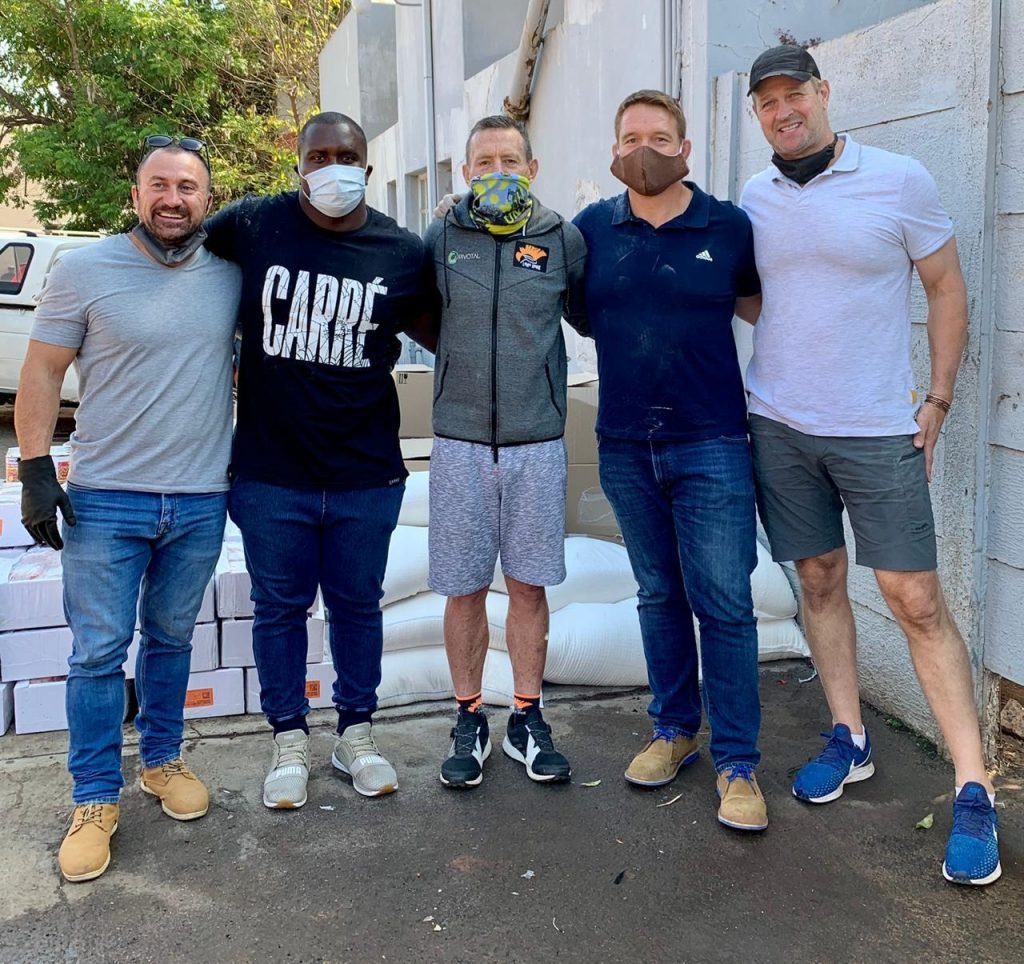
CHAMPIONS – Rugby stars (from left) Dave von Hoesslin, Trevor Nyakane, Joel Stransky, John Smit and Wayne Boardman at a food drop-off for the One Cup of Pap initiative.
Photo by Lauren Terras

Africa is certainly a continent of extremes and millions of her inhabitants have scant resources when it comes to basic necessities we take for granted. The situation is only going to become worse due to the Covid-19 pandemic. And although we all miss the game, not being able to play or watch rugby in this time of crisis is a minor hardship compared to those who are living in poverty, in horribly overcrowded conditions, suffering from malnutrition and a lack of running water.

And we can be proud of our South African rugby community because they certainly get this, and the paycuts they have willingly taken and the number of charitable initiatives they have supported or started themselves shows they are not just champion sportsmen but champion human beings.

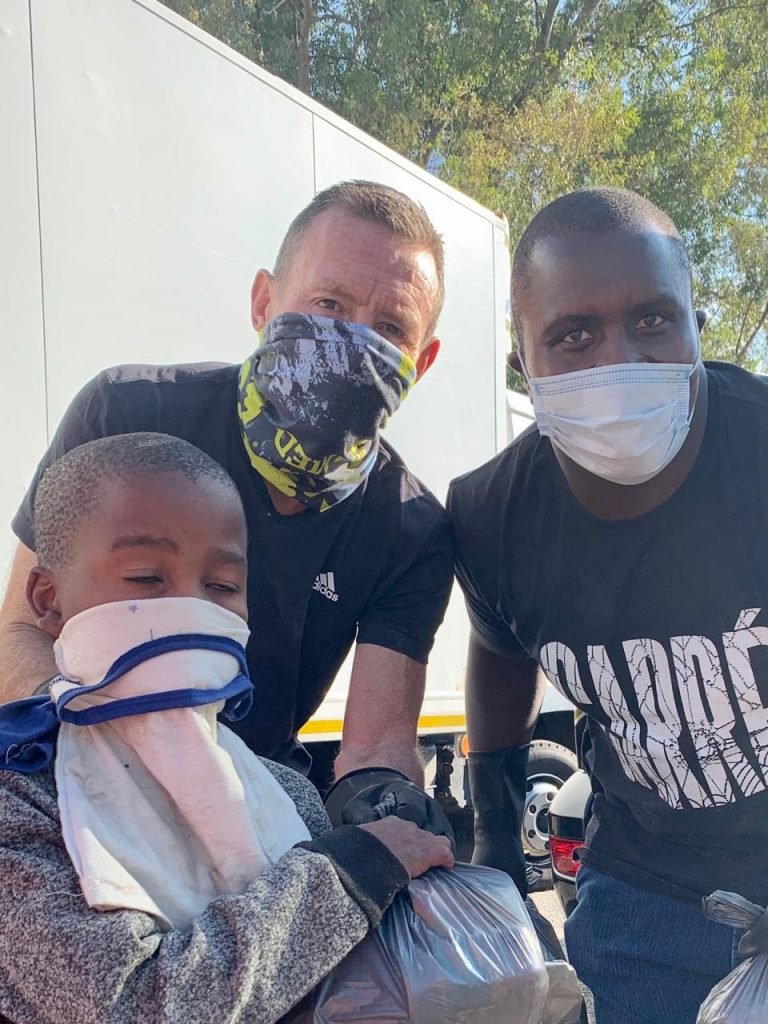
It’s amazing how far a simple act of kindness can go and this was rammed home for me recently by the work of the One Cup of Pap initiative.

It all started at the beginning of Lockdown in late March when former Sharks and Stormers lock Wayne Boardman, together with his father and domestic worker, decided to put some money together to feed at least one family in need. It started out as one cup of pap and a sachet of soup being dished out at an informal settlement in the northern suburbs of Johannesburg, with a budget of R250 a week.

But seeing desperate people fighting over what little he could give – “We were overwhelmed and the last few people were like hyaenas fighting over the food before it ran out,” Boardman says – he decided to reach out to his friends, local community and his rugby network.

In the last eight weeks, the One Cup of Pap feeding scheme has mushroomed to an R80000-a-week operation, feeding approximately 2000 hungry people with two tons of pap, between 500 and 1000 loaves of bread, and one ton of polony, soup and tinned food.

“We started slowly with not a lot of food, but with the help of a couple of influencers and getting social media full of it, it has grown to a size we never expected. To get one or two big names involved like John Smit and Joel Stransky, who are close to everyone’s hearts, automatically gave us big pull and credibility. Their involvement and that of other Springboks like Trevor Nyakane and Dave von Hoesslin has really seen it grow,” Boardman says.

LINED UP – The different food stations and the queues of people at the One Cup of Pap feeding scheme.
Photo by Ken Borland

The project has also spread its reach to areas such as Munsiville in Krugersdorp, Midrand and the Tshuma Stingers development rugby club, Roodepoort and the Feed Thy Kids Creche, the Chilli Lane Community in Sunninghill, the Waste Pickers at Megawatt Park, those living under the bridge at Braamfontein Spruit, Ivory Park and Parkmore. Community involvement is essential because it’s not as if the One Cup of Pap initiative have a census of informal settlement residents to work with when calculating the numbers they need to cater for. The South African Police Services, especially Sandton Police Station, have offered considerable support along with TRSG Security and Security Web.

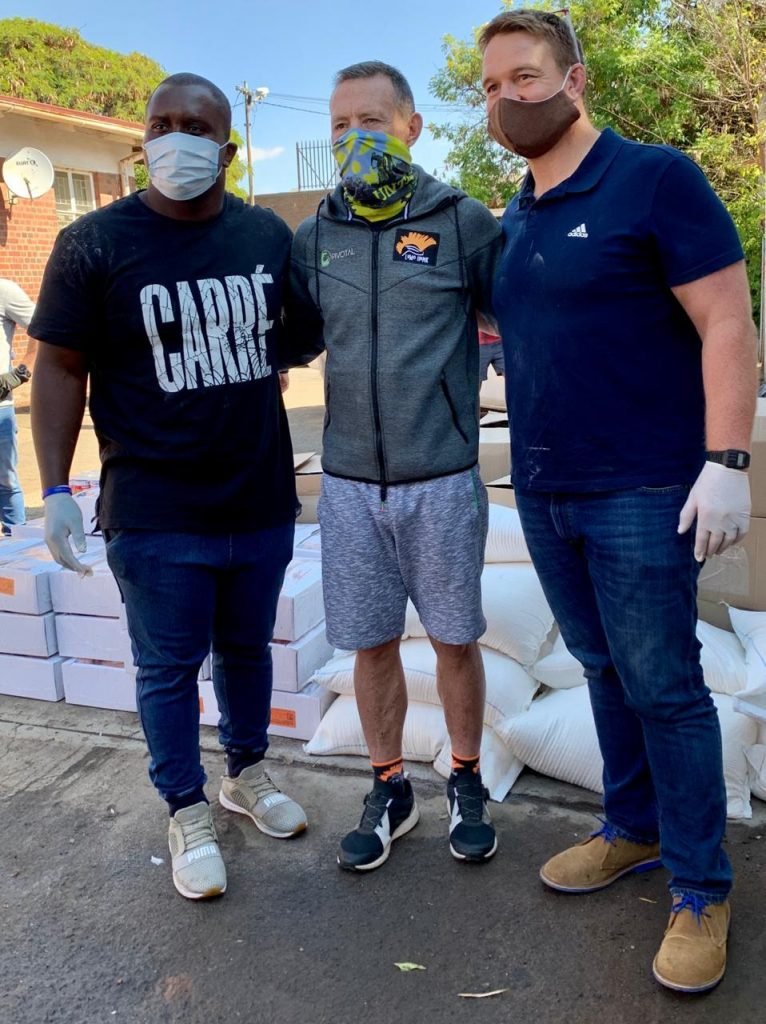
Joel Stransky & Trevor Nyakane
Photo by Lauren Terras

Stransky is famous for his charitable initiative, the LumoHawk Foundation which specialises in testing the eyesight of underprivileged children and giving them glasses. But with Covid-19 having stopped all testing, Stransky has now taken over sponsoring all the children’s food packs for the One Cup of Pap scheme. “I just want to see these kiddies get a proper education that will prepare them for life and give them hope,” he told Saturday Citizen.

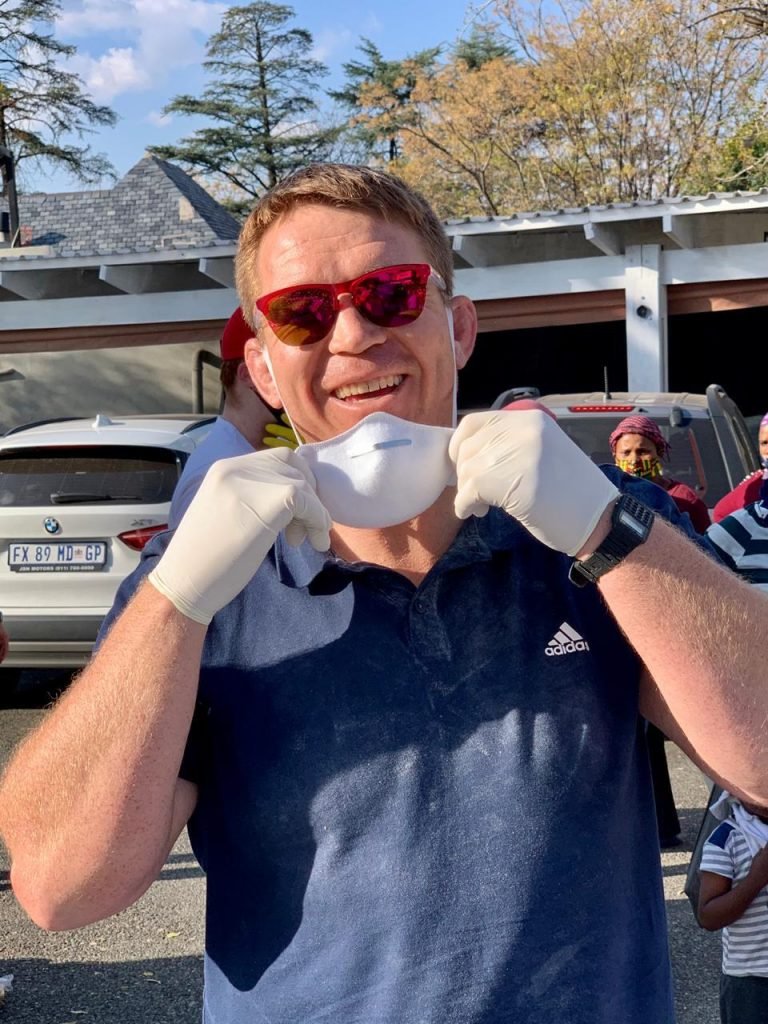
Smit has had his own charitable foundation, Barney’s Army, since 2012 and they have also thrown their weight behind Boardman. “If we all do a little bit then we can make it through this crisis. I’m able to leverage off my profile and I’m sure there are plenty of others doing great work, but we need to highlight everyone doing their bit,” Smit said.

Nyakane, who completed the hat-trick of World Cup winners involved, was moved by the experience.

“Lending a hand has made me realise how poor so many people are, it was a no-brainer to help out and hopefully make a difference in their lives. Every little bit helps and it hit me seeing hundreds of people lining up, all needing a lot of help, even if it’s just shelter and being able to get food. I would urge every South African to just lend a hand, it goes a lot further than you realise,” Nyakane said.

World Cup winners (from left) Trevor Nyakane, Joel Stransky & John Smit.
Photo by Lauren Terras

To get in touch with the charity: Wayne Boardman 084 545 1717

Banking details:

John Smit all smiles
Photo by LT

A Knowles

Nedbank

1969043962

Rivonia Branch

Ref: One Cup Pap

  • Recent Posts

  • Archives

  • Thought of the Day

    Revelation 3:15 – “I know your deeds, that you are neither cold nor hot. I wish you were either one or the other.”

    How can you expect blessings without obeying?

    How can you expect the presence of God without spending time quietly before him?

    Be sincere in your commitment to Him; be willing to sacrifice time so that you can grow spiritually; be disciplined in prayer and Bible study; worship God in spirit and truth.

    Have you totally surrendered to God? Have you cheerfully given him everything you are and everything you have?

    If you love Christ, accept the challenges of that love: Placing Christ in the centre of your life means complete surrender to Him.


↑ Top