for quality writing

Ken Borland


An office without coffee 0

Posted on April 02, 2020 by Ken

It’s hard to describe for non-sports lovers what A World Without Sport is like, but I guess an office without coffee or a party without any music could mimic the same feelings of emptiness and loss myself and millions of others are feeling right now in these times of Covid-19.

It is, of course, a small, hopefully shortlived price to pay for our health and ensuring that society itself does not break down. As one government minister put it, every life saved now is a potential sports fan in the future.

But it is hard not to feel sad that, as summer fades into autumn, there will be no more bat on ball, no nervewracking SuperRugby clashes, no more peaceful hours on the couch watching the best golfers in the world strut their stuff on beautiful courses. The hockey astroturfs, usually so full of joie de vivre on the weekends, are quiet. There is no more gloating from Liverpool fans on social media, or the angst of long-suffering Arsenal supporters.

Sport provides a thrill, a shot of inspiration watching real-life superheroes overcoming the odds and, for many people, gives them a reason to slog through the week and make it to the weekend. As if to rub it in, the weather in Johannesburg has been glorious the last couple of days, sunny and warm, perfect for a day at the Wanderers or SuperSport Park.

But when the governing bodies of the various sports sift through the wreckage of 2020 once this pandemic has passed, they will have the opportunity to perhaps ‘reboot’ several aspects of their product.

It seems inevitable, given the financial damage Covid-19 will do to the coffers of sport across the board, that the sporting landscape will change once the world returns to ‘normal’ again. Sadly, some cherished things might fall by the wayside; happily, some blights might disappear.

Writing in The Guardian (https://www.theguardian.com/sport/blog/2020/mar/16/beware-sporting-disaster-capitalists-crisis-go-to-waste), the excellent Jonathan Liew speaks about the Covid-19 crisis causing financial turmoil and then warns of “greedy disaster capitalists” taking advantage. Sporting bodies could be forced into some unpalatable decisions simply due to financial pressures.

The column ends with the warning – “For the next few weeks, perhaps even months, the power-brokers of sport – administrators and executives, sponsors and speculators, agents and marketers – will be at a loose end. Nothing to do but plot and strategise and kick around ideas. And then ask yourself a question: how far do you trust these people to act in the best interests of the sport you love?”

The South African situation is further complicated by Icasa, the broadcast and telecoms regulator, drawing up the new legislation governing the coverage of sport in the country. The amendments are due to be published by the end of September and Icasa have already said the goal is to ensure more free-to-air coverage of sporting events that are “in the national interest”.

The problem is the free-to-air broadcasters do not have the means to do this properly; the national broadcaster is all but bankrupt and e.tv are far from the forefront of the sports business game.

The loss of income from the exclusive television rights SuperSport pays will only add to the burden of our sports bodies after the Covid-19 pandemic.

SA Rugby seem to be one of the earliest movers in terms of strategising for what happens next. There have been strong suggestions that once it is safe to start playing rugby again, SuperRugby 2020 will be rebooted with the South African franchises (and possibly the Free State Cheetahs) playing each other in a series of local derbies.

This is a fantastic idea and hopefully crowd attendances will be much greater than they have been for SuperRugby in recent years.

And the icing on the cake would be if this spurs major change in our competition structures and the Currie Cup is restored to its rightful place as a major tournament and not just an afterthought.

With enthusiasm waning for the 25-year-old SuperRugby concept, change, accompanied by a move towards Europe, could be good.

https://citizen.co.za/sport/sport-columnists/2258834/post-pandemic-days-a-chance-for-sport-to-reboot/

THE TROUBLE WITH ELEPHANTS 0

Posted on August 14, 2018 by Ken


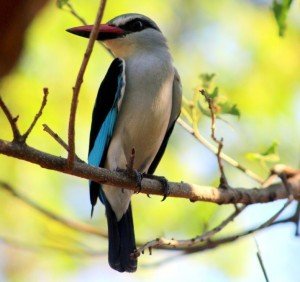
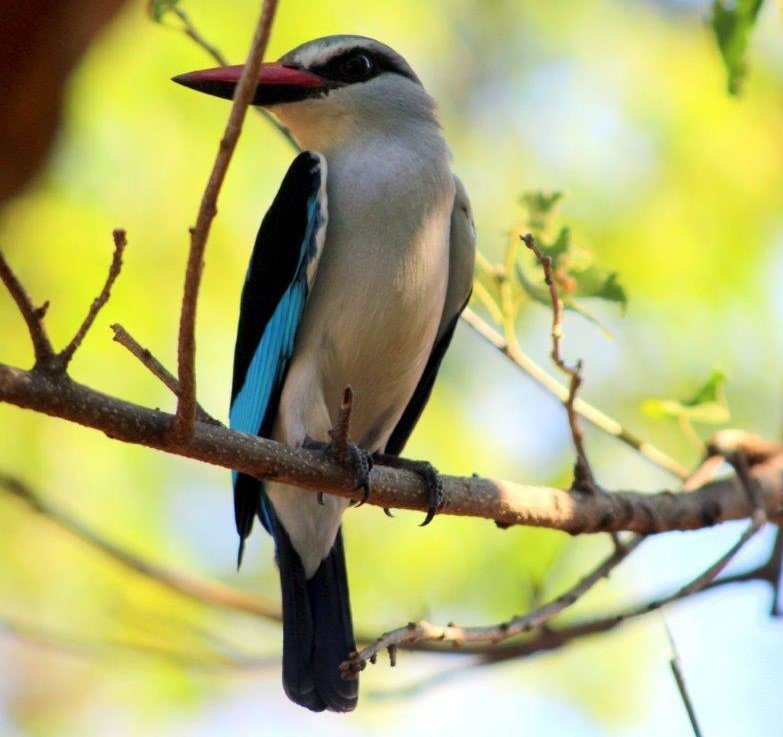
Woodland Kingfisher

Woodland Kingfisher

by Anthony Stidolph

I am not a man who deliberately courts disaster or intentionally goes looking for bad experiences. By the same token, I am not such a fool as to think the odd mishap won’t occasionally befall me. And when you go travelling with my birding partner Ken, rotten luck does have a habit of following you around.

For example: on a recent trip to Marakele National Park we found ourselves being chased down a narrow, twisting mountain pass in reverse by a very angry elephant who clearly resented our presence in his private domain.  Luckily – I have a feeling some benevolent deity saw fit to intervene – we survived that harrowing encounter. What I did not realise was that more trouble with elephants lay ahead…


From Marakele we had followed a circuitous route that took us to Blouberg Nature Reserve and then cut east along the base of the Soutpansberg range to Punda Maria in North Kruger. We planned to camp the night here and then press on to Pafuri the next day, where we hoped to get in some good birding.

Up until now the weather had been kindly – more spring than summer and I had even found myself wearing a jacket in the evenings and early mornings. In Kruger, however, the hot weather we had been expecting all along finally caught up with us, with the temperature soaring up to 39 degrees. The air around us was heavy and listless and steamy, almost tropical, perhaps hardly surprising since we had crossed over the Tropic of Capricorn some days before.

Eager to be off, I was up early the next day although I had to first wait for Ken to complete his complicated early-morning-ablution rituals. Once he was done with that, we set off northwards through the familiar vastness of flat grassland and mopane trees. On the way we stopped to allow the biggest herd of elephants I have ever seen cross the road. Shortly afterwards we were forced to repeat this exercise for an even bigger herd of buffalo.

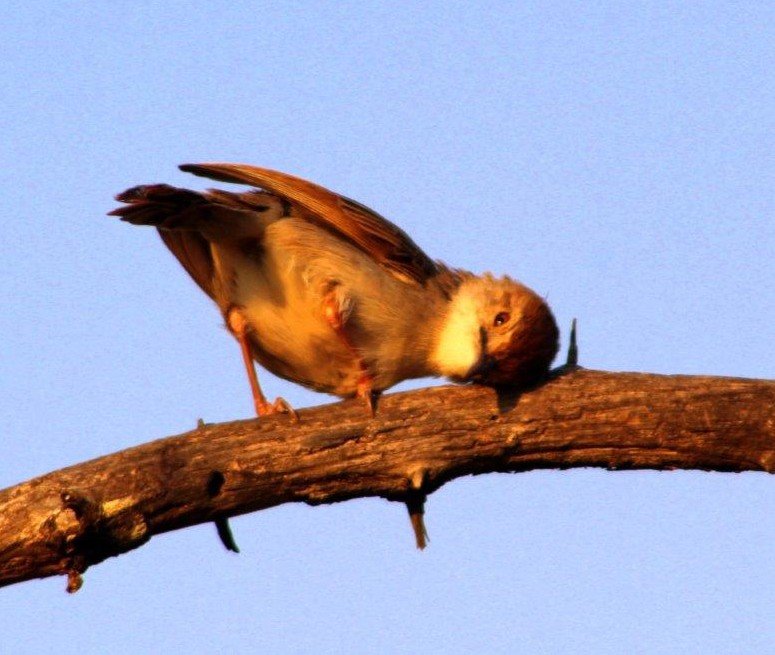
The common bird in this neck of the woods – or at least the most vocal – is the Rattling Cisticola. There seemed to be one trilling its silly head off on top of virtually every second tree we passed.
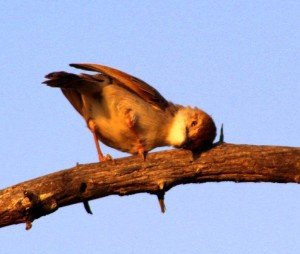
Cisticola, Wailing, Kruger

The highly-vocal Rattling Cisticola – Can rub some people up the wrong way

As you draw close to Pafuri, the terrain starts to break up and rearrange itself and you are suddenly confronted by the arresting sight of Baobab Hill, with its commanding views over the Limpopo Valley. In the early days this iconic hill served as both a landmark and sleepover point for the ox-wagons travelling up from Mozambique.

By the time we got to Pafuri the sun was high and blazing. There had obviously been no rain here this season and the grass was pale and dry, although the trees had mostly come out in leaf.

At the crossroads we turned left down the Nyala Drive, which takes you into some wonderfully hilly country before taking a lazy loop back to the main road. Ken likes this less-used drive because, he says, it often throws up unexpected surprises.

There wasn’t much on offing this time around besides the usual suspects – Meves’s Starlings, Arrowmarked Babblers, Whitefronted Bee-eaters and Emeraldspotted Wood Dove. We passed a solitary elephant but he paid us no mind.

On the top of the small, baobab-clad hillock, directly above where the road swings back, is the Thulamela archaeological site, a restored Zimbabwe-type ruin. Unfortunately you can only go up with a guide and because of our tight schedule we did not have time for that.
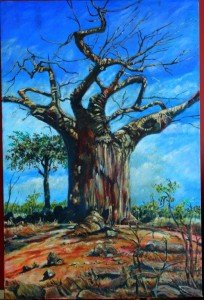
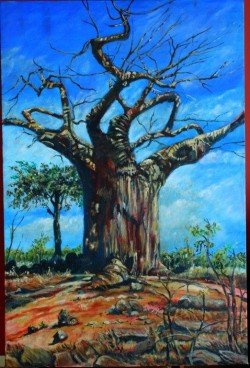
One of the commanding Baobab trees of northern Kruger. This painting by Stidy is available for sale. 42x60 stidy@sai.co.za

One of the commanding Baobab trees of northern Kruger.
This painting by Stidy is available for sale. 42×60 stidy@sai.co.za

From the Nyala Drive we crossed back over the main tar road and followed the dirt track that takes you to Crooks Corner, where the brown waters of the Luvuvhu collide with the blue of the Limpopo. The combination of water, sun and rich alluvial soils has led to a proliferation of vegetation along the rivers’ banks so that you drive through a glittering tunnel of Sycamore Figs, Nyala trees, Jackal Berry, Ana and Fever trees.

Crooks’ Corner, where you can get out of your cars, marks the border between South Africa, Mozambique and Zimbabwe. In the early 1900s this remotest of places gained its moniker and dodgy reputation with gun-runners, fugitives and others on the run from the law, using it as a safe haven because it was easy to hop across the border whenever the police from one country approached.

Distinctly, there was a sense of a frontier on that lazy meandering river, although I don’t think the solitary Saddlebilled Stork fishing in its waters gave a fig where the international boundary lay or as to who held sovereignty over the country he was standing in.

Normally, it feels like you can’t get much further away from civilization than here, but we had chosen a busy weekend to visit so it was like a major thoroughfare with a steady stream of traffic passing through. Many of the visitors didn’t even bother to wind down their windows or get out of their luxury 4x4s because it would mean switching off their air-conditioners. They just drove in, stopped, glanced around and drove out again, leaving me to wonder why they had bothered to come all this way …

Needless to say Ken – who, contrarily, makes it a rule to ALWAYS switch off his air-conditioner when he enters a park because he likes to experience Africa in all its extremes –  and I did get out.

Rich plant life invariably means rich animal and bird life and Pafuri is no exception. In the past the storied riverine forest has provided both of us with some good sightings. It was here I saw my first Gorgeous Bush Shrike, Bohm’s Spinetail and Ayre’s Hawk Eagle. I have also recorded Lesser Jacana, Greencapped Eremomela, Hooded Vulture, Tropical Boubou and the palm-dwelling Lemonbreasted Canary.

This time, we could hear both the Gorgeous Bush Shrike and a melodious Whitebrowed Robin-Chat calling from the depth of a nearby thicket but could not entice either of them out.  Instead we had to make do with a bunch of waders and a noisy party of Trumpeter Hornbills who, I think, were off to join the celebrations in neighbouring Zimbabwe.

It was now well past lunchtime so we doubled back to the Pafuri picnic site on the edge of the Luvuvhu. Feeling somewhat dehydrated, I was desperate for an ice-cold coke but had to wait patiently in queue behind an American who was explaining to the bemused coke seller-cum bird guide – who, I suspect, knew the answer but was too polite to say so – what a turkey is (“It’s a big black bird with a red head”).

At this juncture of its journey the Luvuvhu is always a ruddy brown colour such as might be achieved by mixing cans of tomato soup with cans of chicken soup. There was an enormous crocodile lying directly opposite us, not, as one would expect, by the water’s edge but high up on the bank under some trees. I had a feeling some unsuspecting animal was in for a nasty surprise.

On the way back to Punda Maria, we took the shortcut via Klopperfontein Dam, another place which can throw up some unexpected treats even though the area around the dam has been grazed as smooth as a billiard board. Sure enough, we were rewarded with a wonderful sighting of a Painted Snipe snooping around in the shallows of the nearby stream.

It was getting on for late afternoon by now. Ken consulted Emily, his prissy, admonishing Satnav, and worked out how far we had to go and what time we had to do it in. What neither factored into their calculations was our old nemesis, the elephant.

The first one, which we encountered just after Klopperfontein, kept us waiting for ages, while it feasted on the side of the road, before moving off into the surrounding bush. A little later we passed him siphoning water by the trunk load out of the top of a reservoir.

We ran in to the second one on the home stretch with the hills around Punda Maria in plain sight. Although this bull appeared much more amiable then the one who had chased us down the mountain in Marakele, he had obviously decided he held all the rights to this road.

The whole thing quickly degenerated into a stage farce. We kept reversing and reversing and he kept trundling on towards us. I suspect he was headed for his evening sundowner at the same reservoir where the other elephant was sloshing water around.

One of us had to blink and we did so first. Muttering angrily to ourselves about the beast’s poor road etiquette, we turned around and headed back to the tar and took the much longer route home to Punda Maria.

In Kruger, as in other parks, you are not supposed to arrive in camp after dark, which we now did, finding the gate locked on us. Fortunately, the guard was still at his post but Ken had to use all his silky skills as a sports writer and commentator to try to convince him it wasn’t really our fault. I am not sure he bought our explanation, but he let us through without imposing a fine.

So we drove into camp feeling like a pair of naughty schoolboys who had just been caught bunking …

But we were not done yet. We arrived to a scene of utter devastation – in our absence a troop of baboons had ransacked the place, flattening my tent, breaking its poles and ripping gaping holes in the fly-sheet (even though there was nothing inside but my bedding and clothes), as well as scattering our possessions far and wide.

To tell you the truth I was getting seriously tired of this. I had just bought the tent to replace the one that got ripped by monkeys in Mapungubwe on my last trip which, in turn, I had bought to replace the one that had suffered a similar fate at the hands of baboons when I attended a wedding in De Hoop Nature Reserve in the Western Cape. At the rate I was getting through tents, it would have been cheaper to have just booked into a luxury lodge!

I am not sure what one does about this menace. The problem is both monkeys and baboons have become habituated to both human beings and human beings’ food.

We did discover afterwards that there was supposed to be a guard on duty to stop these opportunistic raids but, even though the campsite was virtually booked out, he had decided to take the Sunday off …

I was still sulking about my poor tent the next morning when we drove out of the gate, destination Mapungubwe. There to wish us on our way was the scruffiest Ground Hornbill I have ever seen. It flew up into a tree from where it regarded us quizzically through its girlishly-long eyelashes.

For some reason the sight of that lugubrious bird, peering around its branch, cheered me up no end. It made me realise that on the Richter Scale of Travel Disasters we had got off relatively lightly compared to what other great explorers, like David Livingstone or Scott’s Antarctic expedition, had been forced to endure…


ANTHONY STIDOLPH
Bulls earn credit, but still lose 0

Posted on April 01, 2017 by Ken


The Bulls will earn deserved credit for their improvement, but the end result was still the same as they went down 28-12 to the Chiefs in a bonus point defeat in their SuperRugby match in Hamilton on Saturday.

A superb first-half display by the Bulls in which intensity crackled through everything they did – in attack they were direct and handled superbly, while their defence was physical and uncompromising – saw them claim a deserved 9-3 lead at the break.

But the Chiefs showed their class as they stayed composed and were able to pull away from the 50-minute mark, scoring three tries in an ultimately impressive victory.

The Chiefs had a terrible time in the first half trying to contain superb Bulls inside centre Burger Odendaal, who led the visitors’ resurgence with some powerful ball-carries and excellent midfield defence. It led to the home side having missed an awful 15 tackles by halftime.

But the Bulls just lacked the attacking incisiveness to convert their gains into points on the scoreboard.

When centre Jan Serfontein went inside instead of pinning his ears back on the outside following some storming runs by Odendaal in the fourth minute, it was one of many moments when the Bulls were left wondering what might have been.

The Chiefs had been caught offsides in the build-up, however, and flyhalf Handre Pollard was at least able to kick a penalty for an early 3-0 lead.

More superb carries and direct running by the Bulls, and a determined rumble forward by prop Trevor Nyakane, led to another Pollard penalty in the 10th minute, but the Chiefs dominated the first scrum four minutes later, earning a penalty kicked by flyhalf Aaron Cruden (3-6).

But the Bulls had the final say in the first half as the Chiefs tried to run the ball out of their own 22 after conceding a free kick, but were turned over, allowing the Bulls to string several phases together and earn another Pollard penalty for not releasing at the ruck.

But the tide began to turn in the 51st minute as wing Jamba Ulengo suffered another horrible moment in defence, wing Shaun Stevenson leaving him flatfooted as the Chiefs attacked off a lineout, and then grubbering through and regathering the ball for the first try of the match. Cruden converted to give the Chiefs a 10-9 lead.

That was quickly stretched to 13-9 with another Cruden penalty after Bulls captain Adriaan Strauss stupidly went off his feet at a ruck in front of his own poles, but the visitors had a stroke of luck in the 62nd minute when a dominant Chiefs scrum was penalised for illegal wheeling, Pollard’s long-range penalty closing the gap to one point (12-13).

But it was all the Chiefs in the final 15 minutes as the Bulls suffered another late-game fade.

The Bulls lost a four-man lineout in their own 22 but a superb tackle by lock RG Snyman prevented fullback Damian McKenzie from knifing through to score. But an earlier infringement allowed Cruden to kick a penalty and stretch the lead back to 16-12.

A lovely 71st-minute move from a scrum saw scrumhalf Tawera Kerr-Barlow running at the line before putting a grubber through that McKenzie raced on to and dotted down.

Another slick backline move with two minutes remaining saw different angles of running and McKenzie bursting through, before replacement prop Atunaisa Moli charged through and reached over the line for the bonus point try.

The scrums were hard-fought transactions, but they did allow the Chiefs to release some of the pressure on them as they had the edge in that set-piece. Nyakane’s move to tighthead was again a talking point.

Lock Lood de Jager was a hardworking – if not always accurate – member of the pack, with partner Snyman also shining, while Jannes Kirsten came off the bench after 20 minutes to replace eighthman Arno Botha and made his presence felt. He should be in the starting line-up next week.

Jesse Kriel was impressive at fullback and halfbacks Rudy Paige and Pollard were on the same page.

But while the Bulls were much-improved, being gutsy losers is not a tag they or their supporters will take kindly to.

Scorers

ChiefsTries: Shaun Stevenson, Damian McKenzie, Atunaisa Moli. Conversions: Aaron Cruden (2). Penalties: Cruden (3).

BullsPenalties: Handre Pollard (4).

All eyes on FNB Stadium as football, rugby & music share the stage 0

Posted on December 19, 2016 by Ken


Notwithstanding the awful events in Cairo, the eyes of much of the sporting world will be on South Africa on Saturday as a football international and a rugby Test are played at the same stadium on the same day.

Bafana Bafana will take on Burkina Faso in a friendly at FNB Stadium from 1.30pm, to be followed by the Springboks’ Rugby Championship opener against Argentina from 5pm, and it’s all to celebrate the birthday of Nelson Mandela, the Messiah from the Transkei, as the Parlotones call Madiba.

With a music concert to come after the rugby match, there is plenty of scope for things to get messy as a soccer field has to be turned into an international rugby pitch.

For the sake of the ailing former president’s good name, let’s hope everything works smoothly.

But the Springboks have a different kind of mess to try and avoid on Saturday.

Their last meeting with Argentina ended in a 16-16 draw in Mendoza last August as the Pumas turned the breakdowns, now the most important facet of rugby, into a messy scramble for possession. The naïve Springboks failed to protect their ball in the rucks, the cleaners weren’t there to hold off a horde of spoilers, and South Africa could never get their game plan going and were fortunate to escape with a draw thanks to a charge-down try by Frans Steyn.

This year, Springbok coach Heyneke Meyer has tried to ensure the breakdowns are an area of strength for his team. Not only has he hired a Scot – Richie Gray – as a specialist consultant for that key area, but he has also chosen a back row that features two players renown for their ability in the rucks in eighthman Duane Vermeulen and openside flank Francois Louw.

With Siya Kolisi, another loose forward who plays to the ball, on the bench it is clear Meyer has placed new emphasis on the breakdowns.

Of course, quick ball still has to be used wisely and much will depend on how sharp scrumhalf Ruan Pienaar and subsititute Fourie du Preez, a hero of yesterday making an international comeback a la George Smith, are when it comes to controlling the game and distributing to the backline.

It’s easy to picture Saturday’s groundbreaking Test becoming a dour battle for territory.

Springbok flyhalf Morne Steyn spoke this week about righting the wrongs of that Mendoza shocker and using a kicking game to pin Argentina in their own half, while not spending too much time in their own territory.

Meyer sometimes errs on the side of caution in selection and strategy, but it is encouraging that he has chosen the likes of Willie le Roux, JJ Engelbrecht and Bjorn Basson in the backline.

All of them have formidable attacking strengths but they have also all made defensive blunders this year that would have been enough to send them to church on Sunday for forgiveness. But there’s no doubt fullback Le Roux has added vision and spark to the backline, Engelbrecht has the pace and strength to cut defences to shreds and Basson has brilliant ability in the air and tremendous pace on the counter-attack.

Forward play has traditionally been the strength of the Pumas and Meyer has identified that it is amongst the backs, where veterans Bryan Habana and Jean de Villiers are playing as well as they ever have, where the Springboks could have a clear edge.

The Argentina team has been rocked by the absence of star loose forward Juan Martin Fernandez Lobbe and highly-rated prop Marcos Ayerza, but it is still crucial that the Springboks have done their homework on the new scrum laws, that seem tailor-made to the famous bajada scrum employed by the Pumas.

A weak scrum has done irreparable damage to several team’s chances already this year, but Meyer is a great believer in laying a platform up front in the set-pieces.

A great deal of work has also been done on the Springbok lineout, where the rapidly-maturing Juandre Kruger has returned in the number five jersey.

Providing everyone does their job clinically, the Springboks should have too much firepower for Argentina, who lost 27-6 to the Springboks in Cape Town in their Rugby Championship debut last year.

Speaking of debuts, Ewen McKenzie will make his first appearance as the new Australian coach when they take on the All Blacks in Sydney on Saturday.

McKenzie, the Queensland Reds coach until last month, has put his trust mostly in a bunch of players who led the Brumbies into the SuperRugby final.

Chief among those is Matt Toomua, the debutant who has been put in the crucial flyhalf position, ahead of Reds pivot Quade Cooper, who is back in the Wallabies squad after falling out with previous coach Robbie Deans.

https://www.dailymaverick.co.za/article/2013-08-16-preview-boks-and-bafana-have-their-work-cut-out-at-fnb-stadium/#.WFkjr1N97IU

  • Recent Posts

  • Archives

  • Thought of the Day

    Revelation 3:15 – “I know your deeds, that you are neither cold nor hot. I wish you were either one or the other.”

    How can you expect blessings without obeying?

    How can you expect the presence of God without spending time quietly before him?

    Be sincere in your commitment to Him; be willing to sacrifice time so that you can grow spiritually; be disciplined in prayer and Bible study; worship God in spirit and truth.

    Have you totally surrendered to God? Have you cheerfully given him everything you are and everything you have?

    If you love Christ, accept the challenges of that love: Placing Christ in the centre of your life means complete surrender to Him.


↑ Top