for quality writing

Ken Borland


Absorb intensity and assess the situation: Princely advice and what was lacking 0

Posted on October 13, 2026 by Ken

In wonderful batting conditions, South Africa dismayed their sparse number of supporters at the ground with a naive, almost clownish batting display.
The Ball in Play

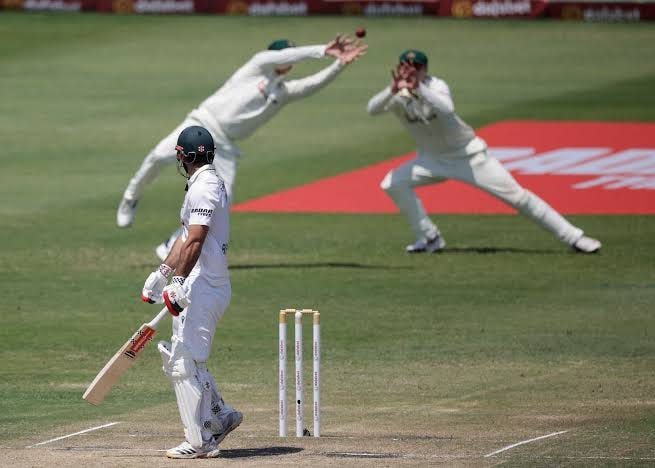
Steve Smith is about to catch David Bedingham, who has played an ill-advised back-foot drive, for one of his four catches, three of them brilliant, which gave him the world record for the most outfield catches – 223.

Absorbing intensity and assessing the situation were the two key phrases used by Proteas batting coach Ashwell Prince at the end of the third day of the first Test against Australia at Kingsmead on Sunday.

It was a day which ended with Australia leading by 139 runs with all 10 second-innings wickets intact. That fact alone suggests things did not go well with the bat for South Africa, who had begun the day on 27 for one in reply to Australia’s 390.

While it may seem appropriate to blame the bowlers for allowing the tourists to score so many first-innings runs, having been 124 for six at one stage, Australia’s revival was down to the conditions easing and the brilliance of Matt Renshaw in scoring a career-best 190 which was the epitome of patience and good judgement.

So the template for success with the bat was there, plain to see, and South Africa’s batsmen had seen it up close for the whole of the second day as they toiled in the field under clear blue skies and a north-easterly wind: Leave well, stick to safe shots that fit your game plan and make the bowlers bowl to you.

But the Proteas top-order ignored what had been in plain sight and tumbled to 284 all out. The fact that their first innings made it that far – a deficit of 106 – was thanks to partnerships of 52 for the ninth wicket between Simon Harmer and Keshav Maharaj (34) and 35 for the last wicket between Harmer (35*) and Anrich Nortje (16).

Those two last partnerships showed up the proper batsmen for their lack of composure and indicated that there were no demons in the Kingsmead pitch. The north-easterly blew again and batting should have been a pleasure. The pace and carry were true, the new ball moved around just a bit and off-spinner Nathan Lyon obtained bounce but not much turn.

Australia bowled full lengths at the start of the day, looking for swing with the ball being nine overs old, and Aiden Markram and David Bedingham capitalised with a series of handsome drives.

They put on 84 for the second wicket in an hour-and-a-half and all seemed right with the world.

But Australia, who have undoubtedly played smarter cricket than the hosts, then switched to back-of-a-length bowling, plugging the line just outside off-stump. Markram fell for 37 trying to punch Mitchell Starc off the back foot through the covers with little footwork; Bedingham did much the same on 49 to give Pat Cummins his first wicket. The back-foot drive is a difficult stroke to play on a pitch renown for the bounce it offers.

Lyon and Starc bowled particularly well to Proteas captain Temba Bavuma, who could only score three runs off 26 balls. And so he tried to relieve the pressure through a reverse-sweep, which was a reasonable option. Except when Steve Smith is at slip and, in a moment of brilliant anticipation, he moved rapidly into the likely path of the ball and made the catch.

Bavuma could maybe be sympathised with, but when Kyle Verreynne (13) did exactly the same thing two-and-a-half hours later, it seemed awfully naive and foolish, notwithstanding the psychic Smith making a sensational one-handed grab.

That was the most frustrating aspect of the Proteas’ batting display, their complete failure to learn from what had happened before. Renshaw had been widely praised for leaving so much during his epic innings; South Africa’s batsmen flashed with abandon outside off-stump.

Cummins then devoured the middle-order as both Wiaan Mulder (30) and Tristan Stubbs (32), who had combined promisingly for a 56-run fifth-wicket stand in just over an hour, tried to hook well-directed bouncers in that off-side channel. Not taking the bait would have been a far better option.

Marco Jansen lifted the mood briefly with six fours in a 26 off just 20 deliveries with powerful pulls and classy drives down the ground. But then he too picked the wrong delivery to attack. Josh Hazlewood hit the deck hard and bowled a straight line, cramping Jansen, who still tried to clear mid-on but with a more vertical bat, only managing to sky the ball to mid-off.
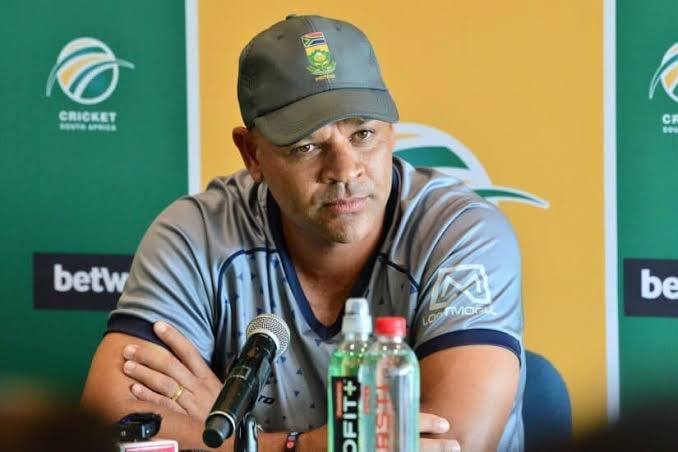
Ashwell Prince in serious mood trying to explain the Proteas’ batting woes.

Ashwell Prince is the batting coach of the Proteas and the man who shored up their middle-order in the 2000s was careful to tread gently as a guardian of his charges.

“I don’t think there was too much aggression, it was more the timing of the dismissals, which kept hurting us. Everyone has their individual approaches and we’ve talked a lot about playing positively and being on the front foot.

“In the subcontinent we played spin well and all the sweeps are options there. As long as the guys have been training them and playing them well, then you can accept it when they get out to one. They were a couple of blinders by Steve Smith.

“It was a really good innings by Renshaw and he deserves a lot of credit. He was very patient and he took the approach of wearing the bowlers down. Everyone has their personal approach and some are more aggressive, they go after their shots more and sometimes it does not pay off.

“There’s lots to take away from today, probably the biggest learning is that the make-up of the Australian attack means they are heavily dependent on three seamers and they have a classy spinner, they come at you with a certain intensity, but that can only last for so long. Sometimes you have to absorb intensity, because it can only last so long.

“The pitch so far has been pretty good and most batsmen feel that they can play more strokes. The ball seemed to come on better today, the bounce was consistent. You could trust the bounce and pace, so the confidence is there.

“Maybe we need to be better at sensing the intensity of the bowlers and assessing the situations. Pat Cummins is astute and when he feels they have a sniff, he pushes his fast bowlers. Just when it looked like a partnership was going to wrestle the advantage our way, a wicket would fall. Every time that would energise them and the bowlers would come again,” was Prince’s carefully considered, diplomatic response.

Australia came out to bat for 25 minutes before bad light stopped play and their dominant position allowed them to be aggressive. Nic Maddinson, who had made a 33-ball duck in the first innings, shook off the pressure of being a controversial selection and hooked his first ball from Marco Jansen for four.

The comeback man added one more four and a flick for six over midwicket to reach 17 not out off 19 balls at stumps, with Travis Head on 10 not out off 15 deliveries, out of a total of 33 without loss.

Prince believes they will bring the same aggressive approach on the fourth day.

“Tomorrow we’re going to see a lot more of the same approach, they’re going to come out with a lot of aggression to try and make up time and stretch their lead as much as possible,” he said.

South Africa will need to try and prolong the amount of time Australia spend at the crease, to make their task of saving the match an easier one. To do that, Prince says they will need to attack rather than defend.

“Taking wickets will be our best approach, while trying to control the run-rate at the same time. In the first innings, Australia made a big total, but they scored it at 2.8 runs-per-over. It’s a different scenario now that they are over a hundred ahead and they can take more risks.

“So we have to be positive, we’ll probably see more spin tomorrow and some innovative field placings to put the ball in their court,” Prince said.

Innovative is one thing, but what the Proteas most require is smarter cricket.

Many metres of newsprint devoted to why JSK can’t make an SA20 final … 0

Posted on January 23, 2026 by Ken

Joburg Super Kings coach Stephen Fleming has had to deal with once again falling short of the SA20 final.
Photo: Arjun Singh/SportzPics

In the old days, many metres of newsprint would have been used to try and answer the question of why the Joburg Super Kings, despite finishing in the top four of all four editions of the SA20, have not yet been able to proceed to the final.

These days, the post-mortems will mostly be done in digital form, computer codes leading to text on some kind of screen.

The Joburg Super Kings’ 2026 campaign came to an end at SuperSport Park on Thursday night as they were well beaten by 36 runs by the Paarl Royals in the SA20 Eliminator. Once again they had fallen short and coach Stephen Fleming, at the helm for all four tournaments, admitted to an “empty feeling”.

Having won the toss and sent Paarl Royals in to bat, but allowing them to post a fine total of 210 for five, and then slumping to 103 for six in reply, it is not that difficult to pinpoint where this season’s push for the final was derailed.

Especially when one considers the Super Kings went into their last fixture without their regular captain, Faf du Plessis, and experienced stars like Rilee Rossouw, Reece Topley and Donovan Ferreira. Injuries and the comings-and-goings of players meant 17 different people took the field for them during the season, so they never really became a settled outfit.

“We’ve had players down, and experienced ones at that, which meant there were guys who had to play at a level they have never been at before and it was asking a lot of them to rise to the challenge. They didn’t respond tonight, but I’m proud of the way they stepped up in Paarl to get into the playoffs,” Fleming said after the loss.

Even though they conceded 210 for five, Joburg Super Kings were by no means out of the contest at the midway point.

It was a fine effort by Paarl Royals, but a curious innings because even though such a big score in a knockout match is always daunting, one felt the Boland side had left a few runs on the table.

Lhuan-dre Pretorius was the top-scorer with a commanding 51 off 34 balls, but he did not seem to have hit top gear yet, seemingly setting his stall to bat deep, when he ran himself out (helped by an excellent piece of out-fielding by Matthew de Villiers) in the 11th over.

There were four other very useful contributions in the Paarl innings: Kyle Verreynne lashed 30 off 15 balls at the start to ensure they had a brilliant powerplay, scoring 61 for one in the first six overs; Dan Lawrence kept the momentum going and had set up a big finish with his 36 off 23 deliveries; and Sikandar Raza (35 off 19) and Asa Tribe (30 not out off 16 balls) provided the big finish with 62 runs scored off the last five overs.

But when the SuperSport Park pitch is as true and well-paced as it was on Thursday, no total is safe if a batter gets in, stays in and goes deep; if one of the Super Kings could score a quickfire 80 and the rest bat around him, then 211 was certainly not out of reach.

But the brilliant Royals attack, led by Hardus Viljoen (4-0-24-3), gobbled up four wickets in the powerplay and some patrons had not yet finished their dinner when the result became fait accompli with the dismissal of Dian Forrester for just three leaving JSK on 103 for six after 13 overs, needing 108 runs off the last seven overs.

Wiaan Mulder deserves credit for showing plenty of fight as he stuck around for three-quarters of an hour to score 41 off 27 balls, while tailenders Duan Jansen (18* off 12) and Nandre Burger (17* off 11) helped themselves to 36 unbeaten runs off the last 23 deliveries.

But shorn of too many inspirational players, there was to be no miracle for Joburg Super Kings.

Impact sub rule negates need for smart batting – Klaasen 0

Posted on December 30, 2024 by Ken

South African batting star Heinrich Klaasen hopes the impact sub rule used in the Indian Premier League never makes its way into international cricket, saying it negates the need for “smart batting”.

Klaasen steered the Proteas to victory in their opening T20 World Cup match in New York, a meagre target of 78 still requiring the batsmen to be at their sharpest on a treacherous pitch that saw the facilities at the Nassau County International Cricket Stadium being criticised for producing a game that lacked entertainment value as the International Cricket Council seeks to reach new markets.

It was all a far cry from the recent IPL, in which strike-rates and totals reached all-time highs. Klaasen, the key finisher for Sunrisers Hyderabad in the IPL, had to play clever cricket against Sri Lanka on a pitch with inconsistent but often steep bounce, and plenty of seam movement, finishing with 19 not out off 22 balls.

It was the sort of match that would have been near-impossible in the IPL with the impact sub rule allowing teams to bolster their batting line-up while not weakening their bowling attack. Klaasen told SportsBoom that he would not like to see the international game adopt the gimmick.

“The impact sub rule allowed batsmen to play with much more freedom and the execution was at a different level on pitches that were good. In the IPL, you are measured by the number of sixes you hit and your strike-rate, that’s your bread-and-butter and no-one worries about your average,” Klaasen said.

“But I hope the impact sub does not come into international cricket. It frees up the batting side too much and you can have a batsman at number nine with it, so there’s no need for anyone to hang around.

“It takes away the creativity of batting, it takes away smart batting. Like when Jos Buttler scored a superb century off 60 balls for Rajasthan Royals against Kolkata Knight Riders to chase down 224, having scored just 25 off his first 18 deliveries. The impact sub will take away that sort of brilliance to sum up conditions and hang around a bit, against just bombing the ball over small boundaries.

“It will allow teams to not play the situation so well. We also don’t get a lot of difficult pitches in the IPL, which is why the way teams go extremely hard in the powerplay is the big trend, and then the middle-order adjusts depending on whether you’re in trouble or flying,” Klaasen said.

While South Africa started their T20 World Cup campaign in impressive fashion against Sri Lanka, Lady Luck has not always been on their side in ICC events and they are yet to win one of the main trophies. Klaasen says the number of players they have with experience in the high-pressure IPL arena has helped them perform better in recent World Cups.

“We’ve got off to a very good start which means we can relax a bit and just keep building on that confidence. We need to focus on what we do best and keep that intensity.

“But the Netherlands have beaten us twice and Bangladesh can beat any team on their day, so we need to play the big moments well in those games.

“We’ve matured and gelled nicely as a team and a lot of the guys have played in the IPL, where there is a lot of pressure and expectation. We have been playing good World Cup cricket lately. Of the last three World Cups, we’ve only had one bad one, the 2022 T20 in Australia when we didn’t play well.

“But in Abu Dhabi in the 2021 T20 we only lost one out of five matches but missed out on the semi-finals on nett run-rate, and last year in India in the ODI World Cup, we played some unbelievable cricket to reach the semi-finals,” Klaasen said.

SA20 is about adapting to different types of pitches; Pretoria Capitals show how 0

Posted on January 18, 2024 by Ken

POWERHOUSE: Will Jacks of Pretoria Capitals celebrates the fastest century in SA20 history.
Photo by Sportzpics

One of the joys of the SA20 is that there are different types of pitches that are used in the tournament and teams are often forced to think on their feet and adapt at short notice. The Pretoria Capitals were quicker and better in adapting to the SuperSport Park wicket on Thursday night and duly notched their first win of the season, beating the Durban Super Giants by 17 runs.

When returning captain Wayne Parnell won the toss and elected to bat first, eyebrows were raised because Centurion is traditionally a venue full of runs, where defending any sort of total can be tough at altitude on a pitch full of runs and a smallish, very quick outfield.

But this pitch behaved slightly differently. The best time to bat was up front and batting second was just that little bit harder as the ball gripped on a dry surface once the new-ball shine had gone.

Will Jacks was the man who seized the moment as he plundered the fastest century in SA20 history, needing just 41 balls to get there, and his onslaught up front gave the Pretoria Capitals such a good platform that their deceleration in the second half of their innings and a collapse of five wickets for seven runs at the death did not cost them the match.

A total of 204 for nine was certainly competitive and the Durban Super Giants were unable to replicate Jacks’ aggression up front and finished on 187 for seven.

Junior Dala, the Durban Super Giants strike bowler but usually based at SuperSport Park, said “It was a game that was probably won and lost in the powerplays. We showed fight with both bat and ball at the end, but we probably conceded 15 to 20 runs too many in our bowling powerplay as Will came hard at us.”

With Jacks hammering eight fours and nine sixes, including a straight hit into the media centre that I have never seen before at SuperSport Park, and fellow Englishman Phil Salt also scoring freely with 23 off 13 balls, the Capitals were off to a blazing start.

The opening pair lashed 75 runs off the first five-and-a-half overs, but then crucially, the Super Giants began taking wickets. As the ball became older, so the cutters came out and the visitors kept chipping away at the Pretoria batting line-up.

“With the newer ball, your cutters and slower balls just skidded on more, but by the eighth or ninth over they were beginning to grip more. But you still had to be smart and understand your match-ups,” Dala later explained.

Jacks reached his hundred two balls quicker than Durban’s Heinrich Klaasen had done in his landmark effort in this same fixture last season, the ball whizzing off his bat in a sparkling innings that should attract many, many views on SA20’s various digital platforms.

But when Jacks (101 off 42 balls) cut his next ball after reaching his second T20 century straight to point, Dwaine Pretorius making the breakthrough, the Pretoria Capitals innings rather lost its fizz. The wicket left them 151 for four after 13 overs, and although Colin Ingram scored a busy 43 off 23 deliveries, their momentum petered out.

Marcus Stoinis (4-0-37-1), playing his first SA20 match having just arrived from the Big Bash in Australia, lit the fuse for the bowling comeback as he dismissed Jimmy Neesham and conceded just two runs in the 18th over; Reece Topley (4-1-34-3) then bowled an astonishing double-wicket maiden and Dala (4-0-32-2) also took two wickets in the final over while conceding just seven runs.

Jacks then toyed with the Super Giants with the ball as well. He opened the bowling and conceded just seven runs in the first over, before returning and claiming two wickets – Kyle Mayers bowled for 1 and the massive scalp of Klaasen for just a single. The off-spinner finished with two for 18 in his three overs.

Opener Matthew Breetzke ought to have batted deeper after scoring 33 off 24 balls but he steered Parnell straight to deep cover and the Capitals just kept chipping away with regular wickets.

Quinton de Kock made 25 off 20 before he sent a mistimed pull off Hardus Viljoen straight to deep midwicket, Stoinis hit a couple of big sixes before holing out to Neesham, and Jacks then took a boundary catch to dismiss Keemo Paul (18) off Parnell.

Jon-Jon Smuts scored a defiant 27, but not even a late flurry from Pretorius (19* off 10) and Keshav Maharaj (25* off 12) was enough to take the Super Giants to a win.

Eathan Bosch was the other Pretoria bowler to excel, showing what a top-class talent he is as he adapted beautifully to the pitch, bowling effective cutters and conceding just 18 runs in his three overs.

  • Recent Posts

  • Archives

  • Thought of the Day

    Colossians 3:13-14 – “Bear with each other and forgive whatever grievances you may have; forgive as the Lord forgave you. And over all these virtues put on love, which binds them all together.”

    “When the Holy Spirit lives in you, you reflect the qualities of Christ in your life. Love and courtesy are basic characteristics of the Christian life. … If Chris lives in you, you will be kind and patient toward others.

    “A person who is truly courteous is humble, … His attitude is the same regardless of whether he is talking to kings or beggars. He treats everyone alike, no matter what race, colour or creed they are. He rejoices in making the path through life easier for others to travel.

    “It is impossible to say that you love and serve God while at the same time treating your neighbour with contempt and disrespect.” – Solly Ozrovech, A Shelter From The Storm


↑ Top