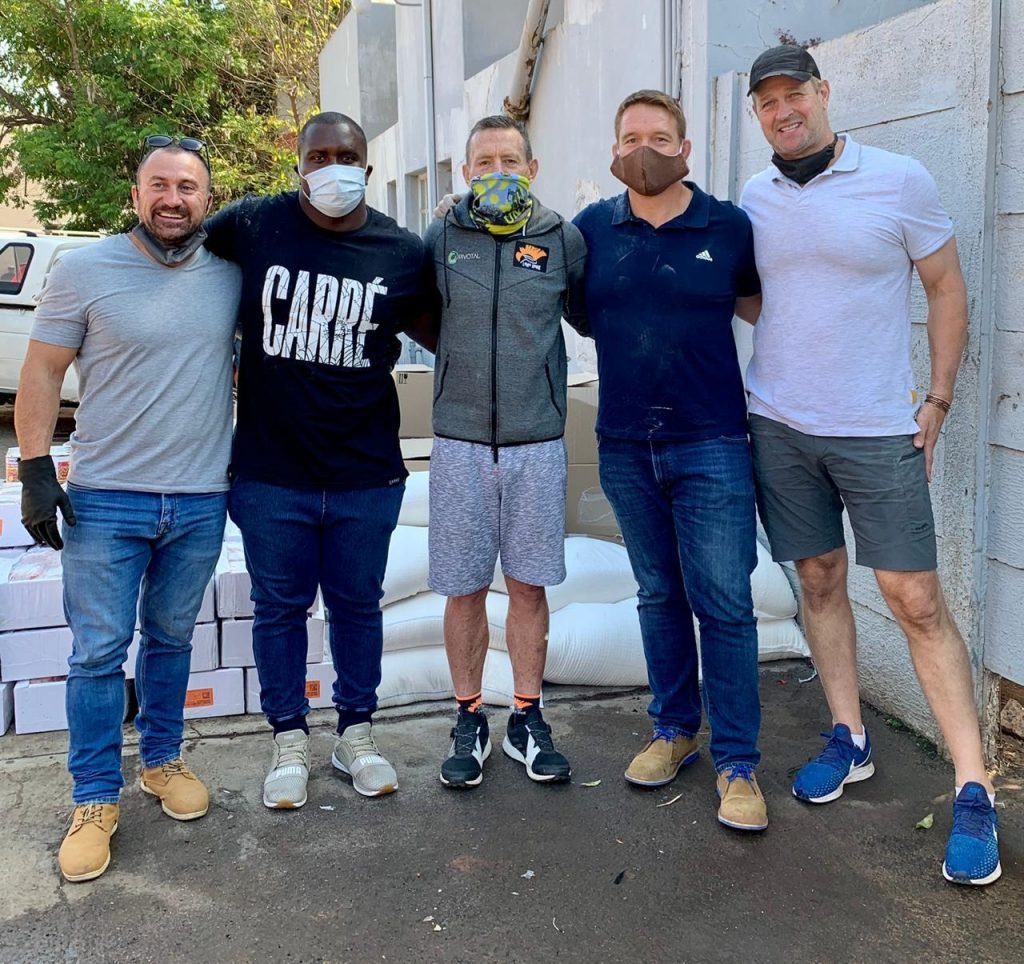
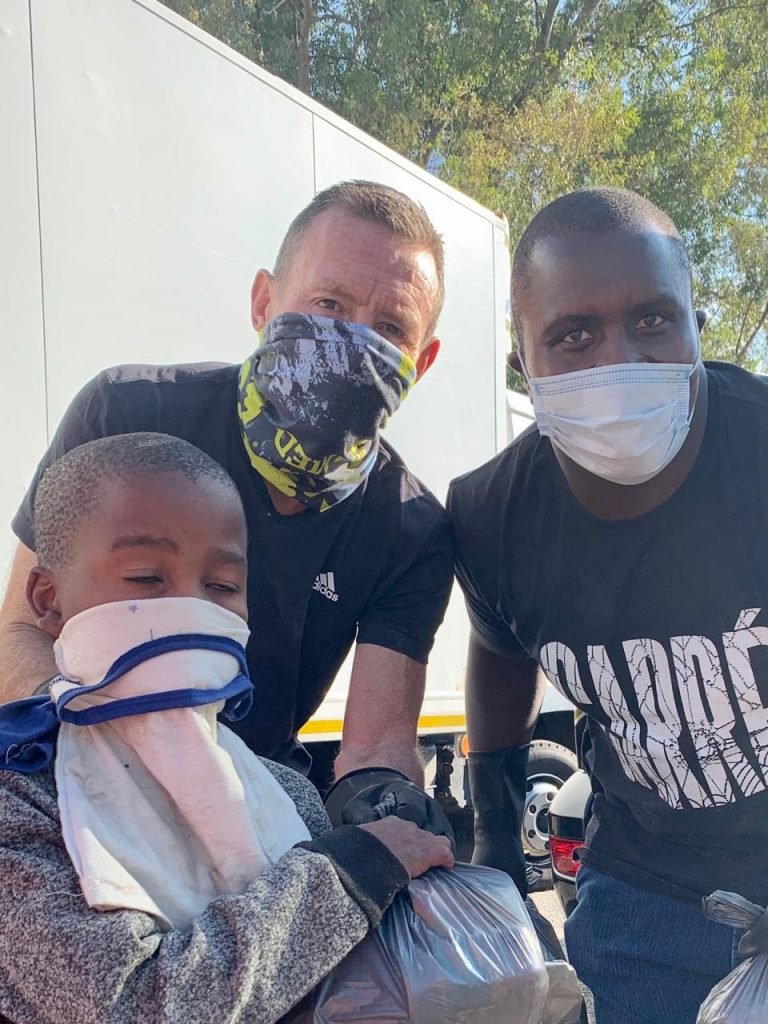
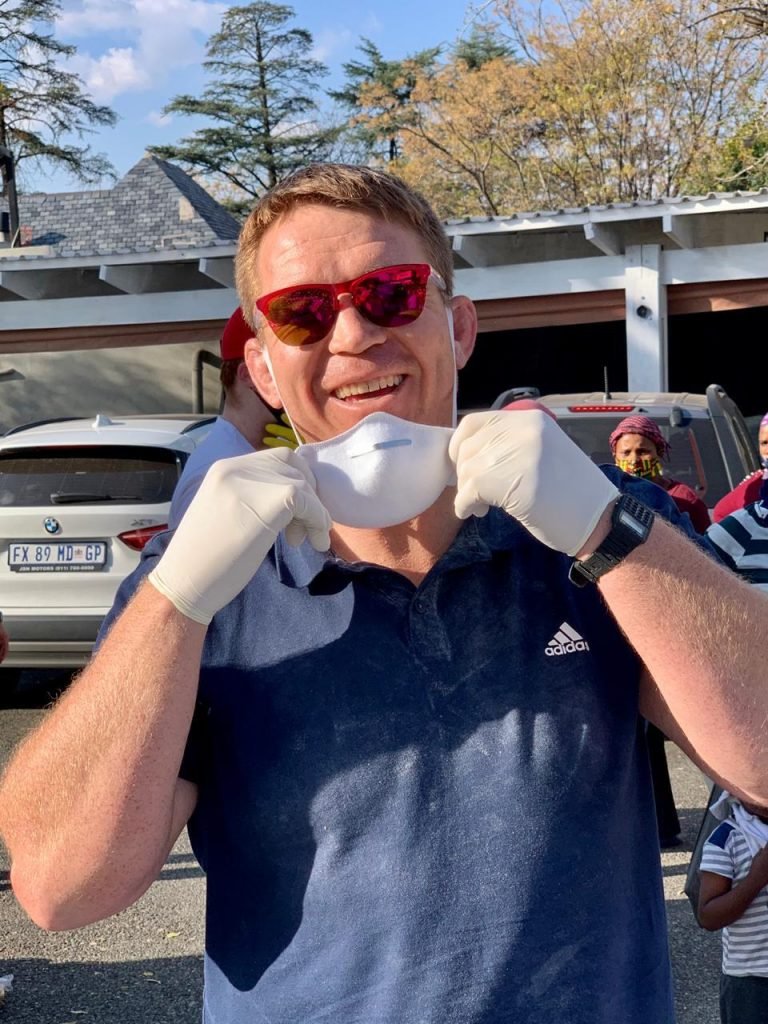
CHAMPIONS – Rugby stars (from left) Dave von Hoesslin, Trevor Nyakane, Joel Stransky, John Smit and Wayne Boardman at a food drop-off for the One Cup of Pap initiative. Photo by Lauren Terras
Africa is certainly a continent of extremes and millions of her inhabitants have scant resources when it comes to basic necessities we take for granted. The situation is only going to become worse due to the Covid-19 pandemic. And although we all miss the game, not being able to play or watch rugby in this time of crisis is a minor hardship compared to those who are living in poverty, in horribly overcrowded conditions, suffering from malnutrition and a lack of running water.
And we can be proud of our South African rugby community because they certainly get this, and the paycuts they have willingly taken and the number of charitable initiatives they have supported or started themselves shows they are not just champion sportsmen but champion human beings.
It’s amazing how far a simple act of kindness can go and this was rammed home for me recently by the work of the One Cup of Pap initiative.
It all started at the beginning of Lockdown in late March when former Sharks and Stormers lock Wayne Boardman, together with his father and domestic worker, decided to put some money together to feed at least one family in need. It started out as one cup of pap and a sachet of soup being dished out at an informal settlement in the northern suburbs of Johannesburg, with a budget of R250 a week.
But seeing desperate people fighting over what little he could give – “We were overwhelmed and the last few people were like hyaenas fighting over the food before it ran out,” Boardman says – he decided to reach out to his friends, local community and his rugby network.
In the last eight weeks, the One Cup of Pap feeding scheme has mushroomed to an R80000-a-week operation, feeding approximately 2000 hungry people with two tons of pap, between 500 and 1000 loaves of bread, and one ton of polony, soup and tinned food.
“We started slowly with not a lot of food, but with the help of a couple of influencers and getting social media full of it, it has grown to a size we never expected. To get one or two big names involved like John Smit and Joel Stransky, who are close to everyone’s hearts, automatically gave us big pull and credibility. Their involvement and that of other Springboks like Trevor Nyakane and Dave von Hoesslin has really seen it grow,” Boardman says.
LINED UP – The different food stations and the queues of people at the One Cup of Pap feeding scheme. Photo by Ken Borland
The project has also spread its reach to areas such as Munsiville in Krugersdorp, Midrand and the Tshuma Stingers development rugby club, Roodepoort and the Feed Thy Kids Creche, the Chilli Lane Community in Sunninghill, the Waste Pickers at Megawatt Park, those living under the bridge at Braamfontein Spruit, Ivory Park and Parkmore. Community involvement is essential because it’s not as if the One Cup of Pap initiative have a census of informal settlement residents to work with when calculating the numbers they need to cater for. The South African Police Services, especially Sandton Police Station, have offered considerable support along with TRSG Security and Security Web.
Joel Stransky & Trevor Nyakane Photo by Lauren Terras
Stransky is famous for his charitable initiative, the LumoHawk Foundation which specialises in testing the eyesight of underprivileged children and giving them glasses. But with Covid-19 having stopped all testing, Stransky has now taken over sponsoring all the children’s food packs for the One Cup of Pap scheme. “I just want to see these kiddies get a proper education that will prepare them for life and give them hope,” he told Saturday Citizen.
Smit has had his own charitable foundation, Barney’s Army, since 2012 and they have also thrown their weight behind Boardman. “If we all do a little bit then we can make it through this crisis. I’m able to leverage off my profile and I’m sure there are plenty of others doing great work, but we need to highlight everyone doing their bit,” Smit said.
Nyakane, who completed the hat-trick of World Cup winners involved, was moved by the experience.
“Lending a hand has made me realise how poor so many people are, it was a no-brainer to help out and hopefully make a difference in their lives. Every little bit helps and it hit me seeing hundreds of people lining up, all needing a lot of help, even if it’s just shelter and being able to get food. I would urge every South African to just lend a hand, it goes a lot further than you realise,” Nyakane said.
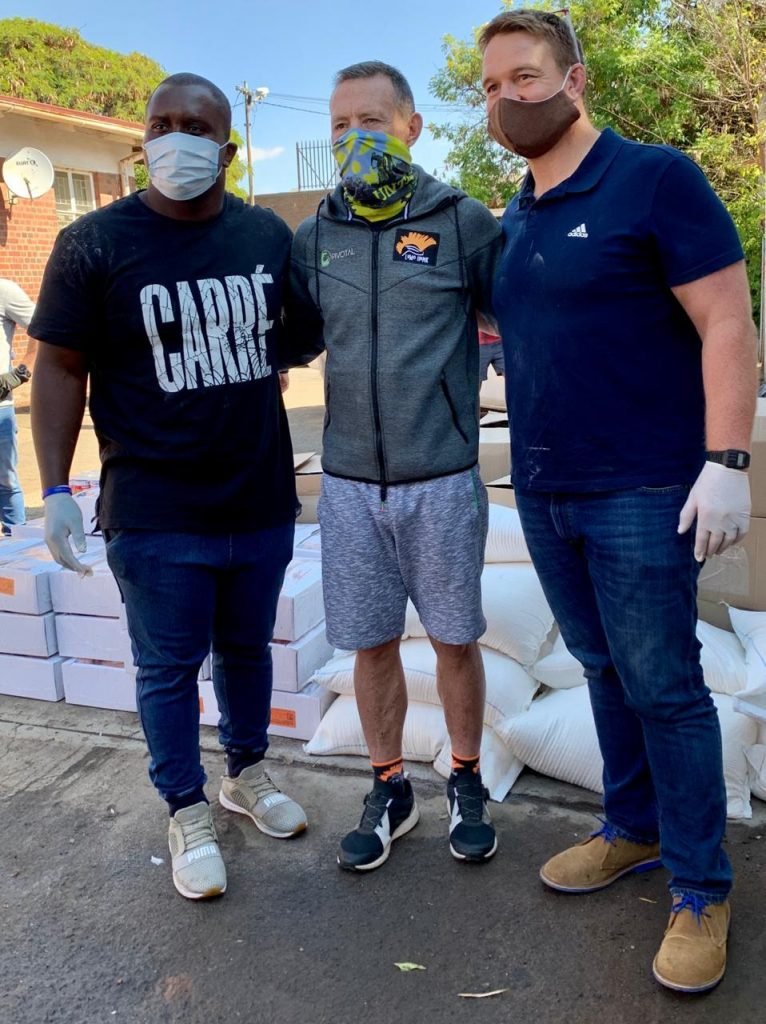
World Cup winners (from left) Trevor Nyakane, Joel Stransky & John Smit. Photo by Lauren Terras
To get in touch with the charity: Wayne Boardman 084 545 1717
Hopes that domestic cricket would be in full swing by October seem to have been knocked to the kerb by CSA but they are hoping to have international cricket back as early as August.
While it was fortunate that the Covid-19 pandemic only struck South Africa when the cricket season was just about over, the effects look set to ironically have an even greater impact on the 2020/21 domestic campaigns, with Cricket South Africa chief executive Jacques Faul admitting on Thursday that only “half a season” is likely.
“It depends on the government levels of Lockdown and we are hoping to meet with the Minister of Sports, Arts and Culture to make a case for us to start playing cricket again earlier. Our initial plan was to start next season as normal, but that seems unlikely now. Our second plan was to have half a season and that is now more likely, with the Mzansi Super League at the start in November/December.
“There are factors like getting permission for domestic travel and the costs – there will be risk involved in playing domestically and I don’t think we can afford the cost of the bio-bubbles for that, with our broadcast deals not so much focused on domestic cricket. But we can probably start with the Mzansi Super League in November/December, even with restricted capacities in stadiums.
“The good news is we have had a teleconference with India and we are encouraged by their willingness to still play three T20s in August, although maybe a bit later in August. We will play behind closed doors if necessary because the India tour is very important to us. That additional content is worth a significant amount of money for us, there are some very important tours in terms of broadcast deals,” Faul said in a teleconference on Thursday.
The Proteas’ first bit of action could come in early August, however, as that is when CSA and Cricket West Indies are hoping to stage the two Tests and five T20s that were initially scheduled from July 15. But the West Indies have had their tour of England rescheduled for July and that has caused a clash of dates with South Africa.
“It’s time to get cricket going again and we’re trying to find a schedule that works with the West Indies. They should finish in England on July 29, which means we have to shift our dates. India should be coming here at the end of August for three T20s, so the West Indies series will have to be before or after that. Obviously this all depends on government regulations on both sides,” CSA Director of Cricket Graeme Smith said.
“Trinidad is favoured by the West Indies at the moment, but we could play at a neutral venue or even here, nothing is cast in stone. The players are preparing though for coming back to cricket and we believe we can get that done behind closed doors if necessary. We will explore all options – neutral grounds, having more than one team at a time because of the 28 days quarantine at either end.”
Cricket South Africa Chief Medical Officer Dr Shuaib Manjra said their scenario planning for the return to play included studying the measures put in place by intercity football competitions like the La Liga in Spain and the Bundesliga in Germany.
“We’re drawing from the England Cricket Board, Cricket Australia, La Liga and the Bundesliga in terms of best practice and we’re also engaging with SA Rugby and Safa to ensure we’re on a common platform when it comes to returning to play. A bio-bubble or Cordon Sanitaire is at the extreme end of the spectrum, but it would ensure all stadia have strict access protocols.
“The stadia would be sanitized, there would be strict control over who comes in and goes out and regular testing – a couple of days before people go in and again just before. We don’t envisage spectators being allowed and things like saliva on the ball are clearly a no-no, there is the sweat option which is believed not to be able to carry the virus but we don’t have adequate research on that,” Manjra said.
Former Springbok captain John Smit believes rugby will need to be drastically streamlined once it resumes after the Covid-19 pandemic, while his fellow World Cup winner Joel Stransky is hoping for a quicker, less contact dominated game when action gets underway again.
Typically for the great South Africans they are, the two World Cup winners were busy handing out food parcels in Lonehill for the One Cup of Pap charitable initiative when they spoke to The Citizen about what they were hoping for once rugby is allowed to take place again.
Smit’s focus was on the effects of the suspension of play and how rugby organisations are going to have to adjust not just their schedules but also the very structure of the game in their respective countries in order to ameliorate the tough financial conditions that will be prevalent.
“Covid-19 has been a massive storm that has had a massive impact on our game, showing us how we have taken certain things for granted. I think it’s important to remember that rugby is largely a product of the players and wherever the sport is not streamlined enough, guys are going to have to make cuts.
“Decisions are going to have to be made about not just the survival of those in the game at the moment. Where the game is running fat, where most of the money is going, that’s where there have to be cuts and I think we all know where those places are,” Smit, a former CEO of the Sharks, said cryptically.
Former flyhalf Stransky wanted to see a pacier game in which there will be more exciting backline play.
“I don’t think the game will change so much although there will be more screening and testing, we will be more aware of the risks but there will still be running, scrumming and tackling. I would just like to see the space on the field used more. Rugby has become very predictable with defensive structures so well organised. The players are now very physical and tend to just bash it up.
“There is not too much backline excitement anymore; players like Cheslin Kolbe at the World Cup, stepping and beating players, using the space, are few and far between; normally the backs just kick the ball through now and hope for a mistake,” Stransky said.
The 1995 drop goal hero said he hoped being deprived of live rugby would encourage people to go back to the stadiums when the action resumes, and Stransky said he counted himself now amongst the people who used to just watch on television (when not broadcasting) but he would now be taking the family to games.
“There’s still going to be massive drama but every sport is in the same boat and we’re no different to other industries – we have all taken a knock. It could take years to bounce back but as soon as there is sport to watch live then hopefully people will be more inclined to go to the stadiums. I know I will be taking the family once rugby is back,” Stransky said.
Springbok tighthead prop Marcel van der Merwe began his professional rugby career at the Free State Cheetahs in 2011 and would play alongside and scrum against a strong but raw loosehead from Limpopo by the name of Trevor Nyakane.
In 2013 Van der Merwe joined the Blue Bulls and made his Super Rugby debut for them the following year. Nyakane followed the Welkom-born, Paarl Boys’ High School educated tighthead to Pretoria, with Van der Merwe then leaving for Toulon in June 2016.
The 29-year-old Van der Merwe will now return to the Bulls after four years in France and he will find Nyakane has not only switched to tighthead prop but become an integral part of both the Bulls and Springbok teams. There will be competition aplenty now for what new Bulls coach Jake White has called the most important position in the team, and Nyakane welcomes it.
Not only because it will push the 31-year-old to even greater heights but it will also help manage his workload. Nyakane had very little respite in last year’s Super Rugby competition, starting every single game, all 17 of them. Eventually all that physical strain adds up and it may have played a role in his unfortunate departure from the 2019 World Cup, after tearing a calf muscle in the second half of the opening game against the All Blacks.
“I played with Marcel at both Free State and the Bulls and I know the type of player he is, so it’s going to be amazing to have him in the squad. We can now look at alternating at tighthead, it’s always great to be able to do that, but you also want to play of course. But it’s really difficult in a full season to play every game,” Nyakane told The Citizen at the One Cup of Pap Feeding Scheme, alongside fellow World Cup winners John Smit and Joel Stransky, who were also helping to hand out food parcels.
White has been quick to make changes at the Bulls and Nyakane said it will be exciting times when the squad finally gets together again after Lockdown. “It’s always exciting having a new coach to change things up a bit and I look forward to meeting up with Jake and everyone else when we go back to Loftus. The coach has obviously been bulking up the squad, which only makes it easier to rotate and manage players, and to have fresh blood coming in will be a positive,” Nyakane said.