for quality writing

Ken Borland


Champion rugby stars are champion humans helping those South Africans in extreme need 0

Posted on May 23, 2020 by Ken

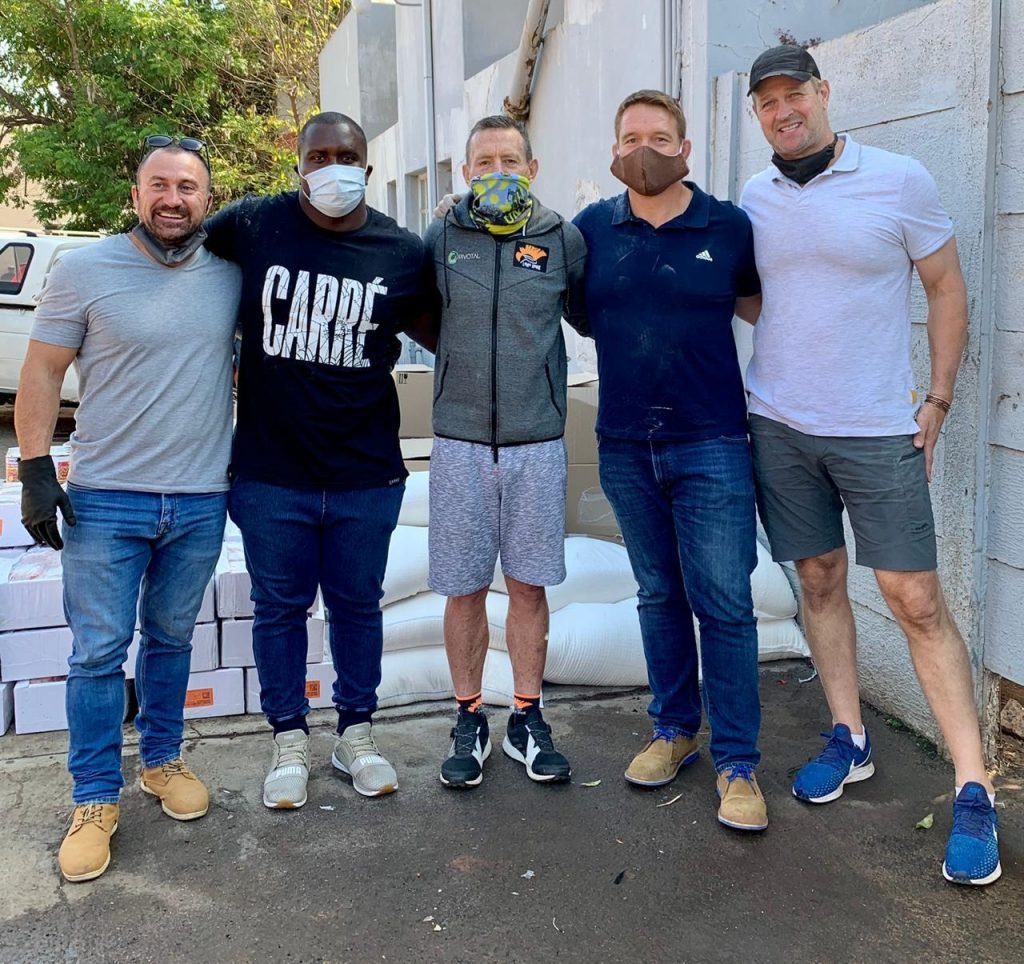
CHAMPIONS – Rugby stars (from left) Dave von Hoesslin, Trevor Nyakane, Joel Stransky, John Smit and Wayne Boardman at a food drop-off for the One Cup of Pap initiative.
Photo by Lauren Terras

Africa is certainly a continent of extremes and millions of her inhabitants have scant resources when it comes to basic necessities we take for granted. The situation is only going to become worse due to the Covid-19 pandemic. And although we all miss the game, not being able to play or watch rugby in this time of crisis is a minor hardship compared to those who are living in poverty, in horribly overcrowded conditions, suffering from malnutrition and a lack of running water.

And we can be proud of our South African rugby community because they certainly get this, and the paycuts they have willingly taken and the number of charitable initiatives they have supported or started themselves shows they are not just champion sportsmen but champion human beings.

It’s amazing how far a simple act of kindness can go and this was rammed home for me recently by the work of the One Cup of Pap initiative.

It all started at the beginning of Lockdown in late March when former Sharks and Stormers lock Wayne Boardman, together with his father and domestic worker, decided to put some money together to feed at least one family in need. It started out as one cup of pap and a sachet of soup being dished out at an informal settlement in the northern suburbs of Johannesburg, with a budget of R250 a week.

But seeing desperate people fighting over what little he could give – “We were overwhelmed and the last few people were like hyaenas fighting over the food before it ran out,” Boardman says – he decided to reach out to his friends, local community and his rugby network.

In the last eight weeks, the One Cup of Pap feeding scheme has mushroomed to an R80000-a-week operation, feeding approximately 2000 hungry people with two tons of pap, between 500 and 1000 loaves of bread, and one ton of polony, soup and tinned food.

“We started slowly with not a lot of food, but with the help of a couple of influencers and getting social media full of it, it has grown to a size we never expected. To get one or two big names involved like John Smit and Joel Stransky, who are close to everyone’s hearts, automatically gave us big pull and credibility. Their involvement and that of other Springboks like Trevor Nyakane and Dave von Hoesslin has really seen it grow,” Boardman says.

LINED UP – The different food stations and the queues of people at the One Cup of Pap feeding scheme.
Photo by Ken Borland

The project has also spread its reach to areas such as Munsiville in Krugersdorp, Midrand and the Tshuma Stingers development rugby club, Roodepoort and the Feed Thy Kids Creche, the Chilli Lane Community in Sunninghill, the Waste Pickers at Megawatt Park, those living under the bridge at Braamfontein Spruit, Ivory Park and Parkmore. Community involvement is essential because it’s not as if the One Cup of Pap initiative have a census of informal settlement residents to work with when calculating the numbers they need to cater for. The South African Police Services, especially Sandton Police Station, have offered considerable support along with TRSG Security and Security Web.

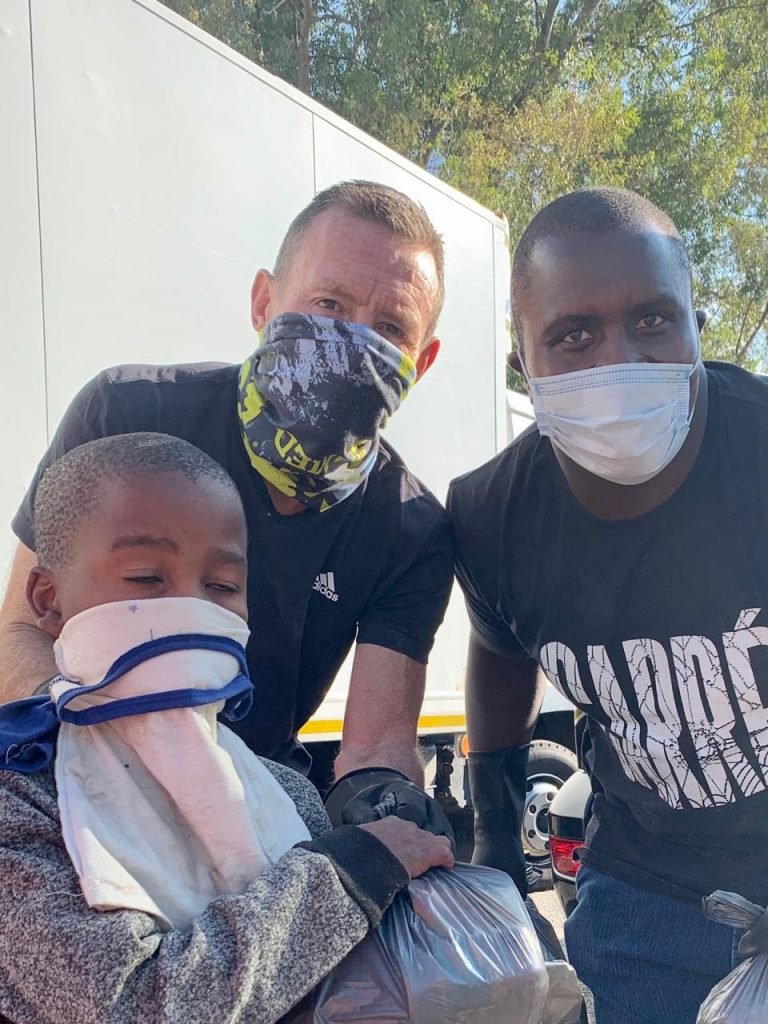
Joel Stransky & Trevor Nyakane
Photo by Lauren Terras

Stransky is famous for his charitable initiative, the LumoHawk Foundation which specialises in testing the eyesight of underprivileged children and giving them glasses. But with Covid-19 having stopped all testing, Stransky has now taken over sponsoring all the children’s food packs for the One Cup of Pap scheme. “I just want to see these kiddies get a proper education that will prepare them for life and give them hope,” he told Saturday Citizen.

Smit has had his own charitable foundation, Barney’s Army, since 2012 and they have also thrown their weight behind Boardman. “If we all do a little bit then we can make it through this crisis. I’m able to leverage off my profile and I’m sure there are plenty of others doing great work, but we need to highlight everyone doing their bit,” Smit said.

Nyakane, who completed the hat-trick of World Cup winners involved, was moved by the experience.

“Lending a hand has made me realise how poor so many people are, it was a no-brainer to help out and hopefully make a difference in their lives. Every little bit helps and it hit me seeing hundreds of people lining up, all needing a lot of help, even if it’s just shelter and being able to get food. I would urge every South African to just lend a hand, it goes a lot further than you realise,” Nyakane said.

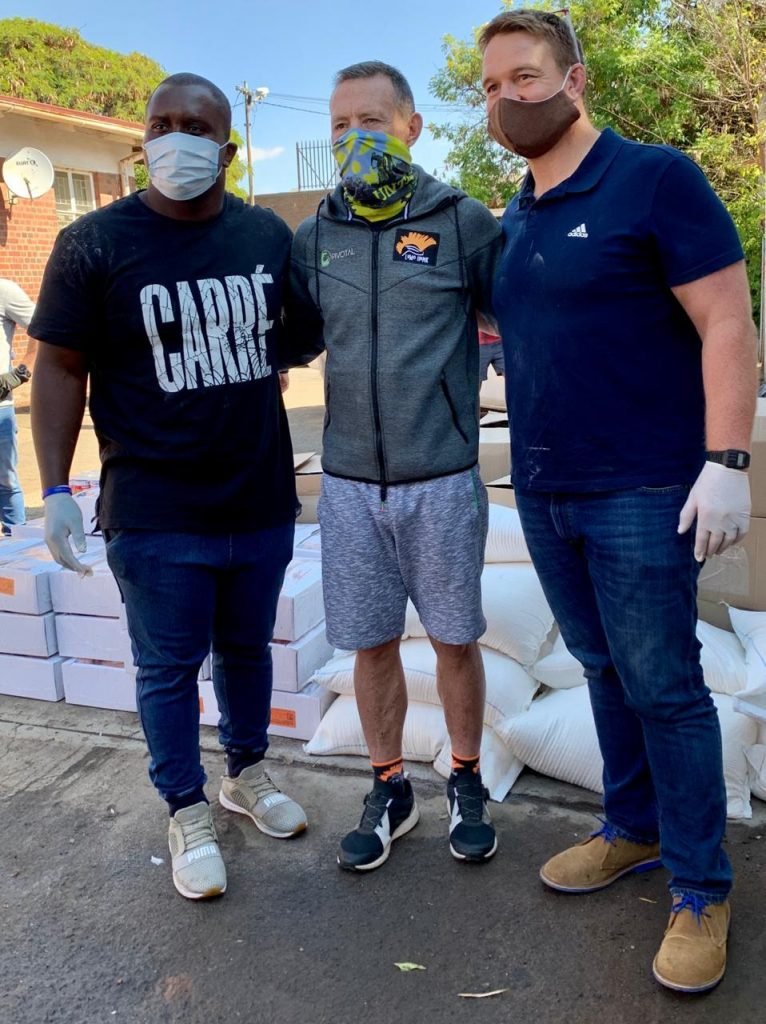
World Cup winners (from left) Trevor Nyakane, Joel Stransky & John Smit.
Photo by Lauren Terras

To get in touch with the charity: Wayne Boardman 084 545 1717

Banking details:

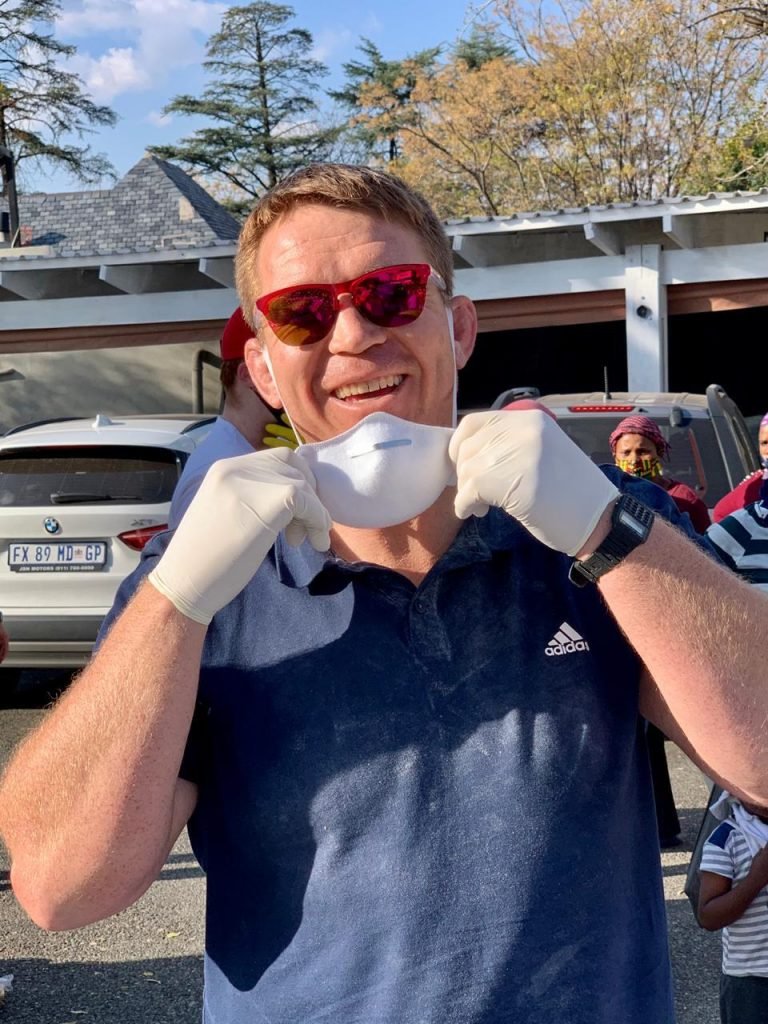
John Smit all smiles
Photo by LT

A Knowles

Nedbank

1969043962

Rivonia Branch

Ref: One Cup Pap

Rugby will need to be streamlined post-Covid, says Smit; ‘Speed it up!’ says Stransky 0

Posted on May 21, 2020 by Ken

Former Springbok captain John Smit believes rugby will need to be drastically streamlined once it resumes after the Covid-19 pandemic, while his fellow World Cup winner Joel Stransky is hoping for a quicker, less contact dominated game when action gets underway again.

Typically for the great South Africans they are, the two World Cup winners were busy handing out food parcels in Lonehill for the One Cup of Pap charitable initiative when they spoke to The Citizen about what they were hoping for once rugby is allowed to take place again.

Smit’s focus was on the effects of the suspension of play and how rugby organisations are going to have to adjust not just their schedules but also the very structure of the game in their respective countries in order to ameliorate the tough financial conditions that will be prevalent.

“Covid-19 has been a massive storm that has had a massive impact on our game, showing us how we have taken certain things for granted. I think it’s important to remember that rugby is largely a product of the players and wherever the sport is not streamlined enough, guys are going to have to make cuts.

“Decisions are going to have to be made about not just the survival of those in the game at the moment. Where the game is running fat, where most of the money is going, that’s where there have to be cuts and I think we all know where those places are,” Smit, a former CEO of the Sharks, said cryptically.

Former flyhalf Stransky wanted to see a pacier game in which there will be more exciting backline play.

“I don’t think the game will change so much although there will be more screening and testing, we will be more aware of the risks but there will still be running, scrumming and tackling. I would just like to see the space on the field used more. Rugby has become very predictable with defensive structures so well organised. The players are now very physical and tend to just bash it up.

“There is not too much backline excitement anymore; players like Cheslin Kolbe at the World Cup, stepping and beating players, using the space, are few and far between; normally the backs just kick the ball through now and hope for a mistake,” Stransky said.

The 1995 drop goal hero said he hoped being deprived of live rugby would encourage people to go back to the stadiums when the action resumes, and Stransky said he counted himself now amongst the people who used to just watch on television (when not broadcasting) but he would now be taking the family to games.

“There’s still going to be massive drama but every sport is in the same boat and we’re no different to other industries – we have all taken a knock. It could take years to bounce back but as soon as there is sport to watch live then hopefully people will be more inclined to go to the stadiums. I know I will be taking the family once rugby is back,” Stransky said.

From the basement to the attic for Beuran, who now knows the levels required 0

Posted on May 12, 2020 by Ken

Beuran Hendricks has become a contracted Protea for the first time and the left-arm pace bowler admitted on Monday that it has taken him a while to understand just what a different level international cricket is, as his career has gone from the basement to the attic of the game in the last four years.

Hendricks actually first played for South Africa way back in 2014, appearing in a couple of T20s against Australia before going to the ICC World Twenty20 in Bangladesh. He did well enough to gain an IPL contract with the Punjab Kings XI, but he then suffered a stress fracture and when he returned at the end of 2015, he struggled to make the Cape Cobras side.

A move to the Highveld Lions, initially on loan, in early 2017 rejuvenated his career, however, and he was back playing T20s for South Africa that October. He has now played 13 T20 Internationals, taking 20 wickets, an ODI debut followed in January 2019, then he was a late replacement for the World Cup in England, and he reached the Holy Grail in January this year when he made his Test debut against England at the Wanderers and took five for 64 in the second innings.

“I’ve been playing pretty decently at franchise level, enough to warrant selection for the national team. I started my international career well enough but then I felt that my performances dipped and they weren’t really at the standard I set for myself. But I now know the intensity and levels I need to be at which should lead to more consistency for the Proteas.

“My Test debut against England was pretty special and I learnt that you can’t drop your intensity at all, it’s five days against opposition who aren’t giving you anything. I was put under pressure in the first innings [23-3-111-1], on the back foot, but in the second innings I picked it up a notch, my intensity was higher and I was able to bring it back a bit. I now know and understand the intensity I need at that level,” Hendricks said on Monday.

“To get my first Proteas contract makes me feel special and proud, it shows that hard work pays off. It has settled a lot of nerves, I now feel part of the Proteas family and team. A lot of positive decisions have got me where I am now in my game and my personal life etcetera,” he added.

But there will be no resting on his laurels for the 29-year-old because Hendricks believes there are no guarantees of Proteas selection given the amount of talent he sees coming through the franchise system.

“There is so much talent coming through, every year there’s a new name. The franchise system just needs to tap into all that talent and make sure that it’s ready for international selection. I think the national selectors are going to be busy over the next two to three years because there will be a lot of options for them to consider, we’re not far off that point.

“But I’ve thought about what I want for my future and I will do whatever I can to make sure that the Proteas stay one of the best teams in the world. Fortunately I have a pretty good relationship with Charl Langeveldt [bowling coach], he understands my bowling best and we know how to communicate with each other. I’m very sure he’s going to be successful now that he’s back with the Proteas,” Hendricks said.

CGL make changes to board composition because ‘individuals only focus on their segment’ 0

Posted on May 09, 2020 by Ken

The Central Gauteng Lions have decided to move away from the prescribed racial constituencies for the election of their board in their AGM on Saturday, because critics say it encourages individuals elected as directors to only focus on their particular segment of the game.

Since the Langa Commission in 2009, which was set up by disgraced Cricket South Africa CEO Gerald Majola as punishment for Gauteng cricket’s role in bringing the bonus scandal to light, the Lions board has had a specific racial composition, with racial voting blocks that meant Black African clubs could only vote for the Black African members of the board, likewise for the Coloured and Indian and White groupings.

Last year, CSA pulled a similar stunt, delaying the AGM when the Ngoepe Commission was instituted to see if the changes brought about by the Langa Commission had aided transformation. Judge Bernard Ngoepe found that they had not, but then said the provisions should continue.

Of the seven non-independent directors to be elected to the board, three of them had to be Black African, with the Coloured/Indian and White constituencies electing two representatives each. But the Members Council, comprising all the province’s clubs, have agreed that in Saturday’s AGM there will be two guaranteed posts for each of the racial categories, for which everyone can vote, while the seventh place on the board is open to anyone.

The Black African Cricket Clubs (BACC) grouping this week lashed out at the Members Council and have threatened to pull out of Saturday’s AGM.

“Transformation has not been fully achieved but there has been progress. The Coloured and Indian clubs don’t feel any less Black than the Black African ones and having more Black African representatives does not automatically guarantee transformation. The board has been majority Black African for a number of years but the report by Judge Ngoepe said transformation had not been achieved.

“We want to vote for the best board, whether that means five Black Africans, seven or two. But the BACC are basically fighting about one seat and have been threating the Concerned Cricketers Forum (Indian/Coloured) and the Previously Advantaged Clubs (White), both of which have definitely changed their demographics anyway. We don’t want to vote by constituency anymore.

“All clubs should play a role in electing all seven board members, so the Members Council have decided that all clubs can vote for all seven, the best seven. There are also the five independent directors to be chosen by the new board and I would be surprised if that wasn’t 80% Black African. We want to be able to hold every board member accountable, with three different constituencies the directors all just look after their own interests. The day a Black African club can ask a White board member what they are doing for that club is the day we move forward,” a Members Council insider told Saturday Citizen.

Central Gauteng Lions CEO Jono Leaf-Wright said he believed the Members Council’s only agenda was to obtain long-overdue unity.

“We just want a united board that can grow all cricket and execute our mandate, including transformation. In terms of transformation, I believe we have ticked many boxes. It would be different if we were fielding lily-white teams, but our system and pipeline are very strong,” Leaf-Wright said.

  • Recent Posts

  • Archives

  • Thought of the Day

    Revelation 3:15 – “I know your deeds, that you are neither cold nor hot. I wish you were either one or the other.”

    How can you expect blessings without obeying?

    How can you expect the presence of God without spending time quietly before him?

    Be sincere in your commitment to Him; be willing to sacrifice time so that you can grow spiritually; be disciplined in prayer and Bible study; worship God in spirit and truth.

    Have you totally surrendered to God? Have you cheerfully given him everything you are and everything you have?

    If you love Christ, accept the challenges of that love: Placing Christ in the centre of your life means complete surrender to Him.


↑ Top