for quality writing

Ken Borland


Close encounters on the Kransberg 1
Posted on April 27, 2018 by Ken


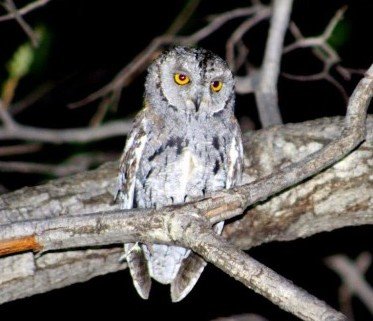
An African Scops Owl comes to visit our campsite

An African Scops Owl comes to visit our campsite


by Anthony Stidolph


I am, by nature, a wanderer. For me there is nothing quite like the thrill of departure, the joy of being on the road again, of heading off to remote and cut-off places.

As an antidote to this restlessness I have travelled the length and breadth of South Africa searching out new places I can claim as my own. In recent years this has involved launching several expeditions up to the Limpopo, along the way taking in Punda Maria and Pafuri in North Kruger, Mapungubwe, Ratho on the Botswana border,  Hans Merensky on the Groot Letaba, the forests of Magoebaskloof, parts of the Soutspanberg and that little-known gem, Blouberg Nature Reserve near Vivo.

Having explored and fallen in love with this sun-drenched landscape, my birding partner Ken and I recently took a notion to recreate these epic treks by heading back up there once again, only, this time, adding Marakele National Park, which would be new country for me.

A Tshwana word, aptly meaning “Place of Sanctuary”, Marakele falls within a transitional zone between the dry western habitat, made up mostly of Kalahari thornveld, and the typical bushveld country of the moister eastern sections of South Africa. It also lies within the Waterberg range of mountains, with an altitude ranging from 1050 metres on the plains to 2088 metres at its highest point.

Because of this broad range of vegetation types and its diverse topography the area boasts a wide variety of game (including the Big Five and Wild Dog) and an abundant bird life. Its biggest attraction, for birders anyway, is the around 800 breeding pairs of Cape Vulture which nest high up in the cliffs of the Kransberg

Arriving at the park, which is situated about twenty kilometres north of the old iron-ore mining town of Thabazimbi, we set up camp and then headed off on our first drive. I was immediately rewarded with my first lifer of the trip – a Greyheaded Kingfisher.

As we sat having a celebratory beer that night, listening to the clear, articulated noises of the bushveld at night, a tiny African Scops Owl landed on a branch above us and began its odd but strangely comforting, frog-like, “Prrrt…prrrt…prrrt…” call. This was more like it. My latest Excursion Into The Great Unknown had officially begun.
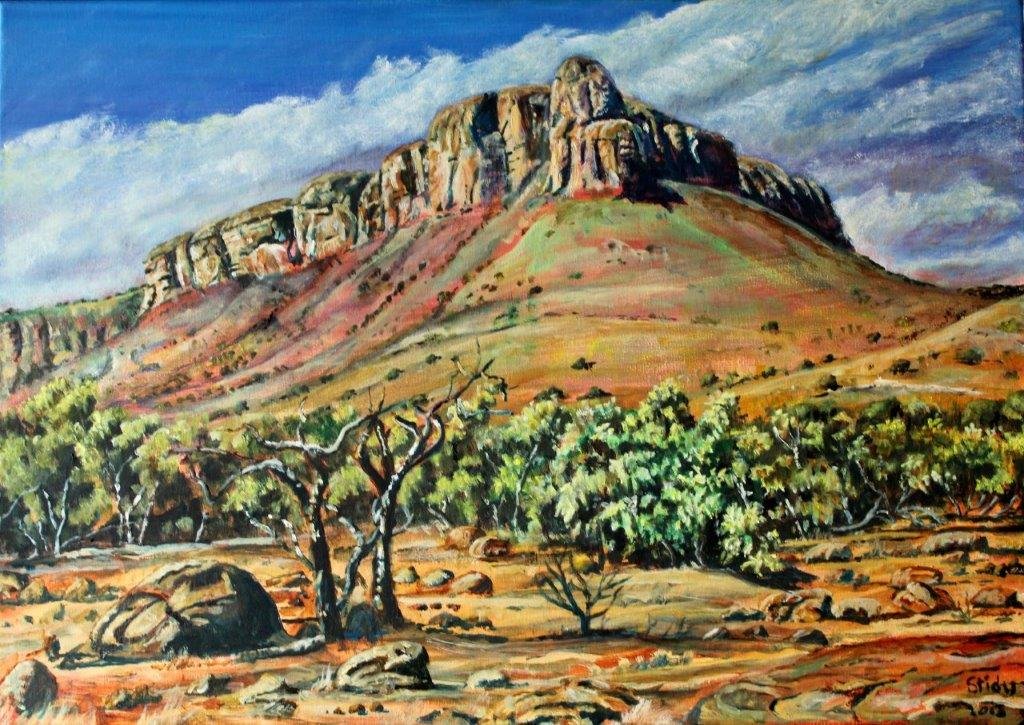
The Kransberg, Marakele NP

Anthony Stidolph’s painting of The Kransberg in Marakele National Park. For Sale – contact Stidy at stidy@sai.co.za (42×60)

The next day we were up at dawn and driving through heavy bush country towards the impressive pass that leads up to the top of the Kransberg mountain. A friend of ours had told us that her biggest concern going up this narrow, winding, precipitous road, was what she would do if she encountered another vehicle coming down the other way as there is little room to pass. That proved to be the least of our worries.

Rounding one steep-sided corner we suddenly found ourselves coming face-to-face with a young elephant bull that had stepped out on to the road. Having been in this situation many times before, Ken immediately pulled up short, stopping a sufficient distance from the animal so as not to make it feel threatened or think that we were encroaching on its space. It didn’t help.

Coming face-to-face with a wild animal so much bigger than yourself can be a slightly intimidating experience and this one decided to remind us of its size advantage. Without even affording us the courtesy of a warning mock charge, it let out an almighty bellow and came thundering down the road.

There was nothing to do but slam the car into reverse and head back down the road with me craning my head out of my window, shouting directions, while Ken did the same on his side.

The kilometre or so we drove in this manner was like a rapid ride through eternity. We kept hoping that each time we rounded a corner and the elephant lost sight of us it would lose interest. No such luck. The beast definitely did not like the cut of Ken’s jib and was determined to drive us clear off his mountain stronghold.

We went back down into the valley and somehow – and I shall never know how we did it – managed to do so without plunging down the mountain side or getting stomped on by the elephant. Once safely back on the flat we found a turning point, backed into it and sped off in the direction we had earlier come from.

A half-an-hour or so later we gingerly ventured back but, very bravely, decided to allow another vehicle – that had come driving up while we were parked on the side of the road observing, of all things, a Neddicky (the ultimate Little Brown Job), while considering the sagacity of continuing on our journey – go up ahead of us. Once we had seen they had safely cleared the ridge we sailed forth ourselves, this time, thankfully, unmolested.

At the top of this particular stretch the road evens out on to a trough through which you drive before getting to tackle the final, most spectacular, stage of the mountain. Here the road begins an even more torturous ascent. On the one side rise the naked sandstone towers of the Kransberg massif itself, weathered into the shapes of fantastical beasts and strange deformed reptiles. On the other side the slopes plunge steeply down into a treeless, meadowy grassland in which several more elephant and a herd of wildebeest were feeding.

As we advanced the road got narrower and narrower. What got us perspiring heavily all over again was that there were yet more fresh elephant droppings at regular intervals all along its surface, virtually to the top.

On the summit it was like another world. The view was colossal. Below us the mountain stretched away in every direction before dropping down, in a series of steps, to the plains, fading away into the blue distance.

Immediately in front was another castle-like knob, a labyrinth chaos of rock, fitted with clefts and chimneys. It was here the vultures nested. There were many of these large, endangered raptors wheeling gracefully above us, trailing their shadows on the ground beneath them.

The protea-covered hillsides on top of the mountain also provide a home for some other unusual species like the Gurney’s Sugarbird and the Buff-streaked Chat, birds which I more commonly associate with the Natal Midlands, where I live, and the foothills of the Drakensberg. Another occupant is the Kransberg Widow, a very rare and beautiful butterfly which puts in an appearance in November and early December and then, like Cinderella, sheds its finery and disappears. This is the only place in the world where it occurs.

We were reading all about the insect on a large information board they have erected up there, alerting us to its presence, when one came fluttering past. A few minutes later it came fluttering back again … and again. It may be scarce but it certainly wasn’t shy about showing off its beautiful cream markings.


A cold wind was blowing across the mountain top and a storm was brewing in the distance and so, after a warming cup of coffee, which we shared with a pair of very tame Cape Buntings and a cheery Mocking Cliff-Chat, we made our way back down the same twisting road, this time without having to face down any elephants with murder on their minds. Heading into camp I did, however, have another good sighting of two more Greyheaded Kingfishers, dive-bombing a family of Banded Mongoose.

Two days later, in Blouberg, I had an even better view of the kingfisher sitting at the end of a dead branch. This meant that after fruitlessly searching for the elusive bird for years I had now seen four in four days …

The grumpy pachyderm who had chased us down the Kransberg may have scared me witless, but I couldn’t help wondering afterwards if he hadn’t deliberately engineered the whole encounter just to make sure I kept running into the bird!


ANTHONY STIDOLPH


Where is Marakele National Park?


John McFarland Column – The intent is obviously there 0

Posted on March 03, 2017 by Ken


Judging by the quality of the games last weekend, I am really looking forward to this weekend’s SuperRugby action, with the Stormers, Bulls and Lions looking like South Africa’s three major contenders.

Last weekend we saw very different South African derbies to what we normally see and the will to attack was clearly there. The intent was obviously there to play with ball in hand and the teams played with real speed in terms of tempo, and pace, which made a heck of an impact.

An example of this was when the Stormers took a quick tap and scored seven points against the Bulls; they, in particular, showed more intent than they have in the past.

The effects of the new tackle law, meaning players now have to go lower with their hits, were also evident in that there were more offloads. Attacks can now continue through the tackle because the arms are free and the tall guys can get the ball above the tackle. It keeps the ball alive and it has led to a lot more continuity.

What was really impressive to me was how lean some of the leading Springboks looked. Guys like Eben Etzebeth, Pieter-Steph du Toit and Siya Kolisi looked in great shape and the speed they played at was a direct consequence of their fitness levels.

There’s definitely been a huge emphasis on conditioning through the franchises and it could mean the end of the New Zealand and Australian sides feeling that a high ball-in-play figure is their secret to success because the South African teams will tire.

While the Stormers were fantastic, what was encouraging about the Bulls was that they never gave up, which is huge. They denied the Stormers a bonus point, which at the end of the day could be vital; from 24-0 up at halftime, the Stormers really needed to get that bonus point. The second half would have provided a huge swing in confidence for the Bulls.

In the Cheetahs versus Lions game in Bloemfontein, the visitors really got out of jail, but if you can score three tries away from home then you deserve your victory.

Rohan Janse van Rensburg showed his finishing power and speed, while the Lions’ try down the short side to win the match showed again that rugby is about defending the full width of the field, even if you only have two or three metres to touch.

The penalty try given off a driving maul was a game-changer; most referees would have copped out and just given a penalty, but if the maul is set and moving forward then it deserves that decision, so credit to referee Quinton Immelman for his brave call.

The Southern Kings looked better and scored some really good tries, but again conceded turnovers at crucial times. During the first half they were in control for long periods, but a yellow card really cost them and prop Ross Geldenhuys was lucky not to get a red card, which a knee to the back should be penalised with.

The major talking point of the last week in the rugby world, however, was Italy and their decision not to contest rucks against England.

I had lunch with Brendan Venter last week and he mentioned that they were going to do it. Any tactic that is new and innovative has to be applauded and it certainly took England a long time to cope with it, so credit to Brendan and the rest of the Italian coaching staff and players for that.

But I believe World Rugby do need to look at the law. As defence coaches, we encourage players to get back on their feet and in the defensive line, but now teams might just try to herd the attacking team into a small radius of the ruck, which would not be good for the game.

It would take a full week of coaching to get a game plan against Italy’s tactic. It was  a real shock-and-awe strategy and difficult to adapt to on your feet. In fact, England played into Italy’s hands with their counter to it, so it clearly worked as a tactic.


John McFarland is the assistant coach of the Kubota Spears in Japan and was the Springbok defence coach from 2012 through to the 2015 World Cup, where they conceded the least line-breaks in the tournament and an average of just one try per game. Before that, McFarland won three SuperRugby titles (2007, 09, 10) with the Bulls and five Currie Cup crowns with the Blue Bulls. In all, he won 28 trophies during his 12 years at Loftus Versfeld.

It takes a special organisation to destroy a top-class brand like the Currie Cup 3

Posted on August 08, 2016 by Ken


It takes a special organisation to destroy a top-class brand like the Currie Cup – a 124-year-old South African sporting institution and one of the most famous competitions in the game – but the South African Rugby Union, the custodians of this treasured tournament, are pulling off this dubious feat with scarcely-believable efficiency.

A crowded schedule and the growth of SuperRugby, both in terms of size and importance, has put the squeeze on the Currie Cup in recent years, but in 2016 Saru have taken the self-sabotage to a whole new level.

The build-up to this year’s tournament can only be described as a fiasco – from a largely pointless qualification competition to the scheduling of the fixtures, the Eastern Province Kings saga and the decision that match-day squads will only feature 22 players, it has been a litany of mistakes by Saru.

Griquas, Boland and the Pumas all finished in the top five of the qualifying tournament and their involvement in the Premier Division is a fine idea. But the Kings are likely to be an absolute shambles given that they have been liquidated and almost all their SuperRugby players have left. Their second-string players could only win two of their 14 qualifying games.

The Nelson Mandela Bay Municipality, itself about to undergo a change of leadership, has temporarily bailed out Eastern Province with a R20 million support package, but that’s not going to fix their tight five or their defence.

Everyone knows that the Kings are going to be a disaster but a Saru vote, thanks to their archaic governance system, has kept them in the Premier Division. Instead of a path being chosen for the benefit of South African rugby as a whole, the decision was made by the general council of the 14 union presidents and it needed to be unanimous for the dysfunctional, bankrupt team to be booted.

Of course one could guarantee self-interest would win the day and the Griffons vetoed the scheme. Apparently they agreed the Kings shouldn’t be in the top division but they didn’t want the Leopards to replace them. Talk about childish petulance and abysmal leadership, and we have seen the same outcome in many other issues Saru have voted for over recent years.

No wonder so many sponsors run a mile when Saru come knocking on their doors, because who wants their brand to be associated with a bunch of dinosaurs who are busy presiding over the extinction of the once mighty and proud Currie Cup?

The scheduling has also been poor with the opening round of the main event taking place in the same radius as the SuperRugby final and one of the biggest stories in the local game for many years, the possibility of the Lions winning that trophy. So nobody really cares that the Currie Cup is starting.

The final is scheduled for October 15 and the Springboks only play their first end-of-year-tour match on November 5, so the Currie Cup could easily have started a week later, out of the shadow of SuperRugby.

The vexed question of the Kings’ participation has also led to a dizzying array of fixture changes, but even before that the Lions were scheduled to play this weekend, even though the attentions of the defending champions were clearly going to be on SuperRugby.

Saru are certainly not putting their money where their mouth is when it comes to the Currie Cup and the lack of resources for the competition is also shown by the decision that teams can only have 22-man match-day squads, instead of the 23 with a full front row on the bench that is used now in all other high-level rugby.

This will not only affect the quality of the competition – expect more uncontested scrums – but obviously affects the preparation of the Springboks because they will have to use 23 players at international level.

No wonder the Springboks have struggled in recent years when their support structures and their pipelines are like an IOU from Cheeky Watson blowing in a Port Elizabeth gale.

Things have obviously changed in KZN rugby 0

Posted on July 18, 2016 by Ken


I can remember well covering Natal Sharks rugby in the 1990s – they were the team of the decade with four Currie Cup titles – and how we used to tut-tut at teams like the Lions because down in Durban we were the best both on and off the field, in terms of administration and brand marketing.

Things have obviously changed and the Lions are leading the way for South African rugby, while the Sharks don’t look like adding to their 2010 and 2013 Currie Cup crowns any time soon, never mind claiming that elusive Super Rugby title. And they are embroiled in the unseemliest of off-field squabbles, one that is straight out of the Louis Luyt book of skulduggery.

The actions of KZN Rugby Union president Graham Mackenzie would appear to be obvious grounds for his removal from his post. This week it was revealed that he was involved in a dirty tricks campaign that included trying to get journalists to publish a prepared article he or someone close to him had written discrediting former CEO and major critic Brian van Zyl under their own bylines. Unfortunately a blogger eventually took the bait and has subsequently been exposed and disgraced.

It would be premature to suggest Mackenzie is another Cheeky Watson waiting to happen because there is no proof of any financial impropriety. Then again, we can’t be entirely sure because for the first time in the KZNRU’s history the financial statements were not ready to be presented to the board or the clubs at the AGMs in April.

But that sort of maladministration inevitably gives birth to speculation and rumours, one just doesn’t expect the president of the union to be involved in spreading misinformation.

The Sharks have been hit by the economic downturn just like all the other franchises, but they have not been helped by the new broom that was wielded by John Smit when he replaced Van Zyl as CEO in 2013 when Mackenzie and chairman of the board Stephen Saad took over control of the Sharks in the boardroom. Some leading Natal rugby figures are apparently still nursing the knife wounds in the back.

While Smit secured several lucrative sponsorships for the Sharks, by getting rid of so many experienced staff members, people who have made an immense contribution to KZN rugby, he caused turmoil in the Kings Park offices. Never mind sacking coach John Plumtree, who it must be remembered had failed to win Super Rugby despite having a powerhouse side full of Springboks, it was the clear-out of people like Piet Strydom, Hans Scriba, Garth Giles and Rudolf Straeuli which raised eyebrows. And inevitably led to allegations Smit was just bringing in his old buddies both on and off the field.

Straeuli was the commercial manager and, ironically, it is the Lions who have now been reinvigorated by his acumen as CEO.

Transparency is the only way to avoid Sharks rugby being plunged into a hole like Eastern Province currently find themselves in, or a scandal like Cricket South Africa found themselves embroiled in during the Gerald Majola days.

SuperSport, as a major player on the Sharks board, have a vital role to play. But so do the clubs, who have a right to hold Mackenzie to account for his actions.

Van Zyl has made a disturbing allegation, however, that Mackenzie has built a devoted power base for himself by adding a raft of smaller clubs to the leagues, leading to a number of mismatches.

Either way, it is time a bright light was shone on the affairs of KwaZulu-Natal rugby to ensure that they can return to being a powerhouse of the South African game.

  • Recent Posts

  • Archives

  • Thought of the Day

    Revelation 3:15 – “I know your deeds, that you are neither cold nor hot. I wish you were either one or the other.”

    How can you expect blessings without obeying?

    How can you expect the presence of God without spending time quietly before him?

    Be sincere in your commitment to Him; be willing to sacrifice time so that you can grow spiritually; be disciplined in prayer and Bible study; worship God in spirit and truth.

    Have you totally surrendered to God? Have you cheerfully given him everything you are and everything you have?

    If you love Christ, accept the challenges of that love: Placing Christ in the centre of your life means complete surrender to Him.


↑ Top