for quality writing

Ken Borland


Lions expose the Jaguares’ pseudonyms with terrific defence 0

Posted on July 21, 2018 by Ken


Lions hooker Malcolm Marx on the rampage once again. Photo by Marcel Sigg, runridedive.com

Lions hooker Malcolm Marx on the rampage once again. Photo by Marcel Sigg, runridedive.com

When the ACT Brumbies’ style of play dominated rugby in the early 2000s there were many pseudonyms for what they were doing – structured rugby, expansive rugby, multiphase play, all set up by skilful ball-carriers.

The Jaguares reminded me a bit of that multiphase play at Ellis Park on Saturday afternoon as they valiantly held on to the ball for phase-after-phase. But the game has moved on since the glory days of Gregan, Larkham and Finegan and these days teams trust their defences to hold out for long periods, eventually forcing the error or a one-off runner that is vulnerable to the breakdown steal.

We saw it in the Crusaders’ victory over the Sharks in the other SuperRugby quarterfinal featuring a South African side earlier in the day, and the Lions’ defence was the biggest factor in their 40-23 win over the Jaguares.

As the Jaguares pushed and prodded with more determination, so the Lions just worked harder and with more physicality in defence, simply not allowing the Argentinians to get their game going. Hooker Malcolm Marx led the way with vital turnovers, but Marnus Schoeman also contributed valuably and Kwagga Smith was also a presence at the breakdown.

“Collectively it was a massive effort and you have to give credit for all the turnovers to the guy who makes the tackle as well because he provides the opportunity. A guy like Malcolm is then just impossible to shift, Kwagga made one or two steals as well and Marnus was excellent when he came on. At stages the Jaguares kept the ball for a long time, but we showed good patience on defence,” Lions captain Warren Whiteley said after his team had clinched their third successive SuperRugby semifinal at home.

Run Ride Dive

Captain Warren Whiteley epitomises the Lions defence with this hit on Agustin Creevy. Photo by Marcel Sigg, runridedive.com

The Jaguares are certainly a force to be reckoned with going forward in SuperRugby, as they showed in the third quarter when they came from 9-24 down at the break to close to 23-27.

They were piling on the pressure, but Marx won three turnover penalties and those are the crucial interventions which win knockout games, with coach Swys de Bruin talking afterwards about “great defence at the right times”.

Jaguares coach Mario Ledesma spoke afterwards about how disappointing it was to concede three “soft” tries in the first half, but the Lions are a clever, innovative side on attack, able to try different things and generally pretty clinical.

All three of the tries came from different kicks: An Elton Jantjies crosskick found wing Ruan Combrinck with pinpoint precision for the first try; centre Harold Vorster followed lovely sleight of hand with a clever kick through that became even more effective thanks to the pace of Aphiwe Dyantyi getting there first to hack through and allow Vorster to score after the Jaguares made a mess of the clean-up operation; and a little dink over the top by flyhalf Jantjies was gathered by scrumhalf Gonzalo Bertranou, but his loose pass was immediately intercepted by Marx, who roared away from the 10m line for the try.

The Lions were cruising with a 24-9 halftime lead, but the admirable Jaguares were not done yet though as Bautista Delguy used his quick feet to score a fine try down the right wing two minutes after the break, and seven minutes later the visitors scored again as flank Pablo Matera crashed over. It was not the best grubber kick by the Lions that had given them broken-play possession.

Flank Cyle Brink, after a barnstorming first half, did not come out for the second half due to a shoulder ‘stinger’, but it was not a problem for the Lions as his replacement, Schoeman, played with tremendous industry. He showed terrific tenacity in the build-up to Andries Coetzee’s try as the fullback wriggled through a couple of tackles.
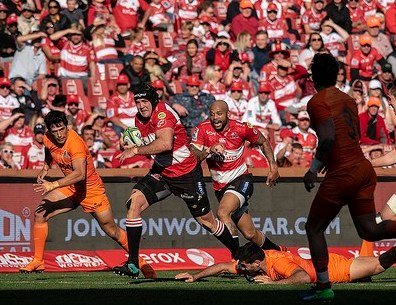
Lions flank Cyle Brink on another storming run. Photo by Marcel Sigg, runridedive.com

Lions flank Cyle Brink on another storming run. Photo by Marcel Sigg, runridedive.com

A typically combative Marnus Schoeman. Photo by Marcel Sigg, runridedive.com

A typically combative Marnus Schoeman. Photo by Marcel Sigg, runridedive.com


Being a knockout game, coach De Bruin had deemed shots at goal acceptable and Jantjies, who produced a polished performance that included a seven-from-seven success rate from the tee, then slotted a sweetly-struck drop goal to take the Lions’ buffer to two converted tries (37-23).

The seventh successful kick at goal by Jantjies was the penalty that completed the scoring with five minutes remaining, confirming that they will host the Waratahs at 3pm next Saturday in the semifinals.

The other huge positive for the Lions was the tremendous dominance of their scrum. The number of set-pieces was relatively low, but whenever the home side needed it, their scrum won them penalties or gave them strong front-foot ball.

 

Events in Durban the catalyst for inspirational Proteas comeback 0

Posted on May 09, 2018 by Ken


There were many inspiring individual performances in the Proteas’ 3-1 win over Australia in what was an incredible series, but the events in Durban on the fourth afternoon of the first Test may have been the most important catalyst for the impressive comeback.

It’s fair to say that the Proteas probably weren’t in the good books of their fans after they were walloped 5-1 in their ODI series against India and lost the T20 rubber as well, and then they were decidedly flat at Kingsmead as Australia put themselves in an unassailable position.

And then David Warner behaved as if he had a hornet in his pants, never mind sandpaper, after AB de Villiers was run out in the second innings, with an unhinged display of angry, crass celebration in the face of young Aiden Markram. It was clear Australia’s attack dog in chief had lost control, but insipid umpiring ensured nothing was done.

Much of the afternoon session was spent verbally abusing Markram and Quinton de Kock, who eventually decided to respond to all the personal taunts with a verbal volley of his own. Of course, according to the Australian team rules, that crosses the line and Warner was now threatening physical harm.

All of this drama had the effect of making the Proteas angry, as captain Faf du Plessis admitted, and from that moment on they were a different beast, and the South African public rallied behind their cause. It was like an unstoppable wave and all because of Warner’s sledging, a tactic which Du Plessis considers counter-productive, due to its motivational effects on the opposition.

The Australians were also angry, Warner’s exposure, Kagiso Rabada winning his appeal in Port Elizabeth and then the crowd in Cape Town making them feel more and more victimised. Warner, who was made vice-captain to bring positive energy into the camp, then crossed over onto the dark side because of how unfair he felt it all was. Ironically, it was he who had set all this in motion.

On the outside, Cricket Australia have seemingly been very upfront in dealing with the issue. But, as the dust has settled, it has become clear that they have merely stage-managed the whole fiasco, they have been doing their utmost to control the narrative and ringfence themselves from any major damage.

They have their three scapegoats in Smith, Bancroft and Warner, who have now accepted major penalties, but what of the organisation itself which has promoted the win-at-all-costs attitude in crass social media posts and that awful gloating podium presentation set-up after the Ashes?

Cricket Australia have not made the whole truth accessible, leaving questions unanswered such as how was it possible that not a single bowler knew what was going on? South African media were deliberately excluded from Darren Lehmann’s first press conference after the scandal and I was effectively banned from asking questions at Australian press conferences – whenever my hand was up, a firm shake of the head by their media manager would follow.

It should also incense South Africans that Cricket Australia came into this country, which holds democratic ideals so dear after our dark past, and tried to interfere in the rights of free speech of spectators. In Cape Town, several spectators were evicted for using abusive or foul language, the kind that is commonplace in Australia, at the behest of the tourists’ management, who had their security manager practically in the field of play.

There has, however, been a lot of soul-searching in Australian cricket this past two weeks, which is a positive, and in Tim Paine they have a captain who can lead them into the new brand of cricket they say they want to play.

But there are already murmurs in Australia that perhaps some leniency should be showed to the culprits, so whether they really do head in a new direction is by no means certain.

https://www.pressreader.com/south-africa/the-citizen-gauteng/20180407/282475709397424

Zimbali 0

Posted on December 07, 2017 by Ken


Zimbali is unlike most other coastal resort developments in that the estate is a richly-rewarding birding spot and large enough – at 456 hectares – for many hours of twitching.

Amongst the more spectacular gems that can be spotted is a pair of breeding Crowned Eagle; and their mere presence is indicative of a natural environment comprising ecological richness and biological diversity.

Because these magnificent raptors are apex predators, it means all other links in the food chain must be intact, or else the Crowned Eagle would relocate elsewhere and certainly wouldn’t be breeding – as they have since 2001 at the luxury North Coast eco-estate.

Studies of their prey items reveal the rich biodiversity in terms of both birds and mammals found at Zimbali, which conserves patches of coastal lowland forest fringing the golf course, which is an interesting challenge when the wind is blowing.

Other specials which one can certainly expect to see at Zimbali include the endearing Goldenrumped Tinker Barbet and the attractive Redbacked Mannikin, which is restricted to the eastern borders of South Africa.

A pair of African Fish Eagle are the other prominent raptors to be spotted at Zimbali, lording it over the open waters, while there are also a few Yellowbilled Kite around in summer and Longcrested Eagle is becoming more regular at the conservancy.

The Eastern Olive Sunbird is a typical forest bird present at Zimbali, along with Collared Sunbird, White-Eared and Blackcollared Barbet, Natal Robin, Greenbacked Camaroptera, Thickbilled Weaver and Yellowbellied Bulbul.

The secluded nature of some of the walks around Zimbali lend themselves to sightings of the shyer Horus Swift, while the riparian vegetation along the Zimbali River is just to the liking of the Yellow Weaver.

Yellow Weaver in the Zimbali reedbeds

Yellow Weaver in the Zimbali reedbeds

Pied Kingfisher hover-hunt over the ponds on the course, where Goliath Heron also go fishing, while African Jacana strut around the water grasses.

In the woodlands, one may see Plumcoloured Starling, Natal Francolin and Whitebrowed Scrub Robin.


Where is Zimbali?


Sightings list

Yellowbilled Kite

African Fish Eagle

Southern Greyheaded Sparrow

Vervet Monkey

European Swallow

Lesser Striped Swallow

Blackeyed Bulbul

Eastern Olive Sunbird

Blackheaded Oriole

Redeyed Dove

Bronze Mannikin

Forktailed Drongo

Redwinged Starling

Whitebreasted Cormorant

Pied Crow

Feral Pigeon

Palm Swift

Common Myna

Hadeda Ibis

Collared Sunbird

Burchell’s Coucal

Cape Wagtail

Horus Swift

White-Eared Barbet

Blacksmith Plover

Longcrested Eagle

Bushbuck

African Pied Wagtail

Fiscal Shrike

Yellow Weaver

Plumcoloured Starling

Redbacked Mannikin

Egyptian Goose

Natal Robin

Little Swift

Goliath Heron

Blackheaded Heron

Greenbacked Cameroptera

Natal Francolin

Pied Kingfisher

Southern Red Bishop

African Jacana

Crowned Eagle

Blackcollared Barbet

Spottedbacked Weaver

Hamerkop

Speckled Mousebird

Thickbilled Weaver

Goldenrumped Tinker Barbet

Tawnyflanked Prinia

Whitebrowed Scrub Robin

Yellowbellied Bulbul


Most daunting journey of all for well-travelled McLaren 0

Posted on November 01, 2017 by Ken


Ryan McLaren has travelled many miles in his cricket career but he is about to embark on his most daunting journey of all as the probable replacement for Jacques Kallis in South Africa’s Test side.

The 30-year-old has gone from being born into a famous Kimberley family through Grey College in Bloemfontein, stints as a Kolpak player in English county cricket for Kent and Middlesex, three IPL teams and on to play for South Africa.

Although the national selectors named a 15-man squad yesterday to take on Australia in the three-Test series next month, McLaren is the favourite to replace Kallis, coming in at number seven and providing the team with a fourth seamer.

National selection convenor Andrew Hudson spoke of “staying with the brand of cricket that has brought us such success” and that means a fourth seamer will be an integral part of South Africa’s game plan, which involves unrelenting pressure on the opposition.

But, as coach Russell Domingo pointed out, with no Kallis, having a fourth seamer means either dropping a batsman or not playing a spinner.

“We have to do away with the luxury of having seven specialist batsmen. Number seven will now probably be an all-rounder or a spinner.

“It’s very difficult to have seven batsmen, four seamers and a spinner. Something has to give, and I do like to have a spinner because it gives the team a lot more balance,” Domingo said yesterday.

It won’t of course be a Test debut for McLaren because he has appeared for South Africa in the ultimate version of the game before – against England at the Wanderers four years ago.

McLaren bowled tidily as part of a five-prong seam attack that ran rampant over England, dismissing them for just 180 and 169 as South Africa romped to victory by an innings and 74 runs to level the series. The left-handed batsman also scored 33 not out coming in at number eight.

Wayne Parnell also made his debut in that match and has also been included in the squad to play the Aussies. Although Domingo said he loved the 140km/h pace and left-arm variation that Parnell brings to the attack, McLaren’s greater consistency – he could do the holding role alongside Steyn, Morkel and Philander very well – and better ability with the bat should see him get the nod.

McLaren has the experience of already playing 40 ODIs and 10 T20s for South Africa and has become an integral part of the 50-over side in the last year. He’s a genuine all-rounder: In 103 first-class matches he has scored 3860 runs at an average of 30 and has taken 329 wickets at 25.47.

McLaren said he has no delusions of stepping into Kallis’s boots but is also confident that he can perform the role the national team requires of him.

“I’ve pretty much made peace with the fact that you can’t make comparisons between myself and Jacques. There’s only been one Jacques Kallis and there will only ever be one.

“So I’m just going to focus on the role I have to perform, which is batting seven and bowling second-change, which is pretty much what I’ve been doing most of my career.

“As an all-rounder, there’s always the physical demands of contributing in both disciplines, but it’s nothing new for me because I’ve been doing it for the Knights for many years – bowling 20 or 25 overs a day and batting.

“I will take some confidence from how I’ve performed well in ODI cricket in the last year, but Test cricket is a totally different game, it’s where every cricketer wants to be measured. And there’s no greater test than playing against Australia, so I’m excited for the challenge,” McLaren said.

The absence of Kallis will lead to another change in the batting order, with Domingo confirming that Faf du Plessis would be promoted to the number four spot, the place where greats such as Graeme Pollock, Sachin Tendulkar, Wally Hammond and Javed Miandad batted.

“It’s no state secret, Faf is the guy we have earmarked for number four. He made a big hundred at number four to save a Test recently and he bats there at franchise level. He’s a suitable replacement,” Domingo said.

Robin Peterson, the left-arm orthodox incumbent, is the only specialist spinner in the squad, but Hudson said the selection certainly did not mark the end of Imran Tahir’s Test career.

“Robbie P has put in some good performances lately and he did well in Perth at the back end of the last tour to Australia. He fits in with the style of cricket we want to play.

“But we know Imran Tahir can bowl with variety and an attacking leg-spinner on a turning pitch is still an option for us because we play a lot of cricket in the sub-continent. We certainly are not going past Imran,” Hudson said.

Domingo suggested that the pitches for the three Tests – in Centurion, Port Elizabeth and Cape Town – will favour the quick bowlers, setting up the most tantalising pace war between the two best fast bowling attacks in world cricket.

“We would like pitches that assist our bowlers. Our batsmen are well-versed in South African conditions, whereas in Australia the pitches are more in favour of the batsmen. In South Africa they favour the fast bowlers more and our batsmen are used to adapting to that,” the coach said.

Squad – Graeme Smith, Alviro Petersen, Hashim Amla, Faf du Plessis, AB de Villiers, JP Duminy, Dean Elgar, Ryan McLaren, Wayne Parnell, Thami Tsolekile, Robin Peterson, Vernon Philander, Dale Steyn, Morne Morkel, Rory Kleinveldt.

*Left-arm paceman Beuran Hendricks and off-spinner Simon Harmer will practice with the squad for the sake of preparation against Mitchell Johnson and Nathan Lyon. 

https://www.dailymaverick.co.za/article/2014-01-30-ryan-mclaren-his-own-man-not-stepping-into-kallis-shoes/#.WfmzAFuCzIU

  • Recent Posts

  • Archives

  • Thought of the Day

    Revelation 3:15 – “I know your deeds, that you are neither cold nor hot. I wish you were either one or the other.”

    How can you expect blessings without obeying?

    How can you expect the presence of God without spending time quietly before him?

    Be sincere in your commitment to Him; be willing to sacrifice time so that you can grow spiritually; be disciplined in prayer and Bible study; worship God in spirit and truth.

    Have you totally surrendered to God? Have you cheerfully given him everything you are and everything you have?

    If you love Christ, accept the challenges of that love: Placing Christ in the centre of your life means complete surrender to Him.


↑ Top