for quality writing

Ken Borland


Ndumo Game Reserve 0

Posted on June 03, 2020 by Ken

I’m sure I speak for most birdwatchers when I say it’s funny how the memory of spotting a Lifer is often permanently seared on the brain with the details of the moment immediately springing to mind.

So much so that when I came across this sightings list from a February 2006 trip to Ndumo Game Reserve in northern Zululand, I could immediately picture in my mind’s eye the little loop off the Paphukulu road that goes around a corner and then crosses a dry river bed before going slightly uphill again and returning to the main road.

As one approaches the dried up river, there is a thorn tree on the other side that hangs over the bank and there, in the gathering gloom of dusk, was a massive owl perched on the edge of the branches, surprisingly exposed.

By its large size I was immediately thinking Giant Eagle Owl and a quick squizz through the binoculars confirmed the diagnostic pink eyelids of the bird now known as Verreaux’s Eagle Owl, annoyingly because those French naturalists had nothing to do with the discovery nor naming of the bird.

The Giant Eagle Owl normally spends its days perched inside a leafy tree along a watercourse and they often begin their nightly hunting forays along an open, dry riverbed.

So perhaps my Lifer Giant Eagle Owl was eager to get going with what would have been its ‘breakfast’. For which I was very grateful and shall always remember my first sighting of what is truly a magnificently impressive bird. Not for nothing are they known as the Martial Eagles of the night sky.

The Paphukulu road runs along the south-western border of Ndumo and is always a very interesting drive as the sand forest and dense thorn thicket of the central regions of the reserve grades into dry savanna woodland, a more bushveld type area dominated by Knobthorn Acacias.

On that steamy February day, there were typical savanna woodland birds present like the Eurasian Bee-Eater, Masked Weaver, Redbacked Shrike, Cardinal Woodpecker, African Hoopoe, Little Bee-Eater, Sabota Lark and Crested Francolin.

The boundary fenceposts along the Paphukulu road are always worth keeping an eye on and Pallid Flycatcher, which is found in the Acacia woodlands of Zululand but is replaced by the Marico Flycatcher in that habitat further west, was spotted as well and then further down the road an interesting-looking raptor was seen perched.

It was a medium-sized brown bird, initial thoughts revolving around a Steppe Buzzard, which often perch on these fence poles. But this bird seemed a bit bigger and then, when it turned around to show its underparts they were all-rufous brown with no hint of white on the breast.

It was an immature Jackal Buzzard, which is not often seen in the tropical north-eastern lowveld, but juveniles do sometimes wander over from the escarpment, in this case probably the nearby (less than 100km) Lebombo Mountains.

An immature Steppe Buzzard was seen later on and Sombre Bulbuls also make their way into this area, on the fringes of the thorn thicket.

Icterine Warbler was also seen in the thorn trees close to the Giant Eagle Owl spot, a good sighting because it is scarce in these parts and sparsely distributed in KwaZulu-Natal as a whole.

The next day, on a small track leading to the NRC Picnic Spot, an even more seclusive but much bigger warbler was spotted. The Olivetree Warbler is a very uncommon and often overlooked Mediterranean summer visitor and I managed to get a glimpse of one foraging in a dense grove of acacias.

Heading back from west-to-east on the Paphukulu-Balemhlanga roads, the more open knobthorn woodlands allowed one to tick other typical bushveld gems like African Cuckoo and both the Eurasian and Lilacbreasted Roller.

It’s an under-rated but always good drive. Ndumo is more famous for the Nyamithi Pan and its guided walks.

But on this occasion in mid-summer, the pan was full to the brim, meaning a much lower waterbird count. There were egrets patrolling the shoreline and Wiretailed Swallows flew overhead along with passing groups of Trumpeter Hornbills.

Closer observation of the fringes of the pan, with bushy cover now right up to the edge of the water, provided sightings of Purple and Greenbacked Heron and Water Dikkop. Where there were some muddy edges, Wood Sandpiper was seen.

African Fish Eagles were seen in the Fever Trees on the other side of the pan, while both Pied and Giant Kingfisher were present, and a Hamerkop came yelping past as Hippopotamus frolicked in the water.

The road back from Nyamithi Pan to camp takes one past the reserve’s vulture restaurant, an open patch in which carcasses of deceased large mammals like Giraffe are dumped. There’s almost always something interesting hanging around and occasionally some real specials wander into this area.

On this occasion a Lesser Spotted Eagle, a Palearctic migrant which, given its preference for savanna and open woodland you wouldn’t fancy seeing at Ndumo, was strolling around on the ground. A real raptor special.

A Reedbuck was also pottering around.

The most famous of the Ndumo guided walks is probably North Pongolo, which takes one through the climax riverine forest of the beautiful dark brown river that has flown from Utrecht in Northern Natal, crossed the Lebombo Mountains and is now close to its confluence with the Usutu and its journey to Maputo Bay.

But the fullness of the Nyamithi Pan was a hint to the conditions of the Pongolo floodplain in general and the North Pongolo forest had been flooded and was temporarily off the roster for guided walks.

So instead a guide and I went to Shokwe Pan, an ear-shaped, generally shallower pan nearly seven kilometres long and in the western portion of Ndumo.

This turned out to be an excellent move because we came across, there in the thickets below the majestic Sycamore Fig trees, an African Broadbill, one of the Ndumo specials that is especially challenging to find.

But on this occasion this largely black, grey, brown and white oddity was just sitting on its display perch and allowed us to approach close enough for me to get a photo.

Other typical forest birds seen at Shokwe were Squaretailed Drongo, Collared Sunbird and Blackheaded Oriole, while Samango Monkey were enjoying themselves high in the trees, keeping their distance as they usually do.

A couple of Darter flew over and there were also a few flocks of Whitefaced Duck which passed by.

The route to and from camp, which is in the south-east of the park, to Shokwe takes you right through the centre of Ndumo and the densest, most impenetrable thickets probably anywhere in the country.
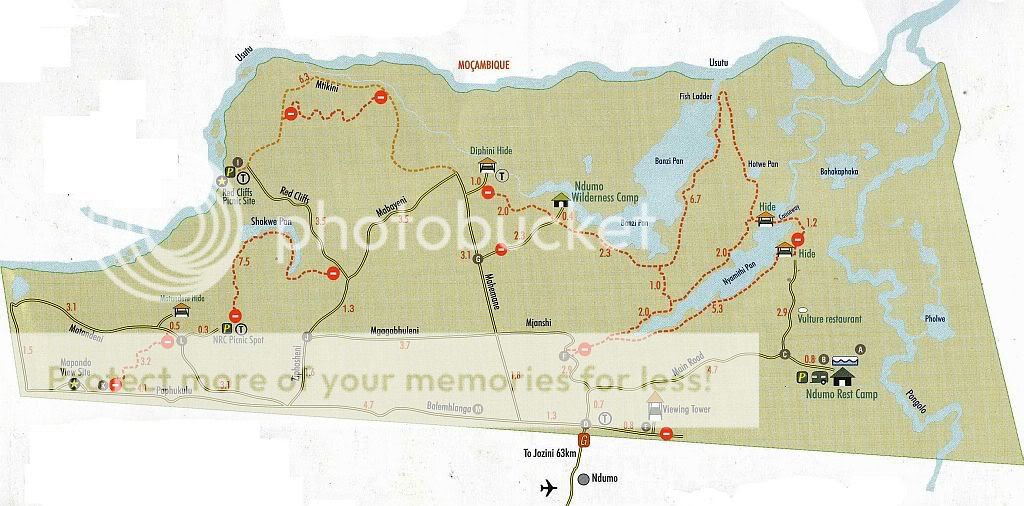
Detailed map of Ndumo

Birding is difficult but there are always surprises for the keen-eyed.

On this occasion the biggest surprise was coming around a corner and finding a thorn tree had toppled over and was blocking the road. Refusing to be denied my route through the wonderful sand forest in the middle of the park, prime birdwatching territory and known for the rare birds that are in residence, I was forced to tow the offending tree out of the road with my car!

My determination was partly rewarded with good sightings of Crested Guineafowl, Orangebreasted Bush Shrike, Dwarf Mongoose and Scimitarbilled Woodhoopoe, while little pans secluded in the forest provided Woollynecked Stork, Common Sandpiper and Greenspotted Dove.

The woodlands on the southern, hilly side of the park are also rich in birdlife. In the thickets and rank grass under the trees one gets the beautiful Melba Finch busily going about its business, normally with a Rattling Cisticola shouting the odds nearby. Neddicky (especially where there are fallen trees), Bronze Mannikin and Common and Blue Waxbill share this habitat too and Tawnyflanked Prinia is often around as well.

Bleating Warbler prefers thicker cover and will often call from a perch two-to-three metres up a tree. While looking for this secretive little bird, the likes of Paradise, Spotted and Black Flycatchers, Redfaced and Speckled Mousebird, Longbilled Crombec, Brownhooded Kingfisher, Puffback, Blackbellied Starling, Crowned Hornbill, Southern Black Tit and Purplecrested Lourie can also be spotted in the trees.

Searching carefully in the canopies threw up African Green Pigeon and Eurasian Golden Oriole.

Birding around the main camp, set in typical Maputaland woodland, is also good and the highlights from there on this trip were a Lanner Falcon, a regionally threatened bird that happened to fly by, probably heading to nearby grasslands to forage, while I was patiently watching the sky from my camp chair, and a Grey Sunbird, an Important Bird Area trigger species, that popped in for some nectar from the flowering hedge and a drink from a birdbath.

Where is Ndumo Game Reserve?

Sightings List

Blackeyed Bulbul

Blue Wildebeest

Nyala

Impala

Lesser Striped Swallow

Whitebrowed Robin

Kurrichane Thrush

Yelloweyed Canary

Chinspot Batis

Moreau’s Tropical House Gecko

Giraffe

Crowned Hornbill

Southern Black Tit

Eastern Coastal Skink

Redeyed Dove

Neddicky

Melba Finch

Spotted Flycatcher

African Green Pigeon

Rattling Cisticola

Redfaced Mousebird

Black Flycatcher

Common Waxbill

Blue Waxbill

Warthog

Common Sandpiper

Crested Guineafowl

Orangebreasted Bush Shrike

Hadeda Ibis

Forktailed Drongo

Vervet Monkey

Dwarf Mongoose

Scimitarbilled Woodhoopoe

Woollynecked Stork

Longbilled Crombec

Greenspotted Dove

Tawnyflanked Prinia

Great White Egret

Cattle Egret

Brownhooded Kingfisher

Lesser Spotted Eagle

Paradise Flycatcher

Speckled Mousebird

Bleating Warbler

Puffback

Blackbellied Starling

Wiretailed Swallow

Eurasian Golden Oriole

African Fish Eagle

Reedbuck

Purplecrested Lourie

Bronze Mannikin

Pallid Flycatcher

Jackal Buzzard

Sombre Bulbul

Eurasian Bee-Eater

Masked Weaver

Redbacked Shrike

Cardinal Woodpecker

Icterine Warbler

Giant Eagle Owl

African Hoopoe

Little Bee-Eater

Sabota Lark

Crested Francolin

Fierynecked Nightjar

Spotted Dikkop

Scrub Hare

Lanner Falcon

Squaretailed Drongo

Samango Monkey

Darter

Whitefaced Duck

Collared Sunbird

African Broadbill

Blackheaded Oriole

Goldenbreasted Bunting

Olivetree Warbler

Southern Boubou

Cape Turtle Dove

Burchell’s Coucal

Plains Zebra

Eurasian Swallow

Steppe Buzzard

African Cuckoo

Eurasian Roller

Red Bishop

Lilacbreasted Roller

Trumpeter Hornbill

Egyptian Goose

Sacred Ibis

Purple Heron

Greenbacked Heron

Water Dikkop

Wood Sandpiper

Pied Kingfisher

Giant Kingfisher

Hippopotamus

Hamerkop

Grey Sunbird

Aplon a feisty little ʼun able to produce moments of magic 0

Posted on May 14, 2020 by Ken

Gio Aplon may be only 1.75 metres tall and weigh just 78kg but he is a feisty individual who is able to produce moments of magic on the rugby field, often enough to convince a famous ‘sizeist’ like Jake White to sign him for the Bulls.

While White was Springbok coach between 2004 and 2007 he made no secret of his belief that a good big ʼun was always better than a good little ʼun, but it seems Aplon first convinced the resolute coach of his merits while playing for Grenoble in France between 2014 and 2017, when White was coaching Montpellier.

When The Cistuses and White split ways not entirely amicably, the coach went to mentor Verblitz in Japan, and signed Aplon early on in his stint.

And now that White has been appointed director of rugby at the Bulls, he has once again brought Aplon with him. The Pretoria-based franchise announced on Wednesday that Aplon will join the team from June or as soon as he is able to travel back to South Africa, saying in their statement that he “epitomised the phrase ‘size doesn’t matter’ with his explosive speed and nimble feet allowing him to score tries from almost anywhere on the field, taking on the biggest and the best the game had to offer”.

Aplon has played 17 Tests for the Springboks, scoring five tries. But his last appearance for South Africa was back in late 2012, although he was part of Rassie Erasmus’s training group in 2018, without making a match-day squad.

The Bulls have developed something of a penchant for bringing veteran players to Loftus Versfeld, from Victor Matfield to Adriaan Strauss, Duane Vermeulen and Schalk Brits, and Aplon continues the trend as he is 37 years old.

Aplon spoke of his respect for the Bulls and what the brand has achieved in the statement, while he has previously spoken of how much he enjoys playing under White.

“The Springboks won the 2007 World Cup because he is such a fantastic coach. System-wise he is exceptional, he has implemented a good programme. He isn’t just there to fill up the post as head coach, he is there with the purpose of making Verblitz better and, as players, we feed off that. Jake is a serial winner and to be coached by him was one of the reasons I went to Japan,” Aplon told SA Rugby Mag.

Cheslin Kolbe, who is even smaller at 1.71 metres and 74kg, has made a massive impact with the Springboks and White will be hoping Aplon, although 11 years older, will prove of similar benefit to the Bulls while also serving as a mentor.

A T20 opener to keep the nerds and dorks happy 0

Posted on April 09, 2019 by Ken


As cricket lovers we often talk about the old days and how our heroes of yesteryear would have fared in modern-day cricket, especially the new white-ball formats which have changed the face of the game.

The more nerdy of us love compiling teams that would never take the field but oh, how we wish they could have. One of the sides that is often discussed is the best T20 XI made up of players who never had the opportunity to play the shortest format of the game. In other words, all cricketers before 2003.

One of my selections would be Chris Wilkins, the former Natal, Eastern Province, Border and Derbyshire batsman who sadly passed away at the start of the week, to open the batting. Members of the younger generation need not feel like total dorks if they have never heard of the man, because he never played for South Africa. But he did command immense respect from his peers and many of them I have spoken to agree that one of the 1966 SA Cricket Annual Cricketers of the Year would make their XI for players who never had the opportunity to play T20.

Opening the batting in limited-overs cricket these days is all about being able to hit boundaries against the new ball by playing orthodox cricket strokes, and Wilkins was a master of that. There is many a former provincial fast bowler who is still bearing the scars of being belted over the covers or straight back over his head to the boundary in the first over of the innings, whether in first-class cricket or limited-overs, by Wilkins.

An average in the mid-30s is not exceptional by today’s standards, but a word of warning to those wanting to cast aspersions on the quality of cricket back then. Because it was three-day cricket, most of the pitches were pretty green and result-friendly, and it was probably the greatest era of South African fast bowling in terms of depth – the likes of Vince van der Bijl, Mike Procter, Garth le Roux, Clive Rice, Eddie Barlow, Rupert Hanley, Kenny Watson and Stephen Jefferies et al were all at the peak of their powers. Back then, only a handful of batsmen would ever average more than 40.

Wilkins was held in high enough esteem to be chosen for the Rest of the World XI that toured England in 1970, making an impact with a swashbuckling 73-minute century, the fastest of the season, against the T.N. Pearce XI at Scarborough.

As well as Wilkins, is not the thought of Graeme Pollock, Barry Richards, Procter and Adrian Kuiper playing T20 cricket a mouthwatering one? Lance Klusener is not eligible for this fantasy XI because he played 53 domestic T20 games, but there would not be a more sought after player in any of the world leagues if ‘Zulu’ were in his prime now.

All those wonderful fast bowlers would have been great to see in T20 as well, but, in these days of spinners being a strike bowler in white-ball cricket, there is not too much by way of South African slow bowlers to choose from. Leg-spinner Denys Hobson would probably have been the Imran Tahir of his day, although the Western Province star would probably have been a better Test bowler.

There are many international bowlers from the 1970s and 80s who are extremely thankful that there was not a T20 format back then during the heyday of the West Indies … bowling to Viv Richards would certainly not have been for the fainthearted.

There is a T20 tournament on the go at the moment in Abu Dhabi, with South Africa’s champions, the Titans, taking part. It seems to be very much a made-for-TV event, judging by a great paucity of spectators in a grandiose stadium. A triumph for the Titans would be nice, but hardly memorable given the gimmicky feel of the event and tiny boundaries that really make it into a slogging contest.

What is clear, however, is that South Africa has a great deal of top-class talent and it was a bittersweet feeling to see Colin Ingram and Kyle Abbott starring for a team from Afghanistan of all places.


Cricket looking to toss a boomerang 0

Posted on September 20, 2018 by Ken


As we have seen so often in rugby, making changes to long-standing rules of the game almost invariably brings unexpected consequences and there has been a lot of talk recently about doing away with one of cricket’s most famous traditions, a move which I believe will boomerang badly on the sport.

South African captain Faf du Plessis was the latest to bring up doing away with the toss, although his beliefs lost some credibility because they came straight after the Proteas had been mauled in their two Tests in Sri Lanka.

Various high-profile Australians have also backed the ending of the toss, but again, these comments were mostly made after they had lost the Ashes in England.

Proponents of the eradication of the toss propose that the visiting team just gets to choose whether they want to bat or bowl, thereby supposedly removing home advantage, which the anti-toss advocates say has become a major problem in world cricket.

Happily, a couple of months ago the ICC Cricket Committee discussed doing away with the toss and decided that it was an integral part of the game and should be spared.

No doubt they had a better grasp of the actual facts surrounding the issue. Home ground advantage has always played a role in cricket, as it does in just about every sport, but winning or losing the toss actually does not have a major effect.

In this decade, the team winning the toss still only wins 43.78% of Test matches, so it is not a massive advantage. There is a slight benefit because only 35.13% of teams that lose the toss go on to win the match. Historically, Australia are the only side that wins more than 50% of the Tests in which they have won the toss, and even then it’s just 50.49%, only slightly higher than their overall success rate of 47.16%.

I believe giving the visiting team total control over what they do first would have a major bearing on the game, which is where the unintended consequences come in, especially in countries like India or New Zealand.

It’s fair to say the weather is out of the control of the people who prepare the pitches in those countries and they can only do so much to negate the effect of overhead conditions. Doing away with the toss would grossly undermine teams like India and New Zealand – in the heat of the sub-continent, dry, dusty, deteriorating pitches are almost inevitable and India would be batting second every time; conversely, New Zealand is usually pretty damp and overcast and the Black Caps would find themselves sent in to bat every time.

It would happen often in England as well that the home team would automatically have to bat at the most difficult time and it could also affect the Proteas at home.

What it boils down to is the ICC actually using the mechanisms they already have in place to ensure fair conditions – they already have rules in the playing conditions when it comes to unfair pitches and they just need to enforce them more diligently, especially when it comes to the sub-continent and even some South African green mambas.

The perception that away teams are struggling does have some basis in fact. In this decade, the visiting team has lost 51.75% of Tests, up from 46.40% in the 2000s. It is interesting, though, that the away team has been winning Tests in the last 20 years at pretty much the same rate as they have been doing through the history of the game.

It is, of course, the number of away draws that has dropped significantly in recent times; down from 47.31% of Tests in the 1960s to just 20.76% in this decade. That is obviously a positive but it also points to the rise of T20 cricket and batsmen being able to hit the ball but not defend against the turning, seaming or swinging delivery.

The problem is not the toss, it’s modern-day batsmen being ill-prepared for foreign conditions, and sometimes the ICC allows the home union to get away with cheap shots in terms of pitch preparation.

  • Recent Posts

  • Archives

  • Thought of the Day

    Have a fulfilled life by caring about the feelings of others. Show interest in the welfare of others, listen to their problems.

    Be tolerant of people and allow for their mistakes, because no-one is perfect.

    Follow the example of Christ, who showed sympathy and understanding towards all people.


↑ Top