for quality writing

Ken Borland


Chatty Saltpans, Swartkops Estuary 0

Posted on May 08, 2018 by Ken


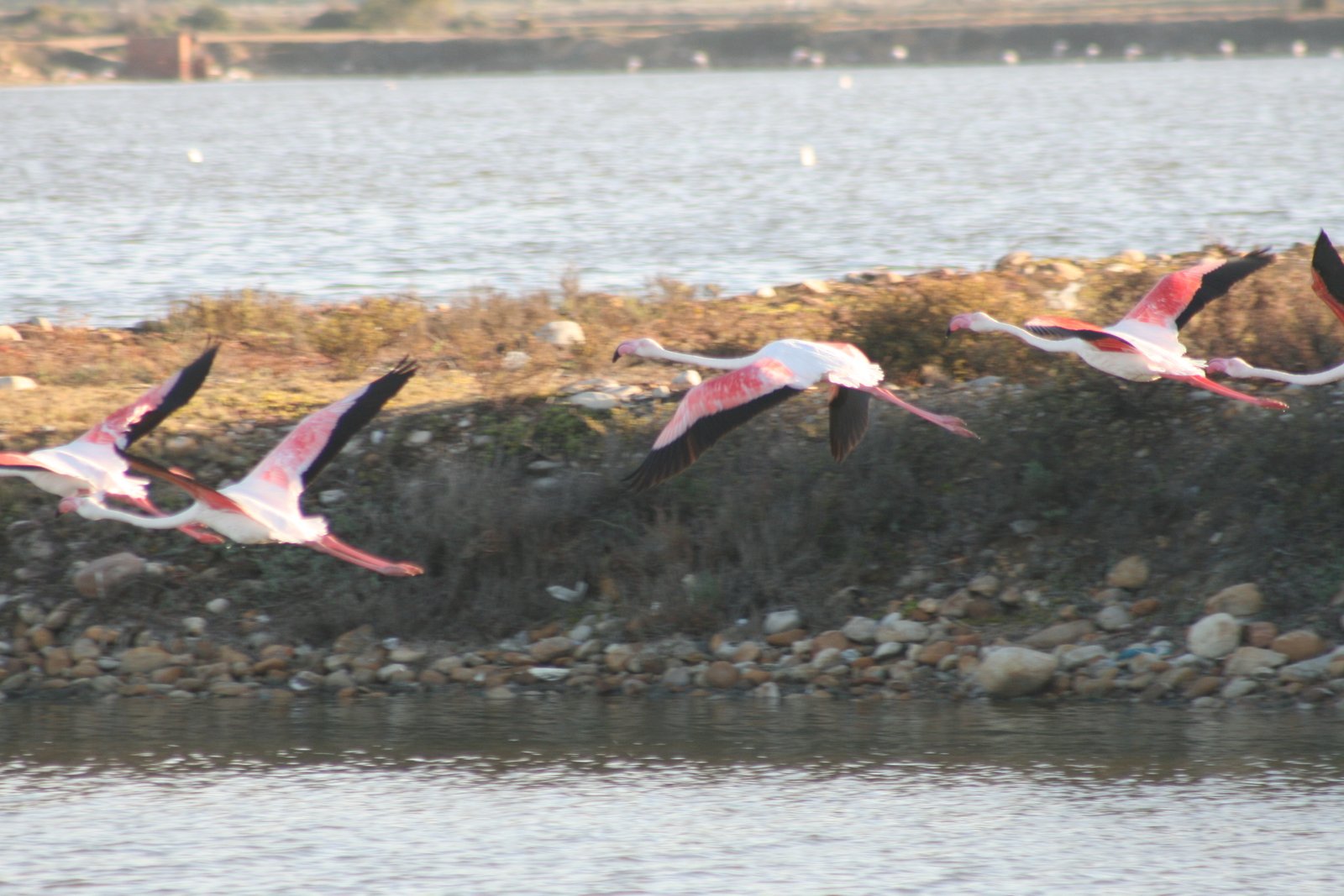
Greater Flamingo flying over the Chatty Saltpans

Greater Flamingo flying over the Chatty Saltpans

The Swartkops Estuary in Port Elizabeth is well-known as one of South Africa’s 112 Important Bird & Biodiversity Areas (IBAs) and while the river and mudflats have the greatest density of birds and hog the limelight as the most natural areas, my sunset visit on December 30 was to the salt pans and threw up a special that is often difficult to find elsewhere.

The Chatty River flows from the west into the Swartkops River and alongside it, next to the R367 main road, there are commercial saltpans which can provide quality foraging opportunities for many birds, especially when the salinity and water level are just right for a host of invertebrates to be crawling around in the benthos.

The elegant flamingos – both Greater and Lesser – immediately catch the eye and I was also drawn to the Pied Avocets, one of my favourite birds, sweeping and scything around in the water.

But dotted around the pan were smaller birds – the Blacknecked Grebe.

The Chatty Saltpans hold globally significant numbers of this uncommon nomad, which has the propensity to suddenly colonise a flooded area and start breeding. There are usually good numbers of this cute little diving bird at Swartkops though, and I did not notice any birds in breeding plumage, so perhaps they were moulting, with the widely-distributed Blacknecked Grebe known to utilise saline lakes overseas for this purpose.

Another special that can be picked up at the Swartkops Estuary is the Hartlaub’s Gull, which has a recently-established breeding colony in the area. It was previously considered a bird of the Western Cape, its distribution tied to that of Kelp, with only vagrant birds moving east of Cape Agulhas, and it interbreeds with Greyheaded Gulls in this river valley. Being omnivorous, it seems to have adapted to new foraging opportunities around human settlements.

Nicely built-up embankments between the pans allow one to approach the vulnerable Flamingos and their friends reasonably closely as they continue their search for invertebrates, and other birds that have adapted well to man-made wetlands were also busy foraging for their dinner in the gathering gloom – Blackwinged Stilt, African Spoonbill, Cape Cormorant, Kelp Gull, Egyptian Goose, Blacksmith Plover, Cape Wagtail and Sacred Ibis.

Where are the Chatty Saltpans?

Sightings list

Greater Flamingo

Kelp Gull

Pied Avocet

Blacknecked Grebe

Blackwinged Stilt

Lesser Flamingo

Egyptian Goose

Cape Cormorant

Blacksmith Plover

Hartlaub’s Gull

Cape Wagtail

Sacred Ibis

African Spoonbill


I know a week is a long time in sport, but … 0

Posted on March 20, 2017 by Ken


I’ve always known that a week can be a long time in the world of sport, but I go away for eight nights to the bush of northern Limpopo and return to find rugby’s entire landscape changing with indecent haste compared to the months of feet-dragging that often characterise a game that has been presided over at some stages by dinosaurs or the old farts of the straw-chair brigade.

One of the changes I saw coming before my departure. I always love unintended consequences and it was former Springboks and Bulls defence coach John McFarland who pointed out to me that the rulemakers’ new emphasis on keeping tackles lower, away from the head and shoulders, was at least partly responsible for the sudden rash of offloads we have seen from the South African teams, who have traditionally preferred taking contact and winning some hard-earned, psychologically-meaningful centimetres.

So it’s not just a mindset change amongst our franchise coaches and players, but also that tacklers are now being forced down below the arms, allowing the hands to be free to keep the ball alive.

Time will tell whether that more skilful approach is carried through to the Springboks, but the national team has already had better preparation than last year with a camp and they look better resourced too in terms of coaching staff.

One of those additional resources is Cheetahs coach Franco Smith and it may be just as well that he has earned a promotion because he might be out of a decent Super Rugby job next year. If we believe what the New Zealand media tell us, then the Cheetahs as well as the Southern Kings will be axed from Super Rugby under the new, hopefully improved format for 2018 that is yet to be unveiled.

Harold Verster, the CEO of the Cheetahs, cheerfully told the world though that he keeps his “ear to the ground” and that the rumbling noise he hears is not a rampaging stampede of buffalo at all, but the sound of the Grey College-Free State-somewhere else in the country pipeline running smoothly. He says the Cheetahs are safe.

You cannot be nearly as optimistic about the Kings, however. They would seem to be sitting ducks as not only are they struggling on the field but they are a financial drain on the South African Rugby Union and money always shouts loudest when it comes to administrators, like politicians.

Speaking of politicians, you cannot escape the irony that Cheeky Watson, the self-proclaimed messiah of transformation, has now left Eastern Cape rugby and has done more damage to the nursery of Black rugby in our country than anything since a Nationalist government functionary.

If you called him a blood-sucking tick you would probably be understating his effect. The man has been a full-blown parasite on the game in that vulnerable region, more like the deadly malaria protozoans that kill half-a-million people a year in sub-Saharan Africa.

Later this year, the British and Irish Lions tour New Zealand in what should be the rugby highlight of 2017, but this type of proper tour probably won’t become more common given the news this week that a new global rugby calendar is being introduced. Coming into effect in 2020, it has reducing player workload as one of its main tenets.

Tours by northern hemisphere teams to the southern hemisphere will be pushed back to July, but this will allow Super Rugby to be completed in one fell swoop from February to June. This is a good thing and will come into effect in 2019, because that is a World Cup year.

The 2023 World Cup is another story of course, with South Africa seemingly ranged against France and Ireland for the right to host the tournament. If you can believe what came out of sports minister Fikile Mbalula’s mouth this week, then government is now backing the bid.

Then again, Mbalula might just have been trying to distract from the fiasco that was Durban’s Commonwealth Games bid. The chairman of that bid was Mark Alexander, the president of the South African Rugby Union, but that’s a story for another day.

Siboto holds his nerve for Titans to win low-scoring T20 final thriller 0

Posted on December 20, 2016 by Ken


Low-scoring games often make for the most exciting finals and so it proved again at Centurion on Friday night as Malusi Siboto held his nerve in the final over for the Titans against the Warriors and bowled them to the CSA T20 Challenge trophy for the second season in succession.

Siboto, who had earlier dropped a sitter of a catch in the field, was defending 12 runs in the final over and consistently went for the blockhole of batsmen Lesiba Ngoepe and Sisanda Magala, conceding just six runs for the Titans to win by six runs and become the first team to defend their T20 title.

The Warriors were chasing 156 for victory and looked on course for their second title as Colin Ackermann (34) and Christiaan Jonker (33) added 48 for the fourth wicket and then Qaasim Adams (17), playing for his loan team against his actual employers, took the visitors to 125 for four after 16 overs.

But Adams, trapped lbw trying to sweep wrist-spinner Tabraiz Shamsi, and Ackermann, caught on the boundary off Lungi Ngidi, fell in successive overs, and Ngoepe and Magala were unable to score the required 31 off 22 balls.

David Wiese, who took one for 31 and claimed the key wicket of Jon-Jon Smuts, caught behind for 16; Ngidi, who took two for 27 including the vital scalp of Colin Ingram caught behind for 12; and Junior Dala (4-0-25-0) were also outstanding with the ball for the Titans.

Albie Morkel bowled the first over, having Clyde Fortuin brilliantly caught at backward point by Aiden Markram, who was superb in the field, and then left the action, never to return, with a hamstring injury.

The home side had been sent in to bat by the Warriors and they struggled to 155 for six, having numerous difficulties on a pitch that made strokeplaying difficult.

Markram opened the batting and scored 33 off 25 balls, before the Warriors’ slow bowlers had their usual suffocating effect in the middle overs. Morkel made 21 off 20 balls, but nobody was able to score at much more than a run-a-ball, with the Warriors producing an excellent display in the field that included two run outs.

Kyle Abbott (4-0-27-1), Basheer Walters (3-0-15-1) and Colin Ingram (4-0-24-1) did a great job with the ball for the Warriors.

But Wiese provided a big finish with his 24 not out off 15 balls, taking 19 runs off the last over bowled by Magala.

The unfortunate 25-year-old will be having nightmares over his two final-over failures.

Former defence coach John McFarland’s six solutions for the Springboks 0

Posted on September 22, 2016 by Ken


It was very hard to watch the Springboks v All Blacks game last weekend because there were a mountain of mistakes. You could see the players were really trying, but very often that’s not good enough against a quality side like New Zealand.

There were many system and individual errors within the Springbok defence, but the good news is that they can all be fixed, they can be corrected through good coaching. So I would prefer to talk about solutions rather than showing what went wrong.

Because I was in charge of the Springboks’ defence and kicking game for four years, I obviously know the pressure the coaching staff feel and have experienced this many times myself in my coaching career. You don’t coach for 21 years at a professional level without experiencing setbacks, so you must know how to fix them, plus the players pick up on your body language, passion and intensity.

Since I left the Springboks, I’ve been lucky enough to be working in Japan at the Kubota Spears. The Springboks defence was taken over by Jacques Nienaber, who was obviously being lined up for the full-time job.

He coached the defence in the Ireland Tests as a consultant for five weeks. Chean Roux worked hand-in-hand with him at the MobiUnit and was then earmarked to carry on his structures and principles as seamlessly as possible.

As a coach in this situation, you can’t just point the finger at the players. It’s important to have solutions and you need to look at yourself as well, take responsibility for the performance and fix it. Heyneke Meyer and Frans Ludeke always knew that I would take responsibility for the defensive performance, win or lose.

It’s very easy to point out what went wrong against the All Blacks, but it’s far more important to identify solutions. So here are six simple things that the Springboks can fix.


  • The passive defence system. Over a period of time it has come through that line integrity is the key. But at the moment the Springboks are not coming off the line and pressurising the attacking team, or if they are, it’s in single fashion, for example Juan de Jongh trying to cut off the outside options.
    Experience has shown that all this does against the All Blacks is pressure our own inside defence. They are very good at running reverse-lines at the shooting defender.
    A 75% tackle success rate at Test level shows that this system is not working. Too many good defenders are making errors and missing tackles because we are allowing the attack to dictate to the defence.
    On the Sam Whitelock try, it came from width and the spacing of the defensive line was really poor – there were only three defenders covering 30 metres of space, they were far too tight to the ruck, which pulled the wings in.
    If you have a passive defence, like the Springboks had, then it highlights if anyone breaks the system. With a passive defence, the whole object is to push the attackers towards the touchline, so it’s never a good idea if everyone is drifting and one player comes in on a read.


  • Winning the gain-line. I don’t think the Springbok backline once won the gain-line off first-phase ball, especially off the lineout. We call it ‘winning the race’ – if the defender can hit the ball-carrier behind the gain-line, it’s so much easier to set your defensive pillars in place. But if you allow the opposition to get easy yards over the gain-line as we did at the weekend, then it’s very difficult to get your pillars in place. The attack just rolls forward, gaining momentum … and confidence and belief.
    It’s quite simple: You have to close the space from the set-piece a lot quicker. You have to close the space (press) on the first receiver when he has the ball.


  • Blindside defence. As alluded to in earlier columns, this was the same part of our defence that was exploited by Australia from the lineout and from a scrum, and was mercilessly exploited by New Zealand on Saturday. The key is that the hooker and blindside wing have to communicate the reversing of play and the players have to look up before folding to the openside. The Springboks’ blindside defence has to be much, much better than it was against the All Blacks.


  • Scrumhalf channel off scrum. New Zealand also ran at this channel and since 2014 they’ve been doing the same thing against us. So as a defence coach that would have been my first port of call – making sure that the defence of the scrumhalf channel was really strong in Christchurch.
    But Aaron Smith punched through that channel so the scrumhalf and the flank have to work together. The first defender has to adjust and basically they have to play flat after that.
    The scrumhalf must defend the ball – after all nobody has ever scored a try without the ball!


  • High balls. Every All Blacks high ball went on Francois Hougaard, so that was obviously seen as a mismatch for Israel Dagg to exploit. To be fair, Francois dealt with it well, but the Springboks need to be able to play from the retreating ruck post-kick.


  • Kicking game. The kicking game is really quite simple and I believe we over-complicate it to a large degree. The key is that a kick is only as good as its chase, so the work-rate has to be much higher. If the kick is long, then the harder the chase, the easier it is to catch the opposition further back, to separate the counter-attacking wing and fullback from their cleaners/forwards. So the chase has to be a heck of a lot better and more aggressive from the Springboks.
    Tactically, the Springboks should be in a strong position because they have right-footed and left-footed options at flyhalf and fullback, because all they have to do then is get into the middle of the field and the right-footer [Johan Goosen] can go on the right side of the ruck and the left-footer [Elton Jantjies] takes the left. That will create indecision in the opposition back three as to who will exit. It will also affect the All Blacks’ pressure plan because the key guys trying to charge down the kick are always Aaron Smith or TJ Perenara and Brodie Retallick – it will be more difficult for them to pick up who is going to kick.
    Because the Boks have such a good mauling game, the box-kick from 9 is vitally important and needs to have an organised chase and contest, so they need to select wings that go up in the air.


These are the solutions to the defensive problems which I know I would be asking questions about if I were in the same situation as Chean Roux.

Just on Malcolm Marx and his alleged throwing woes, I think the criticism is incredibly unfair. People just look at the stats and not at what actually went on. It’s easy to say we lost four lineouts and blame the hooker, but if you look through all our games against New Zealand over the last four years, we’ve always lost four or five lineouts against them in the second half, because at halftime, whatever they talk about, they come out differently in the second half.

The World Cup semifinal last year against the All Blacks was decided because we lost five set-pieces around the halfway line. So to come out firing against a young hooker in his first Test is really not fair.

And I’ve looked at his throws – the first one was not straight, that was obvious and an error on his part because his alignment and set-up were wrong. But the two other lost throws were directly because of poor lifts by the back supporter, he was late.

And then at the lineout on the line, the triggers were not right as to when the hooker should throw in. At the top level, the hooker always has a trigger telling him when to throw, it tells him when to begin the throw. It comes from the jumper and it’s important to get it right.

The positive is that in rugby you always get another chance and I really think the Springboks will be so much better at home, they always do play better back here.

I really hope the Springboks and their coaching staff will bounce back well against Australia. I’m sure they will because there is too much hurt and as a group they know their responsibility is to give the country hope. I believe they will do that in these two home Tests.

Allister Coetzee is also a highly-experienced coach who everyone seems to forget won the World Cup in 2007. He’s been in these situations many times and he will know how to get out of it. We just need to give him and the Springboks our backing and support.


John McFarland is the assistant coach of the Kubota Spears in Japan and was the Springbok defence coach from 2012-15, having won three SuperRugby titles (2007, 09, 10) with the Bulls and five Currie Cup crowns with the Blue Bulls. In all, he won 28 trophies during his 12 years at Loftus Versfeld.
  • Recent Posts

  • Archives

  • Thought of the Day

    Have a fulfilled life by caring about the feelings of others. Show interest in the welfare of others, listen to their problems.

    Be tolerant of people and allow for their mistakes, because no-one is perfect.

    Follow the example of Christ, who showed sympathy and understanding towards all people.


↑ Top