for quality writing

Ken Borland


Lions expose the Jaguares’ pseudonyms with terrific defence 0

Posted on July 21, 2018 by Ken


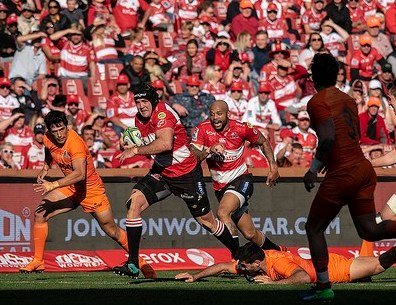
Lions hooker Malcolm Marx on the rampage once again. Photo by Marcel Sigg, runridedive.com

Lions hooker Malcolm Marx on the rampage once again. Photo by Marcel Sigg, runridedive.com

When the ACT Brumbies’ style of play dominated rugby in the early 2000s there were many pseudonyms for what they were doing – structured rugby, expansive rugby, multiphase play, all set up by skilful ball-carriers.

The Jaguares reminded me a bit of that multiphase play at Ellis Park on Saturday afternoon as they valiantly held on to the ball for phase-after-phase. But the game has moved on since the glory days of Gregan, Larkham and Finegan and these days teams trust their defences to hold out for long periods, eventually forcing the error or a one-off runner that is vulnerable to the breakdown steal.

We saw it in the Crusaders’ victory over the Sharks in the other SuperRugby quarterfinal featuring a South African side earlier in the day, and the Lions’ defence was the biggest factor in their 40-23 win over the Jaguares.

As the Jaguares pushed and prodded with more determination, so the Lions just worked harder and with more physicality in defence, simply not allowing the Argentinians to get their game going. Hooker Malcolm Marx led the way with vital turnovers, but Marnus Schoeman also contributed valuably and Kwagga Smith was also a presence at the breakdown.

“Collectively it was a massive effort and you have to give credit for all the turnovers to the guy who makes the tackle as well because he provides the opportunity. A guy like Malcolm is then just impossible to shift, Kwagga made one or two steals as well and Marnus was excellent when he came on. At stages the Jaguares kept the ball for a long time, but we showed good patience on defence,” Lions captain Warren Whiteley said after his team had clinched their third successive SuperRugby semifinal at home.

Run Ride Dive

Captain Warren Whiteley epitomises the Lions defence with this hit on Agustin Creevy. Photo by Marcel Sigg, runridedive.com

The Jaguares are certainly a force to be reckoned with going forward in SuperRugby, as they showed in the third quarter when they came from 9-24 down at the break to close to 23-27.

They were piling on the pressure, but Marx won three turnover penalties and those are the crucial interventions which win knockout games, with coach Swys de Bruin talking afterwards about “great defence at the right times”.

Jaguares coach Mario Ledesma spoke afterwards about how disappointing it was to concede three “soft” tries in the first half, but the Lions are a clever, innovative side on attack, able to try different things and generally pretty clinical.

All three of the tries came from different kicks: An Elton Jantjies crosskick found wing Ruan Combrinck with pinpoint precision for the first try; centre Harold Vorster followed lovely sleight of hand with a clever kick through that became even more effective thanks to the pace of Aphiwe Dyantyi getting there first to hack through and allow Vorster to score after the Jaguares made a mess of the clean-up operation; and a little dink over the top by flyhalf Jantjies was gathered by scrumhalf Gonzalo Bertranou, but his loose pass was immediately intercepted by Marx, who roared away from the 10m line for the try.

The Lions were cruising with a 24-9 halftime lead, but the admirable Jaguares were not done yet though as Bautista Delguy used his quick feet to score a fine try down the right wing two minutes after the break, and seven minutes later the visitors scored again as flank Pablo Matera crashed over. It was not the best grubber kick by the Lions that had given them broken-play possession.

Flank Cyle Brink, after a barnstorming first half, did not come out for the second half due to a shoulder ‘stinger’, but it was not a problem for the Lions as his replacement, Schoeman, played with tremendous industry. He showed terrific tenacity in the build-up to Andries Coetzee’s try as the fullback wriggled through a couple of tackles.

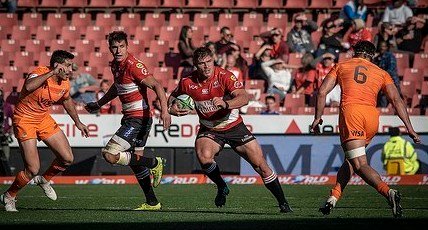
Lions flank Cyle Brink on another storming run. Photo by Marcel Sigg, runridedive.com

Lions flank Cyle Brink on another storming run. Photo by Marcel Sigg, runridedive.com

A typically combative Marnus Schoeman. Photo by Marcel Sigg, runridedive.com

A typically combative Marnus Schoeman. Photo by Marcel Sigg, runridedive.com


Being a knockout game, coach De Bruin had deemed shots at goal acceptable and Jantjies, who produced a polished performance that included a seven-from-seven success rate from the tee, then slotted a sweetly-struck drop goal to take the Lions’ buffer to two converted tries (37-23).

The seventh successful kick at goal by Jantjies was the penalty that completed the scoring with five minutes remaining, confirming that they will host the Waratahs at 3pm next Saturday in the semifinals.

The other huge positive for the Lions was the tremendous dominance of their scrum. The number of set-pieces was relatively low, but whenever the home side needed it, their scrum won them penalties or gave them strong front-foot ball.


Time for club rugby to fix this broken system 0

Posted on June 28, 2018 by Ken


This has been a season of renewal for the Bulls and one of the fresh faces to have really come to the fore in SuperRugby has been loose forward Marco van Staden, a man of frenetic energy, great physicality and no little skill in doing his ball-pilfering job at the rucks.

A couple of the writers who regularly cover the Bulls were fortunate enough to get to interview the 22-year-old recently and he revealed that he played no provincial schoolboy rugby. This is probably largely due to the fact that he went to Hoerskool Bekker in Magaliesburg, not one of the traditional rugby powers.

He has made it this far – now being rated as one of South Africa’s most promising young forwards – thanks to his single-minded determination to fulfil his dream of being a professional rugby player and a bursary to study sports science from the University of Pretoria. Van Staden graduated last month and is the exception to the rule when it comes to how rugby players move through the development pipeline.

This got me thinking about the numerous, who knows how many, talents that fall through the cracks in South African rugby because of our obsession with a handful of elite rugby schools and provincial U19 and U21 competitions and the Varsity Cup.

Our results whenever we get to play against other countries – whether in the Pro14, SuperRugby or at Springbok level – show that our rugby is not well. The main reason for that is the terrible structure of our game. We desperately need a system that includes as much as possible of the undeniable talent that comes flooding through every year.

Instead, our rugby is elitist and there are barriers everywhere. It starts at school level where a few elite schools just get richer and richer through the ridiculous amount of attention that is lavished on them. Just turn on the rugby channel and you are very likely to be watching a schoolboy game.

These youngsters are fawned over from a young age and if you didn’t go to the ‘right’ school then chances are you won’t be playing in Craven Week, which means you won’t get snapped up by a province or university; in other words you are out of the system, generally for good.

Having been taught win-at-all-costs rugby at school level, to the detriment of skills development, these cloistered kids become professional rugby players at the age of 19, big fish in a small pond just going to another small pond. Many of them play in a Varsity Cup that shares little resemblance to the sort of rugby they will need to play if they are going to make it with the Springboks.

That rugby is being jealousy guarded as the preserve of a few was rammed home by two recent incidents.

Wanderers U21 players laid a complaint of vicious racism and assault against Roodepoort, with the disciplinary hearing held on May 9 by the Golden Lions Rugby Union. Seven weeks later and this issue has still not been resolved.

If South African rugby wants their sport to be played and enjoyed by most people in this country then incidents like this cannot be tolerated. If a blind eye is turned to what happens at club level, SA Rugby are discarding the probable solution to their structural crisis. By growing a healthy club rugby culture between the junior and professional ranks, there will be a pipeline that provides opportunity for way more talent.

But this lack of inclusivity is even seen at school level. Hilton College and Paul Roos (still sponsored by a Steinhoff subsidiary) fielded lilywhite teams in their Premier Interschools matches against Maritzburg College and Grey High respectively. Encouraged by blanket television coverage, they are allowed to get away with this gross dereliction of duty.

Both those schools spend a fortune on recruitment, so it is obvious making sure their teams reflect the demographics of our country by obtaining Black talent does not even register on their radar. And these are the schools which are meant to be preparing our children for a future South Africa!

The John McFarland Column: Extremely encouraging 1st Test win for Boks 0

Posted on June 14, 2018 by Ken


It was extremely encouraging to see a really transformed Springbok team play some superb rugby in beating England in the first Test at Ellis Park at the weekend, and you have to give the head coach, Rassie Erasmus, a lot of credit for how his team were able to come through in the end.

England were superfired-up and it’s never easy to win a Test against them, and one can see how the amazing comeback win has uplifted everyone in the country.

At the start, there were some setting issues for the Springbok defence, they were too tight. The wings generally set the width of the defensive line and you’re looking for field coverage from them to the ruck. Depending on the speed of the ball out of the breakdown, you can get 70 to 85% coverage or even 90-95% of the field covered if it’s very slow ball.

They also were trying to come in on England’s second-last player, but the tourists were very clever and they used skip passes, which enabled them to easily get through, as they did when they engineered a two-on-one on Willie le Roux for Owen Farrell’s try. The Springboks also had a disconnected defensive line for the late outside runner from 10 which the English were able to exploit.

So the home side found themselves in a heck of a position – 24-3 down after 17 minutes. The biggest change after that was that England did not see the ball in the middle of the game. For the Springboks to turn ahead of England at halftime echoed so many of the Lions’ games at altitude at Ellis Park – the opposition would go ahead early, but the Lions would always come back in that death-zone period at altitude 15 minutes before halftime.

You could see England were struggling to fold and the key issue was the number of turnovers that Duane Vermeulen got at the breakdown. They were all around halfway and the Springboks were able to kick the penalties for great field position and get their lineout drive going.

South Africa’s third try was a perfect example of that: the maul with poor defence from England in the 22 and an easy walk-in for the open wing, and you have to give Sbu Nkosi credit for working his way all the way around off his wing and getting the inside ball from Aphiwe Dyantyi, the other wing.They both showed a willingness to support off their wings.

At altitude, the game is always so fast and it was perfect conditions for rugby, which is why 56 points could be scored in the first half. There was some calmness though at the start of the second half and it was almost like a huge sigh for the crowd of more than 55 000 as both teams hit each other hard on the gain-line.

I do believe England missed a trick though by taking lock Nick Isiekwe off after just 36 minutes. Sure, Brad Shields, normally a loose forward, made an impact and gave them more mobility, but I felt the England scrum had been quite dominant until that point. You could see the energy South Africa got from the set-pieces after that and rugby is obviously still confrontational at set-piece at Test level. It also left England with only one real jumper in Maro Itoje and that key lineout at the end of the game was lost.

In the first quarter, England cut the Boks’ line so much, and exerted set-piece pressure, but once they made the change at lock it changed. They obviously wanted to play a ball-in-hand type of game, to not have lots of set-pieces. They wanted to keep the ball alive and have a broken-play type of game.

These were the tactical errors made by Eddie Jones, only having loose forwards on the bench instead of another lock. You still need a set-piece or else you will concede penalties.

After the first 20 minutes, the Springboks rarely allowed England into their own half by forcing turnovers and dominating territory. They were totally dominant and rampant in the middle period and it’s been a long time since we’ve seen that – the last time was probably against France last June, so the Ellis Park factor carried on.

When England tried to exit with box-kicks, Vermeulen was there to field them and take the pressure off the debutant wings.

But there were only three points between the sides at the end, which makes one think back to the Elliot Daly howler when he just needed to dot the ball down to prevent Nkosi scoring.

South Africa also didn’t finish all their chances and it’s fair to say England controlled the first 15 minutes and the last 15 minutes, and the Springboks were in charge for the middle 50. If England had won that last lineout, who knows what would have happened with the way the game ebbed and flowed.

The match was a fantastic spectacle and hopefully the next two Tests are sold out because we can definitely see the fact that the crowds are enjoying watching the Springboks win again. It will be a great Test on the weekend in Bloemfontein and I remember all the way back to 2000 when Jonny Wilkinson kicked eight penalties and a drop goal there to give England a 27-22 victory.

It was the penalty count that destroyed England too at Ellis Park last weekend and they came mostly from the scrum or breakdown. England need to carry the ball better and get their cleaners there quicker and more effectively and pick another lock!

The Springboks’ set-piece became stronger and can be a real weapon, it was really encouraging to see RG Snyman really come through. He clearly has a lot of athleticism and is so good in space.

The Boks need the same attitude and attacking mindset this weekend.

Maybe the most important positive so far for the Springboks though is that they have taken a lot of players out of overseas eligibility with 16 new caps in the first two weeks of Rassie Erasmus’s reign!


John McFarland won three SuperRugby titles (2007, 09, 10) with the Bulls and five Currie Cup crowns with the Blue Bulls as their defence coach. In all, he won 28 trophies during his 12 years at Loftus Versfeld.

He is currently the assistant coach of the Kubota Spears in Japan and was the Springbok defence coach from 2012 through to the 2015 World Cup, where they conceded the least line-breaks in the tournament and an average of just one try per game.


The John McFarland Column: Why are there so few Lions backs in the Springbok squad? 0

Posted on May 30, 2018 by Ken


The Lions have an unbelievable record against all other South African SuperRugby franchises since 2015 and they have consistently been our best team. It really is an amazing record, their dominance of South African rugby is the reason they have been in two successive finals and they have consistently scored the most tries in the competition, so you have to ask why they have so few backs in the new Springbok squad?

With only Aphiwe Dyantyi and Elton Jantjies named in the 43-man squad, there may be no Lions back in the starting line-up against England, which is quite interesting when you consider they have been beating everyone else in South Africa convincingly, and especially with their coach, Swys de Bruin, now with the Springboks as a backline consultant.

There have been suggestions that new Springbok coach Rassie Erasmus is concerned with the defensive prowess shown by our SuperRugby franchises, but the Lions in 2016 had one of the best defences in the competition and you have to play, you can’t just kick the ball downfield and defend.

It’s also interesting that none of the first-choice back three from last year’s Springboks – Andries Coetzee, Raymond Rhule and Dillyn Leyds – have been selected by Erasmus.

It is true to win big competitions you need a rock-solid defence.

If you look at the points conceded figure for our teams, the four South African outfits have all leaked between 381 and 392 points, an average of 27.2-29.8 points per match. In terms of tries conceded, the figures are 49 to 52 per side, which amounts to an average of 3.5-3.7 per game.

In comparison, the Jaguares, who are strong contenders to win the South African Conference, are conceding just 26.2 points and 3.4 tries per match. Only the Sunwolves, the bottom team in SuperRugby, have worst stats than the South African franchises.

What is causing our teams to concede so many points? You can’t just say it’s because we now have an attacking mindset. Not one of our sides has been really convincing defensively, which perhaps reflects where most of them are on the overall log. At Test level, the Springboks used to work on trying to concede less than an average of 15-16 points per game, and 11-12 at the World Cup, with just one try. Then, more often than not, you would be on the winning side. It is imperative to get back to these sort of stats now going forward because big Test matches are often gain-line arm-wrestles.

The really good news for the Springboks though is that England have just conceded nine tries and 63 points against a scratch BaaBaas XV, both record lows for them at Twickenham. So their defence is in real trouble and in their last four games one began to notice some real cracks both in terms of their system and individual tackles.They really are sitting before the tackle which causes them to miss so many and any ‘backdoor’ second-line plays cause total disconnection and confusion.

Eddie Jones turned on his players viciously, saying some of them couldn’t cope with the pace of international rugby, but he picked them in the first place, and it will be even harder on super-fast highveld fields with altitude as a factor.

To get back to our Lions, their win over the Stormers at the weekend was so vital because it maintains a buffer between them and the Jaguares, who have a game in hand but are six points behind. It was an exciting battle with the Stormers exploiting the Lions fullback getting into the defensive line early with attacking kicks and the Lions exploiting the home side’s flimsy defence of the rolling mauls and around the edges – the way Nic Groom dummied Ramone Samuels to score was way too easy.

There is also a difference in the way the Lions use the rolling maul these days, they are prepared to wheel it more in order to exploit space and take out the defenders stopping the maul. It is really good use of forces and you have to credit Philip Lemmer for bringing in something different and innovative.

You have to praise the Lions for the win, but the Stormers will rue the red card to Raymond Rhule. You just can’t do what he did anymore on a rugby field, although the nature of his suspension and those of other players in recent weeks does raise fresh questions over exactly how the judiciary works in SuperRugby. How can the ban cause them to effectively miss no rugby?

The Sharks were really outplayed by the Jaguares in Buenos Aires but they also did some sloppy things.

Coach Robert du Preez also made a massive statement during the week that they would be in the final either this year or next, which smacked of desperation and false news from a side scrambling for a quarterfinal place, and about to come up against one of the form teams in SuperRugby.

The Sharks’ pillar defence was just not good enough last weekend, the guys were either too wide or too upright. You can’t allow yourself to just be cut so easily next to the ruck, that should be the strongest part of your defence because that’s where the ball is, but for the Sharks, it was their weakest area.

The Jaguares did finish well and wing Ramiro Moyano scored three tries and they were backing up the ball-carrier well. The try they scored just before halftime to go 17-0 up would have hurt the most for the Sharks because they were slow to react, players had their backs to the ball and conceding a try from a quick-tap penalty is the sort of thing you can’t afford away from home.

It’s a very long trip to Buenos Aires and they had a quick turnaround from their last game, but the Sharks looked sluggish. The Bulls had similar problems the week before and how to manage that trip is something the South African teams have to sort out. When I was involved with the Springboks, we found it better to train in South Africa for two sessions, then fly over, have a captain’s run and play.

It is pleasing, however, to see the Jaguares hit their straps and when SuperRugby resumes they will have three vital games left in which to clinch their playoff place. Their Australasian tour proved that they can win on the road and they have been really impressive in their recent bonus point wins at home, so they are building nicely. It will still, however, be a big test for them to host the Stormers and then play the Bulls and Sharks away after they have played Tests against Wales and Scotland.

The Bulls were also really disappointing last weekend and they will look at their game against the 14-man Brumbies and really rue their defeat – it will probably be the game that loses them a playoff place.

They did some really good things on attack – Handre Pollard’s show-and-go try and Roelof Smit scoring out wide – but their defence is just not good enough for them to be playoff contenders. An example of that was when they had three defenders on two attackers after the restart turnover, but they all just rushed up and opened the space for the Brumbies on the outside. They will also be disappointed with the try when fullback Tom Banks ran the whole length of the field to score.

The Bulls are just not able to stop momentum close to the rucks, their opponents get go-forward too easily, and especially in the 22 that generally means seven points against you because it leads to space around the pillars, something which Brumbies scrumhalf Joe Powell exploited.

The Bulls have certainly been more entertaining this season but they need to step up over the next few weeks. Pretoria only really comes out to the stadium for winning rugby. The Bulls have a lot of talent in key areas, the locks are the envy of every team and the fetchers are second to none, and they have real X-factor in their outside backs.

Pollard has played plenty of Tests and is at the peak of his powers, Jesse Kriel too, and they have more players in the Springbok squad than the Lions, so how come are the Southern Gauteng side so far ahead of them? The Bulls are certainly an enigma, they do a lot of good things in every game, they just need that consistency of performance, they are too up-and-down at the moment.

On a parting, more positive note, my heartiest congratulations to Siya Kolisi on his well-earned appointment as captain for the England series. I am sure he will fly the South African flag high and do the position proud.


John McFarland was the Springbok defence coach from 2012 through to the 2015 World Cup, where they conceded an average of just one try per game and the least line-breaks in the tournament. He is now the assistant coach of the Kubota Spears in Japan and before that, McFarland won three SuperRugby titles (2007, 09, 10) with the Bulls and five Currie Cup crowns with the Blue Bulls. In all, he won 28 trophies during his 12 years at Loftus Versfeld.

  • Recent Posts

  • Archives

  • Thought of the Day

    Matthew 5:14,16 – “You are the light of the world. Let your light shine before men, that they may see your good deeds and praise your Father in heaven.”

    The peace of mind that comes from continuous fellowship with the Lord will enable you to handle all that life brings. True spirituality loves Christ so much that his glory is reflected in holy lives, there for everyone to see. Love Christ with all your heart and mind and allow his love to flow through you.


↑ Top