for quality writing

Ken Borland


Three changes as time for rotation nears for Bulls 0

Posted on March 20, 2019 by Ken


Pote Human admitted that the time is coming when he has to start rotating players, but for now the Bulls coach is able to just freshen up his squad in one or two areas, as he did on Wednesday when he announced a team with three changes in it to face the Chiefs in their SuperRugby game at Loftus Versfeld on Saturday.

Centre Burger Odendaal and flank Ruan Steenkamp, both probable first-choice players, return to the starting line-up after prolonged injury absences, while a shoulder niggle for regular fullback Warrick Gelant has convinced Human to rest the Springbok for this weekend and bring in Divan Rossouw as the last line of defence.

Dylan Sage and Tim Agaba, the players displaced by Odendaal and Steenkamp, are both on the bench, along with returning lock Eli Snyman.

When one considers that available players such as Roelof Smit, Marco van Staden, Jaco Visagie, Aston Fortuin, Travis Ismaiel and Johnny Kotze are all unable to get into the match-day 23 right now, then one can see that Human suddenly has the depth to start rotating players and ensure his squad stays fresh in the toughest competition in world rugby.

“It’s getting more and more difficult to select the team but it’s a good place to be. Some Springboks do need game-time off as well, but we have Marco, Manie Libbok, Johnny and Travis all back and available and it was close between Jaco Visagie and Corniel Els for the substitute hooker position this weekend. So it’s a nice position to be in,” Human said at Loftus Versfeld on Wednesday.

The Chiefs, despite their mediocre start to the campaign, remain extremely dangerous opposition and the Bulls will need to shut them down at source on Saturday. The Bulls pack have certainly rolled up their sleeves in the first month of SuperRugby and Jason Jenkins and Hanro Liebenberg did well enough as the starting lock pairing against the Sharks in their last game for Human to persist with them as they tackle Brodie Retallick and his forwards.

“We kept the same locks because they did very well against the Sharks and they will be very physical, which is what will be needed against the Chiefs. We will try and force our game on their’s and if we can win the battle up front then we’re halfway there. We have the pack to do it so I think we’ll be okay.

“The scrums have been a big plus point for us, with Daan Human [scrummaging coach] coming in and he has done unbelievable work. I’m old school: If we can do well in the scrums and get go-forward then we’ll be okay,” Human said.

Squad: 15-Divan Rossouw, 14-Cornal Hendricks, 13-Jesse Kriel, 12-Burger Odendaal, 11-Rosko Specman, 10-Handre Pollard, 9-Ivan van Zyl, 8-Duane Vermeulen, 7-Jannes Kirsten, 6-Ruan Steenkamp, 5-Jason Jenkins, 4-Hanro Liebenberg, 3-Trevor Nyakane, 2-Schalk Brits, 1-Lizo Gqoboka. Replacements – 16-Corniel Els, 17-Simphiwe Matanzima, 18-Dayan van der Westhuyzen, 19-Eli Snyman, 20-Tim Agaba, 21-Embrose Papier, 22-Manie Libbok, 23-Dylan Sage.

Protea Loftus Park has made the Loftus Versfeld experience easier than ever 0

Posted on February 11, 2019 by Ken


The vibrant Loftus Park piazza as viewed from the Protea Hotel

The vibrant Loftus Park piazza as viewed from the Protea Hotel

If you are one of the many fans of the Bulls from outside of the Pretoria region, when was the last time you made the pilgrimage to Loftus Versfeld?

Fortunately in these tough economic times, the new mixed-use development next door to the stadium – Loftus Park – is going to make it much easier for out-of-town visitors to come and watch their favourite team, whether that be the Bulls or Premier Soccer League giants Sundowns.

The new Protea Hotel by Marriott Pretoria Loftus Park is a four-star oasis and yet you can get a room in this well-appointed, modern establishment for as little as R1045 per night.

And the rooms are spacious, overlooking a piazza that offers a host of eating and shopping options, or the greater Pretoria area, with most of the historic landmarks such as the Voortrekker Monument and the Union Buildings visible.

A room at Protea Hotel Loftus Park

A room at Protea Hotel Loftus Park

There is also plenty of underground parking, which costs just R40 a day. All-in-all, Protea Loftus Park is just the perfect solution for travelling fans wanting to watch a game at Loftus Stadium: Avoid the rush and crush, stay at the hotel and then just simply stroll the 100 metres or so to the stadium.

For after the game, Protea Loftus Park boasts a truly jamming venue in the Skyline Bar, Restaurant and Lounge. This rooftop venue features a pool, live music on weekends and a fantastic selection of food and drinks.

IMG_3468

The swimming pool at Skyline on top of the hotel

My wife and I were hugely content with our steaks – fillet for her, T-bone for me – which were full of flavour, expertly cooked and decent-size helpings as well.

We also thoroughly enjoyed some churros that were brilliantly done – crispy on the outside, light as a feather on the inside and accompanied by a divine dark chocolate sauce. My wife said they tasted as if angels had farted on her tongue.

Best of all, a very attentive staff ensures that they are always close-at-hand to provide superb service that is not too intrusive.

For those that are not interested in the epic sporting battles going on next door, or who have time to kill before or after the big game, the hotel can organise a guided tour of Pretoria. Even though I know the Jacaranda City well, that was one of the highlights of our weekend, being both highly-informative and great fun.

The sun sets over the capital ... and a wonderful weekend ... as seen from Protea Loftus Park

The sun sets over the capital … and a wonderful weekend … as seen from Protea Loftus Park

Lions rugby: Out of the abyss but digging a new hole? 0

Posted on September 24, 2018 by Ken


One has to admire the Lions Rugby Union for the way they have been able to dig their way out of the abyss of financial ruin that faced them when they were relegated from SuperRugby in 2013. Just five years later and they are unquestionably South Africa’s premier franchise, the one most young players probably want to play for and producing a very popular brand of rugby.

But amidst all this success and SuperRugby trailblazing, there have also been messages coming out of Ellis Park that paint a picture of a franchise that is still anchored in the past in many ways and does not seem able to be the standardbearer of a future game all rugby fans should be hoping becomes truly the sport of all South Africans.

As much as the Lions deserve huge credit, one has to call them out for some of the mixed messages that they have sent out recently; as we have seen after another week of anguish caused by awful social media messages, perceptions are vital when it comes to inclusivity.

With Swys de Bruin jetting off overseas with the Springboks, the Golden Lions needed a new head coach for their Currie Cup campaign. But instead of heading for the safety of port and elevating one of the assistant coaches in Philip Lemmer or Joey Mongalo, or even promoting Bafana Nhleko, who has coached the SuperSport Rugby Challenge team as well as the Lions U19s and U21s and been an assistant with the Junior Springboks, they chose strength and conditioning coach Ivan van Rooyen.

Now Van Rooyen has undoubtedly played a very important part in the Lions’ success over the last few years, but his helicoptering into the head coaching job was inevitably attacked as being anti-transformation in certain quarters.

At this delicate stage in our country’s history, organisations really need to be sensitive about how their actions will be perceived by the majority. I am not saying it was wrong to appoint Van Rooyen, who played for the Lions at junior provincial level, and has gained some insights from Rob Walter, the former Proteas strength and conditioning guru who then became head coach at the Titans cricket team and enjoyed great success.

But the reasons for Van Rooyen’s appointment were never fully explained and even more shade is thrown at the Ellis Park hierarchy when Van Rooyen himself says he won’t be doing any actual coaching but is in more of a managerial role.

Why was this not explained properly on the day of his appointment, thus avoiding plenty of bad publicity?

The prospect of getting involved in rugby in Gauteng for a young Black player or coach is daunting enough without considerable barriers being put in their way, like the recent acquittal of Roodepoort U21 players on charges of racism during their April match against Wanderers.

While acknowledging that Sanele Ngcobo of Wanderers was “an honest and truthful witness” who testified that racial slurs had been made, the Golden Lions Rugby Union disciplinary tribunal ruled that because he could not prove who had specifically spoken the words, a not guilty verdict was appropriate.

For the physical abuse that degenerated into a mass brawl at the end of the game, one Roodepoort player was effectively handed a one-match ban! Talk about a slap on the wrist … and another slap in the face for Black rugby players.

To add insult to injury, when Wanderers were on their way to Roodepoort to play a later fixture, their bus broke down and they missed the game. The GLRU docked them five points, meaning Roodepoort now qualify for the Gold Cup instead of them!

Having reinvented themselves so spectacularly on the field, the Lions rugby union now really need to focus on the message they are sending out to their future market.

https://www.pressreader.com/south-africa/the-citizen-gauteng/20180825/282518659358786


THE TROUBLE WITH ELEPHANTS 0

Posted on August 14, 2018 by Ken


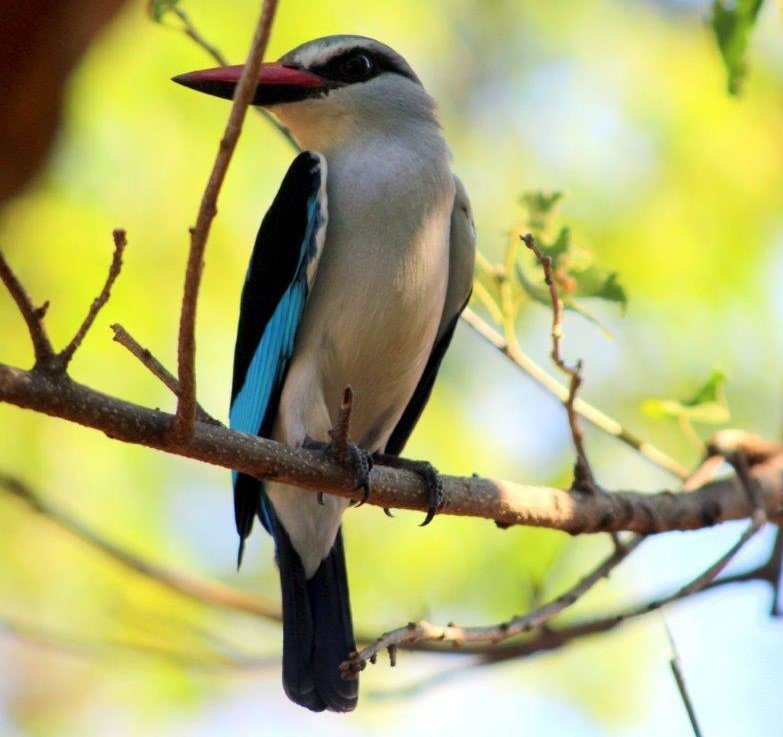
Woodland Kingfisher

Woodland Kingfisher

by Anthony Stidolph

I am not a man who deliberately courts disaster or intentionally goes looking for bad experiences. By the same token, I am not such a fool as to think the odd mishap won’t occasionally befall me. And when you go travelling with my birding partner Ken, rotten luck does have a habit of following you around.

For example: on a recent trip to Marakele National Park we found ourselves being chased down a narrow, twisting mountain pass in reverse by a very angry elephant who clearly resented our presence in his private domain.  Luckily – I have a feeling some benevolent deity saw fit to intervene – we survived that harrowing encounter. What I did not realise was that more trouble with elephants lay ahead…


From Marakele we had followed a circuitous route that took us to Blouberg Nature Reserve and then cut east along the base of the Soutpansberg range to Punda Maria in North Kruger. We planned to camp the night here and then press on to Pafuri the next day, where we hoped to get in some good birding.

Up until now the weather had been kindly – more spring than summer and I had even found myself wearing a jacket in the evenings and early mornings. In Kruger, however, the hot weather we had been expecting all along finally caught up with us, with the temperature soaring up to 39 degrees. The air around us was heavy and listless and steamy, almost tropical, perhaps hardly surprising since we had crossed over the Tropic of Capricorn some days before.

Eager to be off, I was up early the next day although I had to first wait for Ken to complete his complicated early-morning-ablution rituals. Once he was done with that, we set off northwards through the familiar vastness of flat grassland and mopane trees. On the way we stopped to allow the biggest herd of elephants I have ever seen cross the road. Shortly afterwards we were forced to repeat this exercise for an even bigger herd of buffalo.

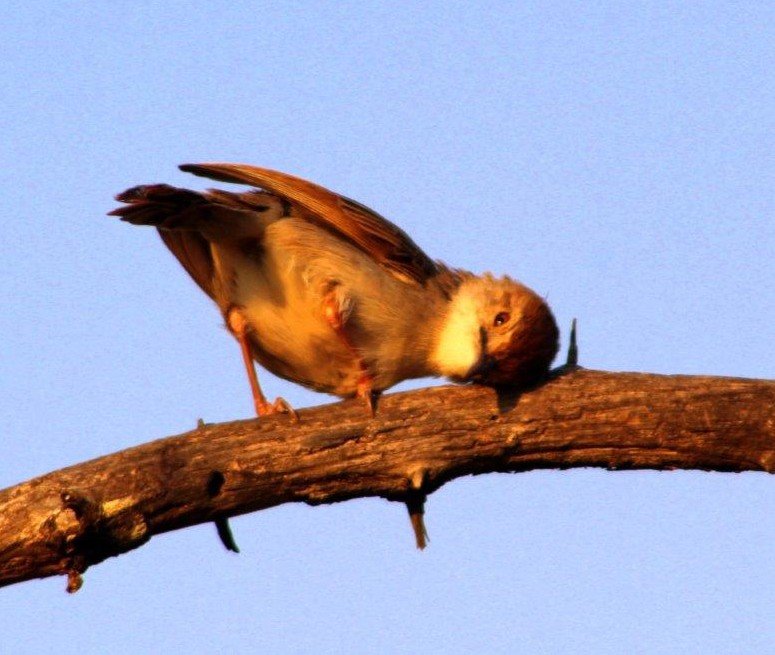
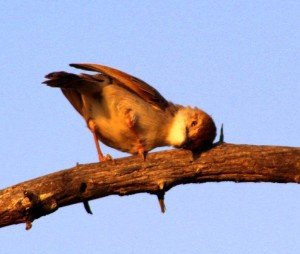
The common bird in this neck of the woods – or at least the most vocal – is the Rattling Cisticola. There seemed to be one trilling its silly head off on top of virtually every second tree we passed.
Cisticola, Wailing, Kruger

The highly-vocal Rattling Cisticola – Can rub some people up the wrong way

As you draw close to Pafuri, the terrain starts to break up and rearrange itself and you are suddenly confronted by the arresting sight of Baobab Hill, with its commanding views over the Limpopo Valley. In the early days this iconic hill served as both a landmark and sleepover point for the ox-wagons travelling up from Mozambique.

By the time we got to Pafuri the sun was high and blazing. There had obviously been no rain here this season and the grass was pale and dry, although the trees had mostly come out in leaf.

At the crossroads we turned left down the Nyala Drive, which takes you into some wonderfully hilly country before taking a lazy loop back to the main road. Ken likes this less-used drive because, he says, it often throws up unexpected surprises.

There wasn’t much on offing this time around besides the usual suspects – Meves’s Starlings, Arrowmarked Babblers, Whitefronted Bee-eaters and Emeraldspotted Wood Dove. We passed a solitary elephant but he paid us no mind.

On the top of the small, baobab-clad hillock, directly above where the road swings back, is the Thulamela archaeological site, a restored Zimbabwe-type ruin. Unfortunately you can only go up with a guide and because of our tight schedule we did not have time for that.
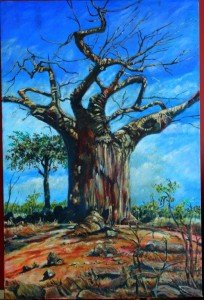
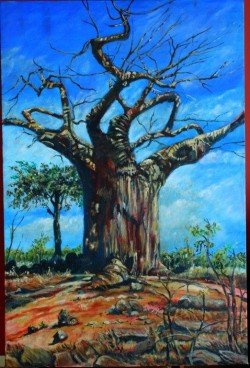
One of the commanding Baobab trees of northern Kruger. This painting by Stidy is available for sale. 42x60 stidy@sai.co.za

One of the commanding Baobab trees of northern Kruger.
This painting by Stidy is available for sale. 42×60 stidy@sai.co.za

From the Nyala Drive we crossed back over the main tar road and followed the dirt track that takes you to Crooks Corner, where the brown waters of the Luvuvhu collide with the blue of the Limpopo. The combination of water, sun and rich alluvial soils has led to a proliferation of vegetation along the rivers’ banks so that you drive through a glittering tunnel of Sycamore Figs, Nyala trees, Jackal Berry, Ana and Fever trees.

Crooks’ Corner, where you can get out of your cars, marks the border between South Africa, Mozambique and Zimbabwe. In the early 1900s this remotest of places gained its moniker and dodgy reputation with gun-runners, fugitives and others on the run from the law, using it as a safe haven because it was easy to hop across the border whenever the police from one country approached.

Distinctly, there was a sense of a frontier on that lazy meandering river, although I don’t think the solitary Saddlebilled Stork fishing in its waters gave a fig where the international boundary lay or as to who held sovereignty over the country he was standing in.

Normally, it feels like you can’t get much further away from civilization than here, but we had chosen a busy weekend to visit so it was like a major thoroughfare with a steady stream of traffic passing through. Many of the visitors didn’t even bother to wind down their windows or get out of their luxury 4x4s because it would mean switching off their air-conditioners. They just drove in, stopped, glanced around and drove out again, leaving me to wonder why they had bothered to come all this way …

Needless to say Ken – who, contrarily, makes it a rule to ALWAYS switch off his air-conditioner when he enters a park because he likes to experience Africa in all its extremes –  and I did get out.

Rich plant life invariably means rich animal and bird life and Pafuri is no exception. In the past the storied riverine forest has provided both of us with some good sightings. It was here I saw my first Gorgeous Bush Shrike, Bohm’s Spinetail and Ayre’s Hawk Eagle. I have also recorded Lesser Jacana, Greencapped Eremomela, Hooded Vulture, Tropical Boubou and the palm-dwelling Lemonbreasted Canary.

This time, we could hear both the Gorgeous Bush Shrike and a melodious Whitebrowed Robin-Chat calling from the depth of a nearby thicket but could not entice either of them out.  Instead we had to make do with a bunch of waders and a noisy party of Trumpeter Hornbills who, I think, were off to join the celebrations in neighbouring Zimbabwe.

It was now well past lunchtime so we doubled back to the Pafuri picnic site on the edge of the Luvuvhu. Feeling somewhat dehydrated, I was desperate for an ice-cold coke but had to wait patiently in queue behind an American who was explaining to the bemused coke seller-cum bird guide – who, I suspect, knew the answer but was too polite to say so – what a turkey is (“It’s a big black bird with a red head”).

At this juncture of its journey the Luvuvhu is always a ruddy brown colour such as might be achieved by mixing cans of tomato soup with cans of chicken soup. There was an enormous crocodile lying directly opposite us, not, as one would expect, by the water’s edge but high up on the bank under some trees. I had a feeling some unsuspecting animal was in for a nasty surprise.

On the way back to Punda Maria, we took the shortcut via Klopperfontein Dam, another place which can throw up some unexpected treats even though the area around the dam has been grazed as smooth as a billiard board. Sure enough, we were rewarded with a wonderful sighting of a Painted Snipe snooping around in the shallows of the nearby stream.

It was getting on for late afternoon by now. Ken consulted Emily, his prissy, admonishing Satnav, and worked out how far we had to go and what time we had to do it in. What neither factored into their calculations was our old nemesis, the elephant.

The first one, which we encountered just after Klopperfontein, kept us waiting for ages, while it feasted on the side of the road, before moving off into the surrounding bush. A little later we passed him siphoning water by the trunk load out of the top of a reservoir.

We ran in to the second one on the home stretch with the hills around Punda Maria in plain sight. Although this bull appeared much more amiable then the one who had chased us down the mountain in Marakele, he had obviously decided he held all the rights to this road.

The whole thing quickly degenerated into a stage farce. We kept reversing and reversing and he kept trundling on towards us. I suspect he was headed for his evening sundowner at the same reservoir where the other elephant was sloshing water around.

One of us had to blink and we did so first. Muttering angrily to ourselves about the beast’s poor road etiquette, we turned around and headed back to the tar and took the much longer route home to Punda Maria.

In Kruger, as in other parks, you are not supposed to arrive in camp after dark, which we now did, finding the gate locked on us. Fortunately, the guard was still at his post but Ken had to use all his silky skills as a sports writer and commentator to try to convince him it wasn’t really our fault. I am not sure he bought our explanation, but he let us through without imposing a fine.

So we drove into camp feeling like a pair of naughty schoolboys who had just been caught bunking …

But we were not done yet. We arrived to a scene of utter devastation – in our absence a troop of baboons had ransacked the place, flattening my tent, breaking its poles and ripping gaping holes in the fly-sheet (even though there was nothing inside but my bedding and clothes), as well as scattering our possessions far and wide.

To tell you the truth I was getting seriously tired of this. I had just bought the tent to replace the one that got ripped by monkeys in Mapungubwe on my last trip which, in turn, I had bought to replace the one that had suffered a similar fate at the hands of baboons when I attended a wedding in De Hoop Nature Reserve in the Western Cape. At the rate I was getting through tents, it would have been cheaper to have just booked into a luxury lodge!

I am not sure what one does about this menace. The problem is both monkeys and baboons have become habituated to both human beings and human beings’ food.

We did discover afterwards that there was supposed to be a guard on duty to stop these opportunistic raids but, even though the campsite was virtually booked out, he had decided to take the Sunday off …

I was still sulking about my poor tent the next morning when we drove out of the gate, destination Mapungubwe. There to wish us on our way was the scruffiest Ground Hornbill I have ever seen. It flew up into a tree from where it regarded us quizzically through its girlishly-long eyelashes.

For some reason the sight of that lugubrious bird, peering around its branch, cheered me up no end. It made me realise that on the Richter Scale of Travel Disasters we had got off relatively lightly compared to what other great explorers, like David Livingstone or Scott’s Antarctic expedition, had been forced to endure…


ANTHONY STIDOLPH

  • Recent Posts

  • Archives

  • Thought of the Day

    Revelation 3:15 – “I know your deeds, that you are neither cold nor hot. I wish you were either one or the other.”

    How can you expect blessings without obeying?

    How can you expect the presence of God without spending time quietly before him?

    Be sincere in your commitment to Him; be willing to sacrifice time so that you can grow spiritually; be disciplined in prayer and Bible study; worship God in spirit and truth.

    Have you totally surrendered to God? Have you cheerfully given him everything you are and everything you have?

    If you love Christ, accept the challenges of that love: Placing Christ in the centre of your life means complete surrender to Him.


↑ Top