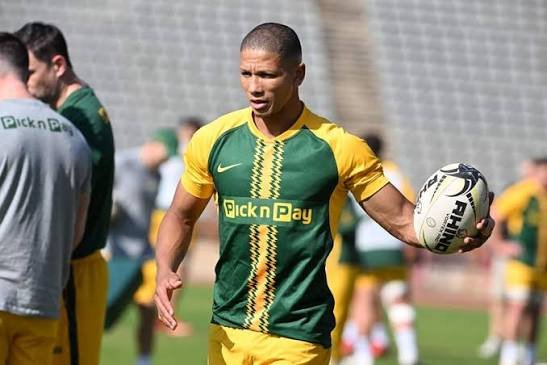
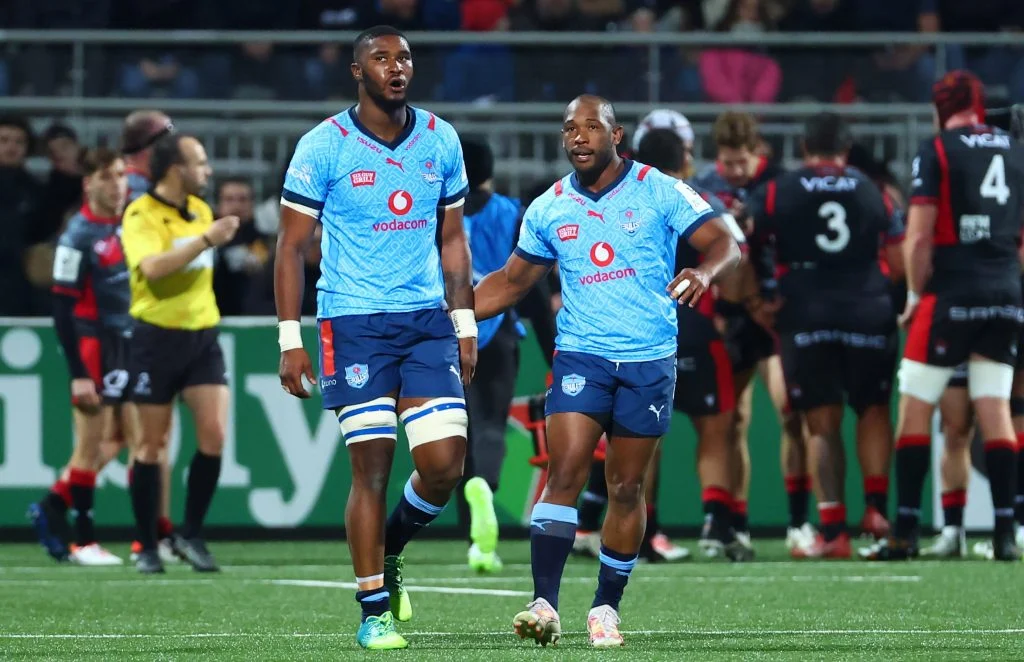
It was certainly a horror show for the Sharks at Loftus Versfeld on Saturday evening as the Bulls walloped them by a record 64-0, a thrashing that was a reversal of the famous Jaws film but every bit as bloody for the visitors.
The Bulls scored five tries in each half and produced an outstanding display of rugby: forward dominance was complemented by a backline that was free-flowing and inventive, and showed both their skills and their physical attributes.
To be fair to the Sharks, they were up against a seasoned Bulls outfit featuring full internationals in brilliant flyhalf Jaco van der Walt and wing Aphiwe Dyantyi, plus a host of players with URC experience. The KwaZulu-Natalians are basically an U21 side playing in the senior Currie Cup.
While the slaughter made ugly viewing for Sharks fans, a good crowd at Loftus Versfeld were royally entertained. Understandably, the mood in the Bulls changeroom afterwards was reportedly “ecstatic”.
“The guys are obviously ecstatic. We were also able to celebrate our nine debutants from the last two weeks, so there’s a very nice vibe in the changeroom. We will all have a cold one tonight,” new Bulls lineout coach Josh Strauss said.
The Bulls’ new head honcho, Johan Ackermann, described this match as “the audition” when he spoke to the Currie Cup team in their changeroom before the match, and the hunger of the players, so many of them who barely had a look-in during the Jake White era, was palpable.
“We’re getting the blend right between the senior and younger players and that mix is definitely vital. We have one or two cooler, more experienced heads who can make decisions and guide the youngsters,” scrum coach Werner Kruger said.
“Obviously we’ve done really well in the first two games and there was probably less pressure today but there were still good lessons in terms of what areas we want to play in, when we want to slow things down and how to close out the game. When you have a performance like that, it means guys have definitely put their hands up, it’s undeniable.”
The Bulls hit the Sharks hard from the outset and there were already some pale Natal faces after the first 10 minutes with the home side 14-0 up. Wing Stravino Jacobs made a big hit after chasing a Van der Walt up-and-under and a penalty soon afterwards allowed the Bulls to use their powerful maul, hooker Juann Else scoring the first of his two tries and prop Dylan Smith also burrowing over the line.
The Sharks also had to face some storming runs from abrasive forwards like Nama Xaba, Jeandre Rudolph and Marvin Orie, and the defence was further tormented by a backline that was flowing beautifully thanks to the impressive and exciting combination of Van der Walt and inside centre Chris Smit pulling the strings.
Smit showed his strength in scoring his first try, and his second came five minutes later when he got on the end of a lovely little dink over the top of the defence by Van der Walt.
The second half started with fullback Boeta Chamberlain gathering a chip over the ruck by scrumhalf Zak Burger and racing away, setting up a try for eighthman Rudolph. An outstanding individual try by Jacobs followed and then it was Van der Walt’s turn to break, running practically from 22-to-22 before finding Rudolph storming through at great pace.
When replacement wing Cornel Smit scored in the 58th minute, the Bulls went 59-0 up and were already ahead of the previous record winning margin for any Loftus Versfeld senior side against the team from Durban – 62-6 in the 1991 Lion Cup final.
The Sharks showed some character, however, and did okay in the final quarter, only conceding another try at the final hooter as replacement flank JJ Theron powered down the touchline to score.
Sharks coach JP Pietersen was bravely taking his medicine after the hiding, reminding the media that their objective in the Currie Cup is to develop players and not compromise their next URC campaign by sending for S.O.S. recruits from that squad.
He also pointed out that the Bulls had been particularly inspired on Saturday.
“It was close to the perfect game for the Bulls. They really hurt us in the collisions and at the breakdown. They kept stealing our ball and shutting us down. Their kicking game was good and then they would get a penalty and maul us,” Pietersen said.
Right wing Angelo Davids (left) celebrates his try on debut for the Lions as they hammered the Sharks in their Currie Cup opener. Photo: Christiaan Kotze (Gallo Images)
The Gauteng Lions played like the team that has had more exposure to the higher level of the United Rugby Championship as they swept aside a young, inexperienced Natal Sharks XV 46-5 in their Currie Cup opener at Ellis Park on Saturday.
The Lions were captained by stalwart hooker Jaco Visagie, a man with plenty of SuperRugby and URC experience, while players like Morgan Naude, Darrien Landsberg, Jarod Cairns, Nico Steyn, Rynhardt Jonker and Gianni Lombard are also regular participants in the European franchise tournament.
The Sharks, in contrast, had captain Nick Hatton and scrumhalf Bradley Davids from last year’s Currie Cup, and centre Litelihle Bester is highly-rated as a former SA U20 star and has even played in the Challenge Cup. But the rest of the squad they brought to Johannesburg was really made up of young talents they are looking to develop further.
The youngsters started well, won the early kicking game and dominated the first seven minutes in terms of territory. But they just could not crack open a committed, physical Lions defence.
And then a poor kick by flyhalf Jean Smith, with father Franco watching from the stands, went over the dead ball line and gave the Lions their first entry into Sharks territory with a scrum. The opening try came after 10 minutes, with three more coming in the first half, the Lions going into the break 24-0 to the good.
The home side scored three more tries in the second half and coach Mziwakhe Nkosi said he was satisfied by the level of performance, whatever the large difference on the scoreboard.
“We were quite apprehensive going into this game because we didn’t have a warm-up match, but it was a good start and we will certainly take it. It was good to get the cobwebs out and get the result we did.
“We came in blind and in the first half, the ball-in-play time was so low, so there wasn’t really any flow due to all the stoppages. With guys like Angelo Davids and Rabs Maxwane on the edges, it’s best to get the ball to them sooner rather than later, and it was good to see us get on to it in terms of how we want to play.
“We were probably the more settled side, but not that much more experienced. These okes have not had much game time in the URC,” Nkosi said.
Visagie was the first to use the space out wide to good effect, finding left wing Maxwane, who then sent flank Cairns charging down the touchline to score the opening try.
Right wing Davids then sliced through a number of defenders after some scrappy play off a lineout, scrumhalf Steyn then sending a crosskick heavenwards and Maxwane leaping high to claim the ball and go over for his first try, in the 22nd minute.
Real calamity struck the Sharks in the 34th minute, however, when wing Phiko Sobahle was yellow-carded for a deliberate knock-on that prevented a certain try by Davids after a blindside move by fullback Lombard. The penalty try took the Lions 17-0 clear, and they added two more tries either side of halftime as Smith was also yellow-carded for the same offence.
Maxwane was put in space again for his second try in the 39th minute and he fed Davids for a try on Lions debut in the 51st minute. Davids had provided the initial impetus for the superb move with his counter off a Sharks kick, while impressive centre Jonker did great work down the right touchline and then cutting infield.
With flyhalf Lubabalo Dobela kicking a penalty and the conversion, the Lions were 34-0 up with half-an-hour to play.
But the Sharks were the next to score, a breakdown in the chain of communication at the back allowing Sobahle to dot down a kick through by Bester, with Lombard getting in the way of replacement flyhalf Kade Wolhuter.
Davids was running free again in the 71st minute and set up Jonker for a try, while replacement prop SJ Kotze burst through off a lineout and sent replacement scrumhalf Layton Horn over for the final try.
Sharks XV coach JP Pietersen acknowledged that he is still trying to bring this new young group together as they look to defend the Currie Cup title they won in thrilling fashion at Ellis Park last year.
“It was our first game together as a group and the average age of the team is 23. So it was a challenge for these young men. They did alright and we showed some fight, especially in defending the Lions’ mauls. But we stayed in the pressure cycle and a team like the Lions will always capitalise.
“We’ll have better cohesion next week and we’re going to be working hard together from Monday. The Sharks angle in the Currie Cup is to develop youngsters for the URC, that’s the trend in the competition.
“The defence wasn’t there today, but that does not mean it is an issue. Defence is about cohesion and trust. This Lions group have been together for three+ years and they have that synergy and understand their game better,” Pietersen said.The Gauteng Lions played like the team that has had more exposure to the higher level of the United Rugby Championship as they swept aside a young, inexperienced Natal Sharks XV 46-5 in their Currie Cup opener at Ellis Park on Saturday.
The Lions were captained by stalwart hooker Jaco Visagie, a man with plenty of SuperRugby and URC experience, while players like Morgan Naude, Darrien Landsberg, Jarod Cairns, Nico Steyn, Rynhardt Jonker and Gianni Lombard are also regular participants in the European franchise tournament.
The Sharks, in contrast, had captain Nick Hatton and scrumhalf Bradley Davids from last year’s Currie Cup, and centre Litelihle Bester is highly-rated as a former SA U20 star and has even played in the Challenge Cup. But the rest of the squad they brought to Johannesburg was really made up of young talents they are looking to develop further.
The youngsters started well, won the early kicking game and dominated the first seven minutes in terms of territory. But they just could not crack open a committed, physical Lions defence.
And then a poor kick by flyhalf Jean Smith, with father Franco watching from the stands, went over the dead ball line and gave the Lions their first entry into Sharks territory with a scrum. The opening try came after 10 minutes, with three more coming in the first half, the Lions going into the break 24-0 to the good.
The home side scored three more tries in the second half and coach Mziwakhe Nkosi said he was satisfied by the level of performance, whatever the large difference on the scoreboard.
“We were quite apprehensive going into this game because we didn’t have a warm-up match, but it was a good start and we will certainly take it. It was good to get the cobwebs out and get the result we did.
“We came in blind and in the first half, the ball-in-play time was so low, so there wasn’t really any flow due to all the stoppages. With guys like Angelo Davids and Rabs Maxwane on the edges, it’s best to get the ball to them sooner rather than later, and it was good to see us get on to it in terms of how we want to play.
“We were probably the more settled side, but not that much more experienced. These okes have not had much game time in the URC,” Nkosi said.
Visagie was the first to use the space out wide to good effect, finding left wing Maxwane, who then sent flank Cairns charging down the touchline to score the opening try.
Right wing Davids then sliced through a number of defenders after some scrappy play off a lineout, scrumhalf Steyn then sending a crosskick heavenwards and Maxwane leaping high to claim the ball and go over for his first try, in the 22nd minute.
Real calamity struck the Sharks in the 34th minute, however, when wing Phiko Sobahle was yellow-carded for a deliberate knock-on that prevented a certain try by Davids after a blindside move by fullback Lombard. The penalty try took the Lions 17-0 clear, and they added two more tries either side of halftime as Smith was also yellow-carded for the same offence.
Maxwane was put in space again for his second try in the 39th minute and he fed Davids for a try on Lions debut in the 51st minute. Davids had provided the initial impetus for the superb move with his counter off a Sharks kick, while impressive centre Jonker did great work down the right touchline and then cutting infield.
With flyhalf Lubabalo Dobela kicking a penalty and the conversion, the Lions were 34-0 up with half-an-hour to play.
But the Sharks were the next to score, a breakdown in the chain of communication at the back allowing Sobahle to dot down a kick through by Bester, with Lombard getting in the way of replacement flyhalf Kade Wolhuter.
Davids was running free again in the 71st minute and set up Jonker for a try, while replacement prop SJ Kotze burst through off a lineout and sent replacement scrumhalf Layton Horn over for the final try.
Sharks XV coach JP Pietersen acknowledged that he is still trying to bring this new young group together as they look to defend the Currie Cup title they won in thrilling fashion at Ellis Park last year.
“It was our first game together as a group and the average age of the team is 23. So it was a challenge for these young men. They did alright and we showed some fight, especially in defending the Lions’ mauls. But we stayed in the pressure cycle and a team like the Lions will always capitalise.
“We’ll have better cohesion next week and we’re going to be working hard together from Monday. The Sharks angle in the Currie Cup is to develop youngsters for the URC, that’s the trend in the competition.
“The defence wasn’t there today, but that does not mean it is an issue. Defence is about cohesion and trust. This Lions group have been together for three+ years and they have that synergy and understand their game better,” Pietersen said.
New Zealand coach Scott Robertson bemoaned small moments of ill-discipline for costing his side as South Africa overturned a 10-point deficit in the final quarter to win their Rugby Championship Test 31-27 at Ellis Park on Saturday.
Tries by replacement flank Kwagga Smith and substitute scrumhalf Grant Williams sealed a third successive win for the Springboks in this year’s Rugby Championship. But it was a game the All Blacks had dominated on the scoreboard for long periods, as they outscored the home side four tries to three.
“I’m so proud of the effort and the way we defended, it was just a little bit of ill-discipline by the lads that cost us, but those are the fine margins in Test footy,” Robertson said. “Some of the penalties were down to a bit of interpretation, but those small moments lead to a bit of momentum and the game changes.
“We still had opportunities to win the game, we’ve just got to execute better. Ellis Park is a helluva arena, what an atmosphere tonight and the crowd really gets involved. But that is where we thrive, we love those moments,” Robertson said.
His captain, lock Scott Barrett, echoed his remarks about discipline.
“The Springboks won the territory battle and then the crowd would get in behind them. But our lack of discipline would feed them. It’s frustrating to have that lead and then not to win at the end of the day. For us to take our foot off the pedal with 15 minutes to go was also frustrating, and a world-class team like the Springboks will punish you,” Barrett said.
Springbok coach Rassie Erasmus admitted that conceding four tries did annoy him and he said if the All Blacks had won the Test then they would have deserved the victory.
“We gave them a couple of easy tries, and their turnover attack hurt us the most when our defence was not quite set. But we defended really well when things were structured.
“We know the result could have gone the other way, we could have easily lost. If the All Blacks had won, they would have deserved it. But our character was there,” Erasmus said.
South Africa’s captain Siya Kolisi praised his team for refusing to go away, even when they were 27-17 down.
“We’ve been in far worse situations and nobody panicked tonight. What’s great about this team is that it doesn’t matter how many caps you have, they just say ‘okay, let’s concentrate on the next play’, like they did when New Zealand scored the intercept try,” Kolisi said.
Another season of the Women’s Premier Division came to an end last weekend with the Bulls Daisies securing back-to-back titles, and the attention in local ladies rugby will now pivot to the newly-announced Super League professional franchise competition recently announced by SA Rugby.
While the Super League would be a boost for the growth of high-performance women’s rugby in South Africa, there are still pivotal questions around when it will start and how it will work, especially in terms of player contracting.
SA Rugby said they intend to contract 150 women players for the new competition, with the provincial unions being invited to submit proposals for inclusion of a franchise in the new Super League.
But the Bulls, who made a groundbreaking move to being fully professional last year, already have 35 players contracted and the vast majority of those will be offered new contracts on September 1.
SA Rugby want the Super League to begin in early 2025 and have said the “centrally contacted players will be shared out among the teams”. Unless the 150 given SA Rugby contracts don’t include any Bulls players, there is going to be a tug-of-war over the services of the players who have dominated the Women’s Premier Division over the last two seasons.
“We will entrench our players,” Thando Manana, the executive in charge of women’s rugby for the Blue Bulls Company, told Rapport. “SA Rugby say they are going to contract 150 players and although it is good to have this innovation, we need to tread carefully in our rush to get this Super League underway. There’s definitely going to be a timing issue if they want to start in January.
“I love anything that develops the game, but we can’t wait for all the details to come out, we will be renewing contracts for the new cycle that starts on September 1, and some of those will be extended to two or three years. We’re not looking at what others do, we will be pushing forward in the months ahead to take women’s rugby to another level,” Manana said.
Blue Bulls Rugby Union president Willem Strauss said he would rather reserve comment on the Super League until they have more information.
“I don’t know much about it, but anything that takes women’s rugby to the next level, I will support. But I need to know the details about the Super League, hopefully it aligns commercially with what we have done with such success over the last two years.
“As a board, we are very happy with what we have achieved in women’s rugby. It was a brave step to go professional in the women’s game because the financial impact was negative. But once we started performing then we started to attract commercial partners.
“Our team has improved a helluva lot and this year we had to use a lot of club players because of national team call-ups. But the number of women taking up the game has expanded by 30% per year, which is fantastic because it shows that going professional is sustainable. There are more and more women’s teams joining the league, as well as youth clubs, which shows that the ecosystem is healthy.
“Plus the Bulls Daisies bring a new audience to Loftus Versfeld which is very important, it’s not a traditional Pretoria crowd. The Bulls Daisies have certainly added value to our brand of excellence and they are inspiring the next generation of women’s stars,” Strauss told Rapport.
Lynne Cantwell, SA Rugby’s High Performance Manager for women’s rugby, praised the Bulls for their top-class programme and said the aim of the Super League was to get the rest of the country’s players to that level of excellence.
“The goal of the competition is to make that leap into where the performance standards align. Once we get there, all the teams will be more competitive and the women’s tournament will go down to the wire, we want to get to the situation where you never know who is going to win.
“The Bulls took that leap two years ago and have led the way, and we’ve seen their big performance leap. You have to give credit to Western Province, and the fact that they pushed the Bulls in the final is testament to their pipeline. There are great signs of growth, they are swelling their player numbers and Boland have done this as well.
“The goal is to have all our premier teams to be like the Bulls, and then that will make for a strong national team. The Super League will be performance-driven, and hopefully that means teams can ask more of sponsors, they can pitch higher because of increased visibility. That will drive game standards and allow teams to employ high-quality coaches, physios, medics and strength-and-conditioning coaches,” Cantwell told Rapport.
The former Ireland star envisages a league with four or five teams, with each side playing eight to 10 matches. The Super League will not replace the Premier Division because it will be played at a different time of year.
Cantwell is keen on a draft system to allocate the contracted players, but she acknowledges the Bulls issue will need to be resolved.
“The Bulls have a significant number of our top players and it will need to be a gradual approach in terms of how we spread the top players around. The Super League will be our top-end competition, but it will take a couple of years for everything to be aligned.
“We want the other teams to have programmes that are the equivalent of the Bulls. With SA Rugby funding the player contracts, there won’t be as much pooling of players at a single union because we can say where they must play,” Cantwell said.
Revelation 3:15 – “I know your deeds, that you are neither cold nor hot. I wish you were either one or the other.”
How can you expect blessings without obeying?
How can you expect the presence of God without spending time quietly before him?
Be sincere in your commitment to Him; be willing to sacrifice time so that you can grow spiritually; be disciplined in prayer and Bible study; worship God in spirit and truth.
Have you totally surrendered to God? Have you cheerfully given him everything you are and everything you have?
If you love Christ, accept the challenges of that love: Placing Christ in the centre of your life means complete surrender to Him.