for quality writing

Ken Borland


Absorb intensity and assess the situation: Princely advice and what was lacking 0

Posted on October 13, 2026 by Ken

In wonderful batting conditions, South Africa dismayed their sparse number of supporters at the ground with a naive, almost clownish batting display.
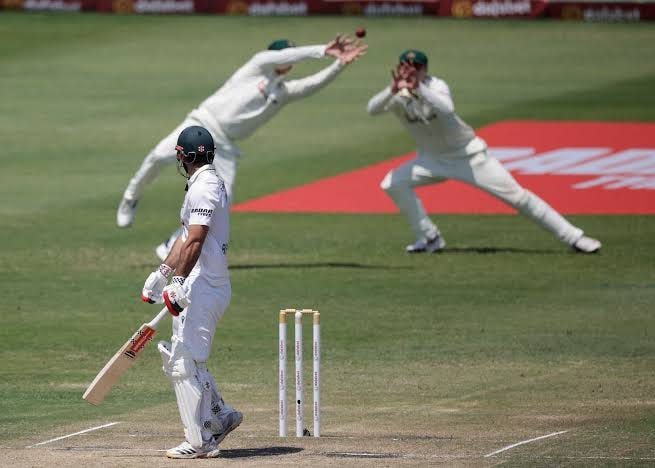
The Ball in Play

Steve Smith is about to catch David Bedingham, who has played an ill-advised back-foot drive, for one of his four catches, three of them brilliant, which gave him the world record for the most outfield catches – 223.

Absorbing intensity and assessing the situation were the two key phrases used by Proteas batting coach Ashwell Prince at the end of the third day of the first Test against Australia at Kingsmead on Sunday.

It was a day which ended with Australia leading by 139 runs with all 10 second-innings wickets intact. That fact alone suggests things did not go well with the bat for South Africa, who had begun the day on 27 for one in reply to Australia’s 390.

While it may seem appropriate to blame the bowlers for allowing the tourists to score so many first-innings runs, having been 124 for six at one stage, Australia’s revival was down to the conditions easing and the brilliance of Matt Renshaw in scoring a career-best 190 which was the epitome of patience and good judgement.

So the template for success with the bat was there, plain to see, and South Africa’s batsmen had seen it up close for the whole of the second day as they toiled in the field under clear blue skies and a north-easterly wind: Leave well, stick to safe shots that fit your game plan and make the bowlers bowl to you.

But the Proteas top-order ignored what had been in plain sight and tumbled to 284 all out. The fact that their first innings made it that far – a deficit of 106 – was thanks to partnerships of 52 for the ninth wicket between Simon Harmer and Keshav Maharaj (34) and 35 for the last wicket between Harmer (35*) and Anrich Nortje (16).

Those two last partnerships showed up the proper batsmen for their lack of composure and indicated that there were no demons in the Kingsmead pitch. The north-easterly blew again and batting should have been a pleasure. The pace and carry were true, the new ball moved around just a bit and off-spinner Nathan Lyon obtained bounce but not much turn.

Australia bowled full lengths at the start of the day, looking for swing with the ball being nine overs old, and Aiden Markram and David Bedingham capitalised with a series of handsome drives.

They put on 84 for the second wicket in an hour-and-a-half and all seemed right with the world.

But Australia, who have undoubtedly played smarter cricket than the hosts, then switched to back-of-a-length bowling, plugging the line just outside off-stump. Markram fell for 37 trying to punch Mitchell Starc off the back foot through the covers with little footwork; Bedingham did much the same on 49 to give Pat Cummins his first wicket. The back-foot drive is a difficult stroke to play on a pitch renown for the bounce it offers.

Lyon and Starc bowled particularly well to Proteas captain Temba Bavuma, who could only score three runs off 26 balls. And so he tried to relieve the pressure through a reverse-sweep, which was a reasonable option. Except when Steve Smith is at slip and, in a moment of brilliant anticipation, he moved rapidly into the likely path of the ball and made the catch.

Bavuma could maybe be sympathised with, but when Kyle Verreynne (13) did exactly the same thing two-and-a-half hours later, it seemed awfully naive and foolish, notwithstanding the psychic Smith making a sensational one-handed grab.

That was the most frustrating aspect of the Proteas’ batting display, their complete failure to learn from what had happened before. Renshaw had been widely praised for leaving so much during his epic innings; South Africa’s batsmen flashed with abandon outside off-stump.

Cummins then devoured the middle-order as both Wiaan Mulder (30) and Tristan Stubbs (32), who had combined promisingly for a 56-run fifth-wicket stand in just over an hour, tried to hook well-directed bouncers in that off-side channel. Not taking the bait would have been a far better option.

Marco Jansen lifted the mood briefly with six fours in a 26 off just 20 deliveries with powerful pulls and classy drives down the ground. But then he too picked the wrong delivery to attack. Josh Hazlewood hit the deck hard and bowled a straight line, cramping Jansen, who still tried to clear mid-on but with a more vertical bat, only managing to sky the ball to mid-off.
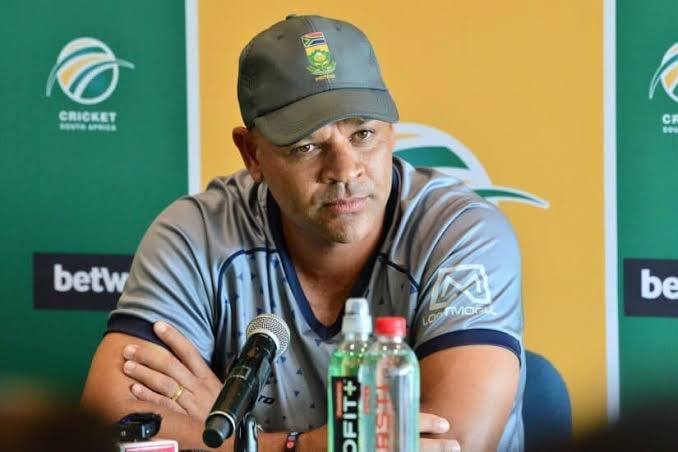
Ashwell Prince in serious mood trying to explain the Proteas’ batting woes.

Ashwell Prince is the batting coach of the Proteas and the man who shored up their middle-order in the 2000s was careful to tread gently as a guardian of his charges.

“I don’t think there was too much aggression, it was more the timing of the dismissals, which kept hurting us. Everyone has their individual approaches and we’ve talked a lot about playing positively and being on the front foot.

“In the subcontinent we played spin well and all the sweeps are options there. As long as the guys have been training them and playing them well, then you can accept it when they get out to one. They were a couple of blinders by Steve Smith.

“It was a really good innings by Renshaw and he deserves a lot of credit. He was very patient and he took the approach of wearing the bowlers down. Everyone has their personal approach and some are more aggressive, they go after their shots more and sometimes it does not pay off.

“There’s lots to take away from today, probably the biggest learning is that the make-up of the Australian attack means they are heavily dependent on three seamers and they have a classy spinner, they come at you with a certain intensity, but that can only last for so long. Sometimes you have to absorb intensity, because it can only last so long.

“The pitch so far has been pretty good and most batsmen feel that they can play more strokes. The ball seemed to come on better today, the bounce was consistent. You could trust the bounce and pace, so the confidence is there.

“Maybe we need to be better at sensing the intensity of the bowlers and assessing the situations. Pat Cummins is astute and when he feels they have a sniff, he pushes his fast bowlers. Just when it looked like a partnership was going to wrestle the advantage our way, a wicket would fall. Every time that would energise them and the bowlers would come again,” was Prince’s carefully considered, diplomatic response.

Australia came out to bat for 25 minutes before bad light stopped play and their dominant position allowed them to be aggressive. Nic Maddinson, who had made a 33-ball duck in the first innings, shook off the pressure of being a controversial selection and hooked his first ball from Marco Jansen for four.

The comeback man added one more four and a flick for six over midwicket to reach 17 not out off 19 balls at stumps, with Travis Head on 10 not out off 15 deliveries, out of a total of 33 without loss.

Prince believes they will bring the same aggressive approach on the fourth day.

“Tomorrow we’re going to see a lot more of the same approach, they’re going to come out with a lot of aggression to try and make up time and stretch their lead as much as possible,” he said.

South Africa will need to try and prolong the amount of time Australia spend at the crease, to make their task of saving the match an easier one. To do that, Prince says they will need to attack rather than defend.

“Taking wickets will be our best approach, while trying to control the run-rate at the same time. In the first innings, Australia made a big total, but they scored it at 2.8 runs-per-over. It’s a different scenario now that they are over a hundred ahead and they can take more risks.

“So we have to be positive, we’ll probably see more spin tomorrow and some innovative field placings to put the ball in their court,” Prince said.

Innovative is one thing, but what the Proteas most require is smarter cricket.

Prince on the attack as problems mount at Newlands 0

Posted on April 06, 2020 by Ken

Cape Cobras coach Ashwell Prince said on Monday that he would prefer to attack the reasons for players going overseas at the next Cricket South Africa Coaches’ Conference but he was happy to firmly back the expansion of premier domestic competitions to 12 teams, saying this would provide more playing opportunity.

The Cobras had already lost talented young batsman David Bedingham to a Kolpak deal mid-season, but the end of the summer has brought the confirmation that senior bowlers Dane Paterson and Dane Piedt are also no longer going to be based at Newlands but will be plying their trade overseas.

Paceman Paterson, who played in South Africa’s final Test of the season, against England at the Wanderers, is also heading to England on a Kolpak deal, while off-spinner Piedt is breaking new ground in playing in the United States.

“They were key bowlers in our attack and we will miss them as leaders. Each case needs to be treated individually and when you’re over 30, especially as a bowler, I’m sure you calculate whether you have a realistic chance of playing for the Proteas.

“But other factors also play a role in guys leaving, but we always talk around them and we don’t deal with them,” Prince said on Monday.

When asked what these ‘other factors’ are, Prince said he would prefer to raise them at the Coaches’ Conference rather than elaborate to the media.

“I have mentioned them before at the Coaches’ Conference and CSA are well aware of them. I believe that’s my platform. We’ve got to get the system operating the best we can, if we can improve it it’s important we identify those areas. I tend to make my feelings heard and I hope the committees considered what I said,” the outspoken former Proteas batsman said.

Prince was more forthcoming when it came to his views on the present franchise system, with six teams still playing in the premier competitions next season but with a reduced number of fixtures.

“The sooner we get to a system that we can have for 10-20 years the better. I’m not convinced by this makeshift plan, although I know it’s based on finances. But we need to get the system fine-tuned so it can last for the next 10 years.

“I’m a firm believer in going to 12 teams, having played in England, where it works, and in South Africa before the franchise system.

“All the smaller provincial teams [barring North-West and Border] have won trophies, they produce talent and they can be competitive. It will get people playing more regularly; at the moment far too many cricketers don’t play regularly at the top level.

“I’m a big fan of opening up the system and more people getting opportunity. For example, a young batsman like Isma-eel Gafieldien, who made lots of runs for Boland, could play a full season with them rather than just having one or two matches for the Cobras. The game is the best teacher rather than just going to training. You learn far more in the heat of the moment.

“Places like Easterns produced Andre Nel, Andrew Hall and Zander de Bruyn, who all played for the Proteas. Border had Pieter Strydom, Steve Palframan, Makhaya Ntini and Mark Boucher. Boland has produced plenty of Proteas – guys like Henry Williams, Roger Telemachus, Henry Davids, Justin Ontong and Charl Langeveldt. These so-called ‘smaller’ provinces have talent and they will produce players for the country. And there’s nothing better for them than playing at a higher level,” Prince said.

Given the emergence of such quality talent as Kyle Verreynne, Janneman and Pieter Malan, Bedingham, Nandre Burger, Zubayr Hamza and George Linde, the 2019/20 season promised much for the Cobras.

But it ended in anticlimax with Prince’s charges finishing last in both the 4-Day Franchise Series and the Momentum One-Day Cup.

To add to the coach’s problems, he has lost nine of the 18 players contracted for last season as well as both nationally-contracted stars in the retired duo of Hashim Amla and Vernon Philander.

In terms of acquisitions, former Titans batsman Tony de Zorzi, who averaged over 45 in both competitions last season, is probably the most exciting.

The likes of Corbin Bosch, Tshepo Moreki, Onke Nyaku and Calvin Savage all have talent, but they all struggled to pin down regular places at their former franchises.

“I’m extremely excited about the players we have. In the bowling department we have more experience now in white-ball cricket which is obviously the area that needed strengthening. We’ve been more competitive in four-day cricket lately.

“The guys who have stayed are our core, they were predominantly starters in most competitions. We just had to make sure we secured good depth because we expect national call-ups. It’s obviously exciting to have those, but they hurt us last season – missing four key one-day players had a major effect.

“But to be honest this transfer window has been a bit of a nightmare with 100% of players’ contracts ending. It became a free-for-all with players just going to the highest bidder. And CSA have said that from May 1 we can give eight players two-year contracts, which means next year it’s going to be another free-for-all for the other 10 players. It will be even more of a bunfight if we go to 12 provinces,” Prince said.

Cobras 2020/21 squad – Ziyaad Abrahams, Jonathan Bird, Corbin Bosch, Nandre Burger, Tony de Zorzi, Isma-eel Gafieldien, Zubayr Hamza, George Linde, Pieter Malan, Janneman Malan, Imraan Manack, Aviwe Mgijima, Akhona Mnyaka, Tshepo Moreki, Onke Nyaku, Calvin Savage, Jason Smith, Kyle Verreynne.

De Villiers’ 99 frustrates Sri Lanka 0

Posted on December 16, 2011 by Ken

AB de Villiers fell irritatingly short of a century but put South Africa in a commanding position after the second day of the first test against Sri Lanka at Centurion on Friday.

    De Villiers scored 99 as South Africa, replying to Sri Lanka’s first innings of 180, amassed 389 for nine for a lead of 209 runs.

    The 27-year-old had just driven seamer Thisara Perera straight down the ground for four to go to 99, but much to his ire, he cut the next delivery, which was short and wide, low to backward point, where substitute Dimuth Karunaratne dived forward to take a good catch.

    De Villiers showed great determination and concentration in his 135-ball innings that was studded with fine strokeplay that brought him 12 fours.

    Ashwell Prince and Mark Boucher, both under pressure to keep their places in the team, were also able to rise to the occasion as South Africa’s lower-order more than doubled the score after they were struggling on 173 for five.

    Prince scored 39 before he edged medium-pacer Angelo Mathews to wicketkeeper Kaushal Silva, but the left-hander could consider himself fortunate to have survived two dropped catches. Prince was dropped by Perera, diving forward in the gully, off Dilhara Fernando on 23, and by Silva off left-arm spinner Rangana Herath when he had 26.
    Boucher finished the day on 49 not out, helping himself to six fours in a confident innings that has eased the pressure on the veteran wicketkeeper/batsman.

    Last man Imran Tahir batted with cavalier disdain for the bowlers and stayed with Boucher for the last 38 minutes before stumps, making his highest test score of 24 not out as they put on 39 for the 10th-wicket, extending the lead past 200.

    Sri Lanka’s attack had bowled with perseverance but little penetration as they failed to obtain the same assistance from the pitch that the South African bowlers had.

    Perera was the most succesful bowler with three for 114 in 24 overs.
De Villiers and Prince combined in a sixth-wicket stand of 97 to take South Africa into a handy lead.
The pair rescued the innings against a probing Sri Lankan attack which had reduced South Africa to 173 for five shortly after lunch.
Left-arm paceman Chanaka Welegedara removed Jacques Kallis for 31 in the fourth over after lunch, his first from the Hennops River End. South Africa’s leading run-scorer drove at a delivery that pitched on off stump and was moving further away from him to edge a tumbling catch to Mathews at third slip.
De Villiers took no risks, pushing singles through the off side but punishing any poor deliveries on the leg side.

    Prince was off to a quick, if streaky, start, collecting four fours, all of them to the third man boundary, off 98 balls.

    A top-class spell of seam bowling by Perera had earlier allowed Sri Lanka to restore a semblance of parity as South Africa reached 168 for four at lunch.
South Africa had resumed on 90 for one, but made a poor start to the day when nightwatchman Dale Steyn was run out for a duck in the second over of the morning.
Steyn fended a lifting delivery from Welegedara away on the leg-side and there was confusion between him and Jacques Rudolph, allowing Rangana Herath at mid-wicket to score a direct hit on the stumps.
Rudolph and Hashim Amla (18) added 35 for the third wicket, but the Sri Lankan bowlers kept plugging away and Perera reaped the reward.
Bowling a consistent line and length outside off stump, Perera found the edge of Amla’s bat and Mathews took a fine diving catch at third slip.
Opening batsman Rudolph, battling the pain of a dislocated little finger on his left hand, showed tremendous determination in a 228-minute vigil at the crease, but Perera ended his resistance on 44, nipping away a delivery that found the edge and travelled low to Tharanga Paranavitana at first slip.
Kallis’s 56-ball stay was not without incident.
He ducked into a bouncer from fast bowler Fernando and was struck a disorientating blow on the earpiece of his helmet. Kallis received treatment for seven minutes before resuming his innings on 25 and was lucky as he prodded at the first delivery of Fernando’s next over and edged a catch which diving wicketkeeper Silva should have taken.


↑ Top