for quality writing

Ken Borland


IPL adds to global pandemic for SA scheduling woes 0

Posted on August 03, 2020 by Ken

As if the global Covid-19 pandemic has not disrupted the international cricket calendar enough, the Indian Premier League has now moved to September, which Cricket South Africa Director of Cricket Graeme Smith said has put paid to any hopes of the Proteas being in action before November.

South Africa were scheduled to play series against the West Indies and Sri Lanka before summer, but Smith admitted at the weekend that those commitments were now on the back burner. The IPL, meanwhile, has taken advantage of the ICC T20 World Cup in Australia being postponed until next year, and will be held in the UAE, starting on September 19.

South Africans scheduled to play in the IPL include Imran Tahir, Faf du Plessis and Lungi Ngidi for Chennai Super Kings, AB de Villiers, Chris Morris and Dale Steyn are in the Bangalore Royal Challengers squad, while Kagiso Rabada is contracted by the Delhi Capitals and Quinton de Kock is on the Mumbai Indians roster.

“The West Indies tour has been postponed indefinitely because now we’re struggling with the IPL – it looks like our players will be needed there at the beginning of September. We also don’t know when the Sri Lanka tour will be able to take place and in terms of the national women’s team, we are working on getting government permission for their tour to England next month.

“Hopefully November is going to be a very busy time for the national team, hopefully we can cram in all the tours we’ve missed out on, if all goes well and we get things up and running by then,” Smith said.

Faced by a barrage of criticism from certain sectors of the Black Lives Matter movement, Smith said he accepted the position of director of cricket in December in order to restore the reputation of the Proteas, who he previously led to the number one ranking in all formats. The 39-year-old reaffirmed his commitment to seeing that through.

“I was sad to see South African cricket fall from its perch, that’s why I got involved. Back in December it was absolute chaos in South African cricket, there was zero trust between anyone. I wanted to be part of the solution and now that it’s feeling chaotic again, you keep revisiting that. The narrative that a clique has taken over is really unfair and I did not appoint myself.

“I went through a rigorous interview process, led by mainly Black African people, and then I made a number of appointments in December – Volvo Masubelele as manager, Justin Ontong, Charl Langeveldt, Mark Boucher, Enoch Nkwe and the medical staff. The appointment of Paul Harris as a consultant was made around Keshav Maharaj’s request and Jacques Kallis was an interim consultant, he has not been on CSA’’s payroll for many months. But we would be stupid not to involve one of the most successful batsmen in the world,” Smith said.

Smith said he was not invited to the inaugural Social Justice and Nation-Building meeting that arose from the BLM movement, but he hoped to be involved going forward. He said it was crucial to co-operate with Black players in order to ensure they could be comfortable in the Proteas environment.

“We want to create a better environment going forward, we’ve got to create a culture in which everyone feels safe to talk. I was most surprised that the players did not feel they had a voice in the past. Hopefully CSA will involve us in the Social Justice project now after the Board asked us not to be part of the first one. We should all want to be part of the solution. “I was very taken aback by the Makhaya Ntini stuff. I never thought of him as being the silent type when I first came into the Proteas team, he was one of the senior players, and he gave me a different explanation for running to the ground and not coming on the bus. But as the only Black African it must have been tough for him and it’s important that nobody else feels that way,” Smith said.

Players to get 1st sip of 3TCricket tomorrow; Toyana says pre-game tactics only the tip of the iceberg 0

Posted on July 16, 2020 by Ken

Geoff Toyana will give his Eagles team his usual shrewd strategic input before the game but the veteran coach knows that the nature of 3TCricket is such that that will only be the tip of the iceberg and captain AB de Villiers will need to be at his sharpest and most flexible if they are to win Saturday’s inaugural unveiling of the new format.

The country’s best 24 available cricketers will return to action in a SuperSport Park bio-bubble and the beloved game will return to our television screens on Saturday in a fundraising match for the cricket industry’s hardship fund. But it will be a version of the sport never seen before as three eight-member teams will battle it out at the same time, each batting for 12 overs in six-over blocks against each of their opponents.

The Eagles, Kingfishers and Kites will get their first sip of 3TCricket on Thursday when they play a practice match, but Toyana is already certain that captains will play the leading role. He has full confidence in his skipper, former Proteas captain De Villiers, who will lock horns with current national limited-overs captain Quinton de Kock (Kites) and ace fast bowler Kagiso Rabada (Kingfishers).

“It’s something new for all of us and we are still finding our strategy, tomorrow [Thursday] is the perfect opportunity to test things out and also sharpen up on the rules. There’s not just one opponent to worry about now but two and you need to be smart in terms of who bowls against who, each bowler only gets three overs, so do you bowl say Lungi Ngidi for two overs against the first team or against the second side?

“There are going to be headaches like that and the last man stands rule in batting is also very exciting. I think the captain is going to be the big player and he needs to get his tactics spot-on. He’ll have to really think on his feet, but fortunately AB is really positive and passionate about this. And he’s hitting the ball extremely well, as good as I’ve ever seen him hit it in fact,” Toyana told The Citizen on Wednesday.

While the Covid-19 restrictions will rob the match of some of its joy, Toyana said the players are all delighted to be playing cricket again.

“It’s just a really good thing to be back on the field again, the sun’s shining and we had really good training. Rassie van der Dussen is also looking good although he keeps wanting to bowl, Andile Phehlukwayo had a good hit too and Bjorn Fortuin was in his element. Lungi Ngidi and Junior Dala have been hard at work here at the Titans for the last two weeks and they are very excited too.

“We will have to observe social distancing of course and there are some strange red lines on the field. Plus the players all use their own balls, which makes it tricky for the coach because you hit one to a player and he ignores it because it’s not his ball! But these are tough times, it’s a charitable cause and the guys all just want to help out,” Toyana said.

Originally, Proteas white-ball spinner Tabraiz Shamsi was the only slow bowler named in the squads, but Highveld Lions star Bjorn Fortuin has subsequently replaced Sisanda Magala, who has pulled out due to a family bereavement. Judging by how spinners were fatally under-rated when T20 first came along, not having a frontline spinner could hurt the chances of the Kites, although Jon-Jon Smuts is far from a part-timer.

“I think this game will be good for spinners as well and I’m glad we’ve got one. And Bjorn is one of the best in the country at controlling the field, we could even use him up front against certain batsmen,” Toyana said.

Future of SA cricket obviously gloomy – Dien 0

Posted on April 30, 2020 by Ken

South African cricket was obviously already in troubled financial waters before the Covid-19 pandemic struck, but outgoing Cape Cobras chief executive Nabeal Dien on Wednesday gave a gloomy forecast for the future of the game over the next couple of years in this country.

Dien is retiring after being at the helm of cricket in the Western Cape since February 2015 and he admitted to some relief that it won’t be his responsibility to negotiate one of the biggest franchises in the country through the coming turmoil as the game looks to recover from their governance scandals as well as simply just trying to get back on to the field again.

“It’s important not to lose sight of the fact that Cricket South Africa was already in dire straits and already talking about making cuts, and all that will obviously be exacerbated due to the virus. The game will have to reinvent itself with the money and resources we have left. It’s going to take a collective effort for us to survive and remain competitive.

“If not much has changed by June/July then we run the risk of not playing at all for the rest of this year, only starting cricket again in January next year. I’m sure that there will then be a flood of members and suite-holders wanting to withdraw. And it would be a huge challenge to play without spectators because it costs money just to host a game and that revenue has to be offset from ticket sales.

“At the moment, CSA just gives us hosting fees, which isn’t enough to cover costs, so we supplement that with our 40% share of ticket sales. To now also have to pay for thermometers, sanitisers, washing of the stadium, will require a rethink. I think this whole situation is going to take away a lot from what it means for us to go and watch cricket,” Dien said on a conference call from Cape Town on Wednesday.

Dien also said he supported a new playing structure in which the 12 provinces would be divided into two pools with promotion/relegation. That would mean teams like Border and Northern Cape, who come from historically economically depressed areas, trying to compete on the same playing field as franchises like the Cobras, Lions and Titans, who come from the major city centres. Dien said he nevertheless expected them to be competitive.

“I unashamedly support going to 12 teams but it’s important to have an A and B Section with promotion/relegation, for the four-day and one-day cricket. I think this has been accepted as the way forward, the Members Council have agreed in principle, but with Covid-19 we don’t know if there will be further changes. The Mzansi Super League will continue but will be different, with the six local franchises plus two new teams based in Free State and Border.

“There’s always this debate around transformation and playing opportunities and having 12 teams will resolve that. It’s up to the affiliates to be competitive and there should be better rewards for the top six. Players will also gravitate towards the top six and the people who run the bottom six teams must do their work, especially in terms of younger players, they will need a vibrant academy system,” Dien said.

CSA announced at the end of March that the six franchises would still compete in 2020/21, playing in two groups, with four home-and-away matches in their own pool and three cross-pool matches, before a final between the two group winners.

Pilanesberg National Park 2

Posted on May 12, 2019 by Ken

A wonderful Leopard sighting near Kubu Dam

A wonderful Leopard sighting near Kubu Dam

Being in the bush and birding is always such a special time for me, real soul-food, and a time of replenishment before heading back into the hectic ‘real’ world. So I have a small obsession about what my last sighting is, always wanting to end on a high note, preferably with something exotic, something I don’t see every day in my garden.

It is also a source of motivation to stay sharp and keen-eyed at the end of what are normally long, hot days in the bushveld.

Pilanesberg National Park may be one of the most popular reserves in the country and is attached to a tourist hot-spot in Sun City, but it is Big Five country and genuine bushveld. It has a ruggedness about it with its hills lying at angles (after the massive volcanic eruptions that shaped the landscape), its rocky outcrops and the densely-wooded gorges where few people would have ventured.

It is normally also blisteringly hot in summer but this October day had been pleasant: a beautiful sunny day with barely a cloud in the sky and a lovely cooling breeze. The temperature did not get above 31 degrees.

I had concentrated my efforts on the southern half of the park, doing a half-circle from KwaMaritane to Bakubung, and I was 10 minutes from the exit gate when sighting number 53 appeared – a pair of Common Mynahs flying along!

These aliens are all over our towns, cities and neighbourhoods and are considered a scourge in our wild places, like game reserves. So you can imagine my dismay at the very real possibility now that this invasive would be my last sighting of the day … Oh, the horror!

But this was a happy day (it had included a Leopard sighting next to the road) and Mother Nature was kind to me.

Just when I thought the Mynahs would be my last bird, a magnificent pair of Violeteared Waxbills popped up in the bush next to me on the side of the road!

Now these waxbills are really exotic-looking with their incredible combination of violet, red, bright blue and chestnut colours. It is one of my favourites, not only because it is exquisite but also because it eluded me for many years before my first sighting. I even had to put up with my birding colleague Stidy seeing it as a passenger in my car while I dipped on it!

It would have been a dream last bird, but Mother Nature had another trick up her sleeve for me. At Bakubung Gate, amongst the buildings – which I guess make fairly authentic copies of the boulders found on the koppies that are normally their home -were a pair of Mocking Chat.

I had no problem with these cute, somewhat mischievous birds being my last sighting. They are real characters and I watched them a bit before finally departing the peaceful, but wild, hills and valleys of the Pilanesberg.

I was still buzzing though from my Leopard sighting, which had been in the vicinity of Kubu Dam, just before I turned west off the tar and on to the Kgama Drive that goes past Lengau Dam and then rejoins the tar just before the Bakubung Gate.

The Leopard was lying with typical insouciance under a shady bush, about 20 metres from the road, but quite hard to see due to the combination of dappled light and the rosettes on its body. What a gorgeous young specimen it was though.

The insouciant Leopard

The insouciant Leopard

While the Leopard was, typically, a loner, there were lovely family sightings of 10 African Elephant marching along the flanks of the Magare Hills, away in the distance as the Tsepe Drive turned to the north-west, having skirted along the south-eastern border of the park for nearly 10km from the KwaMaritane entrance.

It was also most pleasing to see three different family groups of Squarelipped Rhinoceros, numbering 10 in all of these critically endangered animals.

The group theme had started at the beginning as I entered KwaMaritane gate and was immediately bombarded by three Blackchested Prinia dashing around and calling loudly in some sort of furore.

Two Greater Kudu youngsters down by the Maritane River were much more peaceful, and some Little Swift were also swirling around merrily, without a care in the world.

Blackcollared Barbets are normally seen amongst the trees at the picnic sites, so it was nice to see one at the hills and plains of the Tshepe Drive. Further down the road, a Kalahari Robin was conspicuous as it posed on top of a bush, behaving more like a Chat. Which is not surprising because the Scrub Robins (Genus Cercotrichas) are in the same Subfamily – Saxicolinae – as things like the Familiar and Mocking Chats, both characteristic birds of the Pilanesberg.

Close by, a juvenile Blackshouldered Kite was also posing nicely on top of a tree,

Juvenile Blackshouldered Kite

Juvenile Blackshouldered Kite

while both Redfaced and Speckled Mousebirds were in close proximity to each other as the Tshepe Drive crossed the Mankwe River, where, as is often the case, a purposeful Cape Wagtail was doing a thorough inspection.

The Lengau Dam was hosting a big flock of Sacred Ibis, and there were also Redbilled Teal, which I have only seen infrequently in the Pilanesberg.

Where is Pilanesberg National Park?

Sightings list

Blackchested Prinia

Greater Kudu

Little Swift

Blue Waxbill

Blackcollared Barbet

Neddicky

Kalahari Robin

African Elephant

Sabota Lark

Blackshouldered Kite

Rattling Cisticola

Grey Lourie

Redfaced Mousebird

Speckled Mousebird

Cape Wagtail

Cinnamonbreasted Rock Bunting

Glossy Starling

Southern Yellowbilled Hornbill

Southern Yellowbilled Hornbill

Southern Yellowbilled Hornbill

Blackeyed Bulbul

Impala

Marico Flycatcher

Blue Wildebeest

Helmeted Guineafowl

Giraffe

Redbilled Oxpecker

Natal Francolin

Capped Wheatear

Springbok

Pied Crow

Squarelipped Rhinoceros

Lesser Striped Swallow

Common Waxbill

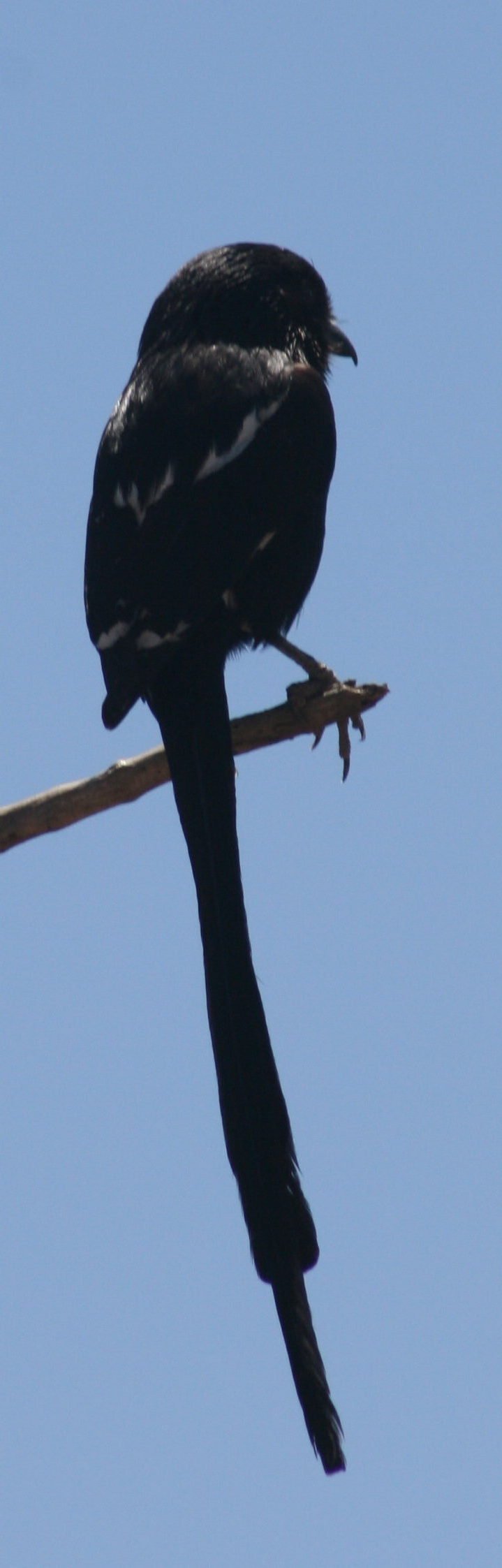
Longtailed Shrike

Longtailed Shrike

Arrowmarked Babbler

Whitebreasted Cormorant

Reed Cormorant

Southern Masked Weaver

Blackbacked Puffback

Laughing Dove

Great White Egret

Browncrowned Tchagra

Warthog

A Warthog strolling along

A Warthog strolling along

Leopard

Familiar Chat

Plains Zebra

Waterbuck

Blacksmith Plover

Redbilled Teal

Dabchick

Sacred Ibis

Egyptian Goose

African Darter

Common Mynah

Violeteared Waxbill

Mocking Chat

  • Recent Posts

  • Archives

  • Thought of the Day

    Revelation 3:15 – “I know your deeds, that you are neither cold nor hot. I wish you were either one or the other.”

    How can you expect blessings without obeying?

    How can you expect the presence of God without spending time quietly before him?

    Be sincere in your commitment to Him; be willing to sacrifice time so that you can grow spiritually; be disciplined in prayer and Bible study; worship God in spirit and truth.

    Have you totally surrendered to God? Have you cheerfully given him everything you are and everything you have?

    If you love Christ, accept the challenges of that love: Placing Christ in the centre of your life means complete surrender to Him.


↑ Top