for quality writing

Ken Borland


Close encounters on the Kransberg 1
Posted on April 27, 2018 by Ken


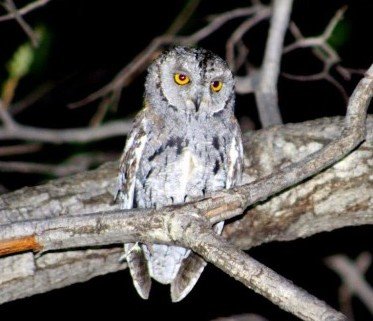
An African Scops Owl comes to visit our campsite

An African Scops Owl comes to visit our campsite


by Anthony Stidolph


I am, by nature, a wanderer. For me there is nothing quite like the thrill of departure, the joy of being on the road again, of heading off to remote and cut-off places.

As an antidote to this restlessness I have travelled the length and breadth of South Africa searching out new places I can claim as my own. In recent years this has involved launching several expeditions up to the Limpopo, along the way taking in Punda Maria and Pafuri in North Kruger, Mapungubwe, Ratho on the Botswana border,  Hans Merensky on the Groot Letaba, the forests of Magoebaskloof, parts of the Soutspanberg and that little-known gem, Blouberg Nature Reserve near Vivo.

Having explored and fallen in love with this sun-drenched landscape, my birding partner Ken and I recently took a notion to recreate these epic treks by heading back up there once again, only, this time, adding Marakele National Park, which would be new country for me.

A Tshwana word, aptly meaning “Place of Sanctuary”, Marakele falls within a transitional zone between the dry western habitat, made up mostly of Kalahari thornveld, and the typical bushveld country of the moister eastern sections of South Africa. It also lies within the Waterberg range of mountains, with an altitude ranging from 1050 metres on the plains to 2088 metres at its highest point.

Because of this broad range of vegetation types and its diverse topography the area boasts a wide variety of game (including the Big Five and Wild Dog) and an abundant bird life. Its biggest attraction, for birders anyway, is the around 800 breeding pairs of Cape Vulture which nest high up in the cliffs of the Kransberg

Arriving at the park, which is situated about twenty kilometres north of the old iron-ore mining town of Thabazimbi, we set up camp and then headed off on our first drive. I was immediately rewarded with my first lifer of the trip – a Greyheaded Kingfisher.

As we sat having a celebratory beer that night, listening to the clear, articulated noises of the bushveld at night, a tiny African Scops Owl landed on a branch above us and began its odd but strangely comforting, frog-like, “Prrrt…prrrt…prrrt…” call. This was more like it. My latest Excursion Into The Great Unknown had officially begun.
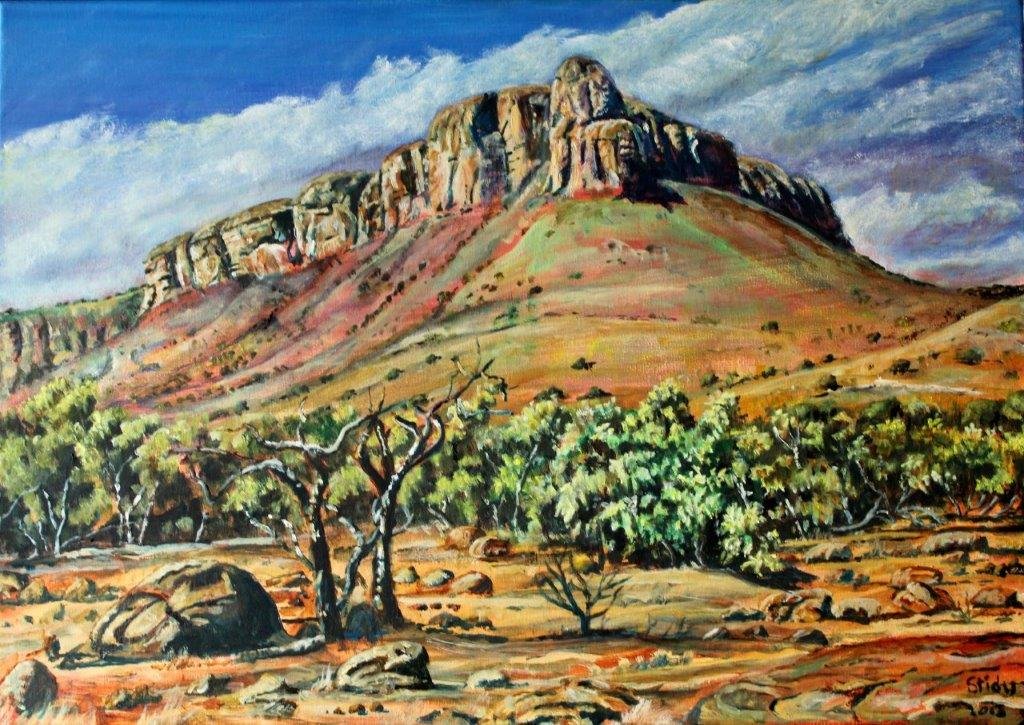
The Kransberg, Marakele NP

Anthony Stidolph’s painting of The Kransberg in Marakele National Park. For Sale – contact Stidy at stidy@sai.co.za (42×60)

The next day we were up at dawn and driving through heavy bush country towards the impressive pass that leads up to the top of the Kransberg mountain. A friend of ours had told us that her biggest concern going up this narrow, winding, precipitous road, was what she would do if she encountered another vehicle coming down the other way as there is little room to pass. That proved to be the least of our worries.

Rounding one steep-sided corner we suddenly found ourselves coming face-to-face with a young elephant bull that had stepped out on to the road. Having been in this situation many times before, Ken immediately pulled up short, stopping a sufficient distance from the animal so as not to make it feel threatened or think that we were encroaching on its space. It didn’t help.

Coming face-to-face with a wild animal so much bigger than yourself can be a slightly intimidating experience and this one decided to remind us of its size advantage. Without even affording us the courtesy of a warning mock charge, it let out an almighty bellow and came thundering down the road.

There was nothing to do but slam the car into reverse and head back down the road with me craning my head out of my window, shouting directions, while Ken did the same on his side.

The kilometre or so we drove in this manner was like a rapid ride through eternity. We kept hoping that each time we rounded a corner and the elephant lost sight of us it would lose interest. No such luck. The beast definitely did not like the cut of Ken’s jib and was determined to drive us clear off his mountain stronghold.

We went back down into the valley and somehow – and I shall never know how we did it – managed to do so without plunging down the mountain side or getting stomped on by the elephant. Once safely back on the flat we found a turning point, backed into it and sped off in the direction we had earlier come from.

A half-an-hour or so later we gingerly ventured back but, very bravely, decided to allow another vehicle – that had come driving up while we were parked on the side of the road observing, of all things, a Neddicky (the ultimate Little Brown Job), while considering the sagacity of continuing on our journey – go up ahead of us. Once we had seen they had safely cleared the ridge we sailed forth ourselves, this time, thankfully, unmolested.

At the top of this particular stretch the road evens out on to a trough through which you drive before getting to tackle the final, most spectacular, stage of the mountain. Here the road begins an even more torturous ascent. On the one side rise the naked sandstone towers of the Kransberg massif itself, weathered into the shapes of fantastical beasts and strange deformed reptiles. On the other side the slopes plunge steeply down into a treeless, meadowy grassland in which several more elephant and a herd of wildebeest were feeding.

As we advanced the road got narrower and narrower. What got us perspiring heavily all over again was that there were yet more fresh elephant droppings at regular intervals all along its surface, virtually to the top.

On the summit it was like another world. The view was colossal. Below us the mountain stretched away in every direction before dropping down, in a series of steps, to the plains, fading away into the blue distance.

Immediately in front was another castle-like knob, a labyrinth chaos of rock, fitted with clefts and chimneys. It was here the vultures nested. There were many of these large, endangered raptors wheeling gracefully above us, trailing their shadows on the ground beneath them.

The protea-covered hillsides on top of the mountain also provide a home for some other unusual species like the Gurney’s Sugarbird and the Buff-streaked Chat, birds which I more commonly associate with the Natal Midlands, where I live, and the foothills of the Drakensberg. Another occupant is the Kransberg Widow, a very rare and beautiful butterfly which puts in an appearance in November and early December and then, like Cinderella, sheds its finery and disappears. This is the only place in the world where it occurs.

We were reading all about the insect on a large information board they have erected up there, alerting us to its presence, when one came fluttering past. A few minutes later it came fluttering back again … and again. It may be scarce but it certainly wasn’t shy about showing off its beautiful cream markings.


A cold wind was blowing across the mountain top and a storm was brewing in the distance and so, after a warming cup of coffee, which we shared with a pair of very tame Cape Buntings and a cheery Mocking Cliff-Chat, we made our way back down the same twisting road, this time without having to face down any elephants with murder on their minds. Heading into camp I did, however, have another good sighting of two more Greyheaded Kingfishers, dive-bombing a family of Banded Mongoose.

Two days later, in Blouberg, I had an even better view of the kingfisher sitting at the end of a dead branch. This meant that after fruitlessly searching for the elusive bird for years I had now seen four in four days …

The grumpy pachyderm who had chased us down the Kransberg may have scared me witless, but I couldn’t help wondering afterwards if he hadn’t deliberately engineered the whole encounter just to make sure I kept running into the bird!


ANTHONY STIDOLPH


Where is Marakele National Park?


Sadness as two players leave the Springbok family 0

Posted on January 19, 2018 by Ken


Coach Heyneke Meyer likes to talk about the Springbok team as being a family, and there was sadness in camp on Monday when two players left the squad ahead of the Rugby Championship finale against the All Blacks at Soccer City on Saturday.

While Jacques Potgieter, who has an abdominal strain, was a fringe player, Francois Steyn is a key figure in the team, having played 53 Tests despite being just 25 years old, and a senior player.

But his departure from the squad to have ankle surgery is undoubtedly in the long-term interests of both the team and the player.

“Frans has quite a few loose pieces of bone in his ankle and every now and then one of them gets lodged in the joint, causing him excruciating pain. As a long-term solution, we’re sending him for surgery to have it cleaned out on Wednesday. Unfortunately that means he will be out for three months and he will miss the end-of-year tour,” team doctor Craig Roberts said.

Steyn might be missing out now, but the positive side is that he will be able to have a proper rest and pre-season conditioning before starting next year’s SuperRugby competition with the Sharks, hopefully in prime physical and mental state.

Sometimes an enforced break like this one can end up adding years to a player’s career and, as Roberts pointed out, the Springboks are looking for another 60 Tests from the utility back and he will be a vital figure in the 2015 World Cup in England.

A third player could well leave the squad on Tuesday, with prop Coenie Oosthuizen going to see a specialist in Durban about his neck injury. Meyer rushed the versatile Oosthuizen back into the team, naming him on the bench for the Test against Australia despite the 23-year-old having played just 35 minutes for the Free State Cheetahs since injuring his neck during his Springbok debut against England in June.

Sometimes players are rushed back into action too soon and it is a credit to Roberts that he managed to convince Meyer to pull Oosthuizen from last weekend’s game; the team doctor clearly has doubts that the prop has fully recovered.

“Again, we want to ensure we make the right long-term decision and I’m not happy with his neck; he still has some quite significant symptoms, especially stiffness,” Roberts said.

Both the Springboks and All Blacks are coming off impressive weekend victories, setting up another titanic clash between the two great rivals at the iconic stadium in Soweto. New Zealand may have already clinched the inaugural Rugby Championship title, but there is no doubt they will be up for the game against the old enemy.

Apart from notching another victory on South African soil, they would also love to complete the year unbeaten and stretch their winning run to 16 matches dating back to the start of their triumphant World Cup campaign.

“We’ve won the Rugby Championship, but we’ve parked that and we’re now focused on winning in South Africa. If you talk to the older guys, they’ll tell you it’s more rewarding winning here than beating the Springboks at home. The guys that have been around a while really love testing themselves against the best here; it’s one of the toughest places to win,” loose forward Sam Cane said on Monday.

Lock Sam Whitelock also stressed the importance of Saturday’s game.

“It’s really nice that we’ve put the trophy away, but this weekend will be a massive challenge. It would be great to start off a new competition with a clean sweep.

“Last year didn’t go so well for us in Port Elizabeth and South Africa is always hard to beat at home. But that’s the beauty of international rugby; you have to perform week in and week out. All you need is one game to not go well and everything can unravel very quickly,” Whitelock said.

The great rivalry between the two sides will be exemplified in the tremendous physicality of Saturday’s Test, with the Dunedin match two weekends ago being widely proclaimed as a coming-of-age performance by the youthful Springbok pack.

“The Dunedin game was a typical All Blacks/Springboks Test, with massive body collisions. It was quite tight and it took a while for either side to win any dominance. I’m sure it will be the case again this week and the body will take a bit of a hammering,” Whitelock said.

The Springboks are obviously not going to make the same mistake that Argentina did in trying to match the expansive, fast-paced game of the All Blacks.

“Playing at home, there’s always more pressure to run the ball, but that’s what New Zealand likes because it gives them turnovers and they punish you. You will never beat New Zealand at their own game, you’ll never out-run them. You have to put pressure on them, especially at the breakdown, in defence and with your kicking game,” Meyer said.

The Springboks are well positioned to do this if they can produce a repeat performance of their Loftus Versfeld heroics against the Wallabies.

For all the elation of the five tries scored, it was a top-class defensive effort in the trenches that set up a morale-boosting win.

“It was a good performance, definitely the most satisfying of the year, and our defence was also the best it’s been the whole year. We made 178 tackles compared to their 109, and we had a 96% completion rate, we only missed seven tackles. Plus we only had 45% possession,” Meyer said.

A win over the in-form world champions would ensure Meyer gets a positive review after his first year in charge.

https://www.dailymaverick.co.za/article/2012-10-02-rugby-tough-calls-for-the-springboks/#.WmHcfK6WbIU


Caution as dead as a dodo for aggressive Titans 0

Posted on November 10, 2017 by Ken

The days of being cautious with the bat in limited-overs cricket are as dead as the dodo for the Multiply Titans, with captain Albie Morkel saying he wants the batsmen to take their aggression to another level when the RamSlam T20 Challenge gets underway on Sunday.


The Titans won both white-ball titles last season, in no small measure because they took their batting to a new level never before seen in South African domestic limited-overs cricket.


The Titans reached 400 on three occasions in last season’s 50-over competition, the Momentum One-Day Cup, including a record-breaking 425 for five in the final against the Warriors at SuperSport Park. In the T20 tournament, the Titans went past 180 on four occasions, including another domestic record in lashing 230 for five against the bizhub Highveld Lions, in Centurion.


Those exploits were made possible by the flying starts given to the Titans by mostly Aiden Markram, Jonathan Vandiar and Henry Davids; with openers averaging well above 50 and scoring at better than a run-ball, the batting unit is always likely to soar to great heights.


“The batsmen must keep playing with freedom and flair. If conditions allow it, then we’ve set ourselves the target of a score of 200 for every innings, we want the batsmen to go a step further, to provide extra impetus. To get 180 is also good, but then you can still fall short,” said Morkel.

“In the 50 overs competition, we passed 400 three times and that doesn’t happen by chance, it comes because the batsmen are encouraged to be aggressive. Batting deep is also important and having guys in the middle who can hit boundaries.”


The Titans start the defence of their title against their neighbours from Johannesburg, the Lions, at SuperSport Park on Sunday, November 12, as the main attraction of a double-header also featuring the WSB Cape Cobras against the Hollywoodbets Dolphins. Morkel’s team also scored 194 for four in their game against the Lions at the Wanderers, on their way to a 42-run win.


With the Titans producing such entertaining, winning T20 cricket, the hour is now to make plans to watch their campaign for a hat-trick of titles. To make attending their games even more attractive, a number of Proteas stars will be playing.


“We didn’t win the last two competitions by chance, we have a recipe that has proved itself, although there are always small things we can improve on. It’s always nice to start a new competition with some sort of momentum and most of the guys have put in good performances to go to the top of the Sunfoil Series log.


“We’ll have a few players from the Proteas as well and we’ll be able to put good sides out on the field again, guys who know how to play T20 and how to play the big moments. Form is very important, but so too is the team gelling together.


“We would now rather rotate players than loan them out, but we have to be mature about it and by the knockouts we should know who the guys in form are. Until then we need to do the basics right, you can’t overlook how important small things are, every ball is an event,” concluded Morkel.

http://www.titans.co.za/index.php/k2-8/2014-12-23-04-21-46/listing-2-columns/item/738-days-of-being-cautious-are-dead

Big Trevor & the lollipop: Meyer leaving nothing to chance 0

Posted on December 22, 2016 by Ken

Being one of the largest specimens of humanity in Pretoria, Trevor Nyakane is not exactly hard to spot. But I was nevertheless very excited to see him at Loftus Versfeld the other day, mostly because of what he was doing.

The Bulls prop was busy with Springbok assistant coach John McFarland practising lineout throwing, with the defence guru using the big metal “lollipop stick” he designed exactly for this purpose to replicate Victor Matfield’s hands soaring high above the opposition and claiming the throw that sets up the maul that sets up the try that wins South Africa the World Cup later this year.

I was intrigued because I figured this may mean Nyakane is being groomed to play hooker for the Springboks.

There has not been much for the Bulls to be happy about this season, but Nyakane has been one of the few shining lights at Loftus Versfeld, and here, at the same venue, he was showing the adaptability that has already seen him master the tighthead position, having left the Cheetahs as a loosehead at the start of the year.

I was very excited because, if Nyakane could play as a back-up No 2 it would mean Heyneke Meyer could name just two hookers in his squad, thereby freeing up a place that could help unblock the amazing loose forward log-jam he has to wrestle with.

Because the World Cup in England will be just an overnight flight away from South Africa, it means Nyakane could sit on the bench if one of the two match-day hookers went down on the eve of a game, with a replacement being flown over if the injury was more long-term.

At the moment, Meyer can only take five loose forwards to the World Cup (with Oupa Mohoje going as a lock), so Duane Vermeulen, Francois Louw, Willem Alberts, Schalk Burger and Marcell Coetzee would appear to be the frontrunners. But that would mean leaving quality, in-form players such as Jaco Kriel, Warren Whiteley, Siya Kolisi and Nizaam Carr behind, so any scheme that could sneak one of those on to the plane to England should be investigated.

Unfortunately it’s turned out that this was one of the many occasions when I was getting ahead of myself and Nyakane is definitely not being groomed as a hooker and Meyer will choose three No 2s in the World Cup squad.

But it is one of the many examples of how detailed Meyer’s planning is for the World Cup because Nyakane is being trained as a back-up thrower should the on-field hooker get a yellow card. Of which Bismarck du Plessis has many.

It’s an emergency policy for 10 minutes, but it has happened a couple of times to the Springboks in the last two years, with Vermeulen notably forced to throw into the lineout against Ireland last year.

It’s another of the many one-percenters that Meyer reckons could decide the World Cup and the Springbok coach has gone into minute detail in his planning. That includes poring over the minutiae of every previous tournament and the venues where his team will play. He has even gone into the weather records and keeps an eye on the long-term forecasts.

Unfortunately there still seems to be no solution to the problem that will see the likes of Kriel, Whiteley, Kolisi and Carr staying at home!

http://citizen.co.za/sport/sport-columnists/408023/kb-col/

  • Recent Posts

  • Archives

  • Thought of the Day

    Revelation 3:15 – “I know your deeds, that you are neither cold nor hot. I wish you were either one or the other.”

    How can you expect blessings without obeying?

    How can you expect the presence of God without spending time quietly before him?

    Be sincere in your commitment to Him; be willing to sacrifice time so that you can grow spiritually; be disciplined in prayer and Bible study; worship God in spirit and truth.

    Have you totally surrendered to God? Have you cheerfully given him everything you are and everything you have?

    If you love Christ, accept the challenges of that love: Placing Christ in the centre of your life means complete surrender to Him.


↑ Top