for quality writing

Ken Borland


Pilanesberg National Park 0
Posted on January 30, 2019 by Ken


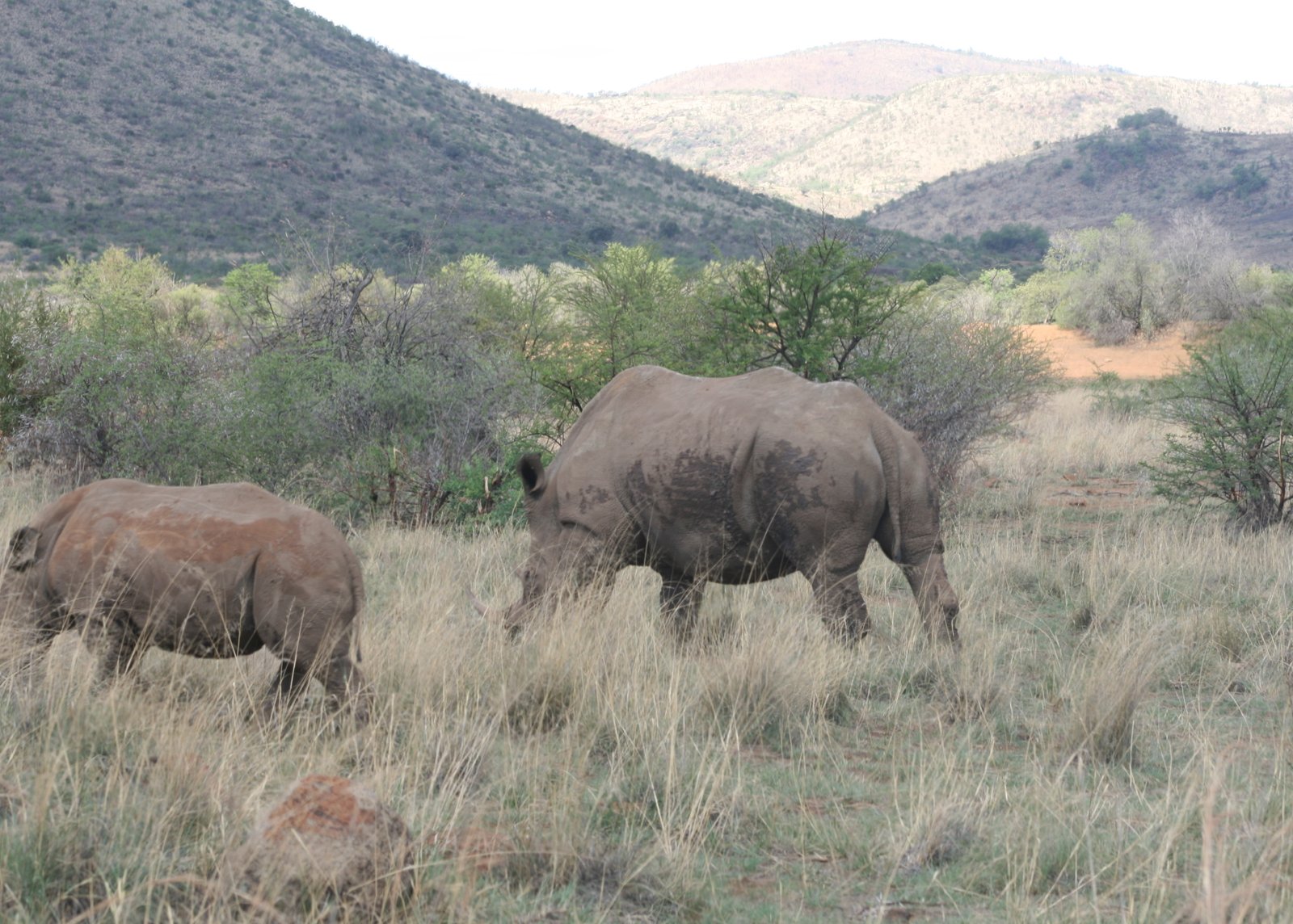
SERENE ... A White Rhinoceros and its calf with the valleys of the Pilanesberg stretching into the distance

SERENE … A White Rhinoceros and its calf with the valleys of the Pilanesberg stretching into the distance

The open country around the Mankwe Dam is bordered by the Tshwene and Kubu drives, two of the four tar roads in the Pilanesberg National Park. I normally try to avoid the tar roads when I’m in the bush, but this area is so peaceful and tranquil, and being the main water source in the reserve, there is also usually lots of game in the vicinity.

But as a very warm afternoon clouded over and a typical Highveld thunderstorm approached, there came a stark reminder that this is wild Africa, red in tooth and claw.

Between the Mankwe and Motlobo drive turnoffs from Tshwene Drive, less than 20 metres from the tar and at the edge of a little bank, an unfortunate Impala took its last breaths. Two Cheetah, still panting hard from the exertions of the chase, soon had blood-stained faces as they tucked into their hard-won meal.

This is Lion and Leopard country as well so the Cheetah, the most lightweight of the big cats, needs to eat quick because there’s nothing like a kill to attract other meat-eaters. While the Cheetahs ripped at the carcass, a sly Blackbacked Jackal was already hanging around waiting for scraps.

Seeing one of the cats on a kill is always a special sighting, but to see Cheetah in the Pilanesberg is an exceptional occurrence because there are only five in the entire 572 square-kilometre park. The open country around Mankwe Dam is probably the best area for them because it allows them the space for their sprint, which is what sets them apart from other predators.

The adrenaline was still flowing from my first Cheetah sighting in the Pilanesberg when my buzz was shattered by an extremely loud, piercing call right next to the car. I was startled and momentarily baffled by what it could be – it was such a high-pitched, pure sound that I thought some sort of emergency alarm had gone off and was wondering if my windshield would crack!

Having regained my senses enough to realise that it was coming from the bushes next to the road, I scanned the vegetation and there the source was, with colours as bright as its song was loud – a beautiful Crimsonbreasted Shrike sitting in an open gap in the bushes.

The Crimsonbreasted is certainly the most brightly coloured of the Laniarius (Boubou) Shrikes and its underparts are a brilliant scarlet colour, heading towards crimson.
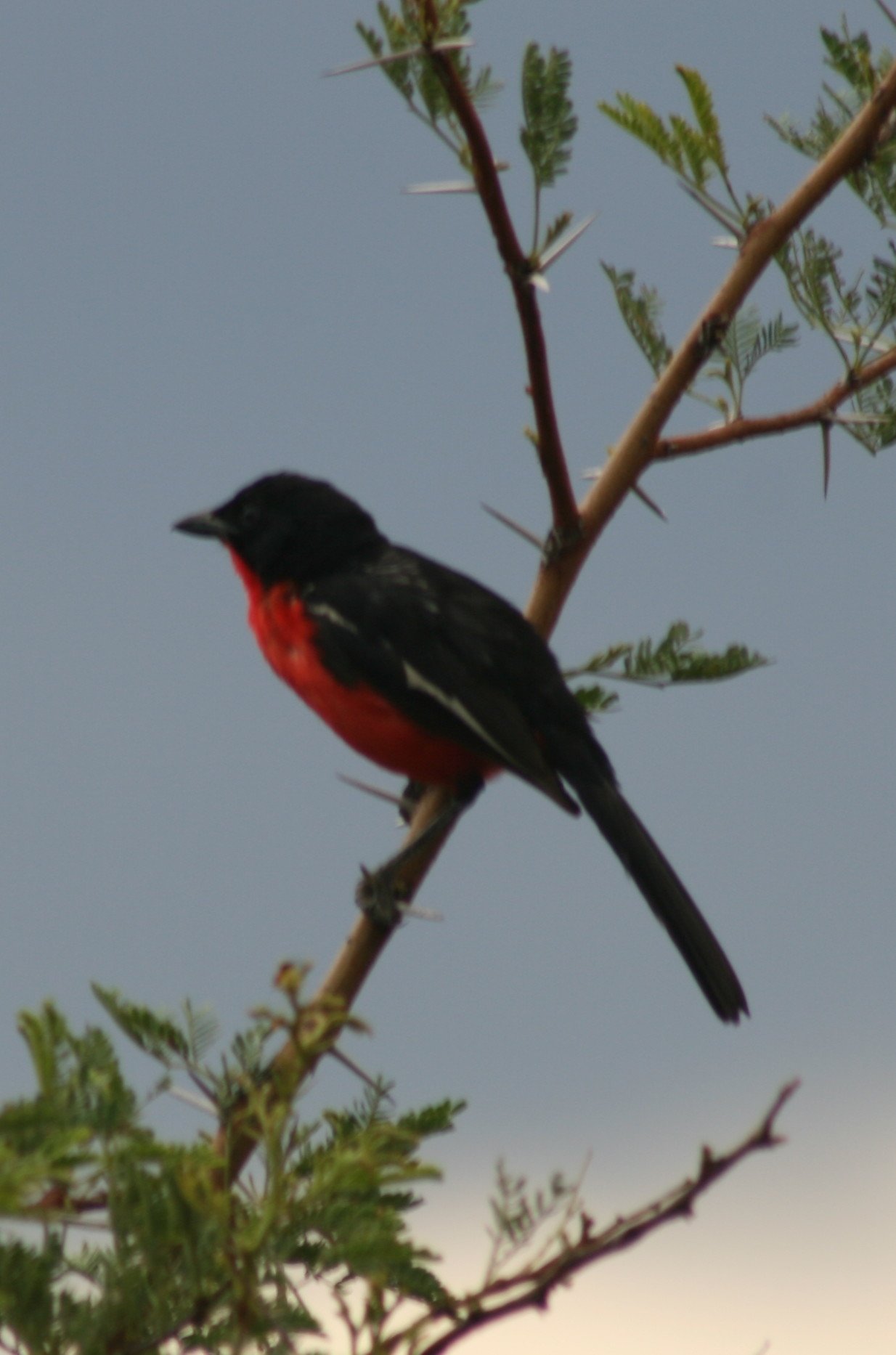
Crimsonbreasted Shrike

Crimsonbreasted Shrike


It provides a real flash of colour particularly when contrasted with the muted tones of the thorny scrub it likes to inhabit.


This is where the Mankwe River flows out of the dam and Mankwe Way crosses the river just north of the Fish Eagle turnoff. It’s a good spot to stop and scan for birds and, having seen one in the exact same dead tree on a previous trip, it was great to see an Osprey once again sitting up in the highest branches. It was joined by a Hamerkop that came to share its lofty perch and there were Pearlbreasted Swallows flying around and landing nearby as well.
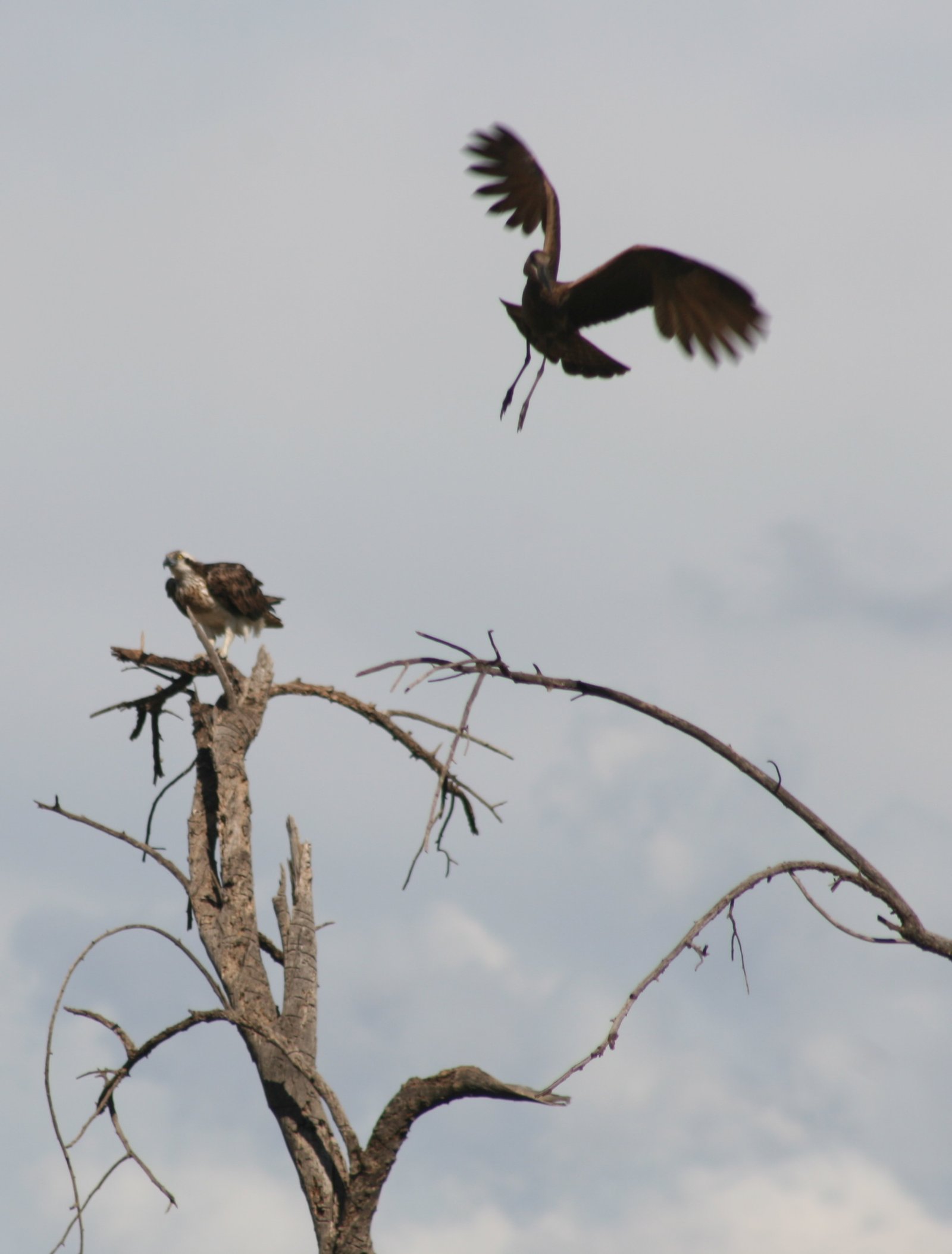
MAY I JOIN YOU? ... A Hamerkop (right) landing in the same tree as an Osprey

MAY I JOIN YOU? … A Hamerkop (right) landing in the same tree as an Osprey

Mankwe Way takes one into an area of open grassland, dotted with termite mounds and boulders as it heads west, past the old farm of General Jan Smuts, Buffelsdrift. Transitional zones where dry plains with short grass meet the longer grasses of the rugged upland areas are excellent for birding as well.

Apart from the White Rhinoceros in the vicinity, there were also Scalyfeathered Finches hopping on the ground and then flying quickly into the small trees when disturbed; Sabota Lark, Crowned Plover, Cinnamonbreasted Rock Bunting and Blackthroated Canary.

But a pair of birds had me a bit confused as they hopped around on the low bushes, behaving much like Capped Wheatears. But the adults of that plains specialist are distinctively marked and these birds were also making some strange, Lark-like calls. With their mottled bands of brown, buff and yellowish colours, they had me thinking of similar-looking rarities.

But discretion won the day and, considering that Capped Wheatears are well-known mimics, I went the most likely route and decided they were, in fact, a pair of immature Capped Wheatears.
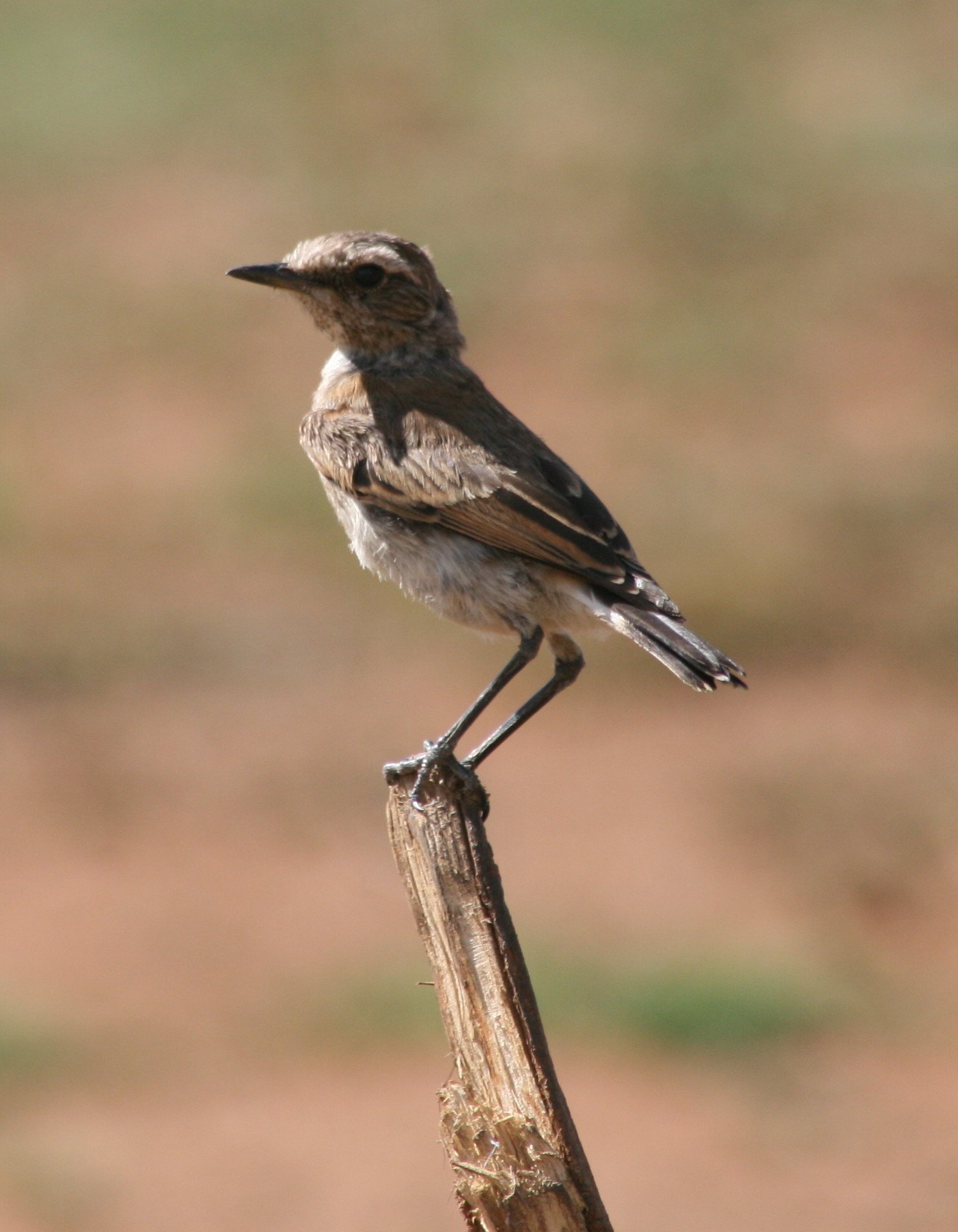
One of the juvenile Capped Wheatears

One of the immature Capped Wheatears

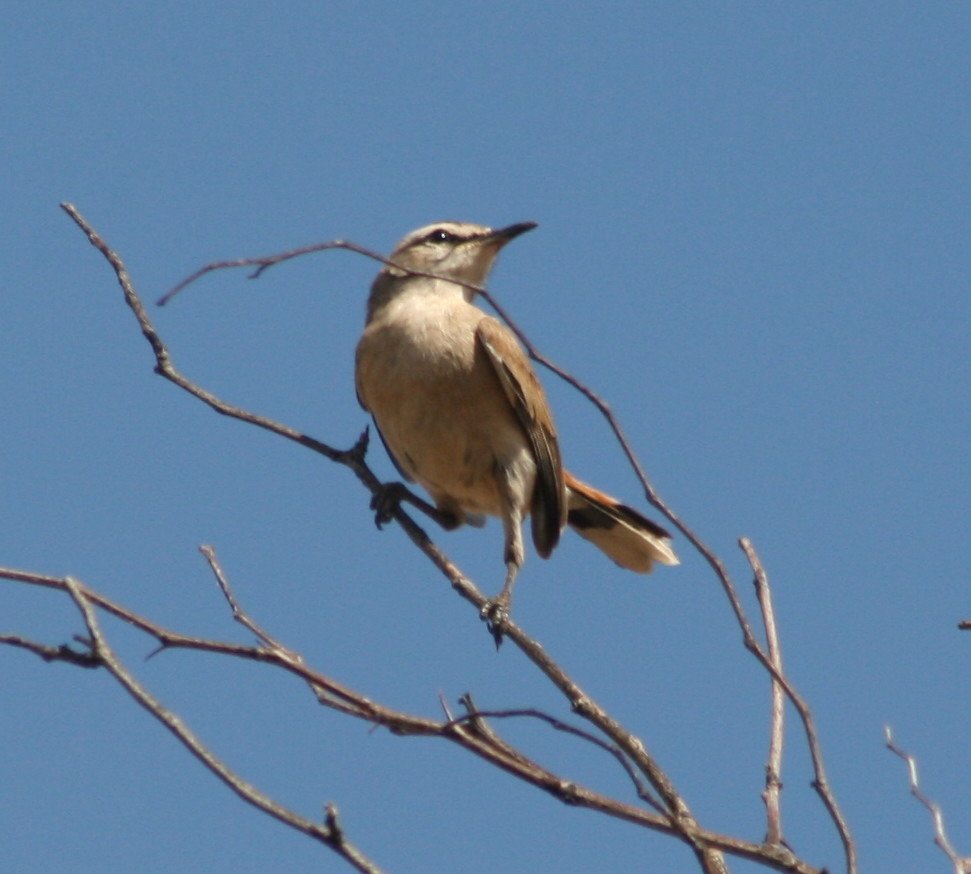
Pilanesberg holds good numbers of both the Kalahari and Whitebrowed Scrub Robins and the central part of the
Kalahari Scrub Robin

Kalahari Scrub Robin

park has both these twitching, insectivorous lovers of thicket and low bushes in close proximity to each other.

Mankwe Dam is by no means the only productive body of water in the park, and if one enters through the south-western gate of Bakubung, after two-and-a-half kilometres on the tarred Kubu Drive, or a bit further if one turns left and takes the more meandering dirt road known as Kgama Drive, one comes to the Lengau Dam.

There are usually large numbers of birds here and on this occasion it was good to see African Darter, Whitefaced Duck, Pied Kingfisher, Greenshank, Marsh Sandpiper and Threebanded Plover. There are usually animals about as well, but this time there was just a solitary Warthog snuffling around.

Even the smallest bodies of water can provide something of interest though and as I was exiting through the easternmost gate – Manyane – four Redbilled Oxpeckers were drinking water from a puddle in the road.

Life can be very tough in the beautiful African bush and to survive the residents need to take advantage of every little windfall they can get.


Sightings List

Blue Wildebeest

Plains Zebra

Sacred Ibis

Warthog

Egyptian Goose

African Darter

Whitefaced Duck

Laughing Dove

Little Swift

Pied Kingfisher

Greenshank

Blacksmith Plover

Marsh Sandpiper

Threebanded Plover

Waterbuck

Jackal Buzzard

Impala

Greater Kudu

Rufousnaped Lark

Palm Swift

Marico Flycatcher

Greater Striped Swallow

Giraffe

Crested Francolin

Streakyheaded Canary

Great White Egret

Southern Masked Weaver

Pintailed Whydah

Blackeyed Bulbul

Whitebrowed Scrub Robin

Blackchested Prinia

Kalahari Scrub Robin

White Rhinoceros

Scalyfeathered Finch

Sabota Lark

Capped Wheatear

Crowned Plover

Cinnamonbreasted Rock Bunting

Blackthroated Canary

Hamerkop

Osprey

Pearlbreasted Swallow

Natal Francolin

Cape Turtle Dove

Grey Lourie

Glossy Starling

Cheetah

Blackbacked Jackal

Helmeted Guineafowl

Rattling Cisticola

Crimsonbreasted Shrike

African Elephant

Forktailed Drongo

Common Myna

Redbilled Oxpecker


Youngest member of SA’s exciting wing stocks just wants to learn 0

Posted on January 30, 2019 by Ken


The country’s wing stocks look very exciting at the moment what with Aphiwe Dyantyi’s heroics in Green and Gold and the likes of Makazole Mapimpi and Sbu Nkosi just waiting to recover from their injuries before exploding on to the international stage once again. But there is another hugely talented winger coming through in Aphelele Fassi, who just happens to be a team-mate of Nkosi and Mapimpi at the Sharks.

The 20-year-old Fassi has burst on to the scene in this year’s Currie Cup and he says the key to his breakthrough has been learning from more experienced players like Nkosi, Lwazi Mvovo and Mapimpi, all of whom are Springboks.

“It’s been a great year for me and the one thing I keep telling myself is that I need to learn more. The likes of Sbu have been there at the highest level and playing with guys like him, Lwazi and Makazole, they have guided me as seniors. It’s all about learning and I’m here now because of that.

“So I plan to learn even more and the coaching staff have given me all the support I need, they back me and I’m very grateful for the opportunities I’ve been given. As a player you intend to improve every time you run on the field and the Currie Cup is no different to the SuperSport Rugby Challenge in terms of speed and physicality, so I’ve set my game there, I’ve reached those levels,” Fassi said.

Perhaps the key to the great industry Fassi has shown out on the wing is that he actually prefers playing at fullback and he also excelled at flyhalf for his school, Dale College in King William’s Town.

“I prefer fullback more, but it’s about where the coach needs you. And obviously coming out of high school rugby, it’s not the same speed and physicality. So I’m working on my tackles, taking the high balls and my long clearance kicks,” Fassi, who also captained Dale at cricket and was a good enough all-rounder to earn junior provincial colours for Border, said.

Saturday’s game against the Golden Lions at Kings Park will provide another good measure of just how exciting a future Fassi has in rugby though, as he comes up against a stellar backline featuring the experienced Courtnall Skosan, Howard Mnisi, Lionel Mapoe and Andries Coetzee.

https://citizen.co.za/sport/south-african-sport/sa-rugby-sport/2011792/exciting-future-ahead-for-sharks-fassi/

Ali deserves another honourable mention for his new development programme 0

Posted on July 27, 2018 by Ken


Of all the contributions Ali Bacher has made to South African cricket – captain of their first world-beating side, CEO of the United Cricket Board during the drive to Unity, running the successful hosting of the 2003 World Cup – the introduction of the then Bakers Mini-Cricket programme to underprivileged areas was arguably the one with the greatest impact on the future of the game in this country.

So one can understand Bacher feeling a little peeved when a Gauteng Cricket Board president mentioned to him almost 20 years after Bakers Mini-Cricket started that the programme was no longer having the desired outcomes.

“The first time we took cricket to the Black townships was in 1986 with the help of Bakers and within 10 years we had sent someone like Makhaya Ntini to Dale College. In 2003 I left Cricket South Africa and in 2005 the Gauteng Cricket Board president phoned me and said the mini-cricket programme is faltering.

“So I looked at the report and the problem was that any young kid with passion and talent would still not make it if they stayed in the township, because everything was against them there. I went to King Edward VII and when we left high school we were ready to play provincial cricket and Kagiso Rabada had five years of that as well at St Stithians.

“But in the townships there are no grass fields, pitches, nets or covers. There are 27 000 schools in South Africa and they are mostly Black with no facilities because they don’t have money for it. If talented players were identified there then you had to get them quickly to government or private schools that were traditionally good cricket schools,” Bacher explains.

KFC have now taken over the mini-cricket programme and their efforts deserve recognition because they are still a tremendous feeder system. But the approach when it comes to high school pupils has now changed, under the guidance of Bacher and with the support of Blue Label.

As the chief marketing officer of the mobile telecoms innovators, Rob Fleming, explains: “Transformation is absolutely critical and it needs constant love and attention. But what’s the best way of achieving it? I’ve seen multiple ideas and there’s no doubt we need to do a better job.

“Our real strength in South African cricket is our schools, but forty of them probably produce 80% of our players, so is that the right place to develop our cricket? If we take township kids to those schools then often they are not up to it academically and it affects their cricket and the whole scheme collapses.

“So it was Ali’s idea to go to old traditional cricket schools and try and reignite the game there, let’s create another forty top cricket schools. There’s no doubt the talent is there, that’s our conveyor belt and I love how coherently this programme can work with the rest of the system,” Fleming says.

What deters many schools from playing cricket is the time and expense it involves, which is where Blue Label is coming in to provide resources for Focus Schools, three of which (Uitsig, Akasia and Hendrik Verwoerd) were recently named in the Northerns region, joining schools in Johannesburg, Krugersdorp and Vereeniging that are already in the programme.

Cricket is competing heavily with other codes at these schools, and teachers and facilities are few, but by combining resources, their weakness has become a strength.

Our schools are where the rubber hits the tar in terms of capacity building and getting more and more talent into the pipeline.

“Many of these traditionally good cricket schools are now 99% Black so we are completing the circle and Rob is passionate about this as well. We’ve identified government schools that were former White schools and they still have good facilities but cricket was no longer being played. For example, Krugersdorp High School, hardly any cricket was being played; Highlands North used to provide most of the Balfour Park club, who were very good, but there was no longer any cricket there.

“But if we can get cricket back on its feet again in schools like that then I reckon we will see a plethora of good players coming through. Like Queen’s High School which is on the other side of the Jeppe Hill, it’s all Black and their cricket is so good. Their U15 side only lost one match last season and they beat Pretoria Boys High, they are well-dressed and their parents are all there. This will be so good for South African cricket,” Bacher says.


https://www.pressreader.com/south-africa/the-citizen-kzn/20180609/282243781291243

SA hockey’s quick demise on Gold Coast does insidious damage 2

Posted on May 16, 2018 by Ken


The South African men’s hockey team’s hopes at the Commonwealth Games were quickly extinguished, but apart from scuppering any possibility of them adding to the Proteas squad’s impressive haul of medals, more insidious damage was done to the image of the game as a whole in this country.

South Africa began their campaign with a disappointing 4-2 loss to Scotland, who are not even in the top-20 of the world rankings, and were then hammered 4-0 by Australia and 6-0 by New Zealand. They ended the pool stage with a good 2-0 win over 11th-ranked Canada, but they were still condemned to playing in the wooden-spoon playoff for ninth and 10th place.

A 3-2 defeat at the hands of Wales, ranked 24th in the world, completed a shocking tournament for South Africa.

No-one is questioning the commitment of the team, who are, after all, basically amateurs trying to compete with professionals, but questions have to be asked about the selection of the squad.

Surely for a tournament of the Commonwealth Games’ stature – which attracts plenty of media attention back home – the selectors should fill the team with their most experienced, best players? This was not the case with several seasoned campaigners being left at home as SA hockey tried to ‘build for the future’.

The South African Hockey Association (Saha) like to give plenty of lip about a lack of financial support from Sascoc and corporates, but in this instance they have shot themselves in the foot.

The Commonwealth Games, with its widespread coverage, is the ideal platform – second only to the Olympics in terms of our hockey – for SA hockey to make a statement. Winning a medal, which is not a realistic target in the World Cup later this year, would make the public and potential sponsors and supporters sit up and take notice.

Even our women’s side, which is a top-class outfit, disappointed, only managing to finish sixth thanks to defeats to India and Canada and a draw with Malaysia. Canada and Malaysia are not even ranked in the world top-20, while South Africa are 14th.

It all just showed a lack of strategic thinking by Saha. No doubt the powers that be will say something about the mechanics of preparation for the World Cup being behind the Commonwealth Games failure. But a Commonwealth Games medal – or even a strong run for one – would have been a real fillip for the game back home, engendering far more positive PR than a 10th-place finish in a World Cup that the average South African will be totally oblivious about.

A full-strength South African side would have had a chance to nick a medal on the Gold Coast, something which nobody expects them to do in the World Cup. Now, instead, the public opinion of hockey will once again be of a bunch of no-hopers.

Saha needs to make better decisions to ensure they at least give their under-resourced, struggling national teams some gloss.

https://www.pressreader.com/south-africa/the-citizen-gauteng/20180421/282376925178424

  • Recent Posts

  • Archives

  • Thought of the Day

    Colossians 3:13-14 – “Bear with each other and forgive whatever grievances you may have; forgive as the Lord forgave you. And over all these virtues put on love, which binds them all together.”

    “When the Holy Spirit lives in you, you reflect the qualities of Christ in your life. Love and courtesy are basic characteristics of the Christian life. … If Chris lives in you, you will be kind and patient toward others.

    “A person who is truly courteous is humble, … His attitude is the same regardless of whether he is talking to kings or beggars. He treats everyone alike, no matter what race, colour or creed they are. He rejoices in making the path through life easier for others to travel.

    “It is impossible to say that you love and serve God while at the same time treating your neighbour with contempt and disrespect.” – Solly Ozrovech, A Shelter From The Storm


↑ Top