The Sharks are hoping that all their excellent programmes to assist their players with life outside rugby will clinch the deal with Eben Etzebeth, leading to the Springbok powerhouse lock joining them after the end of Toulon’s season in June.
The Sharks, thanks to their equity partners, offer enormous networking and advisory possibilities with an array of leading businesspeople and that could be of interest to Etzebeth, who has been one of the best-paid players in France and is now in the second half of his career.
Eduard Coetzee, the CEO of the Sharks, confirmed on Tuesday that the franchise are putting together an offer for arguably the best lock in the world, who was earning about R20 million a year at Toulon.
“We are speaking to Eben, he wants to come back and we will put our best foot forward,” Coetzee told The Citizen. “It’s about what we can offer him on and off the field.
“Eben will be turning 31 in October and we can give him a start for life after rugby. We can match him up with businesspeople who can help him – in the pharmaceutical world, clothing, property etc.
“Hopefully that can make up for the loss of income he will have coming back to South Africa. And with the endorsements and commercial opportunities he can get here, hopefully he can earn something that is not a long ways off what he gets there in France. So we feel there is definitely a chance that we will get him,” Coetzee said.
The salary cap (R65m) that SA Rugby have imposed on their franchises as they try to compete with the big-spending European clubs is a frustration, and the Sharks also have to ensure they do not anger the existing superstars in their squad by paying the likes of Etzebeth considerably more than they are earning.
“Of a probable current World XV, we have Siya Kolisi, Makazole Mapimpi and Lukhanyo Am, and now you add Eben Etzebeth,” Coetzee said. “And you can’t pay one of them twice as much as the others.
“You need a level of consistency in terms of what you are paying the top guys. Fortunately we have some credit still in the salary cap and Eben has got himself out of his contract with Toulon.”
The CEO also cleared up any impression that Neil Powell being parachuted in as director of rugby when he had initially been signed as defence coach would be cause for any anger by head coach Sean Everitt.
“John McFarland left for a long-term deal and Warren Whiteley stepped in as defence coach until Neil arrives in September, and he is doing really well. We felt the gap was in terms of managing the entire rugby programme.
“It has been a consultative process and Sean has a very difficult job managing two teams out of one squad. But Neil runs systems really well and he is very strong on culture and work ethic.
“So Neil will run everything outside of the day-to-day coaching. This will cause the least disruption and his strength is people-management, we need someone to run the whole system from juniors up the pipeline,” Coetzee said.
Duanne Olivier, Ryan Rickelton and Wiaan Mulder were all left out of the Proteas white-ball squad for the Indian whitewash and they will be key players as the Central Gauteng Lions now travel to Cape Town to take on Western Province from Thursday in an attempt to hang on to top spot after the penultimate round of the CSA 4-Day Domestic Series.
The Lions suffered their first defeat of their campaign in their last match, going down by eight wickets as the KZN Dolphins chased down 260 at Kingsmead. But there is no reason to fear that the Lions have lost their mojo: They were in control of the match from the start, declaring in both innings and gambled in the final innings, knowing that a win would have almost assured them of the title. But the Kingsmead pitch can get pretty flat when the north-easterly blows.
Instead, the Eastern Province Warriors, who beat Boland by 168 runs, have closed to within 1.80 points on the log and they now travel to Durban to take on the Dolphins.
But the return of Olivier, still the leading wicket-taker in the competition, means the Lions have a fearsome attack that also includes the fire of Lutho Sipamla, the cunning of Malusi Siboto, the swing bowling of Mulder and the spin of Bjorn Fortuin.
If Newlands is flat, one can also expect the powerful Lions top-order, Rickelton joining Dominic Hendricks, Josh Richards and Reeza Hendricks, to cash in. Richards is the tournament’s leading run-scorer with 413 at an average of 82, while the other three are all averaging over 40.
Western Province are expected to field potential match-winners in Zubayr Hamza and Wayne Parnell, and they will be hoping they can score big alongside David Bedingham and Tony de Zorzi.
The Northerns Titans travel to Bloemfontein to take on the Free State Knights full of confidence and hope after their eight-wicket win over North-West in Potchefstroom lifted them back into contention, just less than 20 points behind the Lions.
Northerns will need a full house of points from the last two rounds to snatch the title from the pace-setting Lions and the charging Eastern Province team, but they will bring an attack full of threats to Bloemfontein.
Lizaad Williams, having just returned to full fitness and picking up six wickets against North-West, unfortunately has a side-strain, but talented fast bowler Okuhle Cele returns to action. There is pace backing from Corbin Bosch and Junior Dala, and swing from Aya Gqamane. One can expect off-spinner Simon Harmer, backed by slow left-armer Neil Brand, to play a key role, especially since his recall to the Proteas squad.
The Titans batting, led by Heinrich Klaasen and Grant Mokoena, has also been full of runs this season.
The other Division One game sees Boland hosting North-West.
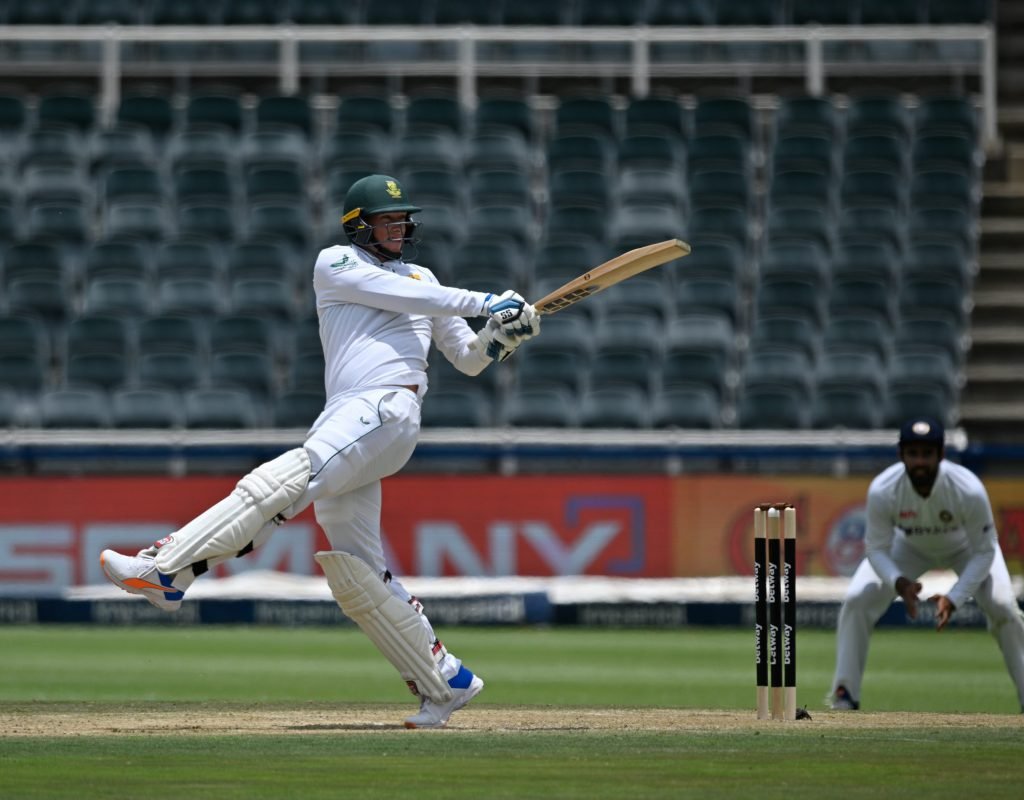
Rassie van der Dussen pulls stylishly at the Wanderers. – Photo by Marcel Sigg
Temba Bavuma has made a tremendous start to his tenure as South Africa’s white-ball captain, and Keshav Maharaj was also excellent when standing in for him, but it is heartening to know that if they are unfortunately unavailable for any reason, there is another calm, deep-thinking leader in the team who could do the job with aplomb.
Rassie van der Dussen has cemented his place in the limited-overs teams in spectacular fashion and his heroics in the recently-completed ODI whitewash of India leave him with 1267 runs in 26 innings in the 50-over format, at the extraordinary average of 74.52.
The second oldest of four sports-mad brothers, Van der Dussen was first touted as leadership material during the horrors of the 2019 World Cup in England. Amidst a chaotic campaign, the Pretoria product impressed with his cool head and clear thinking, as well as the three half-centuries he scored in six innings, finishing the tournament with an average of 62.
That same composure and ability to adapt to any situation was clearly evident during the memorable Test and ODI series wins over India. There were times Van der Dussen had to dig in defiantly; on other occasions he turned the momentum through positive strokeplay and no little skill.
“The Test series was definitely the toughest conditions I’ve ever had to bat in and it was high pressure with the Indian bowlers just never letting you go,” Van der Dussen told Saturday Citizen.
“Every session seemed to be more important than the last, every moment things could swing the other way. It was extremely mentally testing. But being mentally strong is something I pride myself on.
“Under pressure I need to be level-headed and to analyse the situation objectively. Throughout my career I’ve believed that I can manage the chase, absorb the pressure when the opposition is bowling well.
“I pride myself on performing in the big moments and matches. It maybe comes from playing club cricket in Pretoria from a young age, playing against men. There was often verbal abuse and you had to deal with it,” Van der Dussen said in typically stoic fashion.
The 32-year-old currently has the highest average in ODI history of all batsmen who have played at least 20 innings and when one looks at some of the other superstars near the top of that list – Virat Kohli (58.77), Babar Azam (56.92), Michael Bevan (53.58) and AB de Villiers (53.50) – one thing characterises them all. They are all expert players of the situation, whether it called for consolidation or acceleration.
Many other just as talented batsmen ended with inferior records because they would only play in one way, arguing that that was their “natural game”.
“A batsman can be labelled with that – ‘that’s just the way he plays,’ people will say. But it can also be a cop-out,” Van der Dussen said.
“Whenever I bat, I try to change the match and there is always a certain amount of responsibility you have to accept. It’s about reading the match situation and working out what is needed.
“That’s always my thing: to put the team in a good position to win the game. At the Wanderers Test, I knew Dean and I had to be in overnight, the runs did not matter at the end of the third day. But then we were able to start well the next day.”
The way Van der Dussen stayed calm and clear-headed under immense pressure from India was in stark contrast to visiting wicketkeeper Rishabh Pant, a great talent who twice got out for ducks at crucial times on tour due to wild forays down the pitch to try and slog the bowler.
Van der Dussen admits he did have a few words with Pant, who ‘caught’ him in the first innings of the Wanderers Test when the ball had clearly bounced, but the phlegmatic Central Gauteng Lions star did raise the bar above petty sledging.
“I like to think I’m a deep thinker and I just asked Pant a few questions, nothing attacking him personally, but I guess they did not sit well with him. I suppose it made him think differently.
“But the Wanderers incident was a massive moment because chasing 280-300 would possibly have been too much for us and he’s a young and exciting player. We did speak about making sure that was a moment India would really regret and capitalising on it,” Van der Dussen said.
It will surprise no-one that someone as pragmatic as Van der Dussen already has a plan for life after cricket and has gone into business with his agent and close friend Chris Cardoso.
“I’m really enjoying delving into the business side and we now have three coffee shops – called Abantu Coffee – in the Centurion area. Our aim is to make good coffee and create as many jobs as we can.
“I really want to scale up my involvement in it and I enjoy being hands-on in the business,” Van der Dussen said.
Something else that the Menlo Park High School and Affies alma mater enjoys immensely, along with wife Lara, is the bush and especially birdwatching.
Even in that hobby, Van der Dussen is trying to make a change for good with his support of the Mabula Ground Hornbill Project, along with Cardoso.
“I go to Mabula about twice a year, Chris owns a unit in Mabula and through our conservation fund African FRDM x Environment we are helping them with the great work they do in trying to secure a good future for these endangered birds.
“We’ve helped them with new tyres and in trying to build suitable nest boxes that are strong enough for these massive birds and their huge beaks.
“I’ve loved the bush from early on because my grandfather had a farm with game and cattle at Springbokvlakte between Modimolle and Marble Hall. Growing up amongst animals I learnt things like tracking.
“Which got me into birdwatching because of the thrill of the chase, you hear the call and you want to track the bird down and see it. For Lara and I, seeing a rare bird gives us the same feeling as seeing a lion or a leopard,” Van der Dussen said.
But for now, dreams of spending more time in the bush have had to take a back seat because Van der Dussen is spotting both the red and the white ball extremely well at the moment.
The decision by the Bulls to field top players like Bismarck du Plessis, Marcell Coetzee, Morne Steyn, Harold Vorster and Lionel Mapoe in the Currie Cup loans some credibility to the competition, but truth be told, there can be little doubt that the famous old tournament is now on its last legs.
Of course it helps the Bulls that they have deep pockets thanks to the generous investment of their equity partners. But they should not be criticised for being professional and organised enough to attract those investments and also recognising the need to significantly improve the depth of their squad now that they are playing in two competitions at the same time.
The fact that they have been willing to field a number of players who will feature in Saturday’s URC derby against the Stormers shows that they, at least, are taking the Currie Cup seriously, unlike so many in South African rugby.
The Sharks are probably in an even better position financially, but they made a slow start to the Currie Cup by beating Griquas by just one point in Durban. But conditions – hot and humid and then raining – were definitely a levelling factor and the Sharks were not helped by having to play the final quarter with 14 men due to a red card. But even with all their riches – both in personnel and in finances – the Sharks only fielded one Springbok in 33-year-old prop Lourens Adriaanse.
The Bulls being 40-0 up against archrivals Western Province at Newlands and the Pumas putting fifty past the Lions at Ellis Park does little for the credibility of the Currie Cup.
Little wonder then that the public response has been muted. If SA Rugby is barely interested in the Currie Cup, why should spectators pay good money to support it? The Currie Cup, from being South African rugby’s second biggest brand after the Springboks, is now so devalued and the public are not going to be fooled by all the hype when there is little substance.
Some people do enjoy rugby more from the aesthetic of plenty of tries being scored and this mishmash Currie Cup will probably provide that. But even the Bulls are unlikely to use their top players in it once the United Rugby Championship gets into full swing.
SA Rugby find themselves with a problem because the URC hasn’t captured the public imagination yet like SuperRugby did in the early days. In that regard Covid has obviously not helped, neither have the poor performances of the South African franchises overseas.
But a disjointed, lopsided competition – Jake White made the point that Saturday’s game at Loftus Versfeld is the Bulls’ first at home in the URC, which started on September 24 – now also has its waters further muddied by the Currie Cup taking place at the same time.
I would call it an absolute howler by SA Rugby but there are some extenuating circumstances in their defence.
First of all, it is the provinces who have said they want a double-round of Currie Cup, which then becomes a challenge to fit into an already crowded calendar. Player workload concerns are also a factor, with URC starting in January and running through to June 18, after which there is the Test window.
But the last time a normal Currie Cup season was played in a double round, it began on June 18 and ended on September 11. I would still play the Currie Cup after the URC. Sure, the current Springboks would not play, but when last did they feature in a proper Currie Cup anyway?
At the moment, this most famous of domestic competitions has been reduced to Vodacom Cup status.
Revelation 3:15 – “I know your deeds, that you are neither cold nor hot. I wish you were either one or the other.”
How can you expect blessings without obeying?
How can you expect the presence of God without spending time quietly before him?
Be sincere in your commitment to Him; be willing to sacrifice time so that you can grow spiritually; be disciplined in prayer and Bible study; worship God in spirit and truth.
Have you totally surrendered to God? Have you cheerfully given him everything you are and everything you have?
If you love Christ, accept the challenges of that love: Placing Christ in the centre of your life means complete surrender to Him.