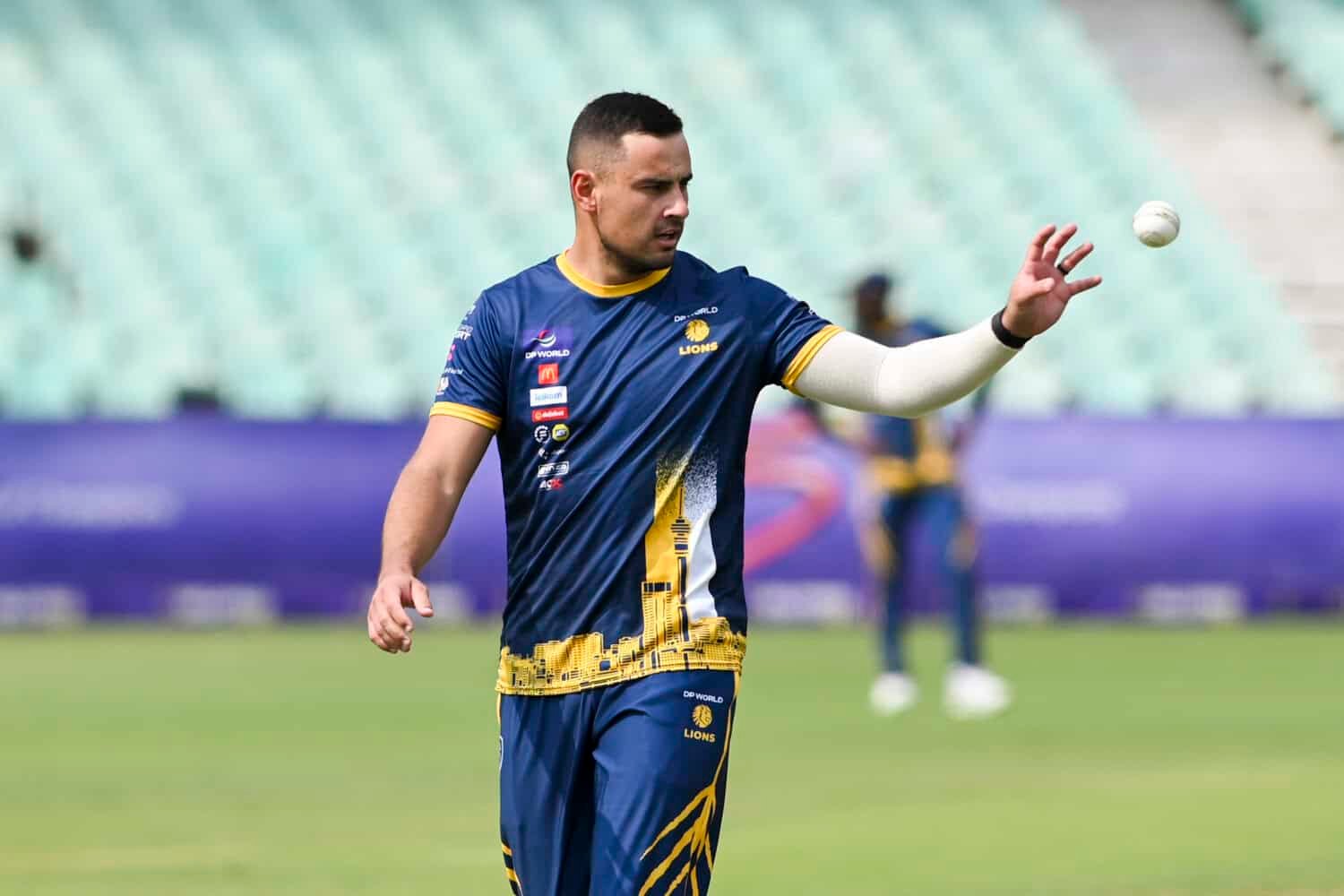
Beyers Swanepoel during his Lions days. (Photo by Darren Stewart/Gallo Images)
Northerns Titans CEO Jacques Faul likes to spring a surprise on the opposition and, on face value, the franchise’s decision to sign Beyers Swanepoel for the coming season will be a shock to some, given the controversial fashion in which the all-rounder’s stint down the road at the Central Gauteng Lions ended.
The final match of last season was the One-Day Cup final between the two Gauteng archrivals and a tightly-contested thriller went the Titans’ way, thanks mostly to the heroics of Keegan Petersen and Duan Jansen.
But Swanepoel’s bizarre decision to leave the field of play in the 43rd over of the Titans chase, having bowled his ration of 10 overs, also played a major part in the visitors to the Wanderers shifting the momentum of the game. Because Swanepoel had not suffered any injury, the Lions were not allowed to substitute him and were left with 10 fielders for the tense finale’, which they lost by three wickets on the penultimate ball of the match.
Swanepoel had chosen to leave early so he could catch a flight to England, where he was due to join Worcestershire for the county season. Astonishingly, he also did not have a No-Objection Certificate (NOC) from his local franchise or Cricket South Africa to play overseas, an incredible oversight by his agents, Tridon Sports Management.
His team-mates were left in a strange state of heartbreak and fury after the game and it did not take long, less than two weeks later, for the Lions to terminate his contract. That did, however, make Swanepoel a free agent and CSA agreed to give him an NOC to play for Worcestershire. The mother body did, however, lay a Level 4 charge of bringing the game into disrepute against him.
That can carry a ban of 10 matches, which would be a sizeable part of next season. The CSA disciplinary hearing has still not been held, however, due to the unavailability of the disciplinary commissioner.
That means there is still a lot of uncertainty over Swanepoel: Not only in terms of his mental state but how much of next season he is going to be missing due to a ban. For Faul and the Titans, however, it is not an outside-the-box signing and the CEO confirmed that he did not even need Board approval to offer the talented 28-year-old a contract.
“Professional sport is cut-throat and we have to sign people who can help us to win. Our information was that four franchises wanted to sign him. He’s 28 years old, so he probably has seven years left as a top cricketer, and he has no track record of this sort of behaviour before,” Faul told kenborland.com.
“I think he just got the date of his flight wrong and to not allow him to play here would be a severe punishment. Everyone’s entitled to one mistake, he has apologised and he has been sanctioned by the Lions.
“He is still a very capable player and it would be wrong to scapegoat a quality cricketer like him. We had to sign him before the CSA disciplinary because the contracting window was closing. But hopefully emotions have died down a bit and he’s not painted into a corner.
“He thought no-one else would want him, but I hope he can redeem himself, I think he will. To be remembered for that one incident would be the saddest thing. And he is the right profile cricketer for us – at this stage he doesn’t play for SA A or the Proteas. And he was schooled here in Titans territory at Garsfontein,” Faul said.
It is believed that the Lions players and coaches did not want to lose a cricketer of Swanepoel’s ability and were willing to forgive him, but the Lions board were adamant that he had to go.
The whole incident will be even more galling for the Wanderers-based team now that Swanepoel has gone across the Hennops River to their great rivals, the same team that snatched the one-day trophy from them after his inexplicable departure. A swing bowler who can be quite phenomenal on his day, both with the red and the white ball, Swanepoel is also a very handy batsman down the order, capable of scoring very quickly.
Our domestic cricket would be the loser without Swanepoel playing and hopefully CSA can sort out his disciplinary hearing soon and therefore finally draw a line under a most unfortunate incident.
“The current structure of global cricket is unsustainable and countries outside of the ‘Big Three’ (India, England and Australia) will play less and less bilateral series cricket, with some in danger of disappearing altogether from the Test cricket scene,” Tony Irish, who is an independent director of cricket’s global players’ body, the World Cricketers’ Association, has warned.
The only international cricket that really makes money now is India at home and abroad, and England and Australia tours. Any other bilateral cricket loses money. Bilateral cricket is those tours between countries playing Tests, ODIs and T20 matches.
The Future Tours Program previously ensured every team would play each other twice in a four-year cycle, home and away. But Narayanaswami Srinivasan [India], Giles Clarke [England] and Wally Edwards [Australia] deregulated everything in 2016, making bilateral tours a free-for-all. There are no rules, and therefore there is no context to so much international cricket.
It has become like Liverpool playing Arsenal and Chelsea five times a year and Bournemouth just once. But the BCCI [Board of Control for Cricket in India] don’t want more regulation and a well-structured calendar. That would mean they cannot wheel-and-deal, give and take games away from countries depending on whether they vote with them or not.
They want the status quo to continue so they can maximise their own revenues. England and Australia just go along with them and no-one stands against them.
There also needs to be a more equitable distribution of ICC revenues. India take nearly 40% of the revenues and they already get huge pots of money through the IPL and bilateral cricket.
There is huge financial inequality across the game with India at the top of the pile. India has resources of approximately $1.5 billion dollars per year; the country in 13th place gets $6 million per year yet these two teams must compete against each other. How do they expect this to be a contest? There are 108 International Cricket Council (ICC) member countries and 50% of ICC revenues go to the ‘Big Three’, 87% of bilateral revenues are retained by England, Australia and India; while countries ranked 13 to 108 get 2% of total cricket revenues. ICC revenues are those generated from ICC events i.e. world cups, and is different to bilateral revenues which are the aggregate of what all of the countries generate from their series against each other.
Why must the ‘Big Three’ take such a huge slice? The system is just so inequitable and so incoherent. The whole structure, even ICC events, is set up for them and they have won 19 of the last 22 major ICC events.
While life is obviously good for Indian cricket, and they do deserve consideration for being the biggest market in the game, the second-biggest sport in the world is in danger of becoming like gridiron or baseball, which are minor sports in all but a couple of countries.
The ‘Big Three’ are just maximising revenue for themselves now, but it’s very short-sighted because in five or six years they might have no-one else to play against. People will get bored of just watching England-versus-Australia-versus-India. It’s a bad strategy and it’s one of the reasons the players are gravitating towards franchise leagues.
The ICC held their AGM in late July and set up a working group to make recommendations to the ICC board on an improved system of playing international cricket. But Irish, who is also a former chief executive of the South African Cricketers’ Association, told kenborland.com that despite this initiative and the phenomenal interest created by the magnificent five-Test series between England and India, “bilateral international cricket for other countries is highly endangered unless structural changes are recommended by this group and those structural changes are implemented”.
“The current system is broken,” said Irish, “primarily because there is no coherent playing schedule centrally controlled by the ICC, and bilateral cricket consists of a matrix of individual deals between countries, with no rules.
“This allows the ‘Big Three’ to play more and more against each other and less and less against the smaller countries. In a landscape where the global media rights revenue pie is also getting smaller, the commercial value of series between the smaller countries is dropping and these countries will soon no longer be able to afford to play bilateral series, which includes Test matches.
“This is also happening in a system where there is an inequitable sharing of revenues from ICC events. The combined effect is that in the current system the rich get richer and the poor get poorer. The smaller countries will, in addition, struggle to retain their best players for bilateral cricket as these players can earn more playing in T20 leagues around the world than they can playing bilateral cricket for their countries.
“The ICC sees all these franchise T20 leagues purely as domestic cricket, but in reality they are not – they all use international players and because of that they compete with bilateral cricket for players. In an unregulated schedule they also compete for calendar space. For a number of the small countries, the leagues are winning this battle against bilateral cricket; and Test cricket being the longest format, and the most expensive to stage, will suffer the most.
“In South Africa, despite the Proteas being the world Test champions, the team is scheduled to play only four Test matches over the next 12 months and there is no home Test cricket in the coming season,” Irish pointed out.
Amidst this pessimistic outlook, however, the World Cricketers Association released its Game Structure Report (https://theworldca.com/wp-content/uploads/2025/03/Global-Game-Structure-Report-Final-1.pdf) in March. The report is the only holistic review of the structure of cricket and is based on over 60 detailed interviews with game stakeholders (including administrators, media and commercial partners, players, team owners and broadcasters and journalists), extensive player surveys, statistical and scheduling data, and financial and economic data. Among the recommended structural solutions are:
A centrally controlled (by ICC) global calendar which includes all bilateral cricket, ICC events (eg World Cups) and T20 leagues using international players
Simpler and easier to follow competition structures across all formats with credible points systems to provide context
Workable windows for core international bilateral (including Test) cricket
A more equitable distribution of ICC event revenues
A regulatory framework across the cricket system.
“This shouldn’t be all doom and gloom because there are solutions to this. They however require structural change to the whole system and not a tinkering with the current system. The introduction of windows for bilateral cricket is part of a workable solution to ensure bilateral cricket, including Test cricket, can co-exist with T20 leagues rather than compete with them,” Irish said.
“In the current system, no top countries play during the IPL, so that effectively has its own window. The IPL is fantastic for the game, but that window will continue to grow because of the billion-dollar investments in it and its insatiable market. It’s already gone from six weeks to nine weeks and this growth cuts into the playing calendar of other countries.”
“In addition, we’re now seeing cross-ownership of teams with the IPL franchises having sides in the SA20, The Hundred, Caribbean Premier League and Major League Cricket (USA). Eventually we’ll get to the stage where T20 franchises will offer the best players contracts to play for all of their teams across multiple leagues.
“If this happens, the national Boards will lose contractual control over their most important assets, being their players. If anything should act as a warning sign to the national Boards that the system must change, it is this.
“In a restructured system, the World Test Championship could also be improved. Currently it is confusing because the points system is contrived to fit the existing matrix of bilateral deals which has some teams playing more matches than others and some countries not playing others at all.
“Very good Test teams like the Proteas and New Zealand are playing fewer and fewer Tests, which will translate into less and less domestic four-day cricket – the breeding ground of Test cricketers. A four-day domestic first-class competition is one of the biggest cost items for every national Board, but if Test cricket loses money and less and less of it is played, then it is obvious that Boards will cut back more and more on four-day domestic competitions,” Irish said.
“We believe, said Irish, “that by making these changes it would significantly improve the global cricket product and that this would result in additional annual global revenues of approximately $250 million. The Boston Consulting Group, which has done a significant amount of work on the economics of the game, believes that the global cricket industry revenues should be about double what they currently are.
“We presented the World Cricketers Association Game Structure Report at the World Cricket Connects conference at Lords in June (just before the World Test Championship final) and it was well-received by the majority of those present at the conference.
“We know however that our proposals are being met with resistance at the ICC level. I think that most countries know that the current system is either broken or that it should be significantly improved. If the ICC group looking into the global structure don’t like our proposals, then it will be interesting to see what recommendations they make to deal with the current problems.
“I don’t believe the current system can carry on much longer without some countries being forced to abandon aspects of bilateral cricket or them losing their most important assets as the game continues in the current direction of travel,” Irish said.
If we want international cricket to be a healthy product then we can’t just go on doing the same thing. Even the richer countries will eventually fall off the edge, it’s a downward spiral. It’s all going in the wrong direction, especially if you’re a smaller country, and no-one is stopping the train.
The Global Game Structure Report calls for four 21-day protected windows reserved for bilateral cricket in which no T20 leagues can be held. It would mean every country would play at least one match per format against all other teams. Promotion and relegation between two divisions would provide greater context and jeopardy.
To save bilateral cricket, we need structural change, not a little plaster. Day/night Tests, pink balls, four-day Tests – none of it has worked to meaningfully change things.
Previously, the Woolf Report was specifically about ICC governance, but India didn’t like it and so the ICC dismissed it. It was the same three countries getting their way because India don’t want to lose their bargaining chips. Remember when Haroon Lorgat stood up to them and India cut their tour to South Africa in half and CSA lost a billion Rand?
The ICC and the ‘Big Three’ seem intent on allowing such great cricketing nations as South Africa, New Zealand and the West Indies to fade into obscurity, their heroes and entertainers seen only in dusty old archival film footage.
EDENVALE, Gauteng – Some subtle swing changes have seen Cara Gorlei jack up her game and the former amateur star from Cape Town is looking forward to contending strongly at this week’s Jabra Ladies Classic that tees off at Glendower Golf Club on Wednesday.
This is the final Sunshine Ladies Tour event before the lucrative co-sanctioned tournaments – the Joburg Ladies Open at Modderfontein and the SA Women’s Open at Erinvale – and Gorlei is also honing her game before she returns to campaigning full-time on the Ladies European Tour.
In between her LET commitments, the 28-year-old has finished tied-fifth in the Dimension Data Ladies Pro-Am at Fancourt and last week she showed ominous form as she fired a 66 in the final round to finish third in the Absa Ladies Invitational at Serengeti.
It is that sense that the changes to her swing are now bedded in and the similarities between Serengeti and Glendower that have Gorlei approaching the R1 million Jabra Ladies Classic with confidence.
“My coach, Doug Wood, and I have been working on some new moves, basically just my positions in my swing and where I need to be, and that seems to be coming a bit more naturally to me now,” Gorlei, a former SA Women’s Amateur champion, said.
“So I’m looking forward to playing the Jabra Ladies Classic this week and hopefully I can keep that momentum from the last day at Serengeti. Glendower is the same sort of course in the sense that you have to hit the fairways. The rough at Serengeti was super-thick and it can be pretty long at Glendower as well. With all the rain around, it could also be wet, so the course will play a bit longer, but we experienced that at Serengeti, so that won’t be something new,” Gorlei said.
The last two tournaments have seen the very fabric of the Sunshine Ladies Tour change with first Gabrielle Venter and then Casandra Alexander breaking the stranglehold overseas golfers had on the winner’s podium. Now, as the series stands poised to be woven into the Ladies European Tour, the foreign golfers are bound to push hard again for the top spots.
But just as Gorlei, 10th on the Investec Order of Merit, raised her game at the end of the Absa Ladies Invitational, she says she is ready to push even harder as the South African campaign heads to its conclusion.
“For the first couple of events, the top South African golfers had other LET events that took them overseas, but now we are back and really keen to perform at home. I have a real drive to get that win.
“Any competitive golf helps and it’s nice to get a lot of rounds in before we start travelling again. After Modderfontein and the SA Open, we go to Korea. Germany and France, and it’s a long stretch of tournaments. But it’s nice to be at home because you can go and put the work in with your coach and there are other aspects that are good too,” Gorlei said.
South Africans have won five of the eight Jabra Ladies Classic tournaments played at Glendower, but the patterns of overseas success this season is shown on the Investec Order of Merit, where Scotland’s Kylie Henry leads and German Helen Kreuzer and Tvesa Malik of India are all in the top-five.
Alexander (6th) is the defending champion at Glendower, while Venter (2nd) and Lee-Anne Pace (3rd) should also be strong South African contenders.
Proteas captain Dean Elgar says he is looking forward to getting home and enjoying a juicy steak on the braai following his team’s 2-0 hiding in the Test series against Australia, but at least some of the hurt and embarrassment was eased by the draw they managed to secure on the final day of the third Test in Sydney on Sunday.
South Africa came through the flames on Sunday, managing to stretch their first innings from 149/6 to 255, and then making 106/2 in their follow-on innings to deny the sizzling hot Australians a 3-0 sweep. They are not scores that would usually prompt satisfied celebrations, but this Proteas team needs small victories at the moment.
“We had a conversation last night where we said we could either lie down today and let Australia roll us, creating more embarrassment, or we could fight it out for the full final day,” Elgar said.
“It was really great to see how the team responded and there were a lot of learnings today. Being hurt and embarrassed probably go hand-in-hand, but maybe we feel that a bit less now. We showed a lot of fight and there were positive signs.”
Elgar must have felt like he was a piece of meat being braaied in the flames as he endured a miserable series, scoring just 56 runs in six innings.
“I could never get going in this series and the one time I did, I managed to run myself out. I can accept being caught down the leg-side twice, but three or four times highly irritates me. That’s something different. Generally there is a way you get out, and bowlers target that.
“Ten years into my Test career and now there’s something new. I’ll have to look at it. There have been a few conversations between me and the batting coach about some extra work.
“But for now I just want to get on a plane, go home, chill out, braai, go to the bush and play some golf. Taking as much time off as I want is what I need,” Elgar said.
The 35-year-old said he still has big ambitions, however, around the whole tricky business of fixing South Africa’s Test fortunes.
“There are four-day games in February before the two Tests against the West Indies. I still have the hunger and drive, no doubt. And I really believe there’s space for CSA to entertain motivating the players more who play this format.
“There’s room for discussion around compensation for the purest format, and we also need to play more games. At the moment the number of Tests is being stripped back and we are behind the pack,” Elgar pointed out.
Colossians 3:13-14 – “Bear with each other and forgive whatever grievances you may have; forgive as the Lord forgave you. And over all these virtues put on love, which binds them all together.”
“When the Holy Spirit lives in you, you reflect the qualities of Christ in your life. Love and courtesy are basic characteristics of the Christian life. … If Chris lives in you, you will be kind and patient toward others.
“A person who is truly courteous is humble, … His attitude is the same regardless of whether he is talking to kings or beggars. He treats everyone alike, no matter what race, colour or creed they are. He rejoices in making the path through life easier for others to travel.
“It is impossible to say that you love and serve God while at the same time treating your neighbour with contempt and disrespect.” – Solly Ozrovech, A Shelter From The Storm