for quality writing

Ken Borland


RWC Pool B players to watch 0

Posted on September 07, 2018 by Ken


Eben Etzebeth

Physically imposing locks are common in South Africa, but there remains something special about Etzebeth. At 2.03m and 117kg he has the physical attributes needed for his set-piece roles, but the 23-year-old is also a formidable ball-carrier, a good linking man and a force at the breakdown. In his prime and with 37 caps to his name, the time is surely right for Etzebeth to explode on the world stage and prove himself a worthy successor to Bakkies Botha.


John Hardie

Dynamic openside flank John Hardie has proved his worth in SuperRugby for the Highlanders and now he needs to prove his commitment to the Scottish cause after controversially being parachuted into the squad, without being associated to a club in Scotland but having a Scottish grandmother. A consistent performer with a huge work-rate, he brings physicality and excellent skills and judgement to the crucial breakdown area.


Lelei Amanaki Mafi

Most Japanese rugby players are small and nippy, but eighthman Lelei Mafi weighs 111kg and is 6’2, which is sizeable for any back-rower. Strong, fast and athletic, Mafi is a marvellous support runner and a terrific force in the collisions that dominate rugby. The 25-year-old of Tongan heritage plays for NTT Shining Arcs.


Tim Nanai-Williams

The 26-year-old cousin of Sonny Bill Williams is a special talent with game-breaking skill who Samoa have mostly used at fullback, although he can play almost anywhere in the backline. Nanai-Williams has provided plenty of excitement in the colours of the pacy Chiefs side that won two Super Rugby titles, but gave up on his dream of playing for the All Blacks in favour of the land of his parents.


Takudzwa Ngwenya

The scorer of the 2007 try of the tournament when he skinned Bryan Habana (who would go on to be named IRB Player of the Year), is the USA’s star player and the first-choice wing of the Biarritz team which is trying to get out of the second division of French rugby. One of only three Americans to appear in the colours of the Barbarians, Ngwenya’s pace is still blistering and the 30-year-old will obviously be relishing a potential rematch with Habana along with the rest of us.


Whiteley back from the cold, but Kolisi right captain – Morne 0

Posted on August 17, 2018 by Ken


Warren Whiteley has come in from the cold in terms of his return to rugby but, as brilliant as he thinks the inspirational Lions leader is, former Springbok eighthman and skipper Morne du Plessis believes he should not resume the captaincy of the national team just yet.

Whiteley was the first-choice Springbok captain last year, leading the team in the first two Tests against France before tearing his groin and being ruled out of action for the rest of 2017. He has only recently returned to SuperRugby action due to a knee injury.

In his absence, and that of Eben Etzebeth, who took over the reins from Whiteley last year, new Springbok coach Rassie Erasmus appointed Siya Kolisi as the 61st national rugby captain, to tremendous acclaim and immediate success with the series win over England.

“There’s no need for me to tell Rassie Erasmus what to do, but I believe consistency is very important. It’s tough on Warren, but he has been injured. There’s no question Siya is the right captain, it’s the right time and right place for him. Warren’s time will come again, but he needs to get back into the team first.

“Siya has really put a marker down now and he’s captain, that’s it for me. I’ve been very impressed with his caring nature, he looks after a lot of his family and every time we have worked with him at the Chris Burger/Petro Jackson Fund he has always gone beyond the call of duty,” Du Plessis, who captained South Africa 15 times between 1975 and 1980, said at a Laureus Sport for Good Foundation breakfast this week.

Du Plessis carries the letters ‘OIS’ after his name these days, which indicate he has been awarded the Order of Ikhamanga Silver Class by the president for excellent achievement in sport, so he is well-placed to comment on the leadership abilities of Kolisi.

“You don’t have to know Siya intimately to know he is obviously a special human being. The whole question of whether you are born or raised a leader is still being debated, whether those skills are natural or groomed, but I would say Siya is a bit of both. He has inherent talents and characteristics, but these have been nurtured by hard times, mentorship and support,” Du Plessis said.


https://citizen.co.za/sport/south-africa-sport/sa-rugby-sport/1984354/theres-only-one-guy-right-for-the-springbok-captaincy/

Time to take ownership of how wasteful we are 0

Posted on August 13, 2018 by Ken


Bulls coach John Mitchell’s comments this week about how he is going to set about changing the entire model of how the franchise recruits and develops players reinforces the belief that South African rugby as a whole needs to take ownership of the fact that we are extremely wasteful when it comes to our talent.

The fact that we have so much rugby talent in this country is both a blessing and a curse. The downside of being so well-endowed with athletes is that very little attention is paid to putting systems in place that will get the best out of young players.

One gets the feeling that the current approach of our franchises’ recruitment officers is to just try and buy up as much talent as possible at Craven Week, let nature run its course and hope one or two of them turn into stars.

Contrast this with a country like Australia where rugby union has a small portion of the talent ‘pie’ and whatever players they have, they have to fully invest in them and maximise their potential. Jake White used to joke that if prop Bill Young, who played 46 times for Australia, had to pitch up at Stellenbosch University they would have sent him to the third XV straight away. But the point was that Young was ‘made’ into a solid Test front-ranker, whereas in South Africa he probably would have just disappeared.

By focusing on quantity and not quality, and by just worrying about who is going to play in the provincial U19 and U21 sides rather than developing the actual skills of the players, South Africa have come to the point where their SuperRugby squads are made up of many players who are not good enough to play in the competition, according to Mitchell, a former All Blacks coach.

Rugby in this country needs to stop being so insular and needs to be open to world trends, including those in other sports.

Even I, who usually uses watching football as a sleeping pill, have been impressed by many aspects of the Soccer World Cup and have been thinking how these could translate into the world of rugby union.

By staging a brilliant counter-attack to beat Japan at the death, Belgium produced a magnificent passage of play that was reminiscent of some of the superb tries scored by the All Blacks in recent years.

Any sports lover would have been impressed by Romelu Lukaku’s brilliant running off the ball and his dummy that set up Belgium’s winner; the lesson for rugby players was that often you can have more impact through what you do without the ball than with it.

And the image of football fans as being hooligans has been challenged by the splendid Japanese and Senegalese fans, who embody all that is good about sport, and they even cleaned up afterwards!

I have also been watching hockey this week and their new interpretations surrounding the use of the aerial ball or overhead might provide some help to rugby lawmakers currently grappling with the ball-in-the-air issues that are bedevilling their game.

Hockey have simplified the whole issue by basically saying whoever is under the ball has all the rights and cannot be played until they have the ball under control. Perhaps if the defender under the ball in rugby had similar protection it would limit kicks to being into space only and would eliminate all the aerial contests that are proving so difficult to control.

https://www.pressreader.com/south-africa/the-citizen-kzn/20180707/282282436055423

Lions expose the Jaguares’ pseudonyms with terrific defence 0

Posted on July 21, 2018 by Ken


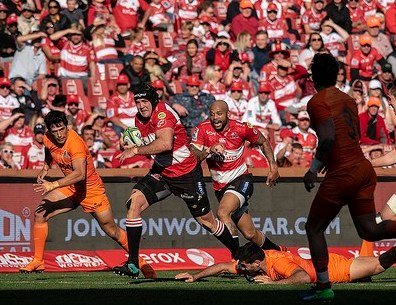
Lions hooker Malcolm Marx on the rampage once again. Photo by Marcel Sigg, runridedive.com

Lions hooker Malcolm Marx on the rampage once again. Photo by Marcel Sigg, runridedive.com

When the ACT Brumbies’ style of play dominated rugby in the early 2000s there were many pseudonyms for what they were doing – structured rugby, expansive rugby, multiphase play, all set up by skilful ball-carriers.

The Jaguares reminded me a bit of that multiphase play at Ellis Park on Saturday afternoon as they valiantly held on to the ball for phase-after-phase. But the game has moved on since the glory days of Gregan, Larkham and Finegan and these days teams trust their defences to hold out for long periods, eventually forcing the error or a one-off runner that is vulnerable to the breakdown steal.

We saw it in the Crusaders’ victory over the Sharks in the other SuperRugby quarterfinal featuring a South African side earlier in the day, and the Lions’ defence was the biggest factor in their 40-23 win over the Jaguares.

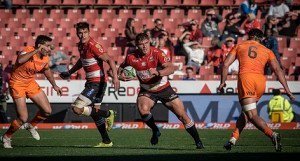
As the Jaguares pushed and prodded with more determination, so the Lions just worked harder and with more physicality in defence, simply not allowing the Argentinians to get their game going. Hooker Malcolm Marx led the way with vital turnovers, but Marnus Schoeman also contributed valuably and Kwagga Smith was also a presence at the breakdown.

“Collectively it was a massive effort and you have to give credit for all the turnovers to the guy who makes the tackle as well because he provides the opportunity. A guy like Malcolm is then just impossible to shift, Kwagga made one or two steals as well and Marnus was excellent when he came on. At stages the Jaguares kept the ball for a long time, but we showed good patience on defence,” Lions captain Warren Whiteley said after his team had clinched their third successive SuperRugby semifinal at home.

Run Ride Dive

Captain Warren Whiteley epitomises the Lions defence with this hit on Agustin Creevy. Photo by Marcel Sigg, runridedive.com

The Jaguares are certainly a force to be reckoned with going forward in SuperRugby, as they showed in the third quarter when they came from 9-24 down at the break to close to 23-27.

They were piling on the pressure, but Marx won three turnover penalties and those are the crucial interventions which win knockout games, with coach Swys de Bruin talking afterwards about “great defence at the right times”.

Jaguares coach Mario Ledesma spoke afterwards about how disappointing it was to concede three “soft” tries in the first half, but the Lions are a clever, innovative side on attack, able to try different things and generally pretty clinical.

All three of the tries came from different kicks: An Elton Jantjies crosskick found wing Ruan Combrinck with pinpoint precision for the first try; centre Harold Vorster followed lovely sleight of hand with a clever kick through that became even more effective thanks to the pace of Aphiwe Dyantyi getting there first to hack through and allow Vorster to score after the Jaguares made a mess of the clean-up operation; and a little dink over the top by flyhalf Jantjies was gathered by scrumhalf Gonzalo Bertranou, but his loose pass was immediately intercepted by Marx, who roared away from the 10m line for the try.

The Lions were cruising with a 24-9 halftime lead, but the admirable Jaguares were not done yet though as Bautista Delguy used his quick feet to score a fine try down the right wing two minutes after the break, and seven minutes later the visitors scored again as flank Pablo Matera crashed over. It was not the best grubber kick by the Lions that had given them broken-play possession.

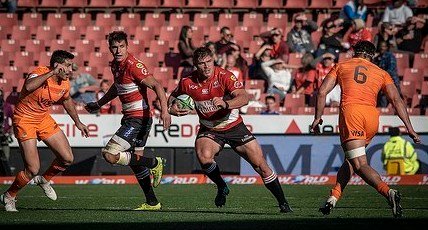
Flank Cyle Brink, after a barnstorming first half, did not come out for the second half due to a shoulder ‘stinger’, but it was not a problem for the Lions as his replacement, Schoeman, played with tremendous industry. He showed terrific tenacity in the build-up to Andries Coetzee’s try as the fullback wriggled through a couple of tackles.
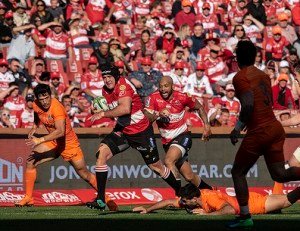
Lions flank Cyle Brink on another storming run. Photo by Marcel Sigg, runridedive.com
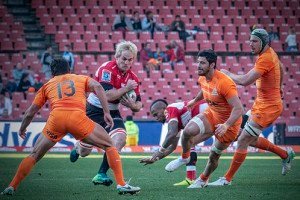
Lions flank Cyle Brink on another storming run. Photo by Marcel Sigg, runridedive.com

A typically combative Marnus Schoeman. Photo by Marcel Sigg, runridedive.com

A typically combative Marnus Schoeman. Photo by Marcel Sigg, runridedive.com


Being a knockout game, coach De Bruin had deemed shots at goal acceptable and Jantjies, who produced a polished performance that included a seven-from-seven success rate from the tee, then slotted a sweetly-struck drop goal to take the Lions’ buffer to two converted tries (37-23).

The seventh successful kick at goal by Jantjies was the penalty that completed the scoring with five minutes remaining, confirming that they will host the Waratahs at 3pm next Saturday in the semifinals.

The other huge positive for the Lions was the tremendous dominance of their scrum. The number of set-pieces was relatively low, but whenever the home side needed it, their scrum won them penalties or gave them strong front-foot ball.
 

  • Recent Posts

  • Archives

  • Thought of the Day

    Revelation 3:15 – “I know your deeds, that you are neither cold nor hot. I wish you were either one or the other.”

    How can you expect blessings without obeying?

    How can you expect the presence of God without spending time quietly before him?

    Be sincere in your commitment to Him; be willing to sacrifice time so that you can grow spiritually; be disciplined in prayer and Bible study; worship God in spirit and truth.

    Have you totally surrendered to God? Have you cheerfully given him everything you are and everything you have?

    If you love Christ, accept the challenges of that love: Placing Christ in the centre of your life means complete surrender to Him.


↑ Top