for quality writing

Ken Borland


Archive for the ‘Cricket’


Absorb intensity and assess the situation: Princely advice and what was lacking 0

Posted on October 13, 2026 by Ken

In wonderful batting conditions, South Africa dismayed their sparse number of supporters at the ground with a naive, almost clownish batting display.
The Ball in Play

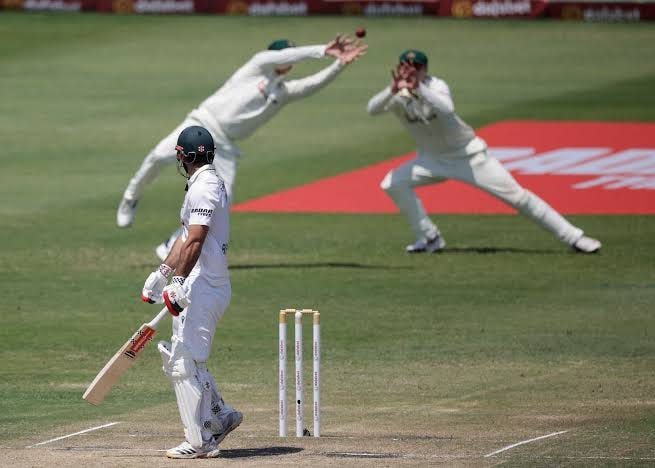
Steve Smith is about to catch David Bedingham, who has played an ill-advised back-foot drive, for one of his four catches, three of them brilliant, which gave him the world record for the most outfield catches – 223.

Absorbing intensity and assessing the situation were the two key phrases used by Proteas batting coach Ashwell Prince at the end of the third day of the first Test against Australia at Kingsmead on Sunday.

It was a day which ended with Australia leading by 139 runs with all 10 second-innings wickets intact. That fact alone suggests things did not go well with the bat for South Africa, who had begun the day on 27 for one in reply to Australia’s 390.

While it may seem appropriate to blame the bowlers for allowing the tourists to score so many first-innings runs, having been 124 for six at one stage, Australia’s revival was down to the conditions easing and the brilliance of Matt Renshaw in scoring a career-best 190 which was the epitome of patience and good judgement.

So the template for success with the bat was there, plain to see, and South Africa’s batsmen had seen it up close for the whole of the second day as they toiled in the field under clear blue skies and a north-easterly wind: Leave well, stick to safe shots that fit your game plan and make the bowlers bowl to you.

But the Proteas top-order ignored what had been in plain sight and tumbled to 284 all out. The fact that their first innings made it that far – a deficit of 106 – was thanks to partnerships of 52 for the ninth wicket between Simon Harmer and Keshav Maharaj (34) and 35 for the last wicket between Harmer (35*) and Anrich Nortje (16).

Those two last partnerships showed up the proper batsmen for their lack of composure and indicated that there were no demons in the Kingsmead pitch. The north-easterly blew again and batting should have been a pleasure. The pace and carry were true, the new ball moved around just a bit and off-spinner Nathan Lyon obtained bounce but not much turn.

Australia bowled full lengths at the start of the day, looking for swing with the ball being nine overs old, and Aiden Markram and David Bedingham capitalised with a series of handsome drives.

They put on 84 for the second wicket in an hour-and-a-half and all seemed right with the world.

But Australia, who have undoubtedly played smarter cricket than the hosts, then switched to back-of-a-length bowling, plugging the line just outside off-stump. Markram fell for 37 trying to punch Mitchell Starc off the back foot through the covers with little footwork; Bedingham did much the same on 49 to give Pat Cummins his first wicket. The back-foot drive is a difficult stroke to play on a pitch renown for the bounce it offers.

Lyon and Starc bowled particularly well to Proteas captain Temba Bavuma, who could only score three runs off 26 balls. And so he tried to relieve the pressure through a reverse-sweep, which was a reasonable option. Except when Steve Smith is at slip and, in a moment of brilliant anticipation, he moved rapidly into the likely path of the ball and made the catch.

Bavuma could maybe be sympathised with, but when Kyle Verreynne (13) did exactly the same thing two-and-a-half hours later, it seemed awfully naive and foolish, notwithstanding the psychic Smith making a sensational one-handed grab.

That was the most frustrating aspect of the Proteas’ batting display, their complete failure to learn from what had happened before. Renshaw had been widely praised for leaving so much during his epic innings; South Africa’s batsmen flashed with abandon outside off-stump.

Cummins then devoured the middle-order as both Wiaan Mulder (30) and Tristan Stubbs (32), who had combined promisingly for a 56-run fifth-wicket stand in just over an hour, tried to hook well-directed bouncers in that off-side channel. Not taking the bait would have been a far better option.

Marco Jansen lifted the mood briefly with six fours in a 26 off just 20 deliveries with powerful pulls and classy drives down the ground. But then he too picked the wrong delivery to attack. Josh Hazlewood hit the deck hard and bowled a straight line, cramping Jansen, who still tried to clear mid-on but with a more vertical bat, only managing to sky the ball to mid-off.
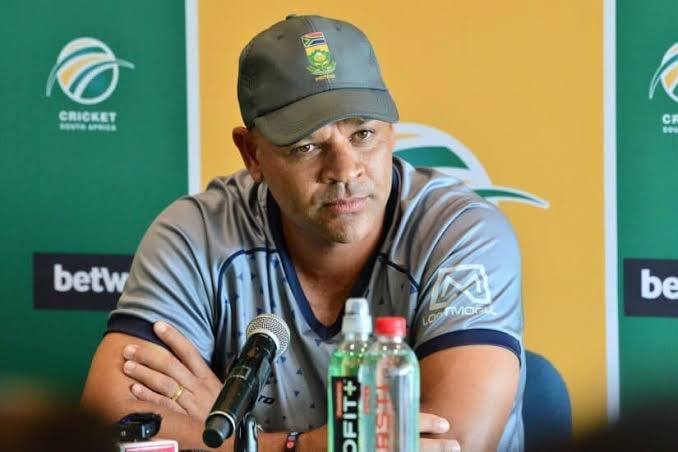
Ashwell Prince in serious mood trying to explain the Proteas’ batting woes.

Ashwell Prince is the batting coach of the Proteas and the man who shored up their middle-order in the 2000s was careful to tread gently as a guardian of his charges.

“I don’t think there was too much aggression, it was more the timing of the dismissals, which kept hurting us. Everyone has their individual approaches and we’ve talked a lot about playing positively and being on the front foot.

“In the subcontinent we played spin well and all the sweeps are options there. As long as the guys have been training them and playing them well, then you can accept it when they get out to one. They were a couple of blinders by Steve Smith.

“It was a really good innings by Renshaw and he deserves a lot of credit. He was very patient and he took the approach of wearing the bowlers down. Everyone has their personal approach and some are more aggressive, they go after their shots more and sometimes it does not pay off.

“There’s lots to take away from today, probably the biggest learning is that the make-up of the Australian attack means they are heavily dependent on three seamers and they have a classy spinner, they come at you with a certain intensity, but that can only last for so long. Sometimes you have to absorb intensity, because it can only last so long.

“The pitch so far has been pretty good and most batsmen feel that they can play more strokes. The ball seemed to come on better today, the bounce was consistent. You could trust the bounce and pace, so the confidence is there.

“Maybe we need to be better at sensing the intensity of the bowlers and assessing the situations. Pat Cummins is astute and when he feels they have a sniff, he pushes his fast bowlers. Just when it looked like a partnership was going to wrestle the advantage our way, a wicket would fall. Every time that would energise them and the bowlers would come again,” was Prince’s carefully considered, diplomatic response.

Australia came out to bat for 25 minutes before bad light stopped play and their dominant position allowed them to be aggressive. Nic Maddinson, who had made a 33-ball duck in the first innings, shook off the pressure of being a controversial selection and hooked his first ball from Marco Jansen for four.

The comeback man added one more four and a flick for six over midwicket to reach 17 not out off 19 balls at stumps, with Travis Head on 10 not out off 15 deliveries, out of a total of 33 without loss.

Prince believes they will bring the same aggressive approach on the fourth day.

“Tomorrow we’re going to see a lot more of the same approach, they’re going to come out with a lot of aggression to try and make up time and stretch their lead as much as possible,” he said.

South Africa will need to try and prolong the amount of time Australia spend at the crease, to make their task of saving the match an easier one. To do that, Prince says they will need to attack rather than defend.

“Taking wickets will be our best approach, while trying to control the run-rate at the same time. In the first innings, Australia made a big total, but they scored it at 2.8 runs-per-over. It’s a different scenario now that they are over a hundred ahead and they can take more risks.

“So we have to be positive, we’ll probably see more spin tomorrow and some innovative field placings to put the ball in their court,” Prince said.

Innovative is one thing, but what the Proteas most require is smarter cricket.
North-easterly sees Proteas’ prospects go south at Kingsmead 0

Posted on October 11, 2026 by Ken

An ill wind blew for South Africa on the second day of the first Test against Australia in Durban on Saturday. Ken Borland explains the day, with help from Wiaan Mulder and the heroic Matt Renshaw.

The Ball in Play

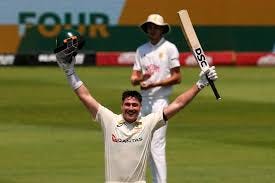
Matt Renshaw celebrates his tremendously well-crafted, determined century, which he took to a career-best 190.

With a north-easterly wind blowing over Kingsmead, the Proteas’ prospects went south on the second day of the first Test against Australia in Durban on Saturday.

Having been reduced to 124 for six midway through the second session of the opening day, Australia managed to stabilise their innings and reach 187 for six at stumps.

On Saturday, with a 9.30am start and the pitch having provided assistance to the bowlers through the first day, as well as the second new ball being due in 14.4 overs, South Africa would have been confident of wrapping up the Australia innings for the addition of maybe 70 runs maximum.

But those who know Durban and Kingsmead know that the wind direction here is crucial to how the pitch behaves. Never mind the mythical effect of the tide coming in or out, with the Indian Ocean just a kilometre away. When the south-westerly blows, it is the cool wind bringing moisture, clouds and rain. The grass on the pitch stands up and the ball swings and seams.

The north-easterly, however, is the warm wind, bringing clear blue skies and hot weather from the Mozambique Channel. The increased temperature sees the grass on the pitch wither and what used to be a snakepit affectionately known as the Green Mamba (a highly venomous snake found along the KwaZulu-Natal coast) becomes a batting paradise.

And so South Africa’s bowlers toiled on the second day. In their way stood Matt Renshaw, a gritty Yorkshire-born Queenslander who played with immense control and determination to score a career-best 190 in 468 minutes, off 397 balls. The epic effort lifted Australia to 390 all out, a highly-impressive comeback from 124 for six and an above-par total that means the Proteas will have to bat very well in their first innings as the pitch is expected to take more turn as the match progresses.

The lower-order stood their ground in support of Renshaw with great application.

Captain Pat Cummins scored 43 as he survived the important first nine overs of the day, extending the seventh-wicket partnership to 86.

Wiaan Mulder had Cummins caught at second slip and then bowled Mitchell Starc for nine with a beauty that pitched middle-and-leg and hit middle-and-off as the left-hander tried to flick the ball through midwicket.

It was 230 for eight, the new ball had just been taken and the Proteas once again seemed on track to have 250-odd to reply to.

Nathan Lyon averages 12.53 with the bat in Africa, but he did score 47 and share a 66-run ninth wicket partnership with Tim Paine in the infamous Newlands Test of 2018. He has caused South Africa frustration with the bat a couple of times, but on Saturday he took it to new levels and, together with Renshaw, broke a Donald Bradman record.

Renshaw made a plan to protect Lyon from strike as much as he could and executed it brilliantly. The off-spinner scored just seven of the first 50 runs they added.

When the partnership reached a hundred, the first time Australia’s ninth wicket has ever done that against South Africa, Lyon had made 17. The previous record was the 78 the great Bradman and Bill O’Reilly put on in Adelaide in 1932.

Eventually, with the tea break 15 minutes away, Marco Jansen fired a yorker into Lyon’s pads to trap him lbw for 27. The partnership had been worth 134 and had taken Australia to 364.

Wiaan Mulder took four wickets for the third time in a Test innings, showing great skill as he swung and seamed the ball.

Mulder, who finished with a four-wicket haul for the third time in his Test career, praised Renshaw’s innings, while also musing that the home side had perhaps not always deployed their fielders in the best places when the left-hander was dominating the strike.

“Renshaw played beautifully, he left really well. He was able to keep the strike, which was really important, and played the situation as well as anyone can. You have to credit him for playing the conditions as well as anyone.

“I don’t think things went wrong for us, it’s just that they played well. We executed most of our plans, maybe we could have bowled a touch fuller, but it was just a good innings to be honest. He left extremely well, with the spongy, steep bounce, sometimes he let it go over the stumps.

“He seemed to get off strike so easily. He had a very different approach to the first four balls of an over and maybe we could have been smarter with the field, that’s something we’ll have to look at. Maybe we could have made it a bit harder for him, but we bowled well and put the ball in the right areas,” Mulder said.

Renshaw, whose innings eclipsed the late Phil Hughes’s 160 as the highest score for Australia against South Africa at Kingsmead, said the aim had been to keep the home side in the field, on a hot day, for as long as possible. Hence there was little need to over-attack and Australia stretched their innings out to 137.2 overs, Renshaw eventually being caught at slip off Simon Harmer, two balls after the tea break that had been delayed for half-an-hour.

“The benefit was keeping them out in the field for as long as possible and their quicks were bowling around 30 overs. I had to play the 4+2 game and sometimes I had to think hard about how to get off strike at the end of the overs, I played some of the weirdest shots I ever have. There was a lot of thinking about how many balls I needed to face and it was tough when the field was spread, I had to try and hit twos,” Renshaw said.

The clouds were just starting to roll in when South Africa, no doubt physically and mentally fatigued from their ordeal, began their reply. The dismissal of Ryan Rickelton, driving loosely at his third ball, and edging the waft to third slip off Josh Hazlewood, looked suspiciously like the after-effects of all that frustrating time in the field.

Aiden Markram (15*) and David Bedingham (12*) found the boundary five times between them with handsome drives as they took South Africa to 27 for one before the umpires mercifully ruled bad light had ended their long day.

Kingsmead’s dull vibe invigorated by Nortje’s return 0

Posted on October 10, 2026 by Ken

How the 1st day of the long-awaited Test series between 2025 World Test Champions South Africa and losing finalists Australia went in Durban.

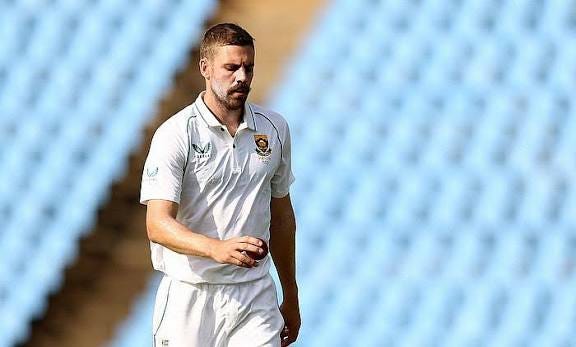
Anrich Nortje bowled with consistent pace, control and skill on the first day.

A dull (in terms of the weather) afternoon in Durban saw Australia reach 187 for six in 65.2 overs before bad light stopped play midway through the final session. Anrich Nortje, playing in his first Test since 2023, had earlier taken two wickets in three balls to plunge the tourists into deep trouble on 124 for six and have the sparse number of South African supporters in sheer delight.

Matt Renshaw (46*) and captain Pat Cummins (33*) showed great determination to keep an excellent Proteas attack out for the remaining hour-and-a-half, but the thrill of seeing a genuine fast bowler return to the Test arena, and enjoy success, had been the highlight of the day.

Having not added to his tally of 70 Test wickets at 26.71 since March 2, 2023, Nortje made a brilliant double strike that left the home side the happier of the two and also allowed him to be full of smiles in the post-play press conference.

“I thought I wasn’t going to get a wicket for the next few weeks the way every ball passed the bat,” Nortje said with the sort of hard-done-by-ness that seems to be hard-wired into fast bowlers.

But after that the 32-year-old was all smiles, delighted just to be out in the middle competing in a format he described as “the best there is”.

“It was good to get the first wicket, it got the blood flowing again, but first and foremost it’s great just to be out there, especially wearing the baggie which was getting a bit worn out just lying at home. Aiden Markram actually said it seems to be part of my game that I don’t get wickets for a while and then I get two very quickly.

“I would have liked to have finished that last spell before bad light and I enjoy the hard graft of coming back for a third or fourth spell, when you have to dig deep,” Nortje said after returning figures of 13.2-2-40-2 on Friday. The way he kept his speeds up above 140km/h spoke to his excellent conditioning.

There are many different excuses given for the poor crowd attendances at Kingsmead, ranging from it being the government’s fault for tanking the economy to the Indian Ocean’s fault for looking so inviting, but it was inexcusable that such a long-awaited series, between great rivals and the finalists of the last World Test Championship, should commence at 9.30am under the bluest of skies but with a backdrop of sheer apathy from so-called cricket lovers.

Marco Jansen and Wiaan Mulder had some unruly moments with the new ball after Australia had elected to bat first, but at least they had a plan. Visiting openers Nic Maddinson and Travis Head are both left-handers, and the tactic early on was clearly to swing the ball back into their pads, looking for lbw.

South Africa should have reviewed when Mulder did just that in the fourth over, but the Proteas declined. Hawkeye showed it was very much out.

Mulder, who moved the ball impressively, did get a wicket four overs later when a delivery swung down leg, Head (9) tried to flick it away but edged the ball on to his thigh, from which it travelled into the gloves of Kyle Verreynne.

Jansen, who also used his ability to extract steep bounce to good effect, removed Maddinson for a 33-ball duck as he threw in a fuller, wider delivery, the left-hander’s eyes lit up and he inside-edged the ball into his stumps.

The debate over Maddinson’s selection has not quite reached the halls of Australia’s government, but it is astonishing. The bare facts are that he turns 35 in December, has not played a Test since 2016 or any red-ball game since March 2025. In his previous three Tests, he batted four times and scored just 27 runs.

On the plus side, Maddinson did survive for 50 minutes in what turned into a probing examination of technique and cha​acter.

From 24 for two, the veterans, Marnus Labuschagne (37) and Steve Smith (25) took Australia to the brink of lunch with a 60-run stand. It looked like the boasting rights for the session would go to the visitors.

But with the last ball before lunch, Mulder managed to nip a delivery into Labuschagne’s pads, the South African-born player trying desperately to get outside the line of off-stump, but his review showing he had just failed (umpire’s call).

Three balls after lunch, Mulder was in the gully to snaffle an edge from Smith’s bat off Jansen, the tall left-armer having thundered a lifter into his gloves the previous delivery.

Alex Carey (14) provided some stabilisation with Matt Renshaw for the next hour, before the return of Nortje and his dramatic one-two.

Carey was removed by a beautiful delivery – perfect length, Carey did not get forward and then the ball moved away and across the left-hander, Markram taking the catch at second slip.

Beau Webster clipped his first ball through midwicket for four, but his second saw him trying to defend well outside off-stump, the delivery straightened and he was caught behind. Umpire Richard Kettleborough, who had a tough day, ruled not out probably because the bat had hit the pad, but another excellent review showed the ball had found the other edge of the bat too.

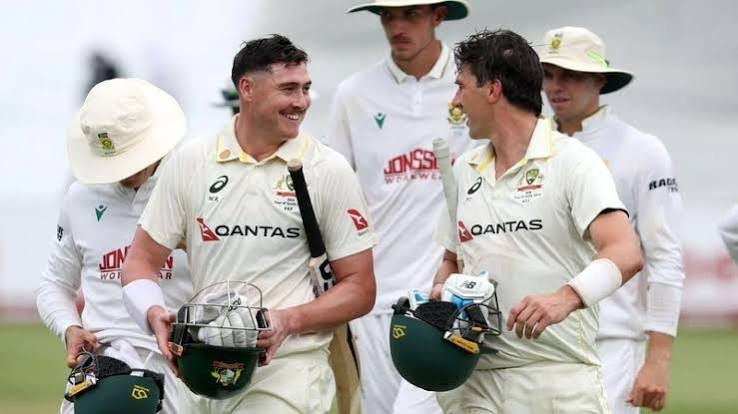
Matt Renshaw (left) and captain Pat Cummins are all smiles after their unbeaten seventh-wicket stand of 63 took Australia through to early stumps due to bad light.

How Renshaw and Cummins progress on the second morning will decide whether Australia have capitalised on a good toss to win.

Nortje has made a decision of his own during his lengthy injury absences. Just like getting a new haircut for your first day back in the office, he is modelling a slightly new action.

“After the T20 World Cup last year and the IPL, my action wasn’t looking great. When I compared it to old footage I could see how bad it was, in terms of my action, my angles and the flow of my arms.

“So I decided to make it right so I could be more consistent and help my body to prolong things. I decided that I had to change things up, I couldn’t go back to what I was doing in 2020 otherwise muscle memory would just take over again and I’d be back where I was.

“So I’ve been working on a new action, the angles of my run-up, my jump and how my arms flow. It might look the same but it’s not, technically it’s slightly different. My action is always a work in progress, I’m never 100% satisfied, but it feels better than ever and I’m very happy with where I’m at,” Nortje said.

And so he should be. As should the Proteas after a successful opening day of the series.

Champions Trophy success hangs on batting & Bavuma heartened by SA20 form 0

Posted on October 06, 2026 by Ken

South Africa captain Temba Bavuma says the success of their Champions Trophy campaign hangs on how well they bat in good batting conditions in Pakistan.

And the Proteas skipper is heartened by the good form most of his batsmen have shown in the ongoing SA20, which concludes on February 8, nearly two weeks before they open their Champions Trophy campaign against Afghanistan in Karachi on February 21.

David Miller has not only captained Paarl Royals to the top of the log and a place in the playoffs already, he is averaging 91.50 with the bat at a strike-rate of 134. Rassie van der Dussen is averaging 50.40 for MI Cape Town, while his opening partner Ryan Rickelton has been restricted to just four innings due to a hamstring strain, but has passed 50 twice in that time.

Aiden Markram is leading from the front for Sunrisers Eastern Cape, averaging 40.50 at a strike-rate of 138, while all-rounder Marco Jansen averages 32.80 at a strike-rate of 131 for the same team.

Even key finisher Heinrich Klaasen found some form in his last game as he plundered 66 off 43 balls for Durban Super Giants against high-flying MI Cape Town at Newlands.

Miller (6th), Van der Dussen (3rd), Rickelton (7th), Markram (4th) and Jansen (10th) are in the top-10 run-scorers list.

“I’m really glad that the core of our batting line-up is doing well in the SA20. In Pakistan we should get friendly pitches for batting, so you need in-form batsmen so that you can take control of matches over there,” Bavuma told sportsboom.co.za.

Interviewed as one of the celebrity guests for a South African Breweries function, Bavuma did, however, admit that the loss of several high-profile Proteas bowlers to injury was concerning. Gerald Coetzee, Anrich Nortje and Daryn Dupavillon, who has played two ODIs, were all recently ruled out of the SA20 tournament, while Nandre Burger, Lizaad Williams and Beuran Hendricks were all forced to withdraw before the event started.

Lungi Ngidi last played on January 18 and has been surrounded by a fitness cloud for most of the summer. He and Nortje were both named in South Africa’s original Champions Trophy squad. No replacement has yet been named for Nortje, with coach Rob Walter hoping Coetzee will recover in time from his hamstring strain.

“There are more question marks over the bowling, but obviously injuries are part of the game,” Bavuma said. “Bowling has always been our strength and you want to be in the position where you can select from everyone. But I have a lot of pride in this team that they always find a way, even if they have to do it the hard way. These sort of injury questions are nothing new.”

Bavuma is probably entitled to feel it will all be okay once they hit the big stage in Pakistan due to the tenacity his team have shown previously. After a torrid start to the World Test Championship, they have regrouped and qualified for the final against Australia in June.

“That this team always seems to find a way speaks to the character and environment in the squad, you are allowed to be yourselves. There have been lots of positives in the last year and the team has been successful in making the Test final.

“We ticked that box, that is a step in the right direction, but we are not at the end of our journey, we still want to achieve more. But we’ve shown we can win away from home, even though we are an inexperienced side. It’s about managing the space. The youngsters have stepped up, the way they have reacted has definitely contributed to our success.

“We obviously want to continue in that vein, but we want to be a lot more disciplined because that will lead to excellence,” Bavuma said.

The Proteas will be able to ready themselves for the Champions Trophy in an ODI tri-series with Pakistan and New Zealand in Lahore and Karachi from February 8.


↑ Top