for quality writing

Ken Borland


New book details how Erasmus was always in full possession of his faculties & emotions 0

Posted on July 29, 2026 by Ken

Staying calm under pressure is probably the most necessary attribute needed to succeed at the highest level of sport and Marais Erasmus always gave the impression when he was umpiring out in the middle that he was in full possession of his faculties and emotions.

Getting 94% of your decisions correct – the general benchmark for being on the International Cricket Council’s Elite Panel of umpires – requires great composure and equanimity, as well as the ability to maintain credibility and authority in the highly-charged arena of the game at its pinnacle.

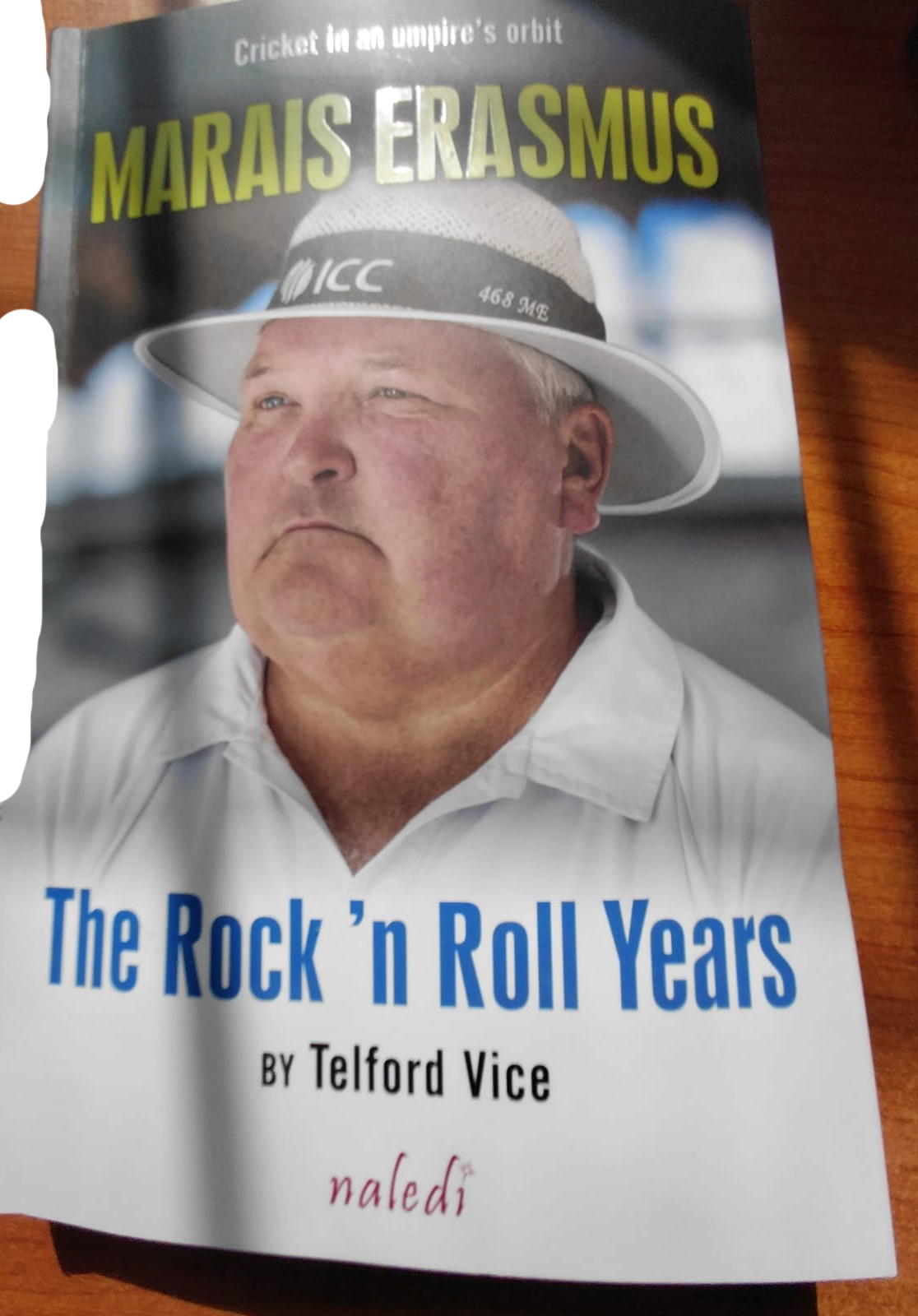
They are the qualities that Erasmus was most known for during his 16-and-a-half years as an international umpire. As renowned Indian commentator Harsha Bhogle says in the Foreword to the biography Telford Vice has written on the South African umpire – Marais Erasmus: The Rock ‘n Roll Years – “Apart from everything else, umpires, like doctors, must radiate confidence and a sense of calm. Marais Erasmus had that. When he walked out on to the field, you felt secure. You knew you were in safe hands.”

While the former Boland bowling all-rounder’s ‘bedside manner’ was imperturbable, Erasmus himself says it is a bit of an illusion.

“I didn’t set out to have a straight face all the time, and I did struggle sometimes not to show my emotions. But I couldn’t give away to the players that I was shitting myself, they do pick up that sort of thing.

“I just tried to apply the laws, even though sometimes a law is controversial. There are some grey areas in cricket, although less so than in rugby. I think it helps immensely to have been a former player, although it’s not a given that if you played good cricket you will become a good umpire – there are lots of other skills involved.

“Simon Taufel was one of the best umpires ever and he didn’t play first-class cricket, so potential umpires shouldn’t be discouraged if they didn’t play to a high level. But at the Elite level, on average 10 of the 12 on the ICC panel will have played first-class cricket, a lot of them have played international cricket. In South Africa, about 40% of our umpires are former first-class players. It means you’ve been in pressure situations before, the players will accept you more and that gives you confidence,” the former Boland flyhalf/fullback says.

The cricket world changed dramatically while Erasmus was progressing from a player who retired in 1996/97 to making his international debut as an umpire in 2006, standing in his first Test in 2010. In that time, the television umpire has become crucial, and the IPL arrived, making India the global superpower of the game. But, unfortunately, India have also not been shy to exert a “Might Is Right” philosophy on cricket and they are used to getting what they want. Which included not using DRS for their games until the absence of it had burned them too often.

Hostile crowds are matched by over-stimulated players like Virat Kohli, who occasionally lose their impulse control. One of India’s greatest captains infamously shouted into the stump-mics at Newlands in January 2022, accusing broadcasters SuperSport and the umpires of bias. Erasmus was standing in that match alongside compatriot Adrian Holdstock due to the Covid pandemic and the difficulties it caused in terms of international travel.

Erasmus had to give Sachin Tendulkar out lbw in his debut Test, thankfully not in India, where international cricket’s leading run-scorer is literally considered to be a god. These are also the days of social media allowing millions of people to dissect and criticise every decision. The officials can be crucified in the court of public opinion should they get the wrong decision wrong at the wrong time. Just think of how we South Africans curse referee Bryce Lawrence to this day for giving David Pocock free rein in the breakdowns during the 2011 Rugby World Cup quarterfinal.

So Erasmus experienced pressure right from the outset and his ability to handle it saw him appointed to the middle for seven World Cup finals across the formats, including the greatest of them all, the 2019 finale’ at Lord’s when England and New Zealand tied and England won the super over.

“Virat was like some of the kids when I was teaching. You give him Ritalin in the morning and you’ll have a good day. But sometimes by second break it’s gone … But we had a good relationship. David Warner is a dangerous man because he doesn’t understand when he’s being stupid and Ricky Ponting always wanted to fight with umpires,” Erasmus says.

Nathan Lyon is someone Erasmus singles out as a favourite, the Australian off-spinner saying on a live television interview that “Marais is a great man and an even better umpire,” when former captain Mark Taylor asked pointed questions about decisions that did not go their way.

Ben Stokes is another who Erasmus found to be likeable and the recently-retired England captain was, of course, pivotal in that 2019 World Cup final.

“Ben is one of my favourites. When you go to a team’s practice, some of the players ignore you but others come up to you. Ben would always ask how the last few months have been, how’s your family? He’s a good human being, although he has got himself in trouble and been through some fires on occasion.”

The details of the drama of the overthrows off Stokes’s arm and the full explanation as to why England were credited with an extra run they shouldn’t have been, are all in the book. Typically, Erasmus does not shy away from accountability.

“The overthrow incident was just a mistake. Kumar Dharmasena and I looked at each other and said ‘Six? Yeah’. Rod Tucker, the TV umpire, asked over the comms whether it was six and Peter Manuel, who was our umpires coach, was trying to explain that where the ball was released was crucial. But that was impossible for me to see.

“Part of the romance of our sport is that the umpires are not without blemish. The only way to survive as an umpire is not to dwell on your wrong decisions. Our coaches used to tell us to park them; my one New Zealand colleague then said ‘but my parking lot is full’.”

In Marais Erasmus: The Rock ‘n Roll Years, the subject brings that same voice of reason and gentle humour to corruption in cricket, the rise of technology and the many memorable Ashes clashes he was involved with.

Boks look in good hands with emboldened Erasmus 0

Posted on August 08, 2018 by Ken


Whenever a governing body hands a coach a long-term contract it is an expression of faith in that person’s ability to succeed, whatever the vagaries of sport or that old chestnut that there are only two types of coaches – those that have been fired and those that are still going to be fired. Remembering of course that the longer a contract, the bigger the payout should it be prematurely terminated.

So to say SA Rugby have faith in new Springbok coach Rassie Erasmus is an understatement, given that they have given him a six-year contract, the longest in any sport in the world, longer than Pep Guardiola or Jose Mourinho.

But their extraordinary decision has certainly had a positive effect judging by the bravery with which Erasmus and his team approached their first four assignments.

Given that he has such job security and knows his buddies in the SA Rugby boardroom want him to have the job, Erasmus was able to make some bold selection calls against Wales and England, and his courage certainly seemed to have rubbed off on the players, given the ambitious rugby they produced and the way they bounced back from big deficits to win the first two Tests against the English.

The fear of failure that characterised the Allister Coetzee years has seemingly gone and a young, inexperienced team showed signs of blossoming into something wonderful. Coetzee had good reason to believe the administrators were waiting for him to fail and it showed in his conservative selections and game plan.

Judging by his first month as coach, it seems the Springboks are in good hands with Erasmus.

The players certainly seem to have enjoyed his coaching and, most importantly, you had to give them 10/10 for character with the way one of the most inexperienced sides in Springbok history overcame a horror start at Ellis Park and another poor opening quarter in Bloemfontein.

Which is not to say everything is perfect in the Springbok camp ahead of the Rugby Championship starting in August. But given the number of players who are just starting out on their international careers, who knows whether what we saw against England is 50% or 80% of their potential.

Probably the area which requires the biggest improvement is the mental side of the game and their ability to adapt to conditions that don’t suit them. Although it was heartening to see the intensity and pace with which they played in the first two Tests, there are times – such as when Newlands is a sodden quagmire – when you have to play the percentages better.

Ellis Park and Bloemfontein – both on the highveld and with weather suiting a quick game – are obviously very much in the Springboks’ comfort zone. The indiscipline and basic errors of the Newlands display indicated a team that was just a bit freaked out by very different conditions.

Since the last World Cup, South Africa have won just three of their last 14 games away from home. The challenges of playing in Mendoza, Brisbane and Wellington lie ahead. Mendoza is the heartland of Argentinean rugby and they pump up the passion even more there, making it a hostile place for visiting teams. The Springboks have won just once in 12 attempts in Brisbane and they have not been able to beat the All Blacks in Wellington since 1998.

But given the honesty of the straightshooting Erasmus in dealing with the negative aspects of his first four games in charge, I’m sure he will not be shying away from the tough questions that need to be asked in order to sort out the Springboks’ issue with playing in foreign conditions.

https://www.pressreader.com/south-africa/the-citizen-kzn/20180630/282574493816989

Foreigner coach idea not discounted by Saru, but Coetzee still favourite 0

Posted on December 05, 2015 by Ken


The idea that a foreigner could succeed Heyneke Meyer as the coach of the Springboks was not discounted by South African Rugby Union (Saru) president Oregan Hoskins on Friday, but a strengthened emphasis on transformation means Allister Coetzee surely remains the hot favourite to take over the poisoned chalice.

Meyer’s dignified exit from the role means Saru have a week in which to hunt down his successor and, with former Stormers coach Coetzee and current Lions mastermind Johan Ackermann the only realistic local candidates, speculation has been rife that the Springboks might have their first overseas coach.

“Yes, a foreigner is an option. We shouldn’t rule out anyone because we want best for South Africa, so we have to consider all the possibilities. There were 13 foreign coaches in charge at the 2015 Rugby World Cup, that’s the way things are going in rugby,” Hoskins said at Saru House in Cape Town on Friday as he addressed media about the Springbok coaching position.

John Plumtree and John Mitchell are the leading candidates in terms of overseas-born coaches, with both of them having led South African franchises in SuperRugby.

But Mitchell is likely to have a long list of demands – such as a four-year contract and being able to choose his own support team – which has been a sticking point in his negotiations to take over the Stormers coaching role.

Plumtree coached the Sharks for four years from 2008, winning two Currie Cup titles but generally under-performing in SuperRugby. Following his dismissal by the Sharks, the New Zealander became the Ireland forwards coach, before joining the successful Hurricanes side as an assistant in this year’s SuperRugby competition.

Former All Black Wayne Smith, a visonary attack coach for New Zealand’s 2011 and 2015 World Cup triumphs, has also been mentioned as a candidate but, like Mitchell and Plumtree, he would appear to be more likely to be involved as an assistant.

Coetzee, the backline coach in the Springboks’ 2007 World Cup win, has always been the favourite to succeed Meyer, having controversially lost out in 2008 when Peter de Villiers was appointed, but what has certainly caused his stock to rise were Hoskins’ comments that transformation would be a priority for the next coach of the national team.

“For the next four years, transformation will be key for us – we signed an agreement with Sascoc and the government. It has been Saru’s policy that the leadership doesn’t interfere in team selection, but we might have to look at that. It’s very difficult to have Saru interfering in team selection, but if policy is not implemented, then we would address that discreetly and find solutions. Anybody applying for Bok coach needs to know transformation is at the top of the agenda – otherwise don’t apply,” Hoskins said.

An overseas coach would probably struggle with the implementation of such transformation policy, while it is an area in which Coetzee, a former scrumhalf star in non-racial rugby, excelled during his time in Cape Town, while still guiding them to four appearances in the SuperRugby knockout phase as well as two Currie Cup titles.

Other favourites of the South African rugby public are Nick Mallett, who has however said he does not want to return to coaching, Robbie Deans, who, like Coetzee is currently coaching in Japan, and Ackermann.

The viewpoint of those involved in making the decision, however, would seem to be that Ackermann needs to gain more experience and win trophies with the Lions over the next four years.

Coetzee as head coach with a high-profile overseas assistant, and the involvement of Saru rugby general manager Rassie Erasmus, would appear to be what the governing body are currently angling for ahead of the expected announcement of the new Springbok management next Friday.


  • Recent Posts

  • Archives

  • Thought of the Day

    Have a fulfilled life by caring about the feelings of others. Show interest in the welfare of others, listen to their problems.

    Be tolerant of people and allow for their mistakes, because no-one is perfect.

    Follow the example of Christ, who showed sympathy and understanding towards all people.


↑ Top