for quality writing

Ken Borland


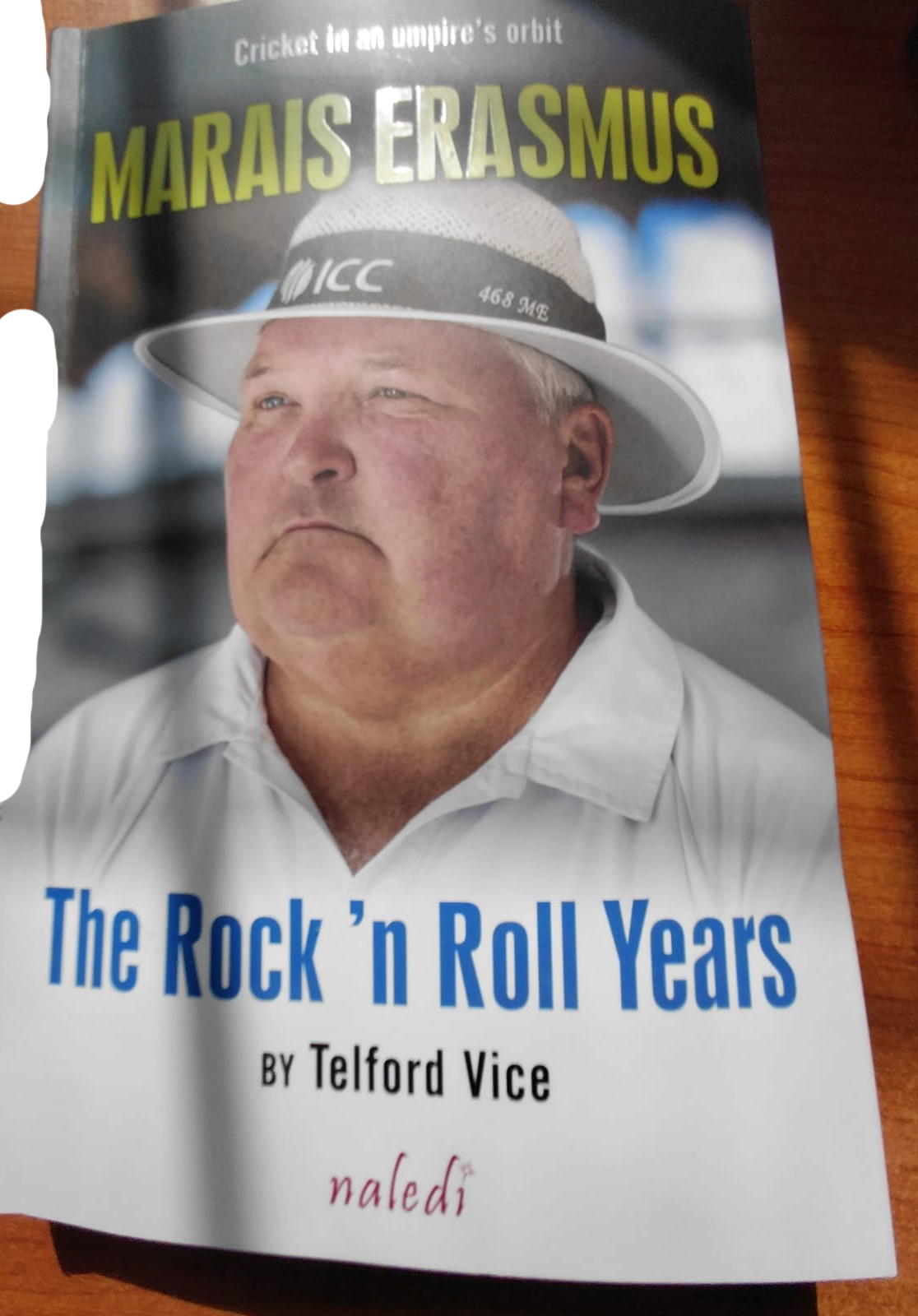
New book details how Erasmus was always in full possession of his faculties & emotions 2
Posted on July 29, 2026 by Ken

Staying calm under pressure is probably the most necessary attribute needed to succeed at the highest level of sport and Marais Erasmus always gave the impression when he was umpiring out in the middle that he was in full possession of his faculties and emotions.

Getting 94% of your decisions correct – the general benchmark for being on the International Cricket Council’s Elite Panel of umpires – requires great composure and equanimity, as well as the ability to maintain credibility and authority in the highly-charged arena of the game at its pinnacle.

They are the qualities that Erasmus was most known for during his 16-and-a-half years as an international umpire. As renowned Indian commentator Harsha Bhogle says in the Foreword to the biography Telford Vice has written on the South African umpire – Marais Erasmus: The Rock ‘n Roll Years – “Apart from everything else, umpires, like doctors, must radiate confidence and a sense of calm. Marais Erasmus had that. When he walked out on to the field, you felt secure. You knew you were in safe hands.”

While the former Boland bowling all-rounder’s ‘bedside manner’ was imperturbable, Erasmus himself says it is a bit of an illusion.

“I didn’t set out to have a straight face all the time, and I did struggle sometimes not to show my emotions. But I couldn’t give away to the players that I was shitting myself, they do pick up that sort of thing.

“I just tried to apply the laws, even though sometimes a law is controversial. There are some grey areas in cricket, although less so than in rugby. I think it helps immensely to have been a former player, although it’s not a given that if you played good cricket you will become a good umpire – there are lots of other skills involved.

“Simon Taufel was one of the best umpires ever and he didn’t play first-class cricket, so potential umpires shouldn’t be discouraged if they didn’t play to a high level. But at the Elite level, on average 10 of the 12 on the ICC panel will have played first-class cricket, a lot of them have played international cricket. In South Africa, about 40% of our umpires are former first-class players. It means you’ve been in pressure situations before, the players will accept you more and that gives you confidence,” the former Boland flyhalf/fullback says.

The cricket world changed dramatically while Erasmus was progressing from a player who retired in 1996/97 to making his international debut as an umpire in 2006, standing in his first Test in 2010. In that time, the television umpire has become crucial, and the IPL arrived, making India the global superpower of the game. But, unfortunately, India have also not been shy to exert a “Might Is Right” philosophy on cricket and they are used to getting what they want. Which included not using DRS for their games until the absence of it had burned them too often.

Hostile crowds are matched by over-stimulated players like Virat Kohli, who occasionally lose their impulse control. One of India’s greatest captains infamously shouted into the stump-mics at Newlands in January 2022, accusing broadcasters SuperSport and the umpires of bias. Erasmus was standing in that match alongside compatriot Adrian Holdstock due to the Covid pandemic and the difficulties it caused in terms of international travel.

Erasmus had to give Sachin Tendulkar out lbw in his debut Test, thankfully not in India, where international cricket’s leading run-scorer is literally considered to be a god. These are also the days of social media allowing millions of people to dissect and criticise every decision. The officials can be crucified in the court of public opinion should they get the wrong decision wrong at the wrong time. Just think of how we South Africans curse referee Bryce Lawrence to this day for giving David Pocock free rein in the breakdowns during the 2011 Rugby World Cup quarterfinal.

So Erasmus experienced pressure right from the outset and his ability to handle it saw him appointed to the middle for seven World Cup finals across the formats, including the greatest of them all, the 2019 finale’ at Lord’s when England and New Zealand tied and England won the super over.

“Virat was like some of the kids when I was teaching. You give him Ritalin in the morning and you’ll have a good day. But sometimes by second break it’s gone … But we had a good relationship. David Warner is a dangerous man because he doesn’t understand when he’s being stupid and Ricky Ponting always wanted to fight with umpires,” Erasmus says.

Nathan Lyon is someone Erasmus singles out as a favourite, the Australian off-spinner saying on a live television interview that “Marais is a great man and an even better umpire,” when former captain Mark Taylor asked pointed questions about decisions that did not go their way.

Ben Stokes is another who Erasmus found to be likeable and the recently-retired England captain was, of course, pivotal in that 2019 World Cup final.

“Ben is one of my favourites. When you go to a team’s practice, some of the players ignore you but others come up to you. Ben would always ask how the last few months have been, how’s your family? He’s a good human being, although he has got himself in trouble and been through some fires on occasion.”

The details of the drama of the overthrows off Stokes’s arm and the full explanation as to why England were credited with an extra run they shouldn’t have been, are all in the book. Typically, Erasmus does not shy away from accountability.

“The overthrow incident was just a mistake. Kumar Dharmasena and I looked at each other and said ‘Six? Yeah’. Rod Tucker, the TV umpire, asked over the comms whether it was six and Peter Manuel, who was our umpires coach, was trying to explain that where the ball was released was crucial. But that was impossible for me to see.

“Part of the romance of our sport is that the umpires are not without blemish. The only way to survive as an umpire is not to dwell on your wrong decisions. Our coaches used to tell us to park them; my one New Zealand colleague then said ‘but my parking lot is full’.”

In Marais Erasmus: The Rock ‘n Roll Years, the subject brings that same voice of reason and gentle humour to corruption in cricket, the rise of technology and the many memorable Ashes clashes he was involved with.

Hungry De Kock frustrated by rain 0

Posted on September 02, 2022 by Ken

Quinton de Kock said after the third ODI between South Africa and England that it was “nice to get out in the middle and score some runs” in his trademark understated way, but given the hunger he showed to make it really count on Sunday, the fact that rain limited his fun to just 76 balls in 105 minutes would have frustrated the 29-year-old.

The left-hander made the most of his time at the crease though, overcoming a scratchy start against excellent English seam bowling to stroke a marvellous 92 not out before the match was washed out. It was his first major innings since his phenomenal 140 not out for the Lucknow Super Giants against the Kolkata Knight Riders on May 18 in his penultimate IPL game.

De Kock had only batted five more times since then, suffering a hand injury during the Proteas’ T20 series in India, so he was eager to make his mark at Headingley.

“It was obviously nice to get out there and score some runs, spend some time in the middle after time away from the game,” De Kock said after the series was shared 1-1 with world champions England.

“The pitch was providing a bit of swing and movement, so I just had to soak up the pressure at first, 50 overs is a long time, and make sure I remained strong in my positions.

“I wanted to make sure I had a strong defence and put away the bad balls, while keeping the ball on the ground for as long as possible. That was the game-plan.

“It was tricky facing three left-arm seamers swinging it around. But we thought that might happen in this series, so we did our prep to make sure we weren’t caught off-guard,” De Kock said.

The three-match series did provide at least one unexpected outcome, with star England all-rounder Ben Stokes’s decision to join the growing number of players who have retired from a format of the game catching many off-guard.

De Kock himself is strictly a white-ball player these days, and pleasingly is still clearly a top-class practitioner who makes batting look so easy on days like Sunday. Part of his secret is that he does not overcomplicate things and he said how much cricket players should be willing to play is purely a personal decision.

“It is starting to be tough for those players who play in all three formats, that is a lot of cricket and there are even more games now over the calendar year,” De Kock said.

“It’s an individual decision, if you feel you can do it then I’m happy for you, but others have taken it into their own hands. It’s a personal decision.

“If you’re still young then I think you should still play in all three formats. But as you get older, the body doesn’t co-operate as much. It’s just about managing things to prolong our careers.

“But there are still World Cups I want to play in and win, I still have a lot to play for. I always try to make an impact, that’s what we’re here to do, no matter how many formats you play,” De Kock said.

Prince Lukhanyo of the Backline: It all comes back to family values in lieu of the bright lights of fame 0

Posted on February 28, 2022 by Ken

Rugby made the front pages of the celebrity magazines this week with the news that Prince Louis, the three-year-old son of Prince William and Catherine, the Duchess of Cambridge, loves playing the sport although his mother is a little concerned with how he always seems to be “in the middle of everything”.

It reminds one of South Africa’s very own modern-day prince of the backline, Lukhanyo Am. But while Prince Louis’ involvement is described as “kamikaze” by his mother, Am’s impact on the rugby field is anything but.

The much-loved Springbok and Sharks centre is a hugely influential player and leader for both teams. But he fulfils both roles with such calm, unflustered assurance that he seems to be gliding around the field, and he is definitely someone who leads by quiet, stellar example rather than by stirring words.

And his own mother, Zukiswa, still features large in his life. As do his siblings.

Now an international star and a certainty for most sensible peoples’ World XV (some even tipped him to be World Player of the Year for 2021), Am is a celebrity in his own right and in his own modest, self-effacing way.

With Sharks CEO Eduard Coetzee confirming that their salary to Am is based on their belief that he is the best outside centre in the world, the 28-year-old could spend his time away from rugby doing any manner of glamourous, exotic pursuits. But in lieu of the bright lights of fame, he returns to family and the values that were inculcated in him from a young age.

“Off the field, I’m very much a family man. My Mom and my siblings, and my extended family, that’s where my heart is,” Am told The Citizen. “Whenever I get a break from rugby, with all the travel we do anyway, I don’t take vacations.

“If I want to feel refreshed, I go where I came from – King Williams Town – and just relax with my family.”

While he is in Durban, on duty for the Sharks as he has been since joining the franchise in 2015, Am has similarly calming ways of getting away from rugby.

“The coaches are usually drilling us in training,” Am smiles, “so days off are all about recovery, relaxing and just spending time off the legs. We are very fortunate with the weather here in Durban and having the ocean right here. A good beach walk really helps me to switch off.”

And it’s little wonder that Am needs time to switch off because that astute rugby brain is constantly organising, analysing and adapting to what comes up on the field. Am reads the game so brilliantly that one is reminded of how Naas Botha used to pull the strings for the Bulls and the Springboks back in the day. Am does not use his boot as often, but his vision in terms of defence and attack is second to none.

The fierce focus the De Vos Malan High School product brings to the game applies to both matchday and the training field.

“Now that I’ve managed to establish myself I’m in a really happy space,” Am says. “My focus is on my goals, which are controlling my performance and improving my game each time I am on the field.

“As soon as the season is starting with the Sharks, my focus is on being the best I can be and then transferring that to the national side. But I don’t look too far ahead because of the different challenges we face nowadays and there is always the risk of injuries.

“I just work on being the best I can be. I’ve always been that way, my focus is on my performance and doing the right things right. Making sure everything is in place to do that. That is what has worked really well for me in the past.

“I take it a game at a time, and then focus on the next one. I analyse myself, where I am at in my game and where I want to be. I just try to tick those small boxes,” Am said.

Despite being raised in the troubled, poverty-stricken surrounds of Zwelitsha in the 1990s, Am was a lover of sport from a young age.

“At school, I was a sports fanatic, those are the memories I have of growing up. Playing cricket, watching athletics, the most fun was always on Saturdays.

“I played cricket until the end of high school. It was a 90s thing: cricket, soccer and rugby were everywhere in the township and when I went to high school I was already comfortable in all three sports.

“I was actually very passionate about my cricket, but as I got older, so rugby took over me. I guess because I was strong at a young age,” Am said.

He also has a most mature head on young shoulders, a characteristic which comes through in aspects of his life outside of rugby.

“Relaxing at home, I listen to tunes. But I guess I’m an old soul because I like things like deep house. But I have no specific favourite genre, I’ll pick whatever goes with my emotion at the time.

“Whatever will calm or relax me, whatever is relevant to how I’m feeling at the time, is what I’ll listen to.”

It’s a thoroughly sensible way of looking at the world. But then again, Lukhanyo Am is a thoroughly sensible person; a top-class rugby player and a wonderful human being.

Proteas ripped amidships by withdrawals torpedoes 2

Posted on April 10, 2021 by Ken

Temba Bavuma’s hopes of starting his Proteas captaincy tenure with a series win were scuttled like a ship being hit amidships by multiple torpedoes when six of his first-choice starting XI were unavailable for the deciding match at Centurion, but it is always good to see what the fringe players can do out in the middle.

Unfortunately, South Africa’s depth would appear to be of rather middling quality at the moment. Especially in the pace bowling department.

Kagiso Rabada was classy as ever and although he only took a couple of wickets, his accuracy was such that his economy rate of 4.70 was the best for any seamer in the series. Lungi Ngidi had a poor series, but he has produced the goods many times before in white-ball cricket, so it should just be considered an aberration.

Anrich Nortje was a revelation, bowling with tremendous aggression and control, and the way he rips batsmen out in the middle overs is crucial for the Proteas. Unfortunately there does not seem to be a ready-made replacement for him yet in what bowling coach Charl Langeveldt described as the “enforcer” role.

Andile Phehlukwayo was relied on to bowl at the death, with mixed success. He did take five wickets, but finished as only a little bit less expensive than Ngidi; the all-rounder bowled some excellent overs, but there were some rubbish ones as well.

One big positive in terms of the attack, though, is that Keshav Maharaj is hot on the heels of Tabraiz Shamsi as the first-choice spinner. Slow left-arm orthodox may not be as sexy as Shamsi’s mystical wrist-spin, but Maharaj showed in his outstanding performance in the third ODI that tremendous accuracy allied with teasing flight and changes of pace make him a very effective limited-overs bowler as well.

The moment Bavuma probably regrets most in the series was when he called on Jon-Jon Smuts to bowl the penultimate over in the Centurion decider. The left-arm spinner had gone well up to that point, conceding just 42 runs in his seven overs, but Hasan Ali deposited him on the banks at SuperSport Park four times in an over that cost 25 and took Pakistan past 300 and enough for victory.

Smuts is the sort of gutsy cricketer that typifies the Eastern Cape’s make-a-plan, find-a-way attitude, and he is most certainly more than the sum of all his talents. He has done well for the Proteas in ODI cricket, averaging 45 with the bat and having an economy rate of 5.46 with the ball. But the time has probably come to call on George Linde, the left-arm spinner and hard-hitting batsman who has done so well for the Cape Cobras, and for South Africa whenever he has had the opportunity.

Coach Mark Boucher also spoke about the need for another left-handed batsman in the batting line-up, and Linde certainly fits the bill.

The batting as a whole looks in better shape and the middle-order is surely settled now with Bavuma steering the ship at three, along with Rassie van der Dussen at four and then David Miller and Kyle Verreynne in the finishing roles.

Heinrich Klaasen has not really set the world alight since being Player of the Series against Australia last year, and Verreynne, with two half-centuries and 163 runs in his four innings, deserves an extended chance now, having shown he has the temperament for international cricket.

Janneman Malan is another of the replacement batsmen who should keep his place. Aiden Markram has just not been able to capitalise on how damn good he has looked at the crease and an average of 25.33 for the series pretty much sums up his ODI career thus far. Malan, meanwhile, has put up the numbers – an average of 74 and a strike-rate of 89 in his four ODI innings – and those are figures that should not be ignored.

The other big positive from a batting point of view was the return to form of Phehlukwayo. His innings of 29 and 54 at Centurion were not enough to secure victory for the Proteas, but they were exactly the sort of contributions the team are looking for from their all-rounder.

  • Recent Posts

  • Archives

  • Thought of the Day

    Have a fulfilled life by caring about the feelings of others. Show interest in the welfare of others, listen to their problems.

    Be tolerant of people and allow for their mistakes, because no-one is perfect.

    Follow the example of Christ, who showed sympathy and understanding towards all people.


↑ Top