for quality writing

Ken Borland


New book details how Erasmus was always in full possession of his faculties & emotions 0

Posted on July 29, 2026 by Ken

Staying calm under pressure is probably the most necessary attribute needed to succeed at the highest level of sport and Marais Erasmus always gave the impression when he was umpiring out in the middle that he was in full possession of his faculties and emotions.

Getting 94% of your decisions correct – the general benchmark for being on the International Cricket Council’s Elite Panel of umpires – requires great composure and equanimity, as well as the ability to maintain credibility and authority in the highly-charged arena of the game at its pinnacle.

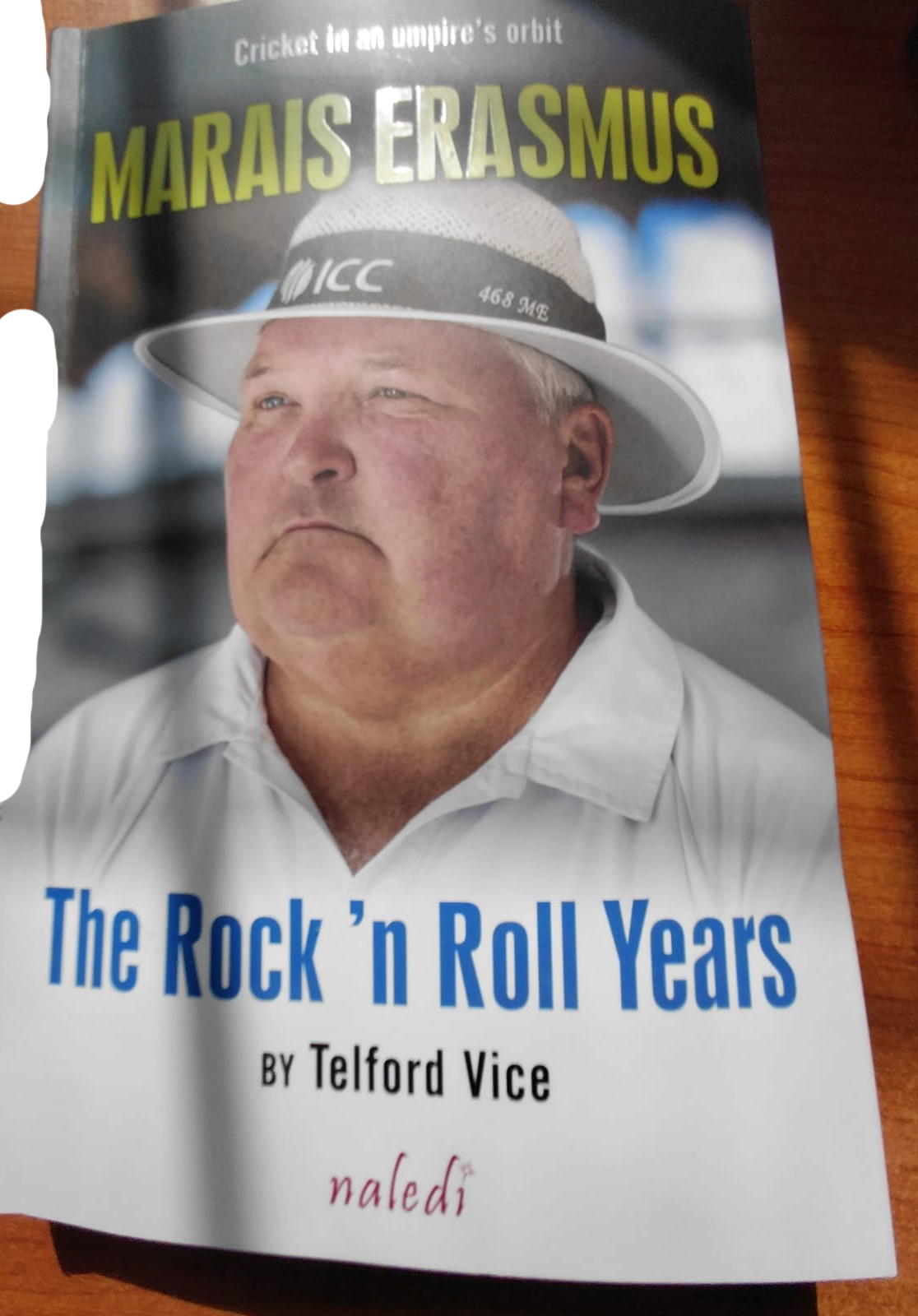
They are the qualities that Erasmus was most known for during his 16-and-a-half years as an international umpire. As renowned Indian commentator Harsha Bhogle says in the Foreword to the biography Telford Vice has written on the South African umpire – Marais Erasmus: The Rock ‘n Roll Years – “Apart from everything else, umpires, like doctors, must radiate confidence and a sense of calm. Marais Erasmus had that. When he walked out on to the field, you felt secure. You knew you were in safe hands.”

While the former Boland bowling all-rounder’s ‘bedside manner’ was imperturbable, Erasmus himself says it is a bit of an illusion.

“I didn’t set out to have a straight face all the time, and I did struggle sometimes not to show my emotions. But I couldn’t give away to the players that I was shitting myself, they do pick up that sort of thing.

“I just tried to apply the laws, even though sometimes a law is controversial. There are some grey areas in cricket, although less so than in rugby. I think it helps immensely to have been a former player, although it’s not a given that if you played good cricket you will become a good umpire – there are lots of other skills involved.

“Simon Taufel was one of the best umpires ever and he didn’t play first-class cricket, so potential umpires shouldn’t be discouraged if they didn’t play to a high level. But at the Elite level, on average 10 of the 12 on the ICC panel will have played first-class cricket, a lot of them have played international cricket. In South Africa, about 40% of our umpires are former first-class players. It means you’ve been in pressure situations before, the players will accept you more and that gives you confidence,” the former Boland flyhalf/fullback says.

The cricket world changed dramatically while Erasmus was progressing from a player who retired in 1996/97 to making his international debut as an umpire in 2006, standing in his first Test in 2010. In that time, the television umpire has become crucial, and the IPL arrived, making India the global superpower of the game. But, unfortunately, India have also not been shy to exert a “Might Is Right” philosophy on cricket and they are used to getting what they want. Which included not using DRS for their games until the absence of it had burned them too often.

Hostile crowds are matched by over-stimulated players like Virat Kohli, who occasionally lose their impulse control. One of India’s greatest captains infamously shouted into the stump-mics at Newlands in January 2022, accusing broadcasters SuperSport and the umpires of bias. Erasmus was standing in that match alongside compatriot Adrian Holdstock due to the Covid pandemic and the difficulties it caused in terms of international travel.

Erasmus had to give Sachin Tendulkar out lbw in his debut Test, thankfully not in India, where international cricket’s leading run-scorer is literally considered to be a god. These are also the days of social media allowing millions of people to dissect and criticise every decision. The officials can be crucified in the court of public opinion should they get the wrong decision wrong at the wrong time. Just think of how we South Africans curse referee Bryce Lawrence to this day for giving David Pocock free rein in the breakdowns during the 2011 Rugby World Cup quarterfinal.

So Erasmus experienced pressure right from the outset and his ability to handle it saw him appointed to the middle for seven World Cup finals across the formats, including the greatest of them all, the 2019 finale’ at Lord’s when England and New Zealand tied and England won the super over.

“Virat was like some of the kids when I was teaching. You give him Ritalin in the morning and you’ll have a good day. But sometimes by second break it’s gone … But we had a good relationship. David Warner is a dangerous man because he doesn’t understand when he’s being stupid and Ricky Ponting always wanted to fight with umpires,” Erasmus says.

Nathan Lyon is someone Erasmus singles out as a favourite, the Australian off-spinner saying on a live television interview that “Marais is a great man and an even better umpire,” when former captain Mark Taylor asked pointed questions about decisions that did not go their way.

Ben Stokes is another who Erasmus found to be likeable and the recently-retired England captain was, of course, pivotal in that 2019 World Cup final.

“Ben is one of my favourites. When you go to a team’s practice, some of the players ignore you but others come up to you. Ben would always ask how the last few months have been, how’s your family? He’s a good human being, although he has got himself in trouble and been through some fires on occasion.”

The details of the drama of the overthrows off Stokes’s arm and the full explanation as to why England were credited with an extra run they shouldn’t have been, are all in the book. Typically, Erasmus does not shy away from accountability.

“The overthrow incident was just a mistake. Kumar Dharmasena and I looked at each other and said ‘Six? Yeah’. Rod Tucker, the TV umpire, asked over the comms whether it was six and Peter Manuel, who was our umpires coach, was trying to explain that where the ball was released was crucial. But that was impossible for me to see.

“Part of the romance of our sport is that the umpires are not without blemish. The only way to survive as an umpire is not to dwell on your wrong decisions. Our coaches used to tell us to park them; my one New Zealand colleague then said ‘but my parking lot is full’.”

In Marais Erasmus: The Rock ‘n Roll Years, the subject brings that same voice of reason and gentle humour to corruption in cricket, the rise of technology and the many memorable Ashes clashes he was involved with.

‘Forgotten’ Brand will persist in forcing his way back into Proteas picture 0

Posted on August 05, 2025 by Ken

Neil Brand was South Africa’s Test captain just three matches ago,  but now seems almost forgotten by Proteas coach Shukri Conrad. But the Titans skipper knows that a far greater weight of runs than he scored last season will be necessary to force his way back into the picture. Fortunately Brand is the persistent sort.

The left-handed opener and under-rated orthodox spinner led South Africa in their two Tests in New Zealand last summer when the SA20 was being played and had gobbled up most of the country’s top players. Now that everyone is available, competition for places for the two Tests in Bangladesh next month, and the series against Sri Lanka and Pakistan at home, is stiff with most of the stars available.

Brand has started the new season in fine fashion though, scoring an impressive century for the SA A team he led against Sri Lanka A, in Benoni. His 129 highlighted all his strengths – defiance at the crease, the technique to see off the new ball and the ability to shift gears when the bowling allowed it.

Despite his dream of playing Test cricket coming true in the most astonishing way, last season was actually a battle for Brand, who averaged just 25.92 in all first-class cricket last season, with one century and two fifties.

“It was a bit of a struggle,” Brand admitted when interviewed by Rapport. “I just couldn’t get going although I had lots of starts. But I learnt a lot last season too, especially going to New Zealand and playing for SA A. And I’ve put a lot of hard work in during the off-season, especially on my set-up because a lot of bowlers were getting me out from around the wicket, it was something they had obviously analysed.

“So I’ve made things a bit more simple for this season and it’s always nice to start with a hundred. It’s not really my personality to try and get away from cricket, I prefer hard work, so that’s what I did during the winter. There’s definitely a step-up between domestic and international cricket and it’s hardest in batting,” Brand said.

Now that the 28-year-old, who has been playing first-class cricket for nearly a decade, has a sense of what it requires to succeed at international level, he is well-placed to answer the question as to what our domestic players need to be able to make that step up.

If one has been following the conversation around local cricket recently, then you’ll not be surprised to hear him say playing more cricket is the key.

“We definitely lack cricket. Playing just seven first-class games makes it really tough and sometimes, if you have Proteas white-ball commitments, you only play three or four matches. I would definitely be keen for more red-ball games, we need at least 10. Most players who play for 10 years would be heading for 100 games, I have 55.

“So definitely more cricket is needed. Even for bowlers, for the volume required they need to be bowling 20 overs a day. Four-day cricket presents you with tough conditions and you have to find a way to perform. Our skills are there, but we just don’t execute them for long enough,” Brand said.

A very good idea gone horribly wrong 0

Posted on January 19, 2022 by Ken

Despite their dodgy origin, there are many who believed the Social Justice and Nation-Building (SJN) hearings would be a very good idea, something necessary to try and heal the increasingly polarised and embittered environment of South African cricket.

But now that the SJN report has been made public, what a grave disappointment it has been and what a waste of R7.5 million. So much evidence has simply been ignored or totally misinterpreted and the legal flaws within the findings reflect very poorly on Advocate Dumisa Ntsebeza’s standing as one of our finest jurists. Never mind the poor job done by his assistants from Werksmans Attorneys.

It is now clear that the entire focus of the SJN was on getting dirt on Graeme Smith and Mark Boucher. Addressing historic wrongs and racial discrimination was just a side project.

Ntsebeza has found Smith’s appointment as director of cricket to be irregular and has also accused him of racist behaviour in the past. This is despite what I thought was compelling evidence presented by the likes of Cricket South Africa, the South African Cricketers’ Association and former Proteas manager Mohammed Moosajee.

The report almost entirely ignores all of that and goes way outside of its mandate in slamming Smith’s appointment. Surely Ntsebeza is aware that headhunting is a common occurrence in the corporate world and his appointment was approved by a number of people, the majority of whom were Black?

But no, it was racist. As was Boucher’s selection as Proteas head coach.

Enoch Nkwe is a very good coach and, in an ideal world, should be the successor to Boucher. But to say he was discriminated against based on the colour of his skin is ridiculous. It ignores the fact Boucher had more experience and more success coaching at the level below the Proteas and the wicketkeeper/batsman’s immense international knowledge from his playing days.

Three franchise trophies in one season point to Nkwe’s potential, but to equate trophies won in second-tier cricket in the Netherlands, semi-pro cricket or junior weeks, and even a second place in the Canadian T20 league, with Boucher’s achievements is ludicrous. The report also makes no mention of the 3-0 hammering South Africa suffered in India under Nkwe as interim head coach just before Boucher’s arrival.

The SJN could really have done with some advice from an ex cricketer or anyone with some idea of how high-performance sport works. The total lack of expertise in this regard has been made clear by the report. There was an early warning sign of this when legal assistant Sandile July asked why Imran Tahir had not stepped down from the Proteas team to allow another spinner a chance!

I also believe Mr July exhibited a lack of impartiality in his examination of those witnesses who had been implicated. He seemed to implicitly believe that the evidence of the complainants, even those dishonest individuals banned from the game for their involvement in matchfixing, was true.

The allegation made this week that over 250 paragraphs of the complainants’ heads of argument, which were written by July and Fumisa Ngqele, have been simply cut and pasted word-for-word directly into the ombudsman’s report, reflects poorly on the fairness of the SJN process.

These are not just minor matters that need amendment. Most damning of all is Ntsebeza’s own admission in his closing remarks that the evidence presented was not able to be tested. He says he cannot make definitive findings, describing his own conclusions as being “tentative”.

And yet he has happily painted Smith, Boucher, AB de Villiers and various other former players and officials as being racist. The decent thing for Ntsebeza to do would be to pay back half the R7.5 million to CSA for doing half a job, never mind the compensation he might have to fork out for the damage he has done to the reputations of people based on “untested evidence” and “tentative findings”.

How to make a star with KFC 0

Posted on July 05, 2016 by Ken


To make a star one needs enough heat and pressure to start nuclear fusion in a cloud of gas, but in a cricketing sense it’s all about CSA’s pipeline and KFC Mini-Cricket provides the masses of raw material that are necessary to find the ones that will glow brightly on fields around the country in the future.

KFC Marketing Director Thabisa Mkhwanazi says it is the biggest grassroots development program in the country, which is a big call, but the numbers back her up. More than 114 000 kids from 5584 schools were involved in the program last season, thanks to the dedication of nearly 9000 volunteer coaches and the excellent custodianship of CSA’s mass-participation manager, David Mokopanele.

Corrie van Zyl, CSA’s general manager of cricket, makes an even bigger call and says it is the best development program in the world. The fact that countries like Australia, India and England have been in contact wanting to know more about KFC Mini-Cricket, especially their marvellous Kids v Proteas Tour, suggests he may be correct.

I was privileged to attend the KFC Mini-Cricket National Seminar held in Kruger Park this week, which is an incentive for the top coaches of the previous season, a celebration of what has been achieved and a focused look at their future targets.

It may surprise some to know that I don’t recall hearing the word “transformation” once over the two days and that’s simply because, at that level, both coaches and players are already predominantly Black. Colour is one thing, but fixing the socio-economic conditions that make it so hard for any talented boy or girl to make it from the vast rural areas of our country is another matter altogether and KFC Mini-Cricket is probably the best weapon we have when it comes to taking the game to greater portions of our population.

Van Zyl was one of the speakers who addressed the delegates drawn from all 16 affiliates of Cricket South Africa and he pointed out in no uncertain terms that excellence at the highest level was non-negotiable, but that it was also dependent on grassroots development and vice-versa.

The former international fast bowler and national coach used the example of The Oaks Cricket Club from a small village near Hoedspruit where Cavaan Moyakamela, a coach with an extraordinary love for the game, mentors 70 children on a concrete slab.

“Imagine if a guy from The Oaks is chosen for the Limpopo U13 side, he will bring great passion and we can use and enhance that. Our dream is that a kid from that area can become a Protea, but there will be performance gaps – socio-economic factors that affect his health, physical and psychological development and his lifestyle – that we need to close for him.

“We cannot change the benchmark of international cricket, we have to take the players to that standard, and the responsibility of our coaches is to get the player there. If we don’t maintain excellence at international level then the grassroots suffers because we need money to develop that. They both depend on each other because the grassroots is the base of our game.

“KFC Mini-Cricket is the biggest part of that base, it is strong and built on the passion and dedication of the coaches. If we are to maintain excellence then we need quality coaching, so we need to grow coaches so the kids can grow under them. The growth of the program has been so good that with that base, the cream will rise to the top,” Van Zyl said.

Temba Bavuma spoke movingly about how he was first introduced to cricket via the program, getting to run around on the same Newlands ground where he scored his historic maiden Test century last summer; AB de Villiers is also a product, while the program is going strong in the remote regions of the former Transkei and Limpopo. It’s reach will only increase thanks to the wonderful news that KFC have extended their sponsorship of the program for another 10 years.

When the Kids v Proteas Tour came to Umtata, it was like the world’s greatest bazaar had hit town, such was the reaction.

“It brought Umtata to a standstill! Their little school was playing against the Proteas and it was magical. Many of the communities we have stores in hunger for this sort of development and our dream is for young people to look back and remember ‘the day KFC came to my small town with cricket’,” Mkhwanazi says.

  • Recent Posts

  • Archives

  • Thought of the Day

    Have a fulfilled life by caring about the feelings of others. Show interest in the welfare of others, listen to their problems.

    Be tolerant of people and allow for their mistakes, because no-one is perfect.

    Follow the example of Christ, who showed sympathy and understanding towards all people.


↑ Top